Legal template
Master Services Agreement template
A master services agreement that sets the framework terms once, with each engagement bought later under its own statement of work. It suits consultancies, agencies and technology suppliers with repeat enterprise clients.
14 sections, 38 clauses, 1 table, 2 signature blocks, with a cover page
Use this template opens a copy in the document builder after you sign in. Adapt it with AI opens the generator with this template chosen, so you can describe your business and get a version written for it. Review before use. This is a starting point, not legal advice.
What you fill in
- [Date]
- [Your company]
- [Company number]
- [Your address]
- [Client company]
- [Client address]
- [Jurisdiction]
- [City]
The template, in full
Parties
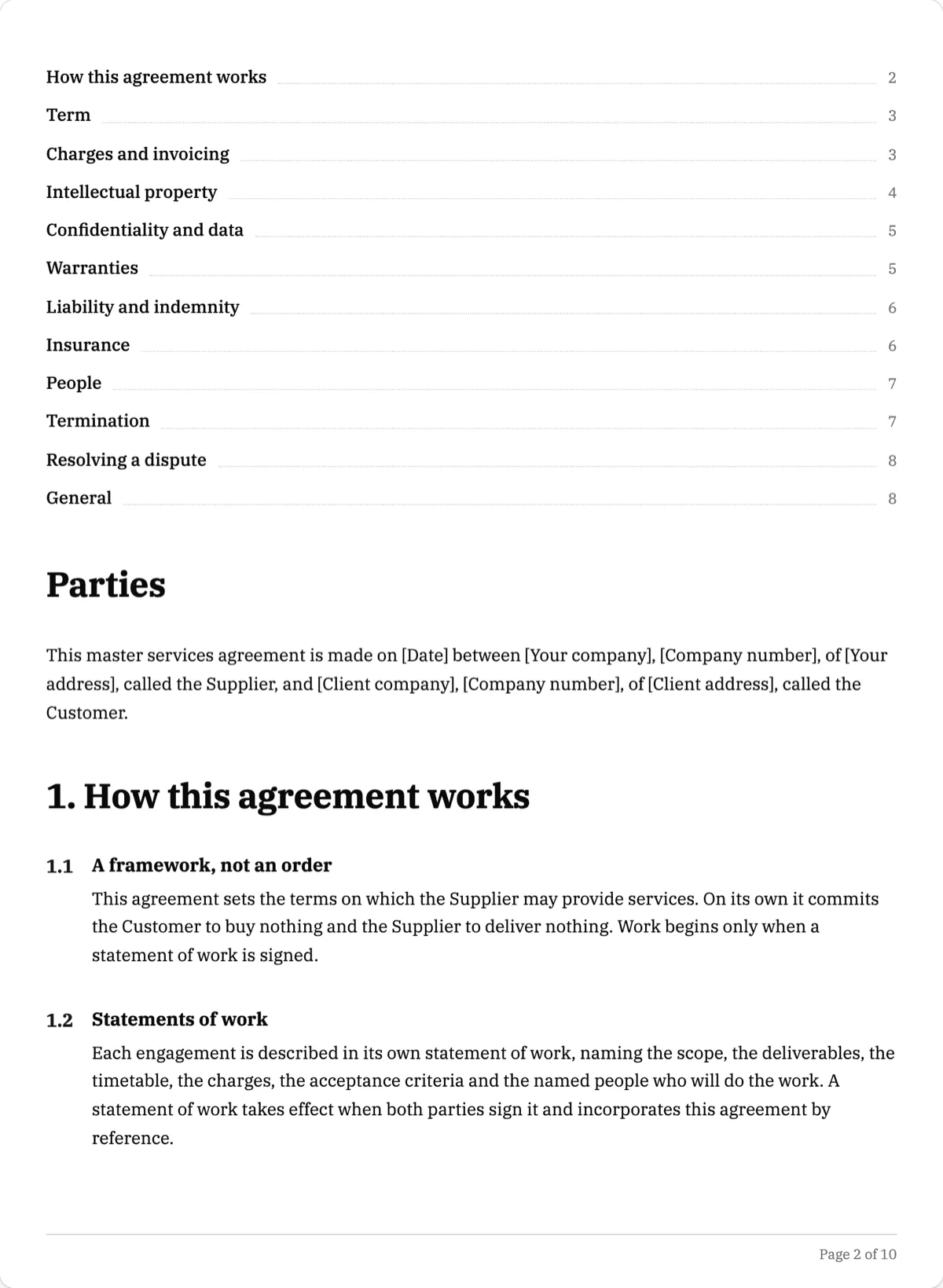
This master services agreement is made on [Date] between [Your company], [Company number], of [Your address], called the Supplier, and [Client company], [Company number], of [Client address], called the Customer.
1. How this agreement works
1.1 A framework, not an order. This agreement sets the terms on which the Supplier may provide services. On its own it commits the Customer to buy nothing and the Supplier to deliver nothing. Work begins only when a statement of work is signed.
1.2 Statements of work. Each engagement is described in its own statement of work, naming the scope, the deliverables, the timetable, the charges, the acceptance criteria and the named people who will do the work. A statement of work takes effect when both parties sign it and incorporates this agreement by reference.
1.3 Order of precedence. Where documents conflict, the order is: a signed variation, then the statement of work for the engagement in question, then this agreement, then any schedule. Terms printed on a purchase order, a quotation or a portal click through have no effect between the parties.
1.4 No exclusivity. Neither party is restricted from contracting with anyone else, including a competitor of the other, provided clause 5 is observed.
What this agreement deliberately leaves out. There is no scope, no deliverable, no date and no price anywhere in it. All four live in a statement of work. That is what lets one signed framework carry twenty engagements over three years without being renegotiated each time.
2. Term
2.1 Initial term. Three years from [Date].
2.2 Renewal. The agreement then continues for successive periods of twelve months unless either party gives 90 days written notice before the end of the current period.
2.3 Work already under way. A statement of work that is still running when this agreement ends continues on these terms until it is completed or ended under clause 10. Ending this agreement does not by itself end any statement of work.
3. Charges and invoicing
3.1 Where the numbers live. Rates are in Schedule 1. The amount payable for an engagement is in its statement of work. The rates in Schedule 1 are held for the first 24 months and then reviewed annually, capped at the consumer price index plus two percent.
3.2 Invoicing. The Supplier invoices monthly in arrears, quoting the statement of work number and the purchase order given by the Customer. Payment is due 30 days from a correct invoice. An invoice missing either reference is returned rather than held.
3.3 Disputed amounts. The Customer pays the undisputed part of an invoice on time and notifies the disputed part, with reasons, within ten business days of receipt. A properly notified amount does not attract interest or suspension while it is being reviewed.
3.4 Expenses. Travel and accommodation are charged at cost with receipts, and only where the statement of work says so. Air travel is economy class for any sector under four hours.
4. Intellectual property
4.1 What each party already owns. Each party keeps the intellectual property it owned before this agreement and anything it develops independently of the services. Nothing in this agreement transfers that ownership.
4.2 Deliverables. Intellectual property in a deliverable assigns to the Customer on payment in full for that deliverable, not on delivery of it. Until payment the Customer has a licence to use the deliverable for evaluation and acceptance only.
4.3 Supplier material inside a deliverable. Where a deliverable contains Supplier background material, the Supplier grants a perpetual, irrevocable, non exclusive licence to use, copy and modify that material to the extent needed to use the deliverable.
4.4 Open source. The Supplier will not include software under a licence that would require the Customer to publish its own source code, without prior written consent. Each deliverable is accompanied by a list of the open source components in it and their licences.
5. Confidentiality and data
5.1 Confidential information. Each party keeps information belonging to the other confidential, uses it only to perform this agreement, and returns or destroys it within 30 days of a written request. The obligation survives for five years after this agreement ends.
5.2 Personal information. The Supplier handles personal information only on documented instructions from the Customer, keeps it within [Jurisdiction], and tells the Customer within 24 hours of becoming aware of anything that may be an eligible data breach, whether or not it has finished investigating.
5.3 Subcontractors. The Supplier may engage the subcontractors named in a statement of work, remains fully liable for their acts and omissions, and binds each of them to obligations no less protective than these.
6. Warranties
6.1 Standard of work. The Supplier will perform the services with the care and skill of a competent professional in the same field, using people who hold the qualifications and experience stated in the statement of work.
6.2 Remedy. If a deliverable fails the acceptance criteria in its statement of work, the Supplier re-performs the work at no charge within the period set there. Re-performance is the first remedy, and the Customer may claim damages only if it fails.
6.3 No other warranty. Apart from the warranties in this agreement and those that cannot be excluded by law, no other warranty is given. In particular the Supplier does not warrant that a deliverable will produce any particular commercial result.
7. Liability and indemnity
7.1 Cap. The total liability of each party under a statement of work is capped at the charges paid or payable under that statement of work in the twelve months before the event giving rise to the claim. Each statement of work has its own cap.
7.2 Excluded loss. Neither party is liable for loss of profit, revenue, goodwill or anticipated savings, or for indirect or consequential loss, however it arises.
7.3 What the cap does not cover. The cap and the exclusions do not apply to death or personal injury caused by negligence, to fraud or wilful misconduct, to a breach of clause 5, or to the indemnity in clause 7.4.
7.4 Intellectual property indemnity. The Supplier indemnifies the Customer against a third party claim that a deliverable infringes intellectual property rights, provided the Customer notifies the Supplier promptly, allows the Supplier to conduct the defence, and does not admit liability.
8. Insurance
8.1 Maintaining cover. Policies are placed with an insurer rated A minus or better, held for the whole term, and the professional indemnity and cyber policies are held for a further two years after the last statement of work ends.
9. People
9.1 Named people. The people named in a statement of work are not replaced without consent from the Customer, which will not be unreasonably withheld. A replacement receives a two week handover from the person leaving, at the cost of the Supplier.
9.2 Not hiring each other staff. Neither party will solicit an employee of the other who has worked on the services, during the engagement and for six months after it ends. Responding to a public advertisement is not solicitation.
10. Termination
10.1 For convenience. The Customer may end any statement of work on 30 days written notice and pays for work performed and for costs the Supplier has committed and cannot reasonably cancel, up to the date of termination.
10.2 For breach. Either party may end this agreement or any statement of work if the other is in material breach and has not remedied it within 20 business days of written notice describing the breach.
10.3 Insolvency. Either party may end this agreement immediately if the other becomes insolvent, has a controller appointed, or is wound up.
10.4 What happens on the way out. The Supplier hands over deliverables in progress, working documentation and system access, and returns Customer data in a usable, documented format within 20 business days. Up to 40 hours of transition assistance is included at no charge; anything beyond that is charged at Schedule 1 rates.
11. Resolving a dispute
12. General
12.1 Assignment. Neither party may assign this agreement without written consent from the other, except to a related body corporate on notice.
12.2 Notices. Notices are in writing and sent by email to the addresses in Schedule 2. A notice is taken to be received when sent, unless the sender receives a delivery failure message.
12.3 Variation. This agreement may be varied only in writing signed by both parties. Conduct, correspondence and meeting minutes do not vary it.
12.4 Governing law. The laws of [Jurisdiction] apply, and both parties submit to the courts of that jurisdiction.
12.5 Entire agreement. This agreement, its schedules and the statements of work signed under it are the whole agreement between the parties, and replace everything discussed or exchanged beforehand.
12.6 Counterparts and electronic signature. This agreement and any statement of work may be signed in counterparts and by electronic signature. A scanned or electronically signed copy has the same effect as an original, and no party may argue otherwise because of the method used.
Schedules
Executed as an agreement by each party through a person authorised to bind it, who confirms that no further board or delegate approval is outstanding.