Legal template
Residential Lease Agreement template
A fixed term residential lease covering rent, bond, utilities, repairs, entry notice, pets and ending the tenancy. It suits private landlords letting a house or flat without an agent.
14 sections, 20 clauses, 2 tables, 3 signature blocks, with a cover page
Use this template opens a copy in the document builder after you sign in. Adapt it with AI opens the generator with this template chosen, so you can describe your business and get a version written for it. Review before use. This is a starting point, not legal advice.
What you fill in
- [Date]
- [Landlord name]
- [Landlord address]
- [Tenant name]
- [Co-tenant name]
- [Property address]
- [Effective date]
- [Jurisdiction]
- [Tenancy regulations]
- [Tenancy authority]
- [Tribunal]
- [Pet name]
- [Email]
- [Phone]
- [Bank account details]
- [Tenancy Act]
The template, in full
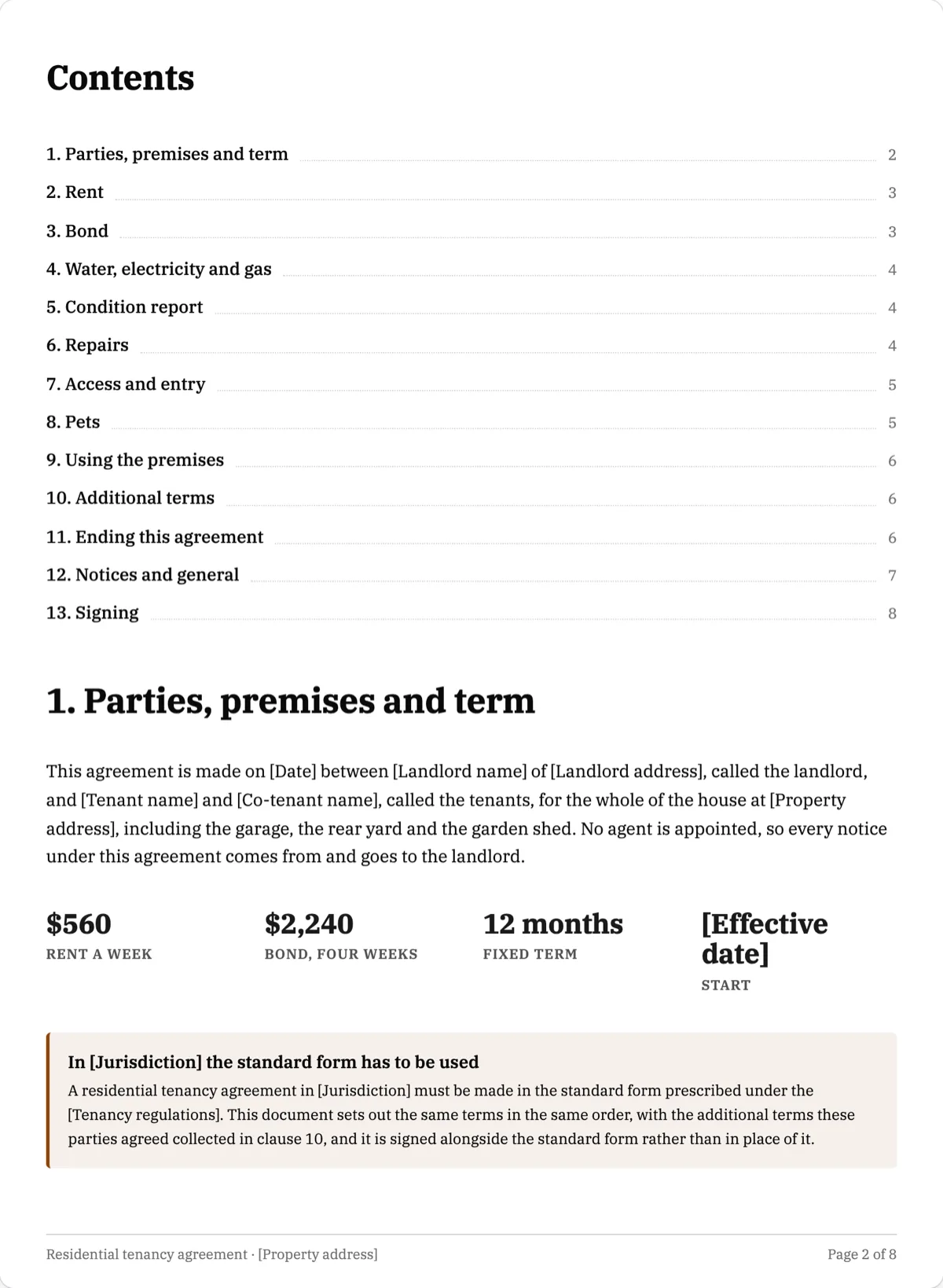
Contents
1. Parties, premises and term
This agreement is made on [Date] between [Landlord name] of [Landlord address], called the landlord, and [Tenant name] and [Co-tenant name], called the tenants, for the whole of the house at [Property address], including the garage, the rear yard and the garden shed. No agent is appointed, so every notice under this agreement comes from and goes to the landlord.
In [Jurisdiction] the standard form has to be used. A residential tenancy agreement in [Jurisdiction] must be made in the standard form prescribed under the [Tenancy regulations]. This document sets out the same terms in the same order, with the additional terms these parties agreed collected in clause 10, and it is signed alongside the standard form rather than in place of it.
1.1 Term. The tenancy is a fixed term of 12 months, starting on [Date] and ending on [Date]. At the end of the fixed term the tenancy continues as a periodic agreement on the same terms unless one party ends it under clause 11.
1.2 Both tenants are liable for all of it. The tenants hold the tenancy together. Each of them is liable for the whole of the rent and for any damage, not for half of it, so the landlord may recover the full amount from either tenant. A tenant who leaves stays liable until the tenancy ends or the landlord agrees in writing to a replacement.
2. Rent
2.1 Amount, day and method. Rent is $560 a week, paid fortnightly in advance as $1,120, by bank transfer to the account named in clause 12.1, first payment on [Date] and then every second Monday. The tenants may pay by a method that costs them nothing, and the landlord does not charge a fee for accepting rent.
2.2 No increase during the fixed term. The rent does not change during the 12 month fixed term. If the tenancy continues as a periodic agreement, the landlord may increase the rent only by giving at least 60 days written notice stating the new amount and the day it starts, and not more than once in any 12 months.
2.3 Rent in arrears. Rent is in arrears from the day after it was due. The landlord tells the tenants in writing as soon as rent is more than three days late, and works out a repayment plan where the tenants ask for one. A termination notice for non payment cannot be given until the rent is at least 14 days in arrears.
3. Bond
3.1 Four weeks, lodged with [Tenancy authority]. The tenants pay a rental bond of $2,240, which is four weeks rent and the maximum the Act allows. The landlord lodges it with [Tenancy authority] within 10 working days of receiving it and gives the tenants the receipt. The bond is not held by the landlord and is not used as rent.
3.2 Getting the bond back. At the end of the tenancy either party may claim the bond through [Tenancy authority]. Where the landlord claims part of it, the claim is itemised in writing with the condition report and photographs attached. Fair wear and tear is not a deduction. Where the parties cannot agree, either may apply to the [Tribunal].
4. Water, electricity and gas
4.1 Who pays what. Electricity and gas are separately metered and the tenants hold those accounts and pay them. The premises are separately metered for water and meet the water efficiency measures the Act requires, so the tenants pay water usage charges, which the landlord passes on with a copy of the bill within three months of it being issued. The landlord pays water service charges, council rates and land tax.
5. Condition report
5.1 Two copies, one week to reply. The landlord gives the tenants two signed copies of the condition report before or on the day the tenants move in, with dated photographs of each room, the yard and the meters. The tenants return one copy within seven days with their comments. The report is the evidence both sides rely on at the end of the tenancy, so anything already marked, chipped or not working is written on it rather than mentioned in passing.
6. Repairs
6.1 Urgent repairs. Urgent repairs include a burst water service, a blocked or broken toilet where there is only one, a serious roof leak, a gas leak, a dangerous electrical fault, flooding, a fire or storm damage, a failure of the gas, electricity or water supply, and a failure of the hot water service, cooking appliance or heater. The tenants call the landlord first on the number in clause 12.1. Where the landlord cannot be reached, the tenants may arrange the repair and be paid back up to $1,000 within 14 days of giving the receipt.
6.2 Other repairs. Any other repair is reported in writing and the landlord arranges it within a reasonable time. The tenants keep the premises reasonably clean, do not damage anything, and pay for damage they or their visitors cause on purpose or through carelessness. Fair wear and tear is not damage.
7. Access and entry
7.1 Notice before the landlord comes in. The tenants have quiet enjoyment of the premises. The landlord may enter only in the circumstances the Act allows, with the notice in the table below, at a reasonable hour, and not on a Sunday or a public holiday without the tenants consent. Entry may also happen at any time the tenants agree to.
8. Pets
8.1 One cat, and how to ask about another animal. The landlord consents to the tenants keeping one desexed cat, registered and microchipped, named on this agreement as [Pet name]. To keep any other animal the tenants ask the landlord in writing, and consent is not unreasonably refused. No extra bond and no pet rent is charged for an animal, because the Act does not allow either. The tenants have the carpets professionally cleaned and the premises treated for fleas at the end of the tenancy if the cat has lived inside.
9. Using the premises
9.1 What the premises are for. The premises are a home for the two tenants and are not used for a business that brings customers to the address, for short stay letting, or for anything illegal. The tenants do not sublet or transfer the tenancy without the written consent of the landlord, which is not unreasonably refused for part of the premises. The tenants do not alter the premises or add a lock without written consent, and consent is not needed for a picture hook or a removable adhesive fitting.
10. Additional terms
11. Ending this agreement
11.1 Ending at the end of the fixed term, or during it. To end the tenancy on the last day of the fixed term, either party gives at least 14 days written notice for the tenants or 30 days for the landlord, ending on or after [Date]. During the fixed term the landlord may end the tenancy only for a reason the Act allows, such as a breach by the tenants, and must give the notice period the Act sets for that reason.
11.2 Breaking the lease early. Where the tenants end the fixed term early other than for a reason the Act allows, they pay the break fee set by the Act for a fixed term of three years or less. The fee is four weeks rent if less than a quarter of the term has passed, three weeks if between a quarter and a half, two weeks if between a half and three quarters, and one week if more than three quarters has passed. No other early termination charge applies.
11.3 The last day. On the last day the tenants return every key, leave the premises reasonably clean and empty of their goods, and the parties walk through together against the condition report. Rent is paid to the last day of the tenancy, not to the day the tenants move out.
12. Notices and general
12.1 Contact details for notices and rent. Notices to the landlord go to [Email] or [Landlord address], and urgent repairs to [Phone]. Notices to the tenants go to the premises and to [Email] and [Email]. Rent is paid to [Bank account details]. A change to any of these is given in writing within seven days.
12.2 The Act prevails. Nothing in this agreement takes away a right the [Tenancy Act] gives either party, and a term that conflicts with the Act has no effect to the extent of the conflict. A dispute either party cannot settle goes to [Tenancy authority] for help, and then to the [Tribunal].
13. Signing
13.1 Copies of the signed agreement. Each party signs below and keeps a copy. The landlord gives each tenant a copy of this agreement signed by everyone within 14 days of signing it, as the Act requires, together with the signed condition report and the bond lodgement receipt.