Legal template
Memorandum of Understanding template
A memorandum of understanding for a joint program, with purpose, principles, a contributions table, a coordination group, a term and clearly marked binding clauses. It suits community groups, nonprofits and organisations agreeing to work together.
1 section, 13 clauses, 1 table, 2 signature blocks, with a cover page
Use this template opens a copy in the document builder after you sign in. Adapt it with AI opens the generator with this template chosen, so you can describe your business and get a version written for it. Review before use. This is a starting point, not legal advice.
What you fill in
- [Date]
- [Your organisation]
- [Partner organisation]
- [Project name]
- [Venue]
- [Name]
The template, in full
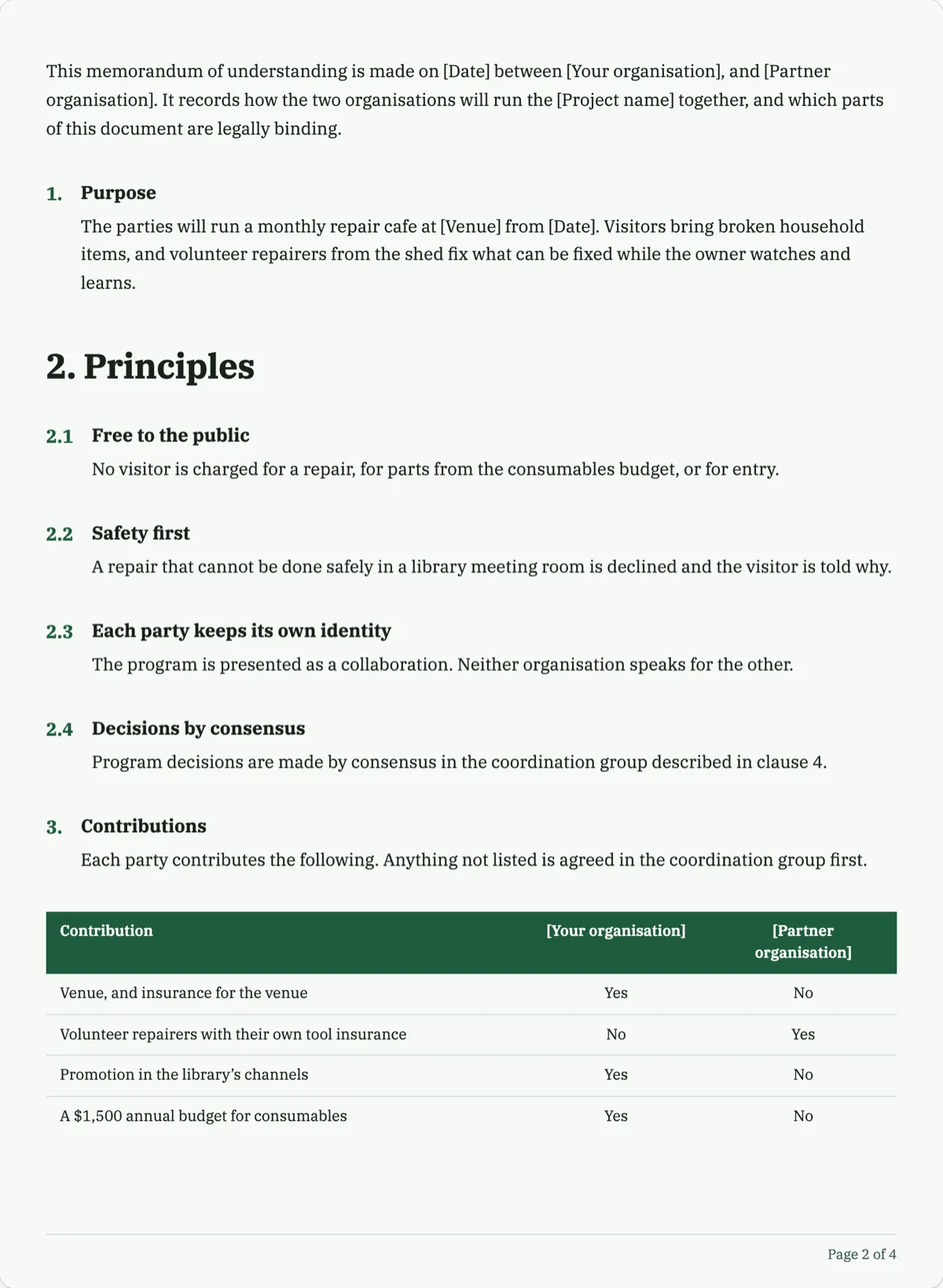
This memorandum of understanding is made on [Date] between [Your organisation], and [Partner organisation]. It records how the two organisations will run the [Project name] together, and which parts of this document are legally binding.
1. Purpose. The parties will run a monthly repair cafe at [Venue] from [Date]. Visitors bring broken household items, and volunteer repairers from the shed fix what can be fixed while the owner watches and learns.
2. Principles
2.1 Free to the public. No visitor is charged for a repair, for parts from the consumables budget, or for entry.
2.2 Safety first. A repair that cannot be done safely in a library meeting room is declined and the visitor is told why.
2.3 Each party keeps its own identity. The program is presented as a collaboration. Neither organisation speaks for the other.
2.4 Decisions by consensus. Program decisions are made by consensus in the coordination group described in clause 4.
3. Contributions. Each party contributes the following. Anything not listed is agreed in the coordination group first.
4. Coordination. A coordination group of two people from each organisation meets monthly. The named leads are [Name] for the library and [Name] for the shed. The group reviews the program at the 6 month mark and reports to both organisations.
5. Term. This MOU runs for 12 months from [Date]. It is renewable by an exchange of letters. Either party may withdraw on 30 days’ written notice to the other’s lead.
6. Status of this MOU. This document records the intentions of the parties and is not legally binding, except clauses 7, 8 and 9, which the parties intend to be legally binding.
The one sentence that matters. This MOU is not legally binding, except clauses 7, 8 and 9. Marking the binding clauses by number is what stops a friendly document becoming an accidental contract, or a real obligation being dismissed as a handshake.
7. Confidentiality, binding. Attendance data and the personal details of volunteers and visitors are not disclosed beyond the coordination group, and are used only to run and report on the program.
8. Costs, binding. Each party bears its own costs of the program, except the consumables budget in clause 3, which the library funds to $1,500 a year.
9. Intellectual property and branding, binding. Each party keeps its own name, logo and materials. Joint materials carry both marks. Either party may use photographs of joint events with the other’s consent.
10. Disputes. A disagreement goes to the coordination group first. If it is not resolved within a month, the library manager and the shed president meet to settle it.
Signed by a person with authority for each organisation. Each keeps a copy, and the coordination group tables this document at the 6 month review.