Contract clause
Liquidation preference clause: who is paid first on a sale
A liquidation preference clause gives investors holding preference shares the right to be paid a set amount, usually their investment or a multiple of it, before ordinary shareholders when the company is sold or wound up. Whether they also share in the rest depends on whether the preference is participating or non participating.
When a startup is sold, the headline price is only the start of the question. The liquidation preference decides who receives the first dollars, and in a modest sale it can mean investors are repaid in full while founders receive far less than their percentage suggests.
Indunil Asanka · Co-founder
3 min read · Published
Sample clause
Written for a seed round in which investors subscribe $2,000,000 for preference shares in Glasshouse Robotics, a fictional Adelaide robotics startup, taking 20% of the company.
Liquidation Preference. (a) On a Liquidation Event, the proceeds available for distribution to shareholders will be applied: (i) first, in paying to each holder of Seed Preference Shares an amount equal to the Issue Price of those shares, being $2,000,000 in total, together with any declared but unpaid dividends; and (ii) second, the balance to the holders of Ordinary Shares in proportion to their holdings. (b) A holder of Seed Preference Shares may instead elect to receive the amount it would have received had its shares converted into Ordinary Shares immediately before the Liquidation Event, and will not receive both. (c) Liquidation Event means a winding up of the Company, a sale of all or substantially all of its shares or assets, or a merger in which the shareholders before it hold less than 50% after it.
Sample wording, not legal advice.
Variants
1x non participating
The common seed and early stage position, giving investors their money back first or their share of the proceeds, whichever is greater.
On a Liquidation Event, each Preference Shareholder is entitled to the greater of the Issue Price of its shares and the amount it would receive if its shares had converted to Ordinary Shares, in priority to the Ordinary Shareholders.
Participating with a cap
Later or riskier rounds where investors want a preference plus a share of the upside, limited so founders are not squeezed.
Each Preference Shareholder receives the Issue Price first and then participates with the Ordinary Shareholders pro rata, until it has received a total of three times the Issue Price, after which it participates no further unless it converts.
Multiple preference
Distressed or bridge rounds, where investors demand more than their money back first as the price of funding.
On a Liquidation Event, each Series A Preference Shareholder is entitled to receive, in priority to all other shareholders, twice the Issue Price of its shares, and does not otherwise participate unless it converts.
What to negotiate
The multiple
One times the investment is market standard in most seed and early stage rounds in Australia, the US and the UK. Higher multiples, such as 2x or 3x, shift value to investors in any sale below a high price and usually appear only in difficult fundraising conditions. Founders should model the effect of a multiple at realistic sale prices before accepting it.
Participation
A non participating preference gives investors the greater of their preference and their pro rata share. A participating preference gives them both: their money back and then a share of what is left, often called double dipping. Participation is less common in early rounds and is often capped, so that above a certain return the investors are better off converting.
Seniority between rounds
When several rounds hold preferences, they can rank in order, newest first, or equally, called pari passu. Senior later rounds push earlier investors and founders further back. Founders and early investors usually prefer pari passu, while new investors with leverage ask for seniority.
The risk of leaving it out
Without a liquidation preference, preference shares would simply share in sale proceeds like ordinary shares, which most investors will not accept, because they paid a higher price per share than the founders. With a poorly understood preference, founders can discover at exit that their percentage of the company bears little relation to their percentage of the proceeds.
Three sale prices, one waterfall
Investors put in $2,000,000 for 20% with a 1x non participating preference. Sale at $3,000,000: the preference of $2,000,000 is worth more than 20% of $3,000,000, which is $600,000, so investors take $2,000,000 and ordinary shareholders share $1,000,000. Sale at $10,000,000: the preference and 20% are both $2,000,000, so investors receive $2,000,000 either way and ordinary shareholders share $8,000,000. Sale at $40,000,000: converting gives 20%, which is $8,000,000, more than the preference, so investors convert and ordinary shareholders share $32,000,000. The preference matters most in the smaller outcomes. Law checked on 21 October 2026. This page explains how the clause works and is not legal advice.
Preference shares in Australia
Under the Corporations Act 2001, a company may issue preference shares if the rights attached to them, including rights to repayment of capital and participation in surplus assets, are set out in its constitution or approved by special resolution. Australian seed and venture documents usually set the liquidation preference in the constitution or the shareholders' agreement, and investor bodies such as the Australian Investment Council publish material on venture capital terms.
SAFEs and convertible notes
Many early rounds use simple agreements for future equity or convertible notes rather than priced preference shares. Y Combinator's SAFE documents give holders priority in a liquidity event before conversion, typically their purchase amount or what they would receive on conversion, and they convert into the preference shares of the next priced round, picking up that round's liquidation preference. Founders should read the liquidity priority in a SAFE as carefully as a preference clause.
What counts as a liquidation event
The definition is crucial. Most clauses cover winding up, a sale of the company's shares or substantially all its assets, and mergers in which existing shareholders lose control. An IPO usually converts preference shares to ordinary shares and is not a liquidation event. If the definition is narrow, a sale structured as an asset sale might avoid the preference, which investors guard against.
Documents that carry this clause
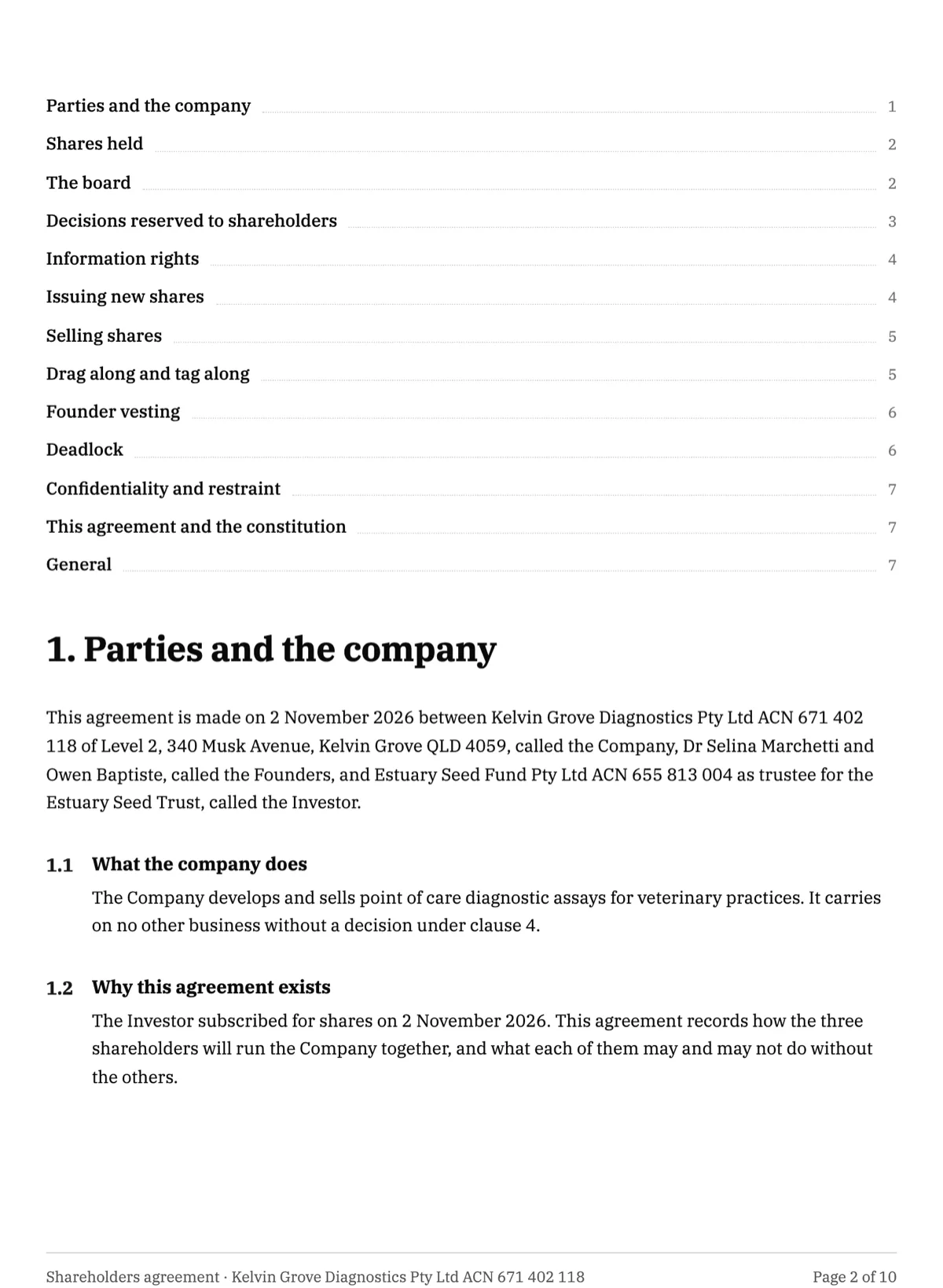 Shareholders agreement template for a company after a seed roundA shareholders agreement template sets out who owns what, who sits on the board, which decisions need shareholder consent, how shares are sold, and how a deadlock ends. This one is filled in for a Queensland veterinary diagnostics company that has just taken $1.5 million from one seed fund, leaving the two founders with 80 per cent between them. Its central number is an 85 per cent consent threshold for eight reserved matters, and the page below shows what that number does and does not protect.
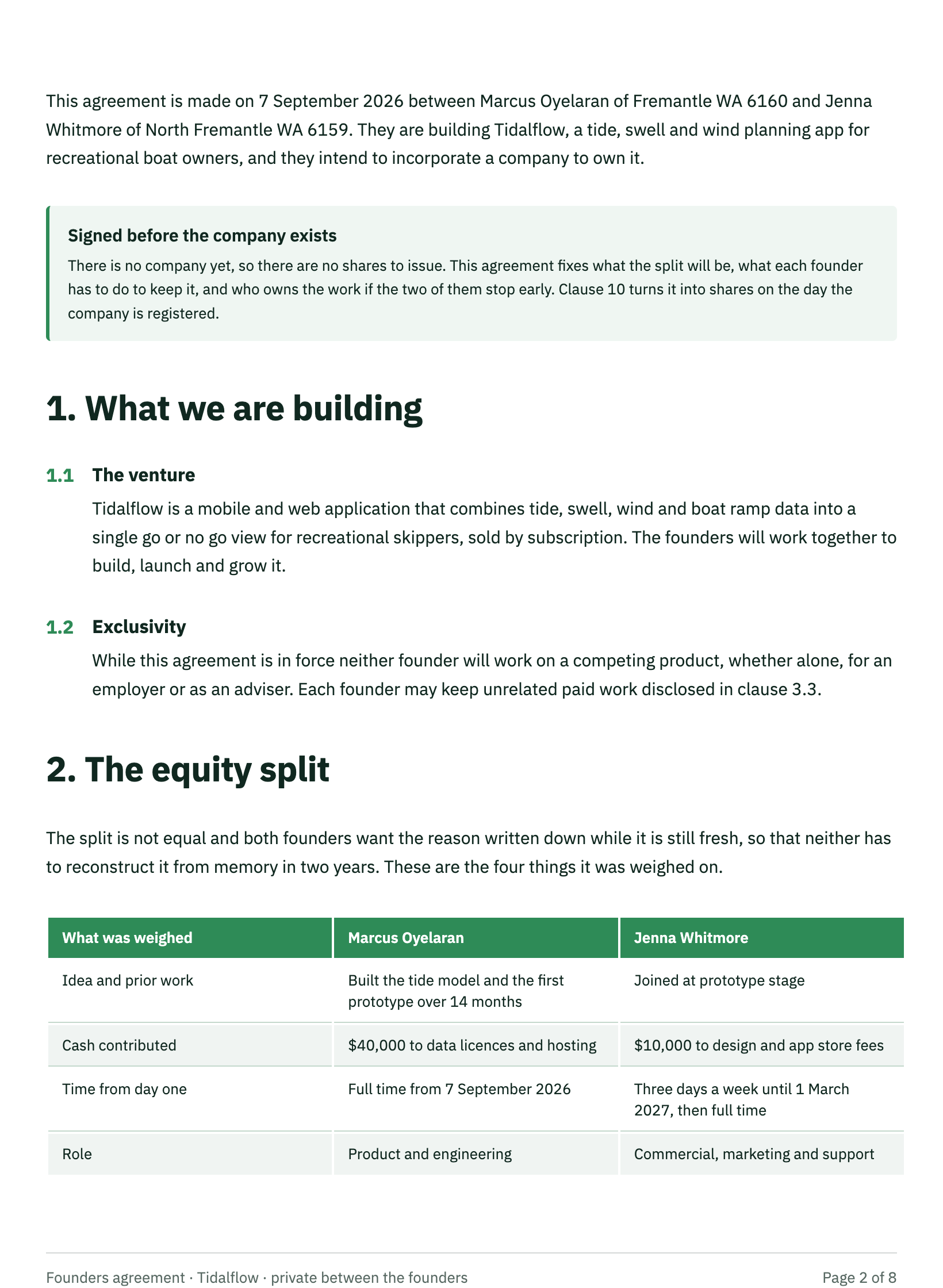 Founders agreement templateTwo people in Fremantle are building a tide and swell planning app and have not registered a company yet. There are no shares to issue, so this agreement fixes the split, records why it is 55/45 while the memory is fresh, and turns itself into shares on the day the company exists.
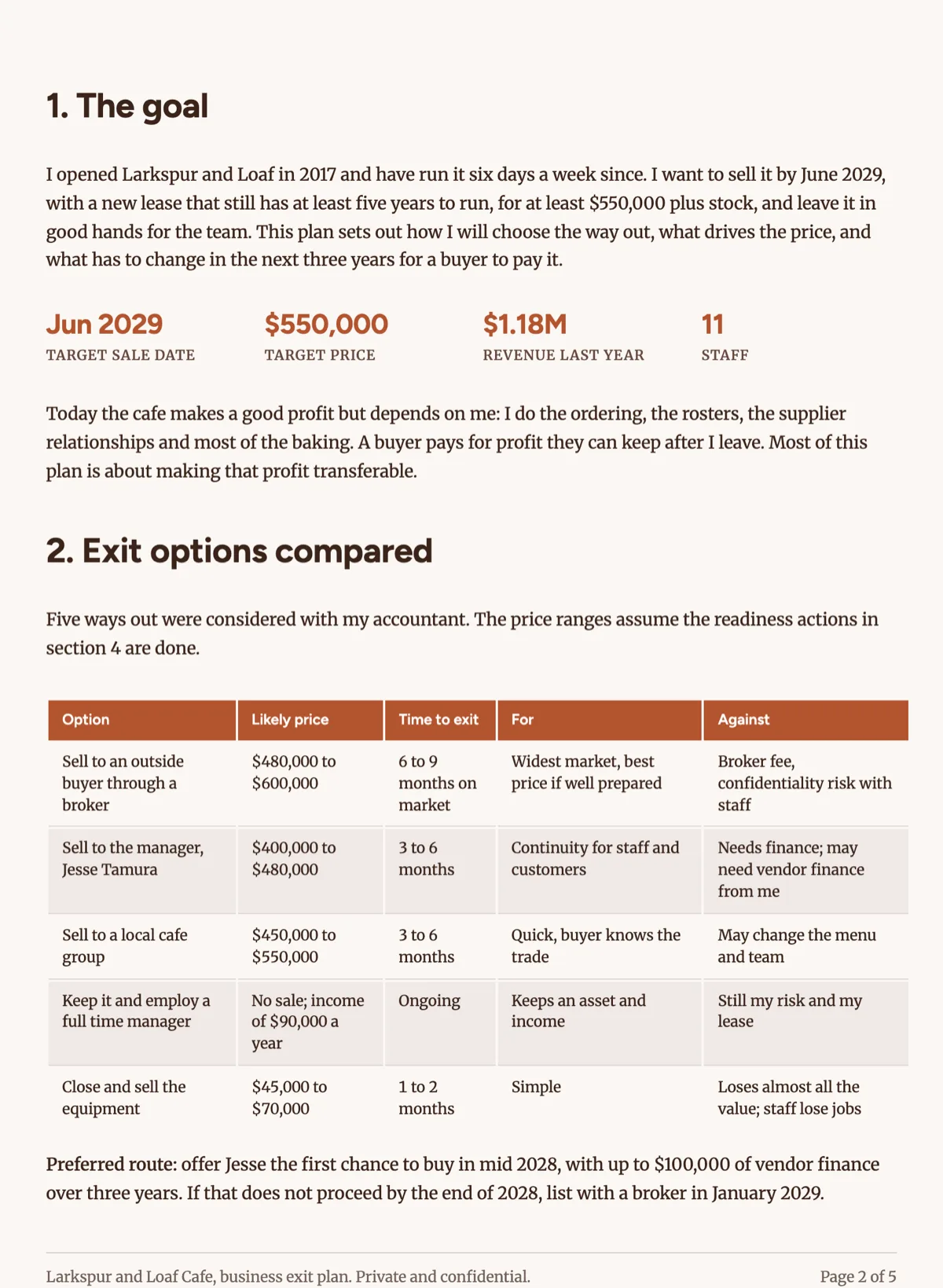 Business exit plan template with options, valuation and timelineA business exit plan has to choose a way out, show what the business is worth and why, and list what must change before a buyer will pay that price. This five page plan for a cafe owner selling in mid 2029 compares five exit options, works from $200,000 of adjusted earnings to a $550,000 target, and sets readiness actions, a timeline, advisers and the net proceeds.
Questions people ask
What does 1x non participating mean?
It means investors are entitled to get back one times their investment before ordinary shareholders on a sale or winding up, or alternatively their percentage share of the proceeds, whichever is greater, but not both. It is the most common preference in early stage rounds.
How does a liquidation preference work in a sale?
The sale proceeds go first to preference holders up to their preference amount, then the rest is shared among ordinary shareholders, unless preference holders choose to convert and share pro rata instead. In a low sale price, the preference can take most or all of the proceeds.
Is participating preferred bad for founders?
It reduces founders' share of sale proceeds, because investors take their money back and also share in the remainder. The effect is largest in moderate exits. A cap on participation, or a non participating preference, limits it. Founders should model several sale prices before agreeing.
Does a liquidation preference apply in an IPO?
Usually not. Preference shares typically convert into ordinary shares automatically on an IPO above a stated size, so the preference falls away. The investors then hold ordinary shares like everyone else. Check the conversion clause to see when automatic conversion applies.
What happens if the company is sold for less than the preferences?
Preference holders share what is available according to their ranking, and ordinary shareholders receive nothing. If several rounds rank equally, they share pro rata to their preference amounts. This is why founders track the total preference stack as they raise more rounds.
Put the clause in a finished document
The button opens the document generator with a starting description already filled in. Change it to match your own agreement before you run it.
Create a document with OneCraftRelated clauses
- Anti dilution clause: protecting an investor's price in a down roundAn anti dilution clause adjusts an investor's price if later shares are issued cheaper. Sample weighted average wording, a worked example and a full ratchet.
- Drag along clause: making minority shareholders join a saleA drag along clause lets majority shareholders make minorities join a sale of the company. Sample wording with a 75 percent threshold, protections and variants.
- Exit clause in a shareholders agreement: planning the sale or listingAn exit clause in a shareholders agreement sets when and how owners pursue a sale or listing. Sample wording with an exit window, exit events and variants.
- Pre emptive rights clause: first right to buy new sharesA pre emptive rights clause gives existing shareholders first right to new shares in proportion. Sample wording, a 10 business day offer and over allocation.
For everything the document generator can do, see the document maker.
Step by step in the builder: Create a document with AI, then Document builder components.
Written and checked by the OneCraft team. Last checked .