Classic form
Supplier registration form built for a quality review
A supplier registration is reviewed twice, once by quality and once by procurement, and a form that only serves one of them stalls for weeks. This one carries a six line product table with real lead times, a certificate with its scheme and expiry, an allergen statement covering the whole site, and the commercial answers on the same page.
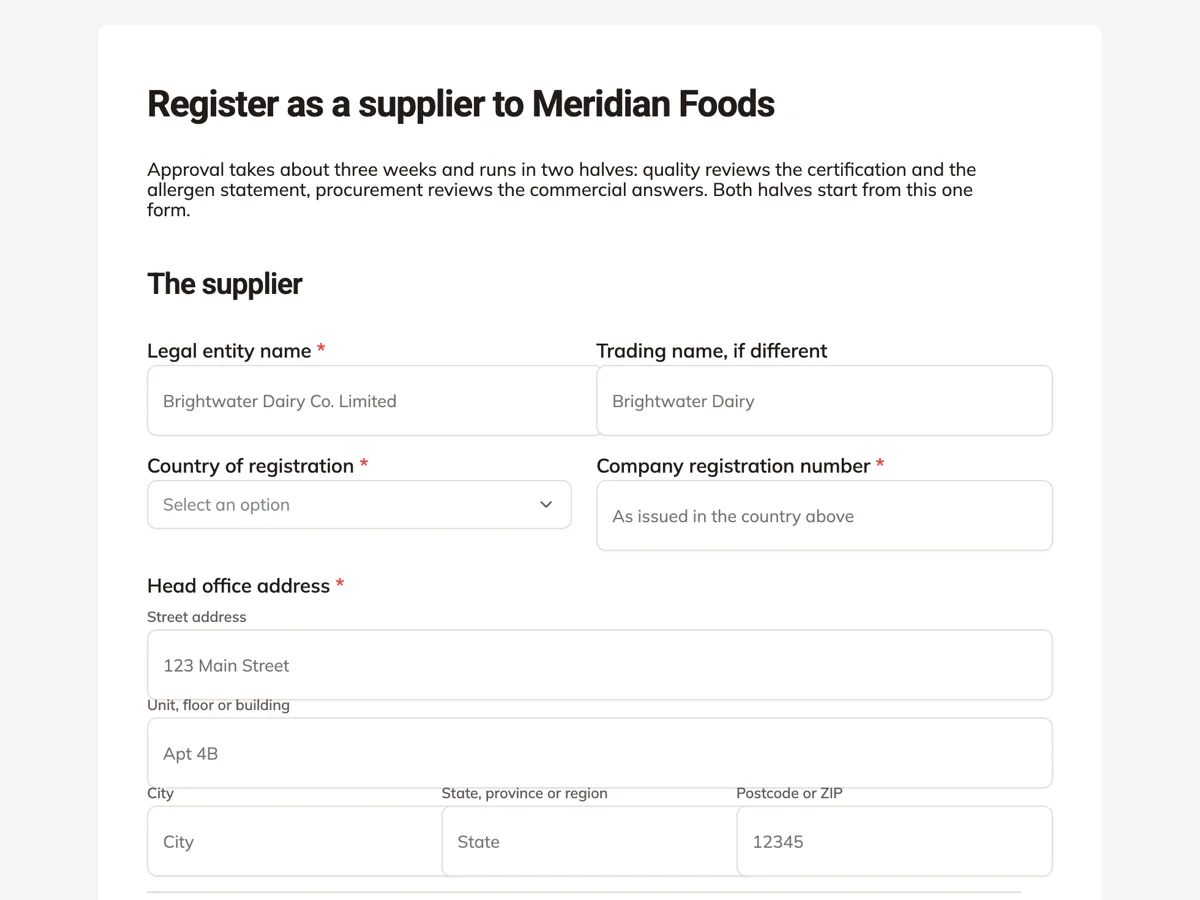
The form itself
A static copy of the finished form, exactly as it renders. Nothing here can be filled in or submitted, so read it as a reference and build your own from the button above.
Every field, and what it collects
The complete field list, in the order respondents meet it.
- Legal entity nameShort textRequired
- Trading name, if differentShort text
- Country of registrationDropdownRequired
- Options: Australia · New Zealand · United Kingdom · Ireland · United States · Canada · Netherlands · Germany · Italy · Spain · Thailand · Somewhere else
- Company registration numberShort textRequired
- Head office addressAddressRequired
- Commercial contactNameRequired
- Commercial emailShort textRequired
- Quality contact nameShort textRequired
- Quality emailShort textRequired
- Products you would supplyTableRequired
- Columns: Product · Unit and pack size · Lead time in days · Minimum order
- Product categoriesMultiple choiceRequired
- Options: Dairy and chilled · Bakery and cereals · Fruit, vegetables and produce · Meat, poultry and seafood · Oils, fats and dressings · Sugars, syrups and sweeteners · Flavours, colours and additives · Packaging and labels
- How many manufacturing sites would supply us?NumberRequired
- Current food safety certificateFile uploadRequired
- PDF, up to three files, 10 MB each. Upload the certificate for every site named above. A scope page is required if the certificate references one. Scanned certificates are accepted if the scope, the site address and the expiry are all readable.
- Certification schemeSingle choiceRequired
- Options: BRCGS Food Safety · FSSC 22000 · IFS Food · SQF Food Safety Code · A HACCP plan verified by a third party, no GFSI scheme · A documented HACCP plan, not third party verified · None of these yet
- Certificate expiryDateRequired
- Allergens handled on siteMultiple choiceRequired
- Options: Cereals containing gluten · Crustaceans and molluscs · Egg · Fish · Milk · Peanut · Tree nuts · Sesame · Soy · Lupin · Sulphites above 10 mg/kg · None of these are handled on site
- Date of your last mock recallDate
- Modern slavery and labour practicesSingle choiceRequired
- Options: We publish a modern slavery statement and can supply the link · We have a policy and supplier audits but publish no statement · We have a policy and no audit programme yet · We have nothing documented yet
- Payment terms you are seekingSingle choiceRequired
- Options: 30 days from end of month of invoice, the standard terms · 45 days from end of month · 60 days from end of month · Something shorter, and I will explain why
- Trade referencesTableRequired
- Columns: Customer · What you supply them · Contact name and email
The supplier
Two contacts, because two teams review this
What you supply
Food safety
Ethics and commercial terms
Two reviewers, one form, no ping pong
The reason supplier onboarding drags is that quality asks for the certificate in week one, procurement asks for lead times in week three, and each round trip costs a week. This form asks both sets of questions at once and names two contacts so each reviewer has someone to write to. The thank you screen commits to the order of play as well, saying quality checks the certificate within ten working days and that an unrecognised scheme is raised before procurement looks at pricing, which is the failure suppliers resent most.
Why the allergen question covers the site, not the product
A supplier reading quickly will tick the allergens in the products they listed. That is the wrong answer, and the paragraph above the list says so in the strongest terms the form allows: tick every allergen handled anywhere on the supplying sites, including shared lines, shared air handling and rework. Cross contact does not respect a product specification, and an allergen missed at registration eventually reaches a label. Twelve options are offered, with a final one for sites that handle none of them, so silence is never the answer.
How to adapt this form
A packaging supplier swaps the allergen block for a food contact material declaration and a migration test upload, since the same risk arrives through a different standard. A services supplier, for cleaning or pest control, replaces the product table with a table of sites, frequencies and technicians, and keeps the references untouched. A retailer running a local producer programme can cut the form to eight fields by dropping the scheme radio and asking instead for a council food business registration number, which is the proportionate evidence at that scale.
What makes this form work
The product table asks for a lead time you can hold
Six rows of product, unit and pack size, lead time in days and minimum order. The note above asks for the time a supplier can actually hold rather than the best case, because a planner schedules a run from that number.
Allergens are asked about the site, not the product list
Twelve options, two columns, and a paragraph that names shared lines, shared air handling and rework as things that count. Cross contact does not follow a specification sheet, and a missed allergen reaches a label.
The certificate scheme is a radio, so registrations sort
BRCGS, FSSC 22000, IFS and SQF sit above two honest HACCP answers and a plain none of these. A reviewer filters by scheme instead of opening every PDF to find out what was uploaded.
Questions people ask
How many rows should a product table have?
Six here, and the count is fixed. A table renders exactly the number of rows it is set to and cannot grow while somebody is filling it in, so the number has to be chosen for the common case rather than the biggest one. Six covers most first registrations and the paragraph above invites a supplier with more lines to say so in the description.
Why ask for the certification scheme separately from the certificate?
Because the scheme is the thing that gets filtered. BRCGS, FSSC 22000, IFS and SQF are the four recognised here, and the radio has two honest steps below them for a verified HACCP plan and an unverified one. A reviewer can sort every registration by scheme in seconds. Opening 200 PDFs to work out the same thing is a week of work.
Can the form check whether a certificate has expired?
Not on its own. The expiry is a date field beside the upload, so a report of certificates lapsing in the next 90 days is one filter on the responses, and the export carries the date in the column. What the form cannot do is read the PDF or verify it with the certification body, and nothing on the page suggests it can.
Are trade references worth collecting this early?
They are cheap to collect and expensive to chase later. The paragraph says they are contacted only at the final stage, about three weeks in, and asks the supplier to warn them first. That single sentence raises the answer rate from referees noticeably, because the call stops being a surprise and starts being expected.
What does the modern slavery question actually establish?
Where a supplier sits on a four step ladder, from a published statement with a link, through a policy with audits, a policy without audits, and nothing documented. It is deliberately not a yes or no. The bottom two answers are not disqualifying at this stage, they set the questions a buyer asks next, which is what an honest screening question is for.
Why two email contacts rather than one?
Because a shared sales inbox does not answer a question about a scope page, and a technical manager does not agree payment terms. The paragraph above says exactly that. Two named routes remove the most common cause of a stalled registration, which is a reviewer waiting on somebody who was never the right person to ask.
Build your own in about a minute
The button below opens the generator with this use case already described. Change the wording to match your own, generate, then edit anything you like.
Make my supplier registration form built for a quality reviewOther form examples
Product registration form that captures the serial and the proof
A product registration is only worth collecting if it produces something a service desk can act on, which means a serial number in the right format and a receipt that is actually readable. This ten field form enforces the serial pattern, tells people where the compliance plate is, and separates a recall notice from a marketing email.
Vendor registration form with ABN, banking and insurance on it
A vendor registration form has one job, which is to get a supplier to the point where a purchase order can be raised and an invoice can be paid. That means an ABN that matches the invoices, bank details collected once and never changed by email, a current certificate of currency with its expiry, and a signature against all three.
New patient registration form with Medicare and IRN on it
A new patient form has to produce a file a doctor can safely open, which means a Medicare number with the right IRN, a medicines list that includes the things people forget, and consents that were actually read. This one asks nineteen questions and explains the two that people get wrong most often.
Want the steps in the builder? Read Every form field and when to use it, then View, export and manage responses. For everything this generator can do, see the form maker.
Written and checked by the OneCraft team. Last checked .