Contract clause
Secondment clause: sample for a three party secondment
A secondment clause sets the terms on which an employee works temporarily for another organisation, the host, while staying employed by their own employer. It covers who pays and employs, who directs the work, safety, confidentiality and intellectual property, how the secondment ends, and the employee's return.
A secondment sends an employee to work for a host organisation for a period while they stay employed by their own employer. The clause, usually in a three party agreement, has to make clear that the employer still employs and pays them, the host directs the day to day work, and the employee comes back to their own role at the end.
Nuwan Madhusanka · Co-founder
3 min read · Published
Sample clause
Written for secondment of a water engineer from Cleargate Water, a fictional utility, to Ashbury District Council, a fictional council, for a 12 month flood resilience project.
Secondment. (a) Cleargate seconds the Employee to the Council for the Secondment Period, from 1 February 2027 to 31 January 2028. (b) Cleargate remains the Employee's employer and continues to pay the Employee's salary, superannuation and leave entitlements. The Council reimburses Cleargate monthly for those costs. (c) The Council directs the Employee's day to day work, hours and location, consistent with the Employee's contract of employment with Cleargate. (d) Cleargate and the Council each comply with their work health and safety duties and consult, cooperate and coordinate with each other on them. (e) Intellectual property created by the Employee in the work for the Council belongs to the Council. Each party keeps the other's information confidential. (f) Any party may end the secondment early on 4 weeks' written notice. At the end of the Secondment Period the Employee returns to their substantive role at Cleargate, or a role of equivalent status and pay.
Sample wording, not legal advice.
Variants
Internal secondment
A move between teams or related companies in the same group, where a short letter is enough.
From 1 March 2027 for 6 months you will work in the Finance team at Group head office, reporting to the Chief Financial Officer. Your pay, leave and other terms do not change, and you return to your current role on 31 August 2027.
Secondment to a client
A professional services firm placing a staff member inside a client, where the firm stays liable to the client for the work.
The Firm remains responsible to the Client for the Secondee's services under the engagement letter, but the Client directs the Secondee's daily tasks and must not offer the Secondee employment during, or for 6 months after, the secondment.
Host pays directly
A host that prefers to pay the secondee an allowance directly, with the employer keeping base pay.
The Host pays the Secondee a living away from home allowance of $450 a week directly. All other pay and entitlements continue to be paid by the Employer.
What to negotiate
Who is the employer
The agreement should say clearly that the employer remains the employer and the host does not become one. That matters for pay, leave, unfair dismissal, workers compensation and tax. Day to day direction by the host is normal, but discipline and termination should stay with the employer, with the host's input.
Safety is shared
Under the model Work Health and Safety Act, both the employer and the host are persons conducting a business or undertaking with duties to the secondee, and where duties overlap they must consult, cooperate and coordinate. The agreement should set who provides inductions, equipment and incident reporting.
Return rights and poaching
Employees should ask for a guaranteed return to their role or an equivalent one at the same pay. Employers often add a clause stopping the host offering the secondee a job during or soon after the secondment, which should be reasonable in length to be enforceable.
The risk of leaving it out
A secondment arranged by email can leave everyone unsure who the employer is, who pays, who is responsible for safety, and who owns the work. Those gaps surface after an injury, a dispute over the work or a host trying to keep the employee, and are much harder to fix then than in a short agreement at the start.
Three parties, one employment
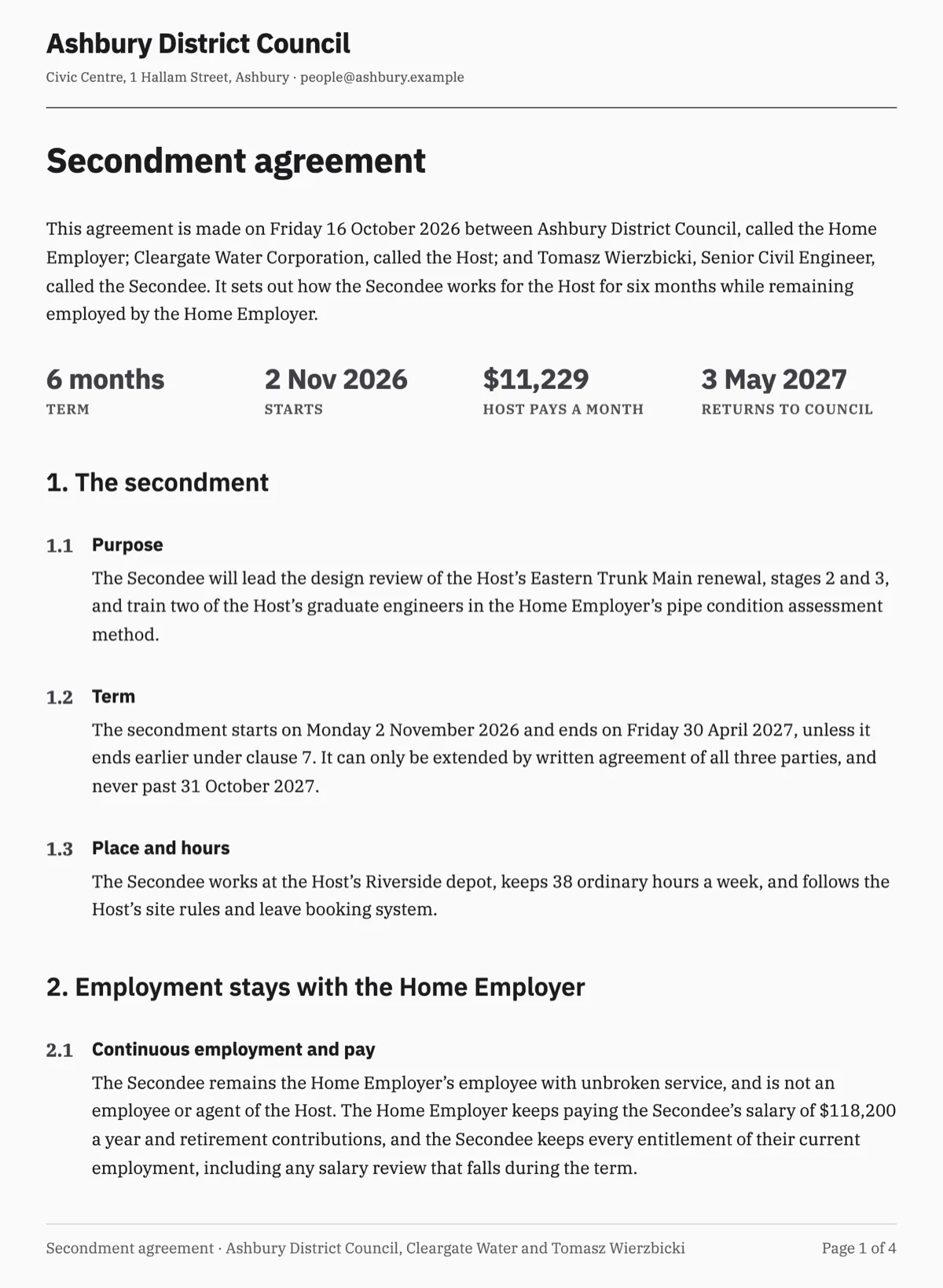
The secondment agreement example is signed by the council as host, the utility as employer and the engineer, so each promise binds the party who makes it. The employee's existing contract continues and the secondment terms sit on top of it, which is why the sample says the host's directions must be consistent with that contract. A two party letter between employer and employee works for internal moves; an external host should sign as well.
Safety duties for host and employer
The Work Health and Safety Act 2011 in its Commonwealth and model form places duties on each person conducting a business or undertaking, so far as reasonably practicable, for workers they engage or direct. A seconded worker is a worker of both. Section 46 requires duty holders with shared duties to consult, cooperate and coordinate, which the sample's sub clause (d) records. Workers compensation usually stays with the employer's insurer. Law checked on 21 October 2026. This page explains how the law works and is not legal advice.
Pay, leave and costs
The employer usually keeps paying salary, superannuation and leave, so continuity of service is not broken, and recovers the cost from the host by invoice. Leave during the secondment is approved by the employer after consulting the host. Allowances for travel or living away from home can be paid by either, and their tax treatment should be checked. The Fair Work Act's entitlements continue to come from the employer.
Where the clause sits in a generated document
Secondment agreements carry these terms as the main body. When asking the AI document generator for one, name the three parties, the period, who pays and recovers costs, who directs the work, the safety arrangements, IP and confidentiality, early ending and the return.
Documents that carry this clause
Questions people ask
What is a secondment clause?
It sets the terms on which an employee works for another organisation for a period while staying employed by their own employer: who pays, who directs the work, safety, confidentiality and IP, how the secondment can end and the employee's return to their role.
Who is the employer during a secondment?
Normally the original employer, which keeps paying salary and entitlements. The host directs the day to day work. The agreement should say so expressly, because who the employer is decides pay, leave, workers compensation and unfair dismissal rights. Tax and super follow the employer too.
How is a secondment ended before its end date?
If the agreement allows it. Most let any party end the secondment on a few weeks' written notice, with the employee returning to their employer. Ending the secondment is not ending the employment; the employee's contract with their employer continues.
Who is responsible for a seconded employee's safety?
Both the employer and the host. Each has work health and safety duties to the worker, and where those duties overlap they must consult, cooperate and coordinate. The agreement should set who gives inductions, equipment and incident reporting at the host's site.
Who owns work a secondee creates for the host?
It depends on the agreement. Without a clause, copyright in work an employee makes in the course of employment usually belongs to the employer, not the host. Secondment agreements often assign it to the host, as the sample does, or license it.
Put the clause in a finished document
The button opens the document generator with a starting description already filled in. Change it to match your own agreement before you run it.
Create a document with OneCraftRelated clauses
- Abandonment of employment clause: sample and the steps behind itAbandonment of employment clause sample for Australia: unexplained absence, contact attempts, a deadline to reply, and why the employer must still act fairly.
- Non dealing clause: a UK sample and how it differs from a non solicitNon dealing clause sample for UK employment contracts: no dealing with former clients for 12 months, the lookback, prospects, and enforceability after Tillman.
- Mobility clause: UK sample and the limits on using itA UK mobility clause for a store manager: move to any store within 40 miles on four weeks' notice with travel costs, plus how tribunals judge reasonable use.
- Confidentiality clauseA confidentiality clause inside a wider contract, not a standalone NDA. Sample consulting wording, mutual and one way variants, the tail period and exceptions.
For everything the document generator can do, see the document maker.
Step by step in the builder: Create a document with AI, then Document builder components.
Written and checked by the OneCraft team. Last checked .