Contract clause
Non dealing clause: a UK sample and how it differs from a non solicit
A non dealing clause stops a former employee from doing business with the employer's clients for a set period after leaving, even if the client approaches them first. A non solicitation clause only stops the employee approaching clients, so a non dealing clause is wider and harder to justify.
A non dealing covenant goes further than a non solicit: it stops a departing employee accepting work from former clients at all, not just chasing them. UK courts enforce it only where it protects a legitimate interest, such as client connections, and goes no further than reasonably necessary in time and scope.
Indunil Asanka · Co-founder
3 min read · Published
Sample clause
Written for contract of employment for an account executive at Wren Insurance Brokers, a fictional Birmingham broker.
Non Dealing. (a) For 12 months after the Termination Date, the Employee will not, on their own account or for any other person, deal with or provide insurance broking services to any Relevant Client. (b) Relevant Client means any person who was a client of the Company during the 12 months before the Termination Date and with whom the Employee had material dealings, or for whom the Employee was responsible, in that period. (c) The restriction does not apply to services unrelated to insurance broking, or to any client the Employee introduced to the Company and who leaves the Company before the Termination Date without any involvement by the Employee. (d) Any period of garden leave immediately before the Termination Date is deducted from the 12 month period. (e) Each restriction is separate, and if any is unenforceable the others continue.
Sample wording, not legal advice.
Variants
Clients the employee handled
The usual form: only clients the employee personally dealt with or managed in the lookback period are covered.
For 9 months after leaving, the Employee will not deal with any client with whom the Employee had material dealings in the 12 months before leaving.
Clients and identified prospects
Sales roles where the employee was in active negotiations with prospects the employer had invested in winning.
The restriction also covers any prospective client with whom the Employee had material dealings in the 6 months before leaving with a view to that prospect becoming a client.
Named key accounts
Senior roles tied to a short list of major clients, where naming them makes the restriction precise.
For 12 months after leaving, the Employee will not provide services to the clients listed in Schedule 4, as updated in writing by the Company from time to time with the Employee's agreement.
What to negotiate
Match the lookback to real contact
A restriction covering clients the employee had material dealings with in the last 12 months is easier to justify than one covering every client of the firm. Employees should push for the shorter lookback and the material dealings test; employers should keep records of who handled which clients.
Length that matches the relationship
Courts ask how long it would take the employer to bed in a replacement and secure the client connection. Six to twelve months is common for client facing roles; longer periods need clear justification. Offsetting garden leave against the restriction, as the sample does, helps the clause survive.
Write it to be severable
In Tillman v Egon Zehnder the Supreme Court allowed offending words to be removed from a restrictive covenant if what remains still makes sense and the change does not alter the overall effect. Drafting each restriction separately, with a severance clause, gives the court something to save.
The risk of leaving it out
Without a non dealing clause, an employer with only a non solicit may find a departing employee taking clients who approach them, which is often how client moves happen in practice. A clause drafted too widely is worse than none, though: if a court will not enforce it, the employer has spent goodwill and legal costs and protected nothing.
Non compete, non dealing and non solicit compared
A non compete stops the employee working for a competitor at all, and is the hardest to enforce. A non dealing covenant lets them work for a competitor but not serve the former employer's relevant clients. A non solicit lets them serve those clients only if the client comes to them unprompted. Courts treat the three as a ladder: the wider the restriction, the stronger the justification needed. Many contracts use a short non compete, a longer non dealing and a non solicit together, each severable.
The UK enforceability test
A post termination restriction is void as a restraint of trade unless it protects a legitimate business interest, such as client connections or confidential information, and goes no further than reasonably necessary to protect it. Reasonableness is judged when the contract is made. In Tillman v Egon Zehnder Ltd, decided in 2019, the UK Supreme Court confirmed this approach and set out when unenforceable words can be severed. Law checked on 21 October 2026. This page explains how the law works and is not legal advice.
Can the client choose to follow?
Clients are free to move their business, and a non dealing clause does not bind them. It binds the employee: the former employee must turn the work away for the restricted period, and the client can take its business elsewhere. That is the main practical difference from a non solicit, where the employee could accept the client's approach, and the reason courts look harder at non dealing restrictions.
Where the clause sits in a generated document
Employment contracts and standalone restrictive covenant or non solicitation agreements carry this clause near the end, after confidentiality. When asking the AI document generator for one, give the role, the lookback period, the restriction period, the clients covered, the garden leave offset and a severance clause.
Documents that carry this clause
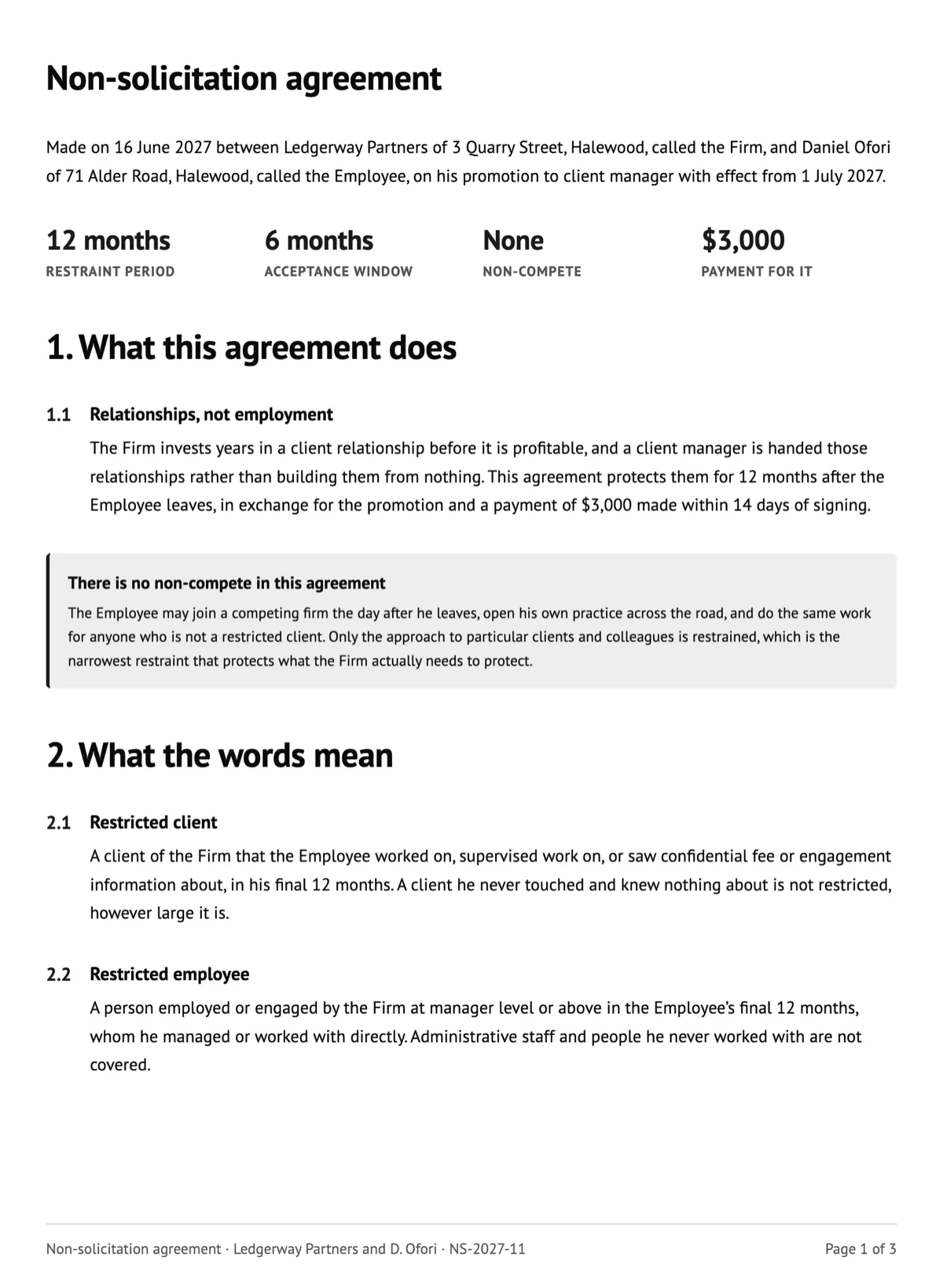 Non-solicitation agreement for clients, staff and durationA non-solicitation agreement restrains the approach, not the work. This one lets an accounting manager join a competitor the day after he leaves, and stops him approaching the clients he handled or the colleagues he managed for twelve months, with a six month window in which he also cannot accept work from those clients.
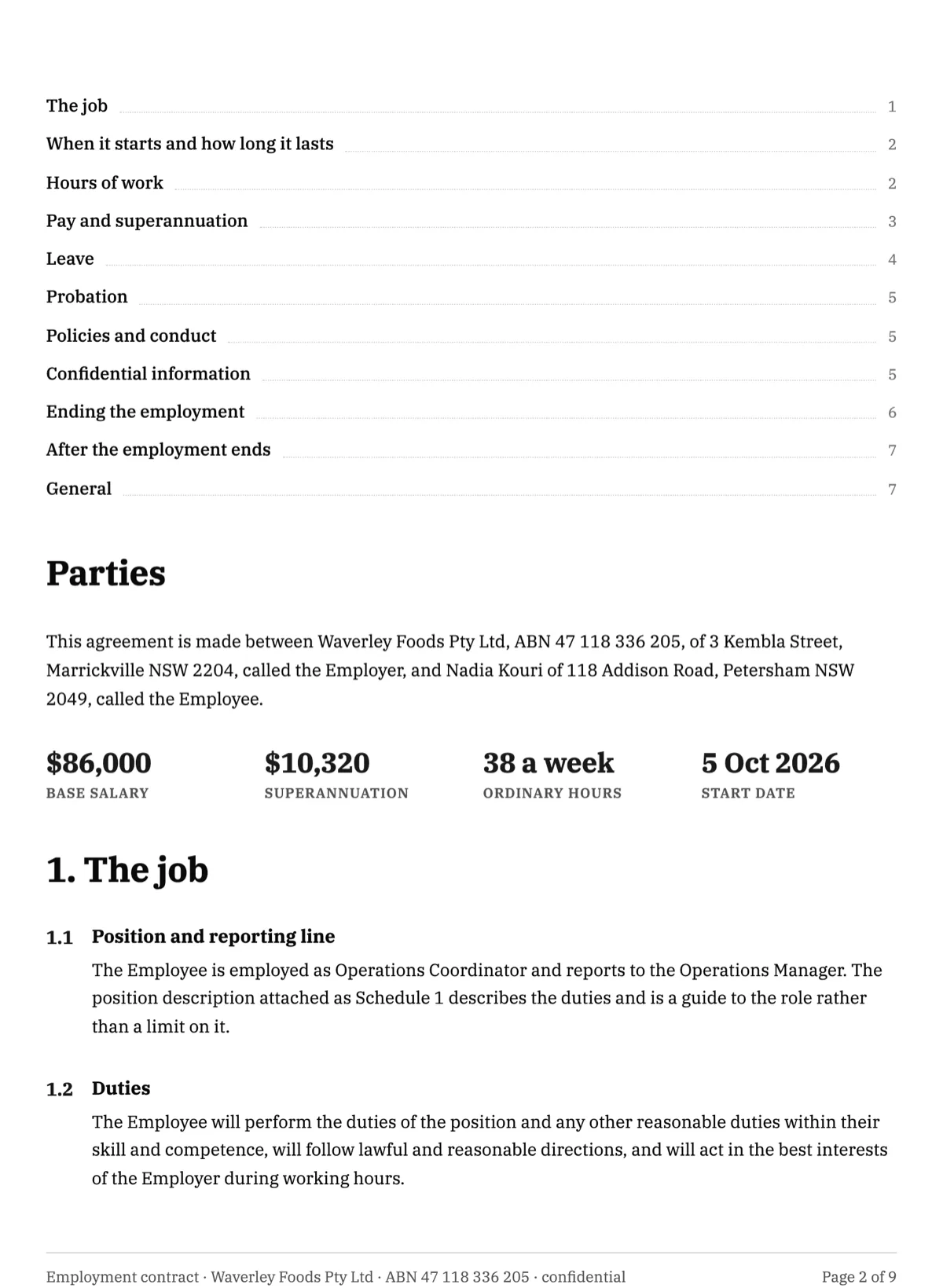 Employment contractA full time ongoing contract for an operations coordinator on $86,000 plus $10,320 of superannuation. Eleven numbered clauses, a leave table drawn from the National Employment Standards, and a notice table that scales with service.
Questions people ask
What is the difference between non dealing and non solicitation?
A non solicitation clause stops a former employee approaching or enticing clients. A non dealing clause stops them doing business with those clients at all, even if the client makes contact first. Because it is wider, a non dealing clause needs stronger justification to be enforced.
Can a client choose to follow me?
The client can move its business wherever it likes; the clause does not bind the client. But if you are bound by an enforceable non dealing clause, you must not accept that client's work during the restricted period, even though the client approached you.
Is a 12 month non dealing clause enforceable?
It can be, for a role with close client relationships where it would take about that long to secure the connection with a replacement. Courts look at the role, the lookback, the clients covered and any garden leave. Twelve months for a junior role with little client contact is likely too long.
Does garden leave count towards the restriction?
Only if the contract says so, but courts may take a long garden leave period into account when judging whether the restriction is reasonable. Offsetting garden leave against the post termination period, as the sample does, makes the clause more likely to be upheld.
What if part of the clause is too wide?
Since Tillman v Egon Zehnder, a court can remove offending words if the rest still makes grammatical sense and the removal does not change the overall effect of the restriction. It will not rewrite the clause, so separate, narrowly drafted restrictions give the best chance.
Put the clause in a finished document
The button opens the document generator with a starting description already filled in. Change it to match your own agreement before you run it.
Create a document with OneCraftRelated clauses
- Severance pay clause: a US sample with a releaseSeverance pay clause sample for US employment contracts: weeks per year of service, payment after a signed release, OWBPA timing for workers 40 and over.
- Retention bonus clause: sample wording and repayment rulesRetention bonus clause sample for US employers: a stay bonus paid in parts, what happens on resignation, layoff or death, repayment terms and tax withholding.
- Non solicitation clause for clients and staffA non solicitation clause stops a former employee approaching clients or staff. Australian sample wording for clients and staff, with three variants.
- Garden leave clause: paid notice away from the businessA garden leave clause keeps an employee paid but away from work during notice. Australian sample wording, restraint set off and three variants compared.
For everything the document generator can do, see the document maker.
Step by step in the builder: Create a document with AI, then Document builder components.
Sources
Written and checked by the OneCraft team. Last checked .