Contract clause
Severance pay clause: a US sample with a release
A severance pay clause promises an employee a payment when employment ends in set circumstances, usually termination without cause, and sets the amount, how it is paid and the conditions, most often a signed release of claims. US federal law does not require severance, so the clause creates the right.
In the US no federal law requires severance pay, so a severance clause is what creates the right: who qualifies, how much, how it is paid, and what the employee must sign first. For employees aged 40 or over, a valid release of age claims must follow the timing rules of the Older Workers Benefit Protection Act.
Nuwan Madhusanka · Co-founder
3 min read · Published
Sample clause
Written for employment agreement of a data engineer at Lakeline Analytics, a fictional Austin data firm.
Severance. (a) If the Company ends the Employee's employment without Cause, the Company will pay severance of two weeks' Base Salary for each completed year of service, with a minimum of four weeks. (b) Severance is paid in equal instalments on the Company's regular pay dates, starting on the first pay date after the Release becomes effective. (c) Severance is conditional on the Employee signing, and not revoking, a general release of claims in the form provided by the Company. If the Employee is 40 or older, the Employee will have 21 days to consider the release, 45 days if the termination is part of a group program, and 7 days after signing to revoke it. (d) If the Employee elects COBRA continuation coverage, the Company will pay the employer share of premiums for the severance period. (e) No severance is payable on resignation, death, disability or termination for Cause.
Sample wording, not legal advice.
Variants
Fixed weeks per year
A predictable formula that scales with tenure, common in employee handbooks and offer letters.
Eligible employees receive one week of base pay for each full year of service, up to 12 weeks, on termination without cause.
Lump sum
An executive or a single negotiated departure, where a clean break suits both sides.
The Company will pay the Executive a lump sum equal to six months' Base Salary within 30 days after the Release becomes effective.
Salary continuation
An employer that wants payments to stop if the employee breaches restrictive covenants during the severance period.
Severance is paid as continued Base Salary for the Severance Period. Payments stop if the Employee breaches the confidentiality or non solicitation obligations in this agreement.
What to negotiate
Release timing for workers 40 and over
Under the Older Workers Benefit Protection Act, a waiver of age discrimination claims is valid only if, among other things, the employee is advised in writing to consult a lawyer, has at least 21 days to consider it, or 45 days in a group termination, and 7 days to revoke after signing. A release that skips these steps may not bar an age claim.
What counts as cause
Severance clauses usually exclude termination for cause, so the definition of cause decides who gets paid. Employees should push for a narrow, listed definition with a chance to cure; employers want broader wording. A good reason trigger, letting the employee resign after a pay cut or demotion and still receive severance, is common in executive agreements.
Benefits and timing
Health coverage often matters as much as cash. Paying the employer share of COBRA premiums for the severance period, as the sample does, is a common addition. Instalment payments are typical; the clause should state when the first payment is made, after the release becomes effective.
The risk of leaving it out
Without a severance clause, an employer decides case by case, which invites claims that similar employees were treated differently, and an employee has no right to any payment at all. An employer that pays severance without a properly drafted release may pay and still face claims, because the money bought nothing in return.
No federal requirement
The US Department of Labor states that severance pay is a matter of agreement between employer and employee and is not required by the Fair Labor Standards Act. A severance plan offered across a workforce can, however, be an employee benefit plan subject to ERISA, which brings plan document and claims procedure duties. Some state laws require notice or pay for mass layoffs, such as the federal WARN Act's 60 days' notice for covered plant closings. Law checked on 21 October 2026. This page explains how the law works and is not legal advice.
OWBPA release checklist
For a release of age claims by an employee 40 or over to be knowing and voluntary, it must be written in plain language, refer to rights under the Age Discrimination in Employment Act, not waive claims arising after signing, give something of value beyond what the employee is already owed, advise the employee in writing to consult a lawyer, allow 21 days to consider, or 45 days in a group program with the required disclosures, and allow 7 days to revoke after signing.
The sample in numbers
A Lakeline Analytics engineer with 6 completed years and a base salary of $3,000 a week is let go without cause. Two weeks a year gives 12 weeks, above the four week minimum, so severance is $36,000, paid over the next 12 weeks of pay dates once the release becomes effective. An engineer with one year would receive the minimum of four weeks, $12,000 on the same salary.
Where the clause sits in a generated document
Employment agreements, offer letters and termination letters carry severance terms. When asking the AI document generator for one, give the formula, the minimum, the payment method, the release and its timing, any COBRA contribution and the exclusions, so the clause and the later release say the same thing.
Documents that carry this clause
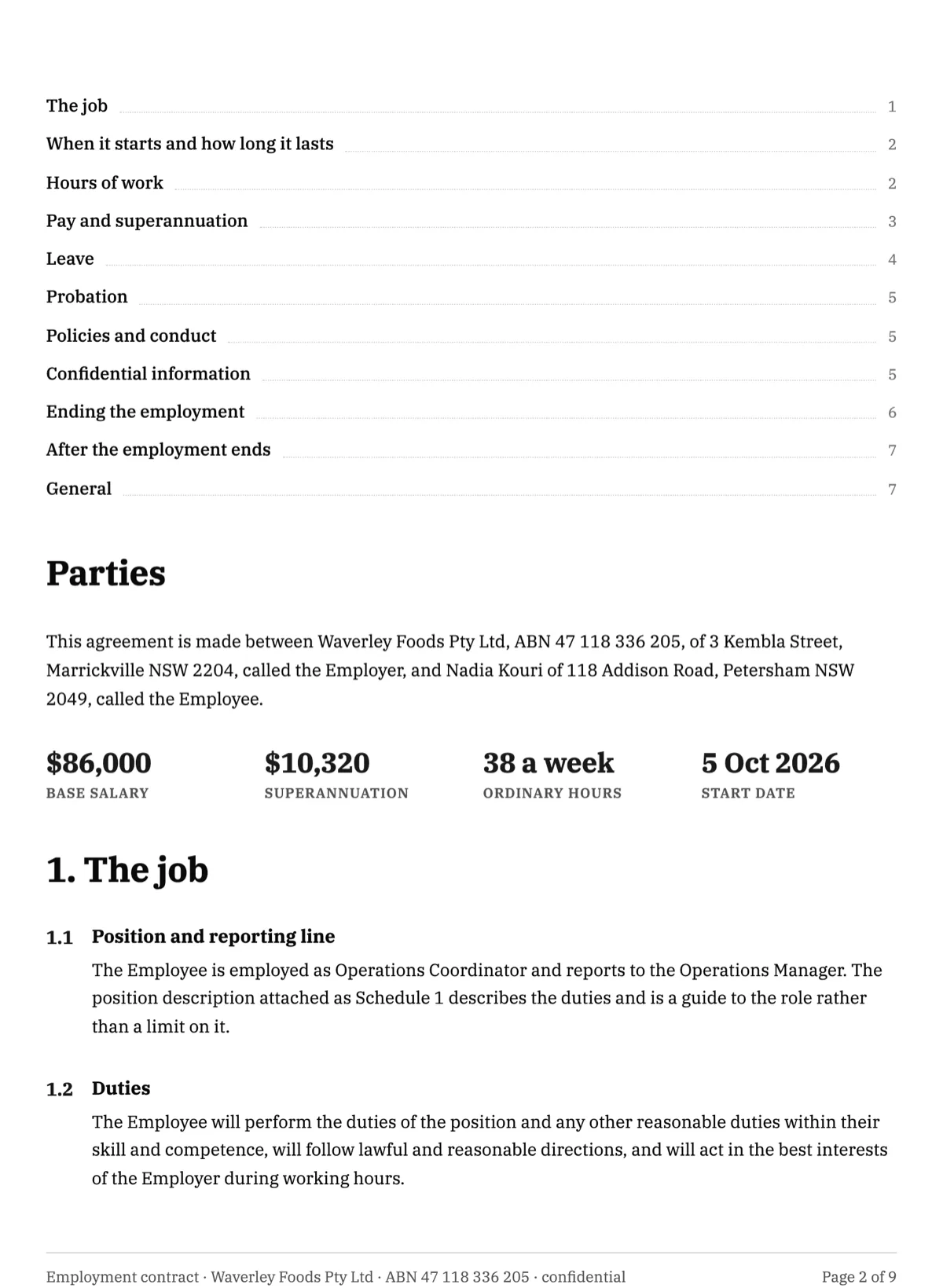 Employment contractA full time ongoing contract for an operations coordinator on $86,000 plus $10,320 of superannuation. Eleven numbered clauses, a leave table drawn from the National Employment Standards, and a notice table that scales with service.
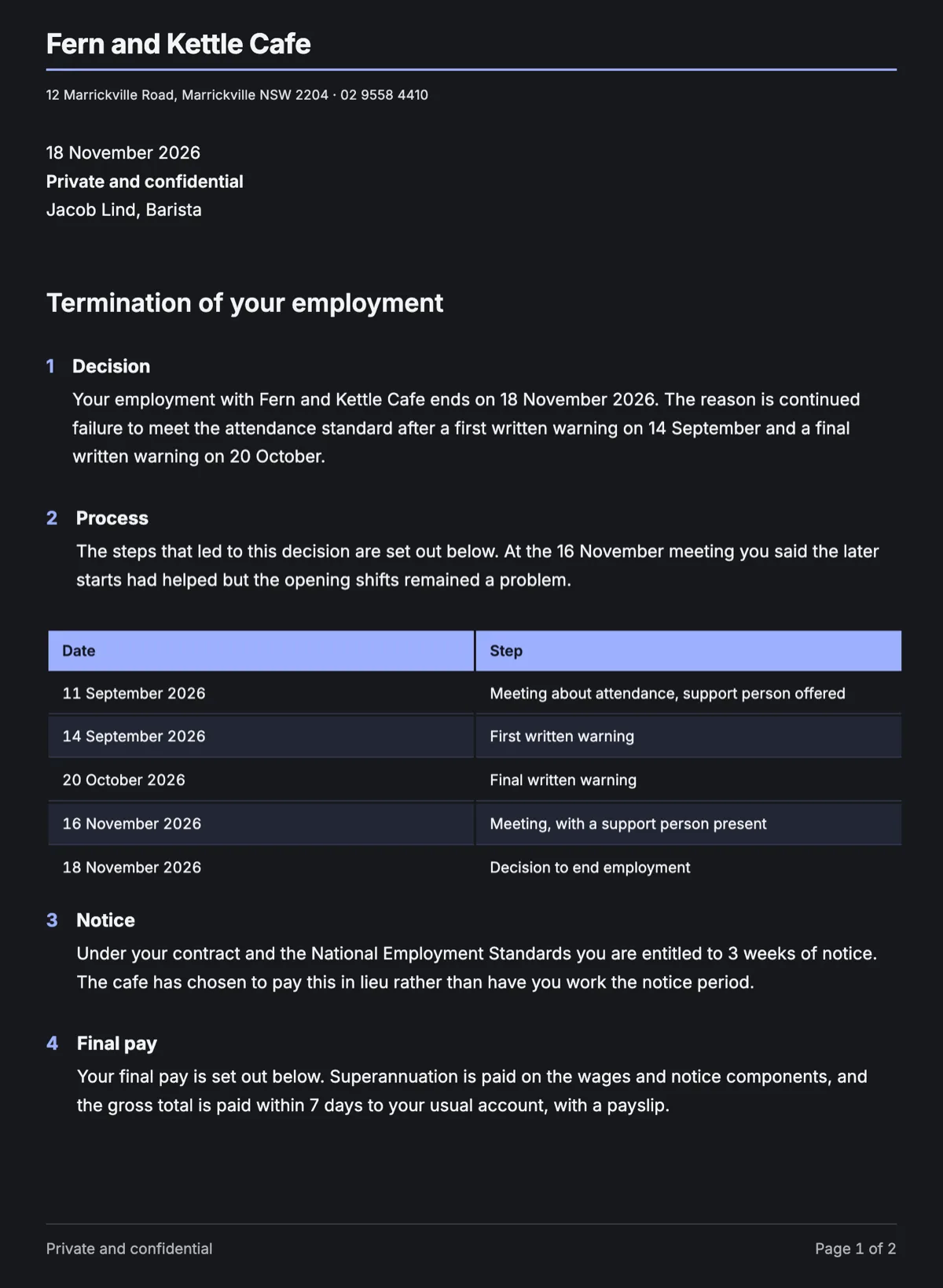 Termination letter template that shows the final payA termination letter is read twice, once by the employee in the meeting and once by a lawyer or a tribunal months later, and both need the same facts. This one states the reason and the process in dates, shows the final pay as a table with each component, and says what happens next, so there is nothing to ask afterwards.
Questions people ask
Is severance pay required by law in the US?
No. Federal law does not require severance pay, and few states do outside specific situations. Severance is owed only if an employment contract, offer letter, handbook or severance plan promises it. The WARN Act requires notice, or pay in lieu, for some mass layoffs and plant closings.
Do I have to sign a release to get severance?
If the severance clause makes a signed release a condition, yes. Most employers require one, because severance is given in exchange for giving up legal claims. For employees 40 and over, the release must allow 21 or 45 days to consider and 7 days to revoke.
How much severance is normal?
Practice varies by industry and level. One or two weeks of pay for each year of service is common for staff, often with a minimum, while executives negotiate months of pay. A written formula avoids claims that similar employees were treated differently.
Is severance pay taxed?
Yes. Severance is wages for federal income tax, Social Security and Medicare, and is usually reported on Form W-2. When paid separately from regular wages, employers often withhold federal income tax at the flat supplemental wage rate. State income tax may apply too.
Can severance be clawed back?
If the agreement says so. Salary continuation clauses often stop payments if the employee breaches confidentiality or non solicitation obligations, and some require repayment. The clawback terms should be in the severance clause or the release the employee signs. Courts read such terms closely.
Put the clause in a finished document
The button opens the document generator with a starting description already filled in. Change it to match your own agreement before you run it.
Create a document with OneCraftRelated clauses
- Retention bonus clause: sample wording and repayment rulesRetention bonus clause sample for US employers: a stay bonus paid in parts, what happens on resignation, layoff or death, repayment terms and tax withholding.
- Commission clause: a sales sample and the written plan rulesCommission clause sample for US sales staff: the rate, when commission is earned and paid, chargebacks, draws, leavers, and the written plan rules.
- Redundancy clause in an Australian employment contractA redundancy clause sets what happens when a role is no longer needed. Australian sample wording, the NES redundancy pay scale and enhanced variants.
- Release clause: giving up claims for goodA release clause gives up claims one party has against another. Australian sample wording for a building settlement and the unknown claims problem.
For everything the document generator can do, see the document maker.
Step by step in the builder: Create a document with AI, then Document builder components.
Written and checked by the OneCraft team. Last checked .