Contract clause
Mobility clause: UK sample and the limits on using it
A mobility clause lets an employer change where an employee works, within limits the clause sets, without negotiating a new contract. In the UK it is enforceable, but an employer must use it reasonably, give proper notice, and avoid indirect discrimination, especially against employees with caring responsibilities.
A mobility clause gives an employer flexibility to move staff where the work is. It does not give it freedom to move someone overnight to the other end of the country, and tribunals have long read an implied duty of reasonableness into how it is used.
Indunil Asanka · Co-founder
4 min read · Published
Sample clause
Written for an employment contract between Ridings Retail, a fictional Wakefield grocery chain, and a store manager.
Place of Work. (a) The Employee's normal place of work is the Company's store at Westgate, Wakefield. (b) The Company may require the Employee to work at any other Company store within 40 miles of that store, on giving at least 4 weeks' written notice, where reasonably required for the needs of the business. (c) Before giving notice, the Company will consult the Employee and take into account the Employee's personal circumstances, including caring responsibilities and travel arrangements. (d) If a move increases the Employee's daily travel cost, the Company will reimburse the additional cost for 6 months from the date of the move. (e) The Company will not require the Employee to move home.
Sample wording, not legal advice.
Variants
Named area
Multi site employers within a region, where staff can reasonably commute between sites.
The Company may require the Employee to work at any of its sites within the Greater Manchester area, on giving at least 4 weeks' notice, if reasonably required for the operation of the business.
Any UK site
Senior or specialist roles where relocation is part of the job and pay reflects it.
The Employee may be required to work at any of the Company's UK sites. Where a change requires the Employee to move home, the Company will give at least 3 months' notice and pay relocation expenses under its Relocation Policy.
With a relocation package
Moves that need a change of home, where the employer wants willing moves rather than disputes.
Where the Company requires the Employee to relocate under this clause, it will pay removal costs, up to 3 months' temporary accommodation, and the legal costs of buying and selling a home, up to the limits in the Relocation Policy.
What to negotiate
Reasonable notice
Tribunals have held that even an express mobility clause is subject to an implied term that the employer gives reasonable notice and does not make performance impossible, the point decided in United Bank v Akhtar. Notice of a few days for a move to a distant site has been found to breach the implied duty of trust and confidence. Four weeks for a local move, and longer for a relocation, is a safer standard.
Indirect discrimination for carers
A requirement to move can disadvantage people with childcare or caring duties, who are more often women, which can be indirect sex discrimination under section 19 of the Equality Act 2010 unless the employer shows it is a proportionate means of achieving a legitimate aim. Consulting the employee and taking personal circumstances into account, as the sample does, helps show the decision was proportionate.
Redundancy when a site closes
Under section 139 of the Employment Rights Act 1996, a redundancy situation exists where the need for work at the place where the employee is employed ceases. Tribunals look at where the employee actually worked, not only at the mobility clause. An employer closing a site may still owe redundancy pay if a move is outside what the employee was really expected to do, though unreasonably refusing a suitable alternative can lose it.
The risk of leaving it out
Without a mobility clause, moving an employee to a different workplace is a change to their contract that needs their agreement. An employer that insists may face constructive dismissal claims, and if the site closes, every employee there is potentially redundant. A clear, limited clause avoids negotiating each move from scratch.
Reasonable and unreasonable use
Uses that tribunals have treated as reasonable: a move to a site within normal commuting distance, with adequate notice, after consultation, for a genuine business reason, with help on extra travel costs. Uses treated as unreasonable or as a breach of trust and confidence: a move with a few days' notice to a distant site; a move used as a pretext to push someone out; a move that ignores a known caring responsibility without good reason; a move outside the area the clause allows. The clause is a power to be used fairly, not a trump card. Law checked on 21 October 2026. This page explains how the clause works and is not legal advice.
Mobility clauses and redundancy
When a site closes, an employer can try to rely on a mobility clause to move staff instead of making them redundant. Tribunals have generally asked where the employee actually worked rather than where the contract says they could be sent, so a wide clause does not automatically avoid redundancy. An offer of suitable alternative employment at another site, made properly, can still mean an employee who unreasonably refuses loses redundancy pay. The ACAS guidance on changing contracts and on redundancy sets out the process.
Writing a clause that works
The narrower and clearer the clause, the more likely it is to be enforced. Name the normal place of work, define the area or distance, set a notice period, commit to consultation, and state what support is given. Avoid wording such as anywhere the Company may require, which tempts unreasonable use. In a contract generated with the AI document generator, ask for the place of work and the mobility clause together, so the base location and the radius sit in one place.
Remote and hybrid work
Mobility clauses deal with moving between the employer's sites. Working from home, or splitting time between home and office, is a different arrangement covered by a flexible work clause and, in the UK, the statutory right to request flexible working. A hybrid worker's contract should say which office is the base for any mobility clause, so a move is measured from the right place.
Documents that carry this clause
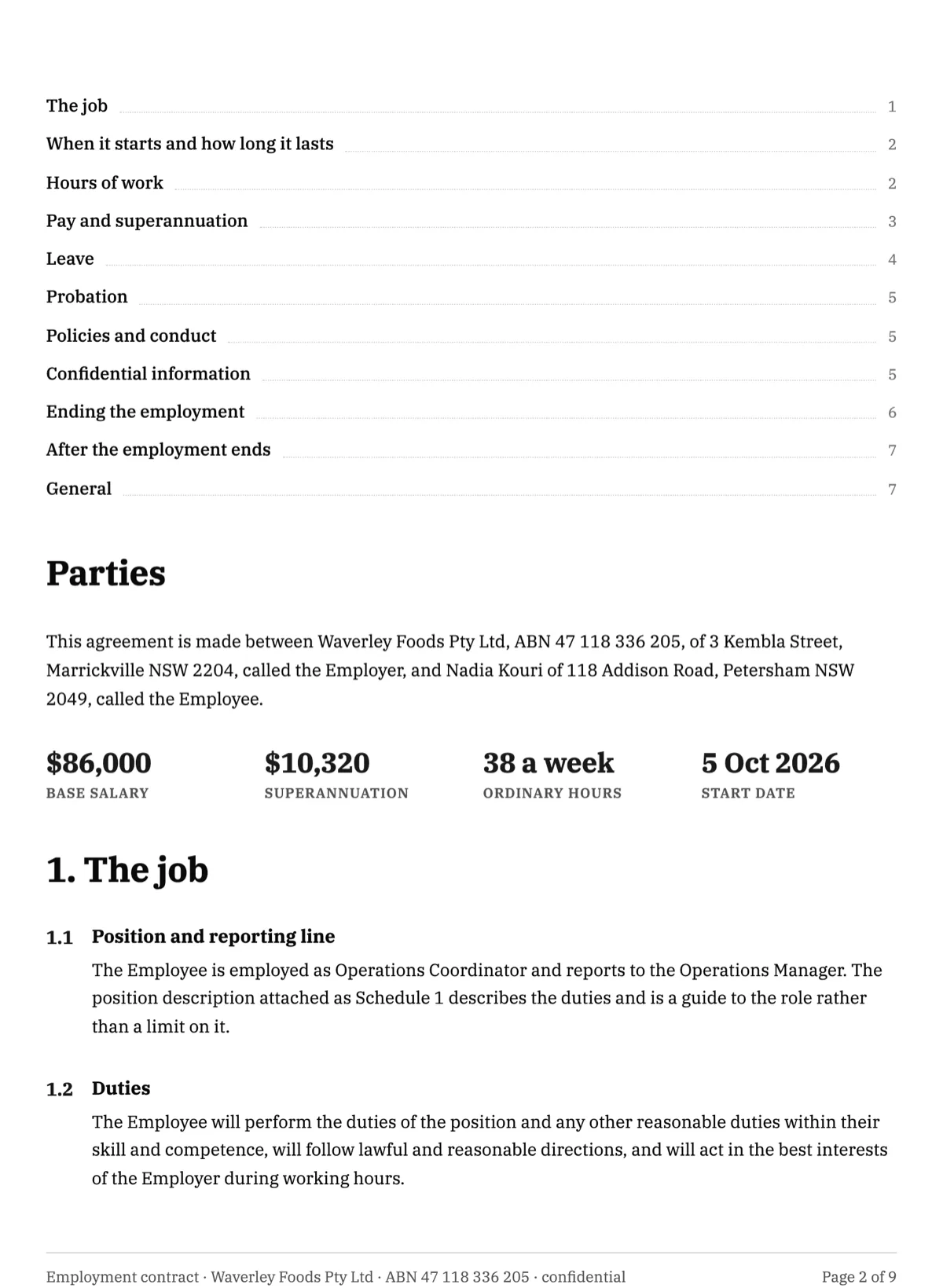 Employment contractA full time ongoing contract for an operations coordinator on $86,000 plus $10,320 of superannuation. Eleven numbered clauses, a leave table drawn from the National Employment Standards, and a notice table that scales with service.
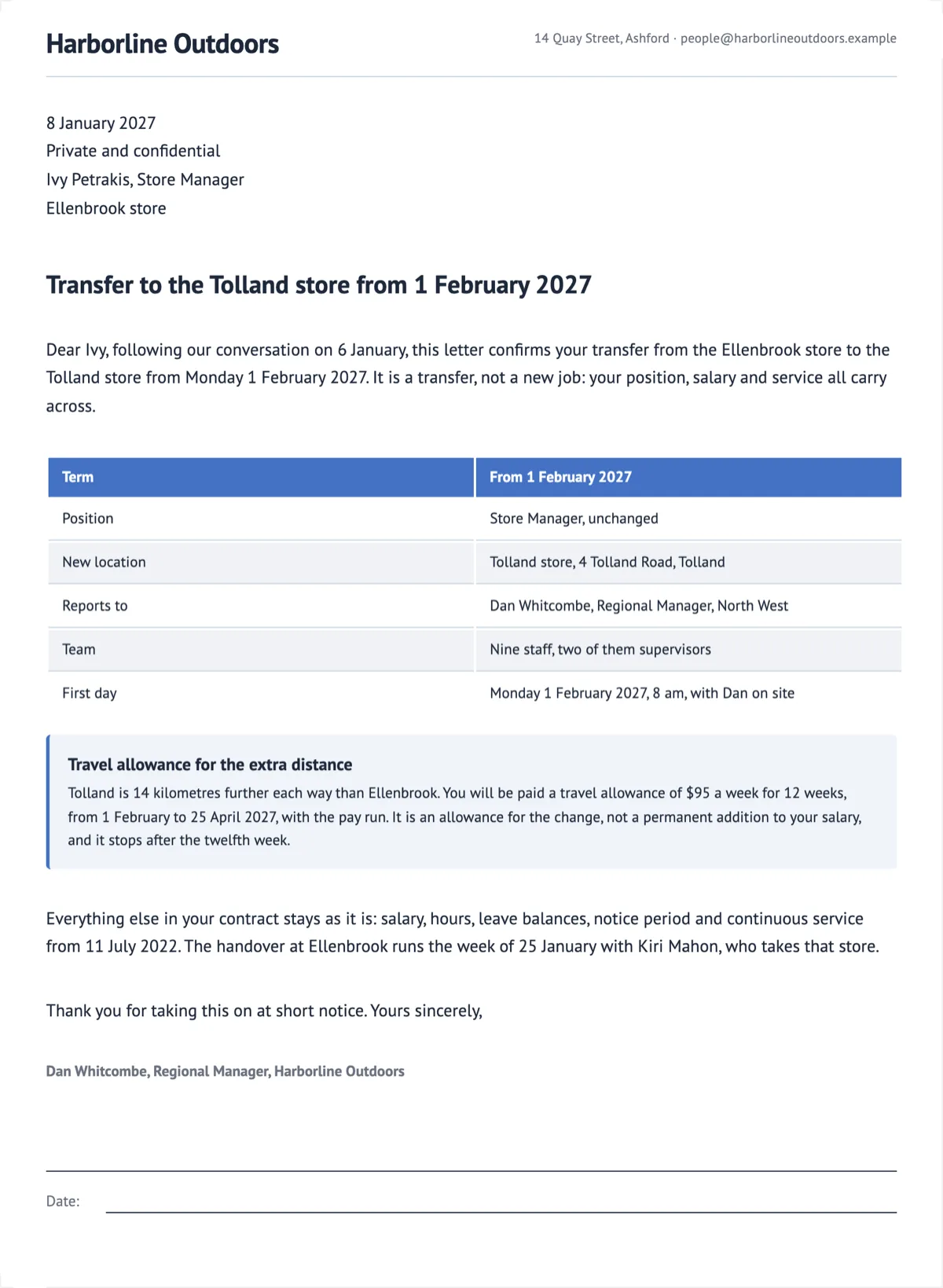 Employee transfer letter naming the new site, the manager and the start dateMoving someone between sites is only a small change on paper and a large one in their week, so the letter has to answer both. This one names the new store, the new manager and the team size, fixes the first day, funds the extra 14 kilometres for twelve weeks, and lists what carries across untouched.
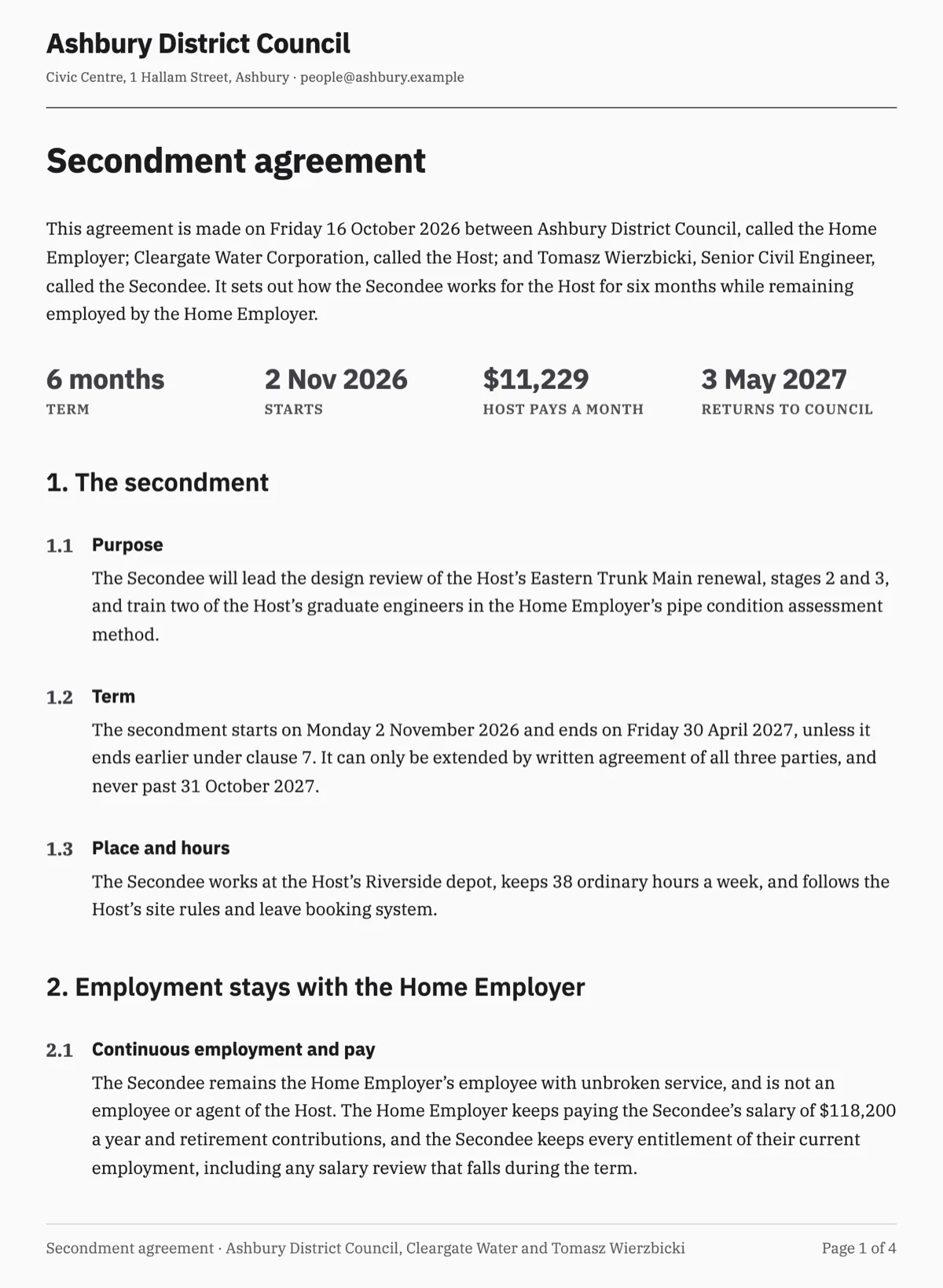 Secondment agreement template for a council engineer and a host utilityA secondment agreement template sets out how an employee works for another organisation for a fixed period while staying employed by their own. It needs three signatures because three parties carry obligations: the home employer keeps paying, the host directs the work and pays it back, and the secondee keeps their job to return to.
Questions people ask
Can my employer make me move to another site?
If your contract has a mobility clause covering the new site, your employer can ask you to move, but it must use the clause reasonably: proper notice, a genuine reason, and attention to your circumstances. Without a mobility clause, a move is a contract change that needs your agreement.
Is a mobility clause enforceable in the UK?
Yes, as long as the move falls within what the clause allows and the employer uses it reasonably. Tribunals imply a duty to give reasonable notice and not to make the move impossible to comply with, and an unreasonable use can amount to a breach of trust and confidence.
Am I redundant if my workplace moves?
Possibly. Redundancy covers the employer ceasing to need work at the place where you were employed, and tribunals look at where you actually worked. A mobility clause does not automatically prevent redundancy, but refusing an offer of suitable alternative work without good reason can cost you redundancy pay.
What notice should I get before being moved?
The notice the clause sets, and at least what is reasonable in the circumstances. For a short move between local sites, a few weeks is common; for a move that requires relocating home, months. Very short notice for a significant move risks a breach of the implied duty of trust and confidence.
Can a mobility clause be added to an existing contract?
Only with your agreement, because it changes your terms. Employers sometimes propose one during a reorganisation or a promotion. You can negotiate limits before accepting, such as a maximum distance or a named list of sites, a minimum notice period, consultation first, and help with extra travel or relocation costs.
Put the clause in a finished document
The button opens the document generator with a starting description already filled in. Change it to match your own agreement before you run it.
Create a document with OneCraftRelated clauses
- Remote work clause: hybrid, fully remote or by requestA remote work clause sets where an employee works, on which days and on what conditions. Sample hybrid wording, fully remote and UK variants, and what to agree.
- Notice period clause in an employment contractA notice period clause sets how much notice ends employment. Australian sample wording, the National Employment Standards minimums and three variants.
- Redundancy clause in an Australian employment contractA redundancy clause sets what happens when a role is no longer needed. Australian sample wording, the NES redundancy pay scale and enhanced variants.
For everything the document generator can do, see the document maker.
Step by step in the builder: Create a document with AI, then Document builder components.
Written and checked by the OneCraft team. Last checked .