Classic form
Disciplinary meeting record for a fair process
A disciplinary meeting record captures who attended, including any support person, the allegation as it was put, the evidence shown, the employee's response in their own words and the outcome. This Australian version is built around the steps that make a process fair, because those are what a tribunal looks at later.
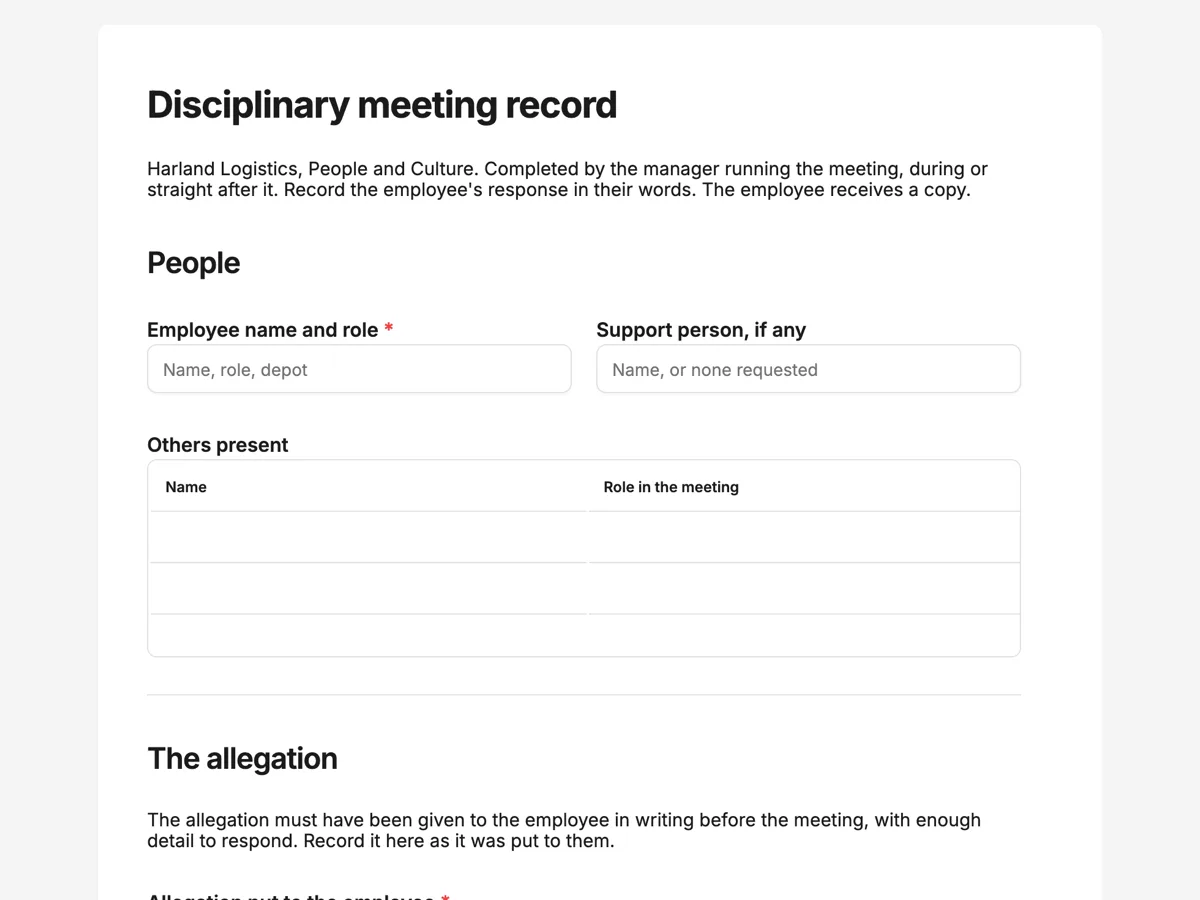
The form itself
A static copy of the finished form, exactly as it renders. Nothing here can be filled in or submitted, so read it as a reference and build your own from the button above.
Every field, and what it collects
The complete field list, in the order respondents meet it.
- Employee name and roleShort textRequired
- Support person, if anyShort text
- Others presentTable
- Columns: Name · Role in the meeting
- Allegation put to the employeeLong textRequired
- Evidence relied onFile upload
- Documents or images shown to the employee in the meeting, as PDF or image files.
- Employee response, in their wordsLong textRequired
- OutcomeSingle choiceRequired
- Options: No further action · Decision deferred, more information needed · Verbal warning · First written warning · Final written warning · Referred to People and Culture for review
- Follow up meeting dateDate
- Manager signatureSignatureRequired
- Employee signature, acknowledging receiptSignature
People
The allegation
Outcome
What each field on this form collects
The employee and any support person share the first row, followed by a three row table of others present and their role. A paragraph reminds the manager that the allegation must have been given in writing beforehand. The allegation, the evidence shown as uploaded files, and the employee's response in their own words follow. A single choice records the outcome from six options, from no further action to a referral for review, and an optional date sets the follow up. The manager signs, and the employee signs to acknowledge receipt.
What a fair process looks like
When the Fair Work Commission decides whether a dismissal was harsh, unjust or unreasonable, it looks at whether there was a valid reason, whether the employee was told of the reason and given a chance to respond, and whether an unreasonable refusal to allow a support person occurred, among other things. A disciplinary meeting is where those steps happen or do not. The form follows them in order: the support person, the allegation as notified, the evidence, the response and then the outcome. Recording the response in the employee's words shows it was actually heard.
Outcomes short of dismissal
Most disciplinary meetings end in something short of dismissal, and the outcome list reflects that. Decision deferred is there because a response often raises something that needs checking before deciding, and a manager who decides on the spot after hearing new information looks as though the outcome was fixed. Warnings carry a follow up date so improvement is reviewed rather than assumed. A process that may end employment should involve People and Culture, which is the last option.
How to adapt this form
A small business with no HR team replaces the referral option with seeking advice. A unionised workplace adds the union delegate to the attendees table and the agreement clause that sets the process. A business in the UK follows the ACAS code instead, which sets out written notice, the right to be accompanied and the right to appeal.
What makes this form work
The response in their words
The employee's response box asks for their words, not a summary. A record that shows what the employee actually said is the strongest evidence they were given a real chance to respond.
Deferral is an option
Decision deferred, more information needed sits in the outcome list. It gives the manager a way to stop and check, which protects the fairness of the final decision.
Acknowledgement, not agreement
The employee signs to acknowledge receipt, and that signature is optional. Signing shows they received the record, without asking them to agree with the outcome.
Questions people ask
Can an employee bring a support person to a disciplinary meeting?
In Australia, an unreasonable refusal by the employer to let an employee have a support person present at discussions about dismissal is a factor the Fair Work Commission considers in unfair dismissal claims. Most employers allow one for any disciplinary meeting. The support person supports; they do not usually speak for the employee.
What should be recorded at a disciplinary meeting?
Who attended, the allegation as put, the evidence shown, the employee's response, any further questions, the outcome or that a decision was deferred, and any follow up. Write it during or straight after the meeting and give the employee a copy.
Does the employee have to sign the record?
No. Asking them to sign to acknowledge receipt is common, and many will. If they decline, note that on the record. Their signature does not mean they agree with the allegation or the outcome, which this form says in the field label.
Should the outcome be decided in the meeting?
Often it should not. Hearing the employee's response and then taking time to consider it, especially if they raised new facts, shows the response was taken into account. The deferred option on this form exists for that reason, and the follow up date can be used to set when the decision will be given.
Who should see disciplinary records?
Only the people who need to, usually the manager, People and Culture and the employee. Disciplinary records are sensitive. Restrict the form to managers and limit access to the responses. Privacy rules for employee records in Australia have an exemption with limits; get advice.
Can the record be changed after it is saved?
Submitted responses cannot be edited. If something was recorded wrongly, add a short correction record and give the employee a copy. A record that cannot be quietly changed is more credible if it is ever examined later by a tribunal, a union or a lawyer.
Build your own in about a minute
The button below opens the generator with this use case already described. Change the wording to match your own, generate, then edit anything you like.
Make one like thisOther form examples
Flexible working request form for Australian employees
A flexible working request form records which eligible ground applies, what change the employee wants, the proposed pattern, when it should start and for how long, and how the work will be covered. This Australian version lists the grounds from the Fair Work Act and states the 21 day written reply rule up front.
Parental leave form for Australian employees
A parental leave form records the expected birth or placement date, the leave start and end dates, how the employee will be paid while away and how they would like to stay in touch and come back. This Australian version follows the Fair Work notice rules and separates government Parental Leave Pay from the employer's own paid leave.
Company car request form for pool vehicles
A company car request form books a pool vehicle for business use: which car, the dates, why it is needed, the driver's licence and history, a fuel card and agreement to the vehicle policy. This version keeps private use off by default, because that is what the logbook and the tax treatment depend on.
Want the steps in the builder? Read Keep the form to managers, then Give the employee a PDF copy. For everything this generator can do, see the form maker.
Written and checked by the OneCraft team. Last checked .