Classic form
Flexible working request form for Australian employees
A flexible working request form records which eligible ground applies, what change the employee wants, the proposed pattern, when it should start and for how long, and how the work will be covered. This Australian version lists the grounds from the Fair Work Act and states the 21 day written reply rule up front.
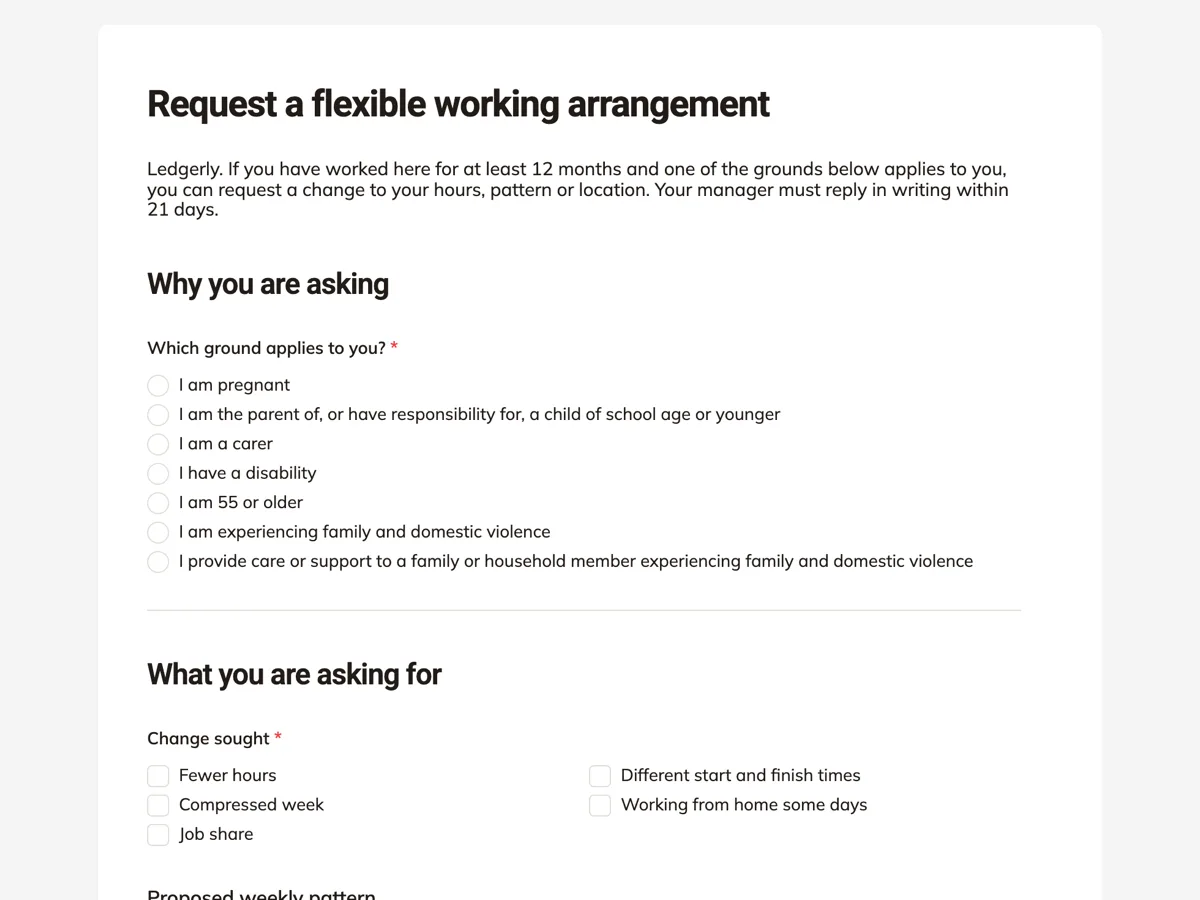
The form itself
A static copy of the finished form, exactly as it renders. Nothing here can be filled in or submitted, so read it as a reference and build your own from the button above.
Every field, and what it collects
The complete field list, in the order respondents meet it.
- Which ground applies to you?Single choiceRequired
- Options: I am pregnant · I am the parent of, or have responsibility for, a child of school age or younger · I am a carer · I have a disability · I am 55 or older · I am experiencing family and domestic violence · I provide care or support to a family or household member experiencing family and domestic violence
- Change soughtMultiple choiceRequired
- Options: Fewer hours · Different start and finish times · Compressed week · Working from home some days · Job share
- Proposed weekly patternTable
- Columns: Day · Hours · Where
- Proposed start dateDateRequired
- For how long?Single choiceRequired
- Options: Ongoing · For a set period, explained below · A trial first
- How the team and your work will be coveredLong textRequired
- Your signatureSignatureRequired
Why you are asking
What you are asking for
What each field on this form collects
A single choice lists the seven grounds that make an employee eligible to request a change. A checklist records the change sought: fewer hours, different times, a compressed week, working from home or job share. A five row table sets out the proposed week by day, hours and place. The start date sits beside how long the arrangement should last. A required long text asks how the work and the team will be covered, and the employee signs.
Who can request, and the 21 days
Under the Fair Work Act, an employee with at least 12 months of continuous service, or a long term casual expecting ongoing work, can request a flexible working arrangement if a listed ground applies: pregnancy, caring for a school age or younger child, being a carer, disability, being 55 or older, or experiencing or supporting a family member experiencing family and domestic violence. The employer must respond in writing within 21 days. It can refuse only on reasonable business grounds after discussing the request and genuinely trying to reach agreement, and must explain the refusal. The Fair Work Ombudsman sets this out in its guidance.
Why the form asks about cover
Most refusals cite the effect on the team or on customers. The cover question lets the employee answer that before it is raised, with a concrete plan such as moving a report to a different day. It does not shift the employer's duty to consider the request properly, but it starts the discussion with a proposal rather than a demand. The trial option in the duration question gives both sides a way to agree to try something without committing forever.
How to adapt this form
A business that offers flexibility to everyone, not just eligible employees, keeps the ground question optional and adds a reason box. A UK employer replaces the grounds with the UK statutory request, which applies from day one of employment. A shift based workplace adds the roster and the shifts the employee could cover.
What makes this form work
The grounds are the law's
Seven options mirror the Fair Work Act grounds. An employee can see whether they are eligible, and a manager can see which ground the request relies on.
A real week in a table
Day, hours and where for five rows. A manager responds to a concrete pattern, not an abstract wish for flexibility.
Cover is proposed up front
The required cover question asks the employee how the work will be done. It answers the most common reason for refusal before it is raised.
Questions people ask
Who can request flexible working in Australia?
Employees with at least 12 months of continuous service with the employer, and long term casuals with a reasonable expectation of ongoing work, where a listed ground applies, such as pregnancy, caring for a young child, being a carer, disability, being 55 or older, or family and domestic violence. The Fair Work Ombudsman explains the rules.
How long does an employer have to respond?
Within 21 days, in writing. The employer must discuss the request, genuinely try to reach agreement, and consider the consequences of refusing for the employee. A refusal must give the reasonable business grounds and any changes the employer could offer instead.
Can an employer refuse a flexible working request?
Only on reasonable business grounds, such as significant cost, no capacity to reorganise work, or a significant loss of productivity or customer service, and only after following the required steps. Employees can take some disputes about refusals to the Fair Work Commission.
Does the request need to be in writing?
Yes. Under the Fair Work Act, a request must be in writing and set out the details of the change sought and the reasons. A submitted form with the employee's signature meets that, and the employee can keep a PDF copy of the submission.
Can the arrangement be trialled?
Yes, if both sides agree. A trial lets a team test an arrangement before committing. Set the trial length and a review date in writing. This form offers a trial as one of three duration options, alongside ongoing and a set period such as a school term.
What if the employee is not eligible?
They can still ask, and many employers agree to flexibility outside the legal process. The formal rights to a written response within 21 days apply only to eligible requests. An enterprise agreement or award may also contain its own flexibility terms.
Build your own in about a minute
The button below opens the generator with this use case already described. Change the wording to match your own, generate, then edit anything you like.
Make one like thisOther form examples
Employee bank details form with split pay
An employee bank details form collects the account name, BSB and account number that wages are paid into, the pay date the change starts from and the employee's signature. This Australian payroll version adds an optional fixed amount to a second account and warns staff about payment redirection scams.
Company car request form for pool vehicles
A company car request form books a pool vehicle for business use: which car, the dates, why it is needed, the driver's licence and history, a fuel card and agreement to the vehicle policy. This version keeps private use off by default, because that is what the logbook and the tax treatment depend on.
Disciplinary meeting record for a fair process
A disciplinary meeting record captures who attended, including any support person, the allegation as it was put, the evidence shown, the employee's response in their own words and the outcome. This Australian version is built around the steps that make a process fair, because those are what a tribunal looks at later.
Want the steps in the builder? Read Table and choice fields, then Notify the manager by email. For everything this generator can do, see the form maker.
Written and checked by the OneCraft team. Last checked .