Classic form
Tractor pre start checklist for rollover and PTO risks
A tractor pre start checklist confirms the rollover protection, seatbelt, PTO guarding, linkage, tyres, brakes and fluids before the tractor leaves the shed. This one is built for an orchard, with the implement recorded and the two checks that prevent most tractor deaths placed at the top.
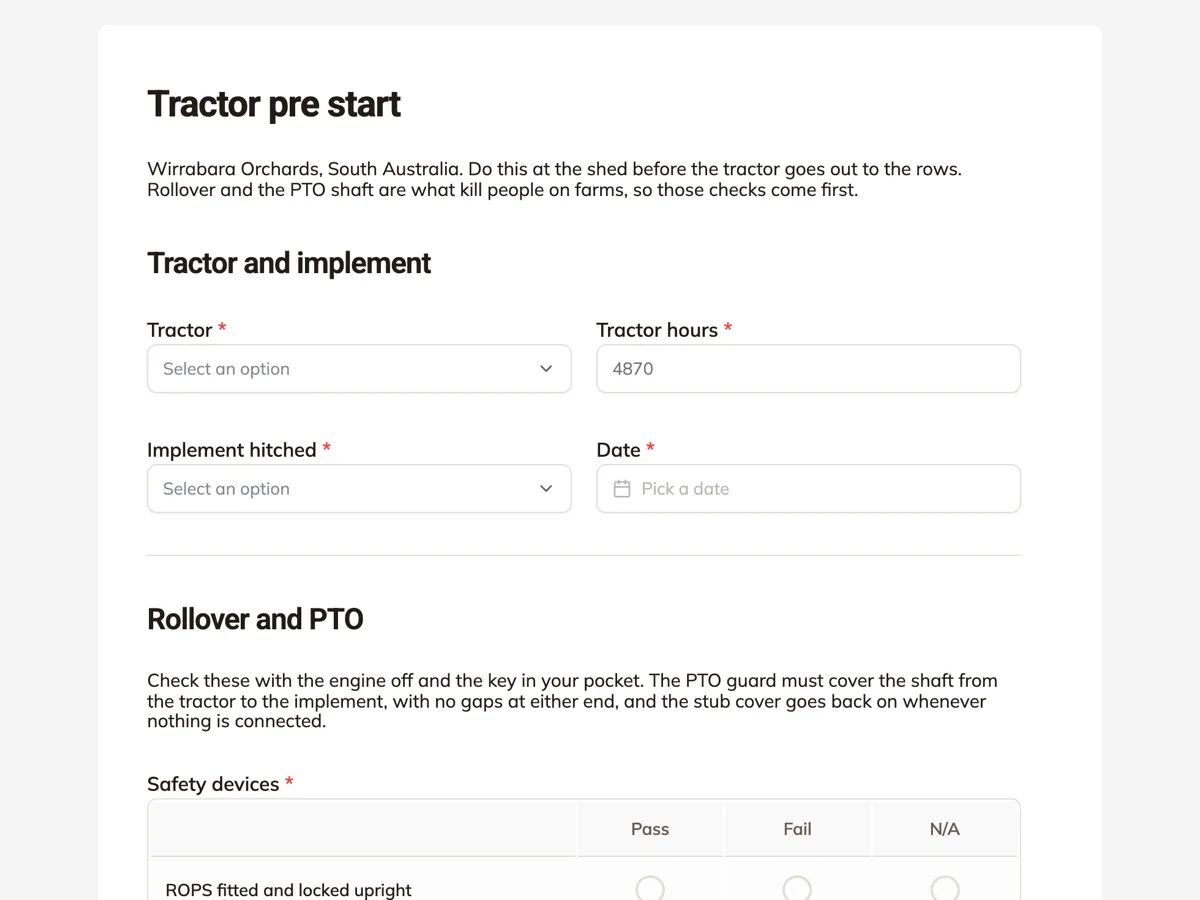
The form itself
A static copy of the finished form, exactly as it renders. Nothing here can be filled in or submitted, so read it as a reference and build your own from the button above.
Every field, and what it collects
The complete field list, in the order respondents meet it.
- TractorDropdownRequired
- Options: T1 orchard tractor, cab · T2 orchard tractor, open station · T3 utility tractor with loader
- Tractor hoursNumberRequired
- Implement hitchedDropdownRequired
- Options: None · Air blast sprayer · Slasher · Mulcher · Bin trailer · Post hole digger
- DateDateRequired
- Safety devicesRating gridRequired
- Statements:
- ROPS fitted and locked upright
- Seatbelt worn and working
- PTO shaft guard complete
- PTO stub cover in place
- Three point linkage pins and clips
- Slow moving vehicle sign
- Tractor checksRating gridRequired
- Statements:
- Tyres and wheel nuts
- Brake pedals latched together
- Hydraulic couplings
- Engine oil
- Coolant
- Lights and beacon
- Front end loader fitted?Single choiceRequired
- Options: No · Yes, bucket low when travelling
- Fault photoPhoto upload
- A photo of anything marked Fail. For a guard, show the whole length of the shaft so the gap is obvious.
- Describe the faultLong text
- Driver signatureSignatureRequired
Tractor and implement
Rollover and PTO
General condition
What each field on this form collects
The tractor comes from a list of three, with hours beside it, then the implement from a list of six and the date. The safety grid holds six rows: rollover protection fitted and locked upright, the seatbelt, the PTO shaft guard, the stub cover, linkage pins and clips, and the slow moving vehicle sign for road travel. The condition grid holds another six: tyres and wheel nuts, brake pedals latched, hydraulic couplings, engine oil, coolant, lights and beacon. A single choice records a front end loader. A photo, a description and the driver signature close the form.
Rollover and entanglement come first
WorkSafe Victoria's tractor guidance puts rollovers and run overs at the top of the risks, and the PTO shaft is the classic entanglement point on any farm. A folding ROPS frame left down to fit under trees protects nobody, which is why the first row says locked upright and the seatbelt row follows it. A frame without a belt lets the driver be thrown out and crushed by the frame itself. The PTO rows separate the guard from the stub cover, because a tractor can go out with the shaft guard in good order and the stub bare after the implement is unhooked in the paddock.
Hitching an implement
Most incidents on hitching happen when someone stands between the tractor and the implement while the tractor moves. The form records the implement so the linkage and coupling checks describe what is actually on the back. A sprayer needs its hoses and the pump shaft guard checked, a slasher its chains and skirt, and a bin trailer its hitch pin and safety chain. Brake pedals latched together is in the condition grid because a tractor braking on one wheel at road speed will swing.
How to adapt this form
A vineyard adds a row for the cab filter when spraying, since the cab is the spray protection. A dairy farm swaps the orchard implements for a feed out wagon and a mower conditioner. A contractor who moves tractors between farms adds the property name and a question about the route, because public road travel brings its own lights, signage and width checks.
What makes this form work
Locked upright, not just fitted
The first safety row reads ROPS fitted and locked upright. Orchard tractors fold their frames to pass under branches, and a frame folded down at the shed is often still folded on the slope where it was needed.
Guard and stub are two rows
PTO shaft guard complete and PTO stub cover in place are separate. The stub is exposed every time the implement comes off, so it fails on a different day from the shaft guard and needs its own answer.
The implement is on the record
A dropdown of six implements, from none to a post hole digger, sits next to the date. The linkage and hydraulic rows only mean something once you know what was hitched when the driver signed.
Questions people ask
Is ROPS compulsory on a tractor in Australia?
Rollover protection is required on tractors used at work under the WHS and OHS rules in every state, with narrow exceptions set out by each regulator. WorkSafe Victoria publishes the requirement for Victoria. Check your own state regulator, and treat a fold down frame as protection only while it is up and locked with the seatbelt worn.
How do you check a PTO guard?
With the engine off and the key out, look along the shaft from the tractor end to the implement end. The guard should cover the whole length, turn freely on the shaft and be held by its restraint chains, with no cracked or missing cones. The tractor end shield and the implement end shield are part of the check too.
What else is checked when an implement is hitched?
The linkage pins and their clips, the top link, any hydraulic hoses and couplings, and the PTO shaft length for that implement. A shaft too long can bottom out on a turn, one too short can pull apart. Never stand between the tractor and the implement while someone else moves the tractor to line up.
Who does the tractor pre start on a farm?
The person driving that tractor that day. On a farm with seasonal workers, the check is also a moment for the supervisor to see that the driver knows the machine. Some farms ask new pickers or casual drivers to complete the first few pre starts with a supervisor present and record both names.
Can the pre start be printed for the shed wall?
Yes. Each submitted check can be saved as a PDF from the responses table, and the photo prints in the body of the PDF next to the answers. A blank template PDF of the form can also be printed for a tractor that goes out without a phone, then typed in later.
Does a tractor with a cab still need the seatbelt row?
Yes. A cab is a rollover structure, but only if the driver stays inside it. Without the belt, a rolling tractor throws the driver against the doors or out through them. The seatbelt row applies to both the cab tractor and the open station tractor on this form.
Build your own in about a minute
The button below opens the generator with this use case already described. Change the wording to match your own, generate, then edit anything you like.
Make one like thisOther form examples
Ride on mower pre start checklist for a council crew
A ride on mower pre start checklist covers the rollover bar, seatbelt, seat switch, blade guards, brakes and tyres at the depot, then the slopes and hazards on the day's run. This council version puts both halves on one form so the mower check and the site walk are signed together.
Electric pallet jack pre start checklist
An electric pallet jack pre start checklist tests the belly button reverse switch, emergency stop, horn, tiller brake and wheels before the jack leaves the charging bay. This cold chain version also records the battery charge and whether the jack is going into a chiller or freezer.
Skid steer pre start checklist built around the seat bar
A skid steer pre start checklist covers the operator station, the coupler, tyres or tracks, fluids and lights before the machine moves off the trailer. The check that decides everything on a skid steer is the seat bar interlock, so this form puts it first and explains how to test it.
Want the steps in the builder? Read Add a matrix of Pass, Fail and N/A, then Print the pre start as a PDF. For everything this generator can do, see the form maker.
Written and checked by the OneCraft team. Last checked .