Classic form
Skid steer pre start checklist built around the seat bar
A skid steer pre start checklist covers the operator station, the coupler, tyres or tracks, fluids and lights before the machine moves off the trailer. The check that decides everything on a skid steer is the seat bar interlock, so this form puts it first and explains how to test it.
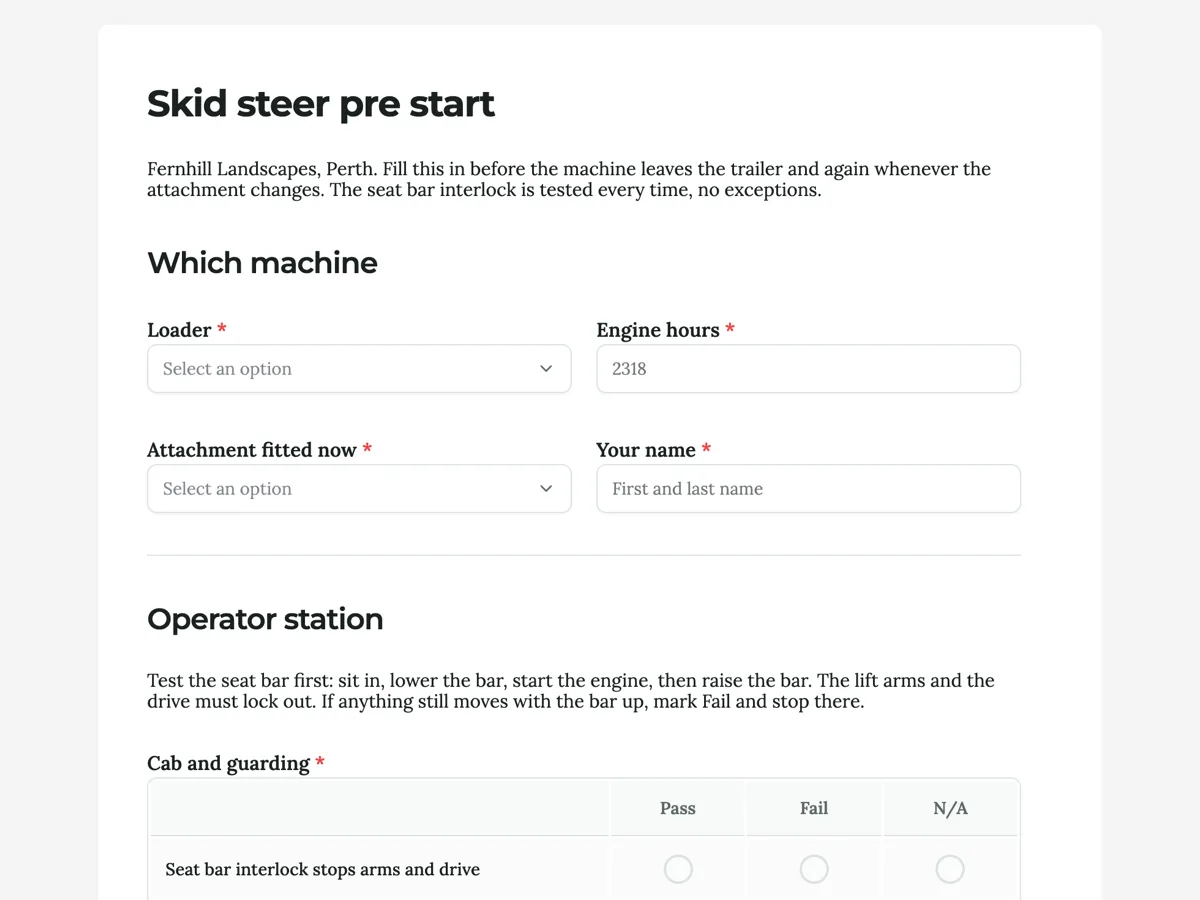
The form itself
A static copy of the finished form, exactly as it renders. Nothing here can be filled in or submitted, so read it as a reference and build your own from the button above.
Every field, and what it collects
The complete field list, in the order respondents meet it.
- LoaderDropdownRequired
- Options: SS1 wheeled skid steer · SS2 wheeled skid steer · CT1 compact track loader
- Engine hoursNumberRequired
- Attachment fitted nowDropdownRequired
- Options: Bucket · Pallet forks · Auger · Trencher · Sweeper · 4 in 1 bucket
- Your nameShort textRequired
- Cab and guardingRating gridRequired
- Statements:
- Seat bar interlock stops arms and drive
- Lap belt
- ROPS and FOPS frame
- Side screens intact
- Front door or mesh guard
- Reversing alarm
- Machine conditionRating gridRequired
- Statements:
- Coupler pins down and locked
- Tyres or tracks
- Hoses and quick couplers
- Lift arm support strut on board
- Engine oil
- Hydraulic oil
- Work lights
- Photo of anything that failedPhoto upload
- Take it with the attachment lowered and the engine off. Get the part and its surroundings in one frame.
- Notes for the yardLong text
- Signed by the operatorSignatureRequired
Which machine
Operator station
Around the machine
What each field on this form collects
Four fields identify the check: the loader from a list of two wheeled skid steers and one compact track loader, the engine hours, the attachment fitted at that moment and the operator. The cab grid has six rows and starts with the seat bar interlock, followed by the lap belt, the rollover and falling object frame, side screens, the front door or mesh and the reversing alarm. The machine grid has seven rows covering the coupler pins, tyres or tracks, hoses, the lift arm support strut, both oils and the lights. A photo field, a notes box and the signature close it.
Why the seat bar interlock comes first
The serious skid steer injuries happen at the front of the cab: an operator leans out or climbs out with the arms raised and is crushed between the arms and the frame. The seat bar interlock exists to stop the arms and the drive when the bar is up, and it is also the part people disable on a hot day. The paragraph above the grid tells the operator exactly how to test it, bar down, engine on, bar up, and to stop the check if anything moves. The lift arm support strut has its own row for the same reason. If a fitter or operator has to work under raised arms, the strut is the only thing that should be holding them.
Attachment changes mid shift
A landscaping crew can swap from a bucket to pallet forks to an auger before lunch. Each change means the coupler pins are disturbed and the machine handles differently, so the attachment is recorded on the form and the intro asks for a fresh check after a change. Forks need the load to sit low and back; an auger needs the operator to know where services run; a trencher throws spoil and needs people kept well back. A crew that changes attachments often can keep a second, shorter copy of this form with only the machine grid and the attachment question.
How to adapt this form
A hire company adds the hire docket number and a row for the operator manual in the cab. A council parks team running a compact track loader on turf adds a row for track tension and cleaning before travelling on roads. A contractor with several crews replaces the name field with a dropdown of operators, so each check sorts by person in the responses table.
What makes this form work
The test is written out
Bar down, engine on, bar up, nothing moves. Spelling out the four steps in the paragraph means a new operator tests the interlock the same way as the leading hand, and a Pass on that row means something.
The strut has its own row
Lift arm support strut on board sits in the seven row machine grid. Its absence is not obvious until someone needs to work under the arms, which is the worst time to find out.
Attachment recorded at the moment of the check
The dropdown of six attachments captures what was fitted when the operator signed. When a fault is found later in the day, the yard can see whether it was checked on forks or on the auger.
Questions people ask
Do you need a licence to drive a skid steer in Australia?
A skid steer is not one of the high risk work licence classes, so no national licence applies. The employer still has to make sure the operator is trained and competent on that machine, which most businesses record with a verification of competency. Keep that record next to the pre starts, because both are asked for after an incident.
How often should the skid steer pre start be done?
At the start of every shift the machine works, by the person operating it, and again after an attachment change for the coupler and handling rows. A machine shared between two operators in a day gets a check from each. The form time stamps every submission, so the responses table shows when each check was done.
Should the pre start be redone after an attachment change?
At least the coupler pin row and the hydraulic hoses should be, since both are disturbed by the change. Many crews simply submit the form again with the new attachment selected. It takes two minutes and leaves a record that the pins were checked down and locked on the attachment that was actually working.
What if the seat bar interlock has been bypassed?
Mark that row Fail, tag the joystick and do not use the machine. A bypassed interlock is a deliberate defeat of a safety device, and the yard needs to know who did it and when. The photo field is useful here: a picture of the bridged switch or cable tie settles the question quickly.
Can the yard be told straight away when a check fails?
The email alert add-on sends every submission to one address, with the answers in the message, so the yard sees each check as it arrives, not only the failed ones. A webhook can pass each submission to another system once. Neither filters by answer, so the person reading decides what a Fail needs.
Build your own in about a minute
The button below opens the generator with this use case already described. Change the wording to match your own, generate, then edit anything you like.
Make one like thisOther form examples
EWP pre start checklist for boom lifts
An EWP pre start checklist runs every function from the ground controls, tests the emergency stop and emergency lowering, then checks the basket gate, anchor, platform controls and harness before anyone goes up. This boom lift version also records the WP licence line at 11 metres and makes the operator write a rescue plan.
Compressor pre start checklist for stored pressure
A compressor pre start checklist looks at the relief valve, the gauge, the receiver drain, hoses, couplings and whip checks before air goes into the line, then the guards, fuel and oil. This blasting workshop version also records when the air receiver is next due for its periodic inspection.
Excavator pre start checklist with quick hitch checks
An excavator pre start checklist is the operator's walkaround before the first bucket: tracks, hoses, fluids, the rollover cab, the alarm and the quick hitch, each marked Pass, Fail or N/A. This one adds the three hitch checks that stop a bucket falling off and a tag out question that keeps a faulty machine parked.
Want the steps in the builder? Read Build a pre start from a description, then Email the yard when a check comes in. For everything this generator can do, see the form maker.
Written and checked by the OneCraft team. Last checked .