Classic form
EWP pre start checklist for boom lifts
An EWP pre start checklist runs every function from the ground controls, tests the emergency stop and emergency lowering, then checks the basket gate, anchor, platform controls and harness before anyone goes up. This boom lift version also records the WP licence line at 11 metres and makes the operator write a rescue plan.
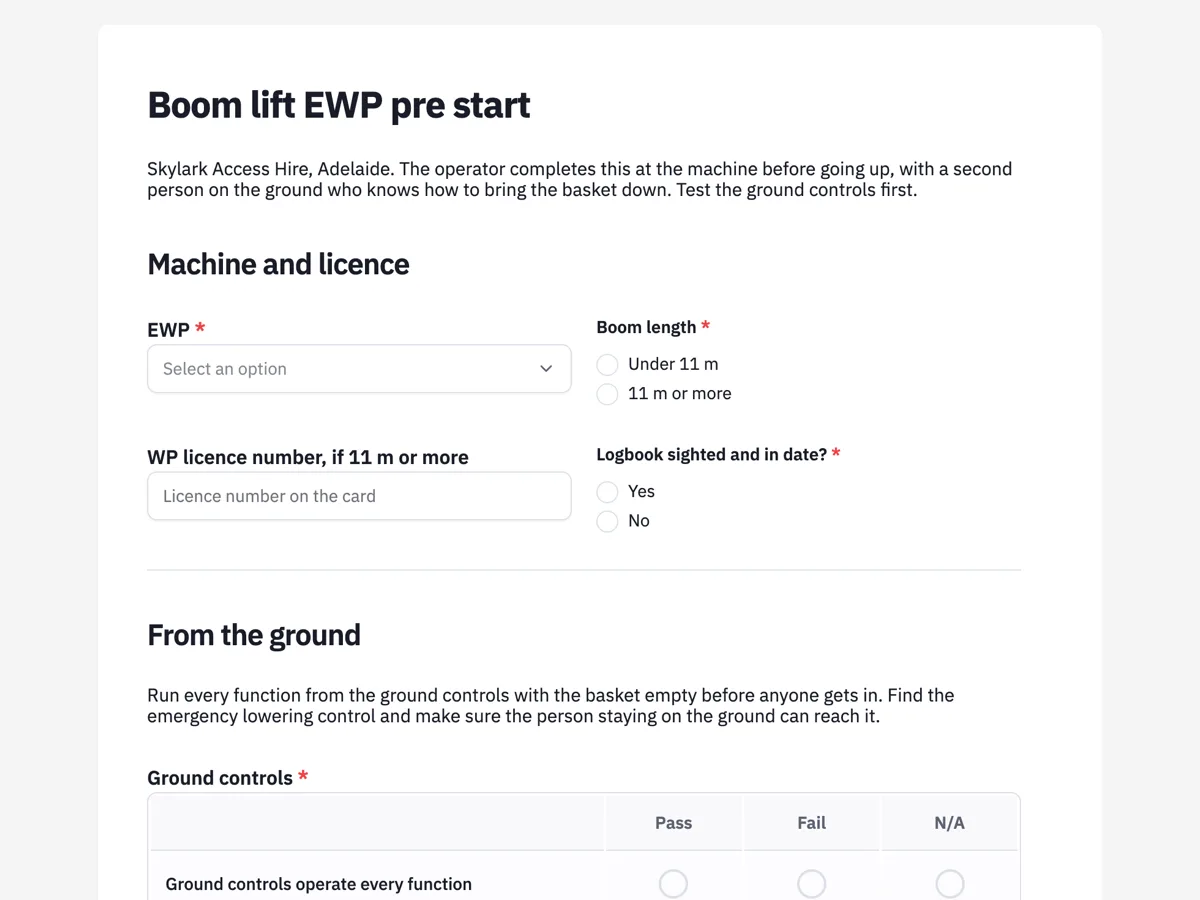
The form itself
A static copy of the finished form, exactly as it renders. Nothing here can be filled in or submitted, so read it as a reference and build your own from the button above.
Every field, and what it collects
The complete field list, in the order respondents meet it.
- EWPDropdownRequired
- Options: B-12 articulating boom, 12 m · B-16 telescopic boom, 16 m · B-09 trailer boom, 9 m
- Boom lengthSingle choiceRequired
- Options: Under 11 m · 11 m or more
- WP licence number, if 11 m or moreShort text
- Logbook sighted and in date?Single choiceRequired
- Options: Yes · No
- Ground controlsRating gridRequired
- Statements:
- Ground controls operate every function
- Emergency stop
- Emergency lowering
- Tilt alarm
- Outriggers or axle oscillation
- PlatformRating gridRequired
- Statements:
- Basket gate closes and latches
- Harness anchor point
- Platform controls
- Load limit plate legible
- Foot switch
- Harness and lanyard inspected and worn?Single choiceRequired
- Options: Yes, attached to the basket anchor · No, do not go up
- Rescue plan for todayLong textRequired
- Photo of a failed itemPhoto upload
- One clear photo of the control, gate or anchor that failed, with the boom stowed.
- EWP operator signatureSignatureRequired
Machine and licence
From the ground
In the basket
What each field on this form collects
The EWP comes from a list of three boom lifts, with the boom length as a single choice either side of 11 metres, the WP licence number and whether the logbook has been sighted. The ground controls grid has five rows: every function from the ground, emergency stop, emergency lowering, tilt alarm, and outriggers or axle oscillation. The platform grid has five: gate, harness anchor, platform controls, load limit plate and foot switch. A single choice confirms the harness and lanyard, a required text box takes the rescue plan, then a photo and the signature.
The 11 metre line and the licence
In Australia a boom type elevating work platform with a boom length of 11 metres or more needs a high risk work licence in the WP class. Under 11 metres, no licence class applies, but the operator still needs training and familiarisation on that model. The form asks the boom length first so the licence field means something. The logbook question follows because a boom lift is plant that has to be inspected and maintained to the manufacturer's schedule, and the logbook is where that history lives.
The rescue plan the pre start should name
WorkSafe Victoria has published an alert about a worker crushed in an EWP basket against an overhead structure. When that happens the operator cannot reach the controls, and the only way down is the person on the ground using the ground or emergency lowering controls. A rescue plan that exists only in a binder at the office does not help. The form makes the operator write today's plan in plain words: who lowers the basket, from where, and who calls emergency services. The thank you screen then tells them to brief that person before going up.
How to adapt this form
A crew using scissor lifts keeps the gate, controls and emergency lowering rows and drops the boom length and anchor questions, since a scissor lift moves vertically. A tree crew using a truck mounted boom adds outrigger pads and a row for overhead power lines. An electrician working near live conductors adds the approach distance and the spotter name.
What makes this form work
Ground controls before anyone gets in
The paragraph asks the operator to run every function from the ground with the basket empty. That proves the controls the ground person will need in a rescue actually work, before they are needed.
The rescue plan is required text
A required long text field asks who lowers the basket, from where and who calls 000. It turns a policy into a sentence the person on the ground can read today.
A No answer that says stop
The harness question has two answers, attached to the basket anchor, or no and do not go up. The form writes the decision into the option, so the record shows the operator chose to stay down.
Questions people ask
When do you need a WP licence for an EWP?
For a boom type elevating work platform with a boom of 11 metres or more, measured as the regulator defines it. Scissor lifts, vertical lifts and booms under 11 metres are outside the WP class, though the operator still needs training on that machine. Check the high risk work licence pages of your state regulator before relying on any machine size.
Do you need a harness in a boom lift?
Manufacturers and Australian guidance expect a harness with a short restraint lanyard attached to the basket anchor point in a boom type EWP, because a sudden jolt can throw the operator out. Scissor lifts are usually treated differently. Follow the manufacturer manual and your site rules for the machine in use.
What is in an EWP rescue plan?
Who stays on the ground, where the ground and emergency lowering controls are, how the basket is brought down if the operator cannot move, and who calls emergency services. For work near structures, it also covers how a crushed operator is freed. Write it for the actual machine and site, not a generic page.
How often is the EWP logbook checked?
At every pre start, to confirm the periodic and annual inspections are current. A hire company usually stamps the logbook before each hire. If the logbook is missing or overdue, answer No to that question and call the hire desk before using the machine.
Can the ground person complete this form instead?
The operator should complete it, because they are the one relying on the checks. Some crews have the ground person sign the rescue plan separately. This form has one signature; adding a second signature field for the ground person takes a moment in the builder.
Build your own in about a minute
The button below opens the generator with this use case already described. Change the wording to match your own, generate, then edit anything you like.
Make one like thisOther form examples
Skid steer pre start checklist built around the seat bar
A skid steer pre start checklist covers the operator station, the coupler, tyres or tracks, fluids and lights before the machine moves off the trailer. The check that decides everything on a skid steer is the seat bar interlock, so this form puts it first and explains how to test it.
Generator pre start checklist with the RCD test
A generator pre start checklist confirms the RCD trips, the earthing decision is followed, leads are tagged and the exhaust points away from people before anything is plugged in. This event hire version records the time of the RCD test and a photo of where the unit sits.
Tractor pre start checklist for rollover and PTO risks
A tractor pre start checklist confirms the rollover protection, seatbelt, PTO guarding, linkage, tyres, brakes and fluids before the tractor leaves the shed. This one is built for an orchard, with the implement recorded and the two checks that prevent most tractor deaths placed at the top.
Want the steps in the builder? Read Build grids, text and signature fields, then Print a check for the logbook. For everything this generator can do, see the form maker.
Written and checked by the OneCraft team. Last checked .