Classic form
Daily vehicle inspection checklist with 20 items
A vehicle inspection checklist walks the driver around the car and then inside it: tyres, wheels, lights, glass, wipers, mirrors, horn, seatbelts, brakes, warning lights, fluids, body, doors and safety kit. This fleet version marks each of 20 items OK or Fault and ends with a plain safe to drive question.
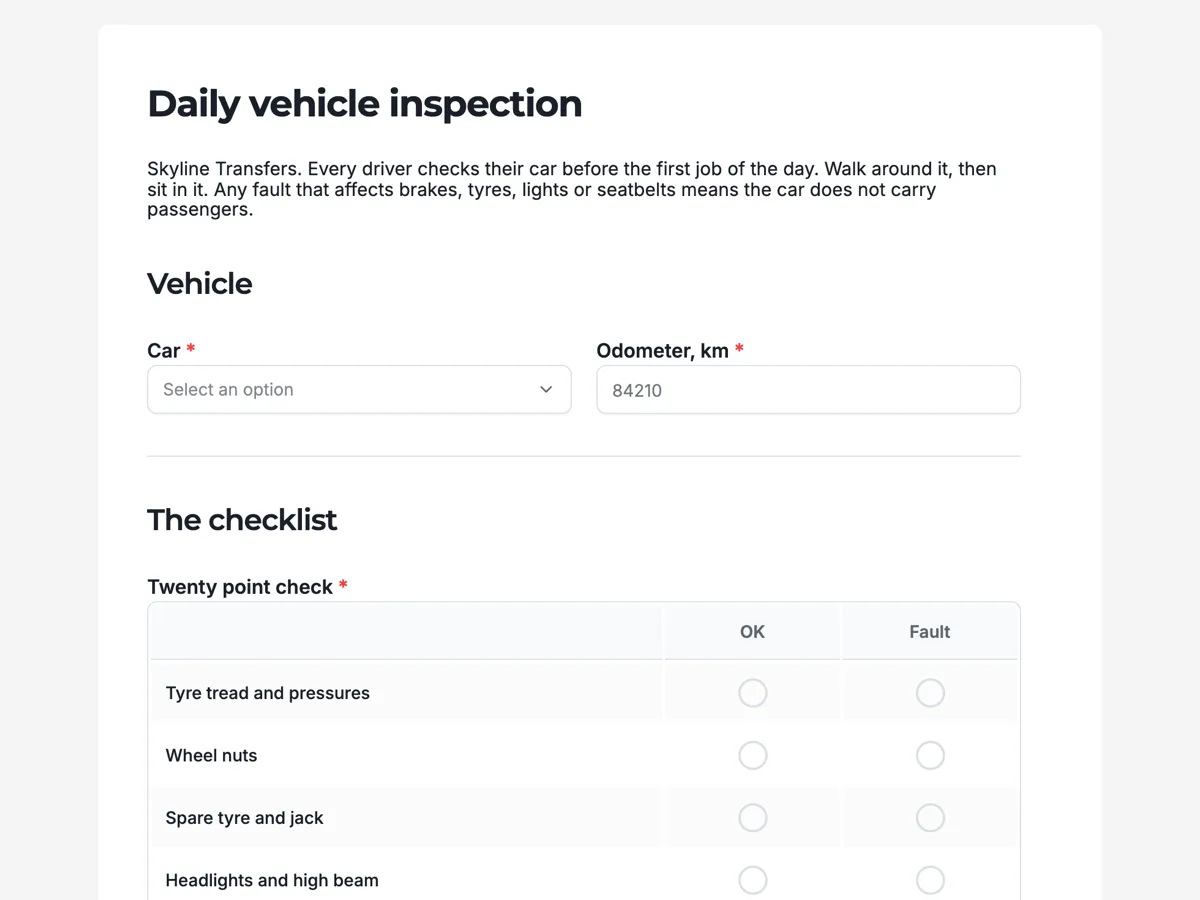
The form itself
A static copy of the finished form, exactly as it renders. Nothing here can be filled in or submitted, so read it as a reference and build your own from the button above.
Every field, and what it collects
The complete field list, in the order respondents meet it.
- CarDropdownRequired
- Options: SK-01 sedan · SK-02 sedan · SK-05 SUV · SK-08 people mover · SK-11 minibus
- Odometer, kmNumberRequired
- Twenty point checkRating gridRequired
- Statements:
- Tyre tread and pressures
- Wheel nuts
- Spare tyre and jack
- Headlights and high beam
- Indicators and hazard lights
- Brake lights
- Windscreen free of cracks
- Wipers and washer fluid
- Mirrors
- Horn
- Seatbelts in every seat
- Brakes feel firm
- Dashboard warning lights off
- Engine oil level
- Coolant level
- No fluid leaks under the car
- Body damage since yesterday
- Doors and child locks
- Interior clean for passengers
- First aid kit and fire extinguisher
- Fault detailsLong text
- Photos of any fault or new damageFile upload
- Up to four photos. Photograph new body damage before the first job so it is not blamed on today.
- Is the car safe to drive today?Single choiceRequired
- Options: Yes · No, keys left with dispatch
- Driver signatureSignatureRequired
Vehicle
The checklist
What each field on this form collects
The car comes from a fleet list of five with the odometer reading beside it. The main field is a matrix of twenty items answered OK or Fault, ordered as a driver moves: tyres and wheels, then lights, glass and mirrors, then the cabin, brakes and dashboard, then fluids and leaks, body and doors, and finally the interior and safety kit. A long text holds fault details, an upload takes up to four photos, and a required question asks whether the car is safe to drive before the driver signs.
Two columns instead of three
Most checklists offer Pass, Fail and N/A. A passenger car fleet does not need N/A: every car has tyres, lights and seatbelts, so the matrix uses OK and Fault only. Fewer columns make a twenty row grid faster to complete on a phone at 5 am. The judgment that matters is left to the last question. Some faults, such as low washer fluid, are fixed on the spot; others, such as a brake warning light, take the car off the road, and the intro lists which systems count.
Photograph damage before the first job
The upload description asks for photos of new damage before the first job, so a scratch from the car park overnight is not blamed on the driver of the day. Odometer readings support the same record: together with the time stamp on each submission, they show how far each car went between checks. For a business whose staff drive for work, WorkSafe Victoria's guidance on work related driving treats vehicle condition as part of managing the risk, and a daily check is the simplest evidence of it.
How to adapt this form
A trades business adds the roof racks, the load restraints and the tool storage. A heavy vehicle operator uses its regulator's daily check items instead, which cover air brakes, couplings and load. A community transport service adds the wheelchair hoist and restraints, checked before each passenger run.
What makes this form work
Ordered as the driver walks
The twenty rows follow a path around and into the car. The driver never has to jump between the boot and the dashboard, which keeps the check quick and complete.
Two answers per row
OK or Fault, with no N/A, because every passenger car has every item. A narrower grid is faster on a phone and leaves no room for a vague answer.
One clear decision
Safe to drive today, yes or no with the keys left at dispatch. The record shows the decision the driver made, not just a list of ticks.
Questions people ask
What should a daily vehicle inspection include?
Tyres and wheels, lights and indicators, windscreen, wipers and mirrors, horn, seatbelts, brakes, dashboard warnings, fluids and leaks, body damage, doors and the safety kit. Heavy vehicles add items set by their regulator. Write the items in the order a driver walks around the vehicle.
How long should a vehicle inspection take?
For a passenger car, about five minutes once the driver knows the routine. A checklist that takes much longer usually gets skipped. That is why this one has twenty rows with two answers each and only one required text box.
What faults make a car unsafe to drive?
Anything affecting braking, steering, tyres, lights or seatbelts, a cracked windscreen in the driver's view, and dashboard warnings for brakes, airbags or oil pressure. Your fleet policy and local road rules decide the list. The intro on this form names the systems this fleet treats as stop items.
Who reviews the inspections?
The fleet manager reads the responses each afternoon and books repairs. The email alert add-on can send each inspection to one address as it arrives. Because a matrix exports to CSV as one column of item and answer pairs, searching that column for Fault finds every car that needs work.
Should drivers photograph the car every day?
Only when there is a fault or new damage. Daily photos of an undamaged car fill storage without adding much. A photo of new damage before the first job protects the driver of the day and starts the repair record for fleet.
Can the checklist be used for hire cars?
Yes, with a few changes: add the hire agreement number and a fuel level, and photograph all four sides at pick up and return whether or not there is damage. Those photos are what settle disputes over damage at the end of a hire.
Build your own in about a minute
The button below opens the generator with this use case already described. Change the wording to match your own, generate, then edit anything you like.
Make one like thisOther form examples
Vehicle accident report form for a company fleet
A vehicle accident report form records the company vehicle and driver, when and where it happened, the other parties and their insurers, whether police attended and anyone was hurt, and the damage with photos. This fleet version also takes a hand drawn sketch of the scene, which insurers ask for more often than anything else.
Security incident report form for event security
A security incident report form records what kind of incident it was, when and where, who was involved, what happened in order, whether police came and anyone was hurt, and where the CCTV is. This event security version also takes photos and the attending officer's signature.
Equipment fault report form for a machine shop
An equipment fault report form tells maintenance which machine is faulty, what is wrong, when it was noticed, how long it has been down, who was running it, whether it is isolated and how urgent it is. This machine shop version adds a photo and sends each report on to the maintenance system.
Want the steps in the builder? Read A two column matrix of OK and Fault, then Review the fleet's checks. For everything this generator can do, see the form maker.
Written and checked by the OneCraft team. Last checked .