Contract clause
Casual conversion clause under the employee choice pathway
A casual conversion clause tells a casual employee how they can move to permanent full time or part time employment. Since 26 August 2024 the Fair Work Act's employee choice pathway lets an eligible casual notify the employer in writing, and the employer must consult and reply within 21 days.
Australia replaced the old casual conversion rules with the employee choice pathway on 26 August 2024. A casual with at least 6 months' employment, or 12 months with a small business, who believes they no longer fit the casual definition can give written notice to become permanent, and the employer can refuse only on limited grounds.
Nuwan Madhusanka · Co-founder
3 min read · Published
Sample clause
Written for casual employment agreement for a barista at Harbour Street Cafe, a fictional cafe in Wollongong NSW, a business with fewer than 15 employees.
Changing from Casual to Permanent. (a) Where the Employee has been employed for at least 12 months and believes they no longer meet the definition of a casual employee in the Fair Work Act 2009, they may give the Employer written notice that they wish to change to full time or part time employment. (b) Before responding, the Employer will discuss the notice with the Employee, including whether the change would be to full time or part time employment, the proposed hours and when the change would start. (c) The Employer will respond in writing within 21 days, either accepting the change with those details, or not accepting it and giving its reasons. (d) The Employer may refuse only if the Employee still meets the casual definition or there are fair and reasonable operational grounds, such as substantial changes to how work is organised. (e) The Employee will not be dismissed, or have their hours reduced, to avoid this pathway.
Sample wording, not legal advice.
Variants
Employer other than a small business
Employers with 15 or more employees, where the eligibility period is 6 months rather than 12.
The Employee may give notice under the employee choice pathway once they have been employed for at least 6 months, and every 6 months after a notice is not accepted.
Offer of permanent work by agreement
Any time both sides agree, without waiting for the pathway's eligibility period.
The Employer and the Employee may at any time agree in writing that the Employee will become a part time employee on the pattern of hours set out in the agreement.
Award provisions
Awards and agreements may carry their own terms that work alongside the NES pathway.
Nothing in this clause limits any right the Employee has under the Award to request or be offered conversion to permanent employment.
What to negotiate
The casual definition comes first
Since August 2024, a person is a casual employee only if there is no firm advance commitment to continuing and indefinite work, judged on the real substance of the relationship, including regular patterns of work, and they are entitled to a casual loading. A casual whose work has become regular and predictable may no longer meet the definition, which is what opens the pathway.
Fair and reasonable operational grounds
The Fair Work Ombudsman lists the grounds an employer may rely on: substantial changes to how work is organised, significant impacts on the business, or changes to the employee's hours that would be needed to accommodate the employee. Cost alone is a weak ground. The reasons must be in the written response.
Disputes and protection
If the employee disagrees with the refusal, the dispute can go through the award's dispute procedure and then to the Fair Work Commission. The Act also protects employees from adverse action for exercising the right, so reducing shifts after a notice is a serious risk for an employer.
The risk of leaving it out
A casual agreement that says nothing about conversion still leaves the employee with the NES right, but staff may not know it and employers may respond late or without reasons. Mishandling a notice, or cutting a casual's hours after one, invites disputes, adverse action claims and penalties under the Fair Work Act.
Who can use the pathway
The Fair Work Ombudsman explains that a casual can notify their employer in writing of their intention to change to permanent employment if they have been employed for at least 6 months, or 12 months if employed by a small business, and believe they no longer meet the definition of a casual employee. A small business employer has fewer than 15 employees. Casuals employed before 26 August 2024 have transitional rules for their first notice. Law checked on 21 October 2026. This page explains how the law works and is not legal advice.
The 21 day reply
Before responding, the employer must consult the employee about what would change, including full or part time status, hours and the start date. It must reply in writing within 21 days of the notice, either accepting with those details or refusing with reasons. If it accepts, the change takes effect on the agreed date, usually the start of the next full pay period. The casual employment example sets out this process in its own clause.
Casual Employment Information Statement
Employers must give casual employees the Casual Employment Information Statement when they start, and employers other than small businesses must give it again at set points in the employment. The statement explains the casual definition and the employee choice pathway. A contract clause that summarises the pathway, as the sample does, reinforces the statement rather than replacing it.
Where the clause sits in a generated document
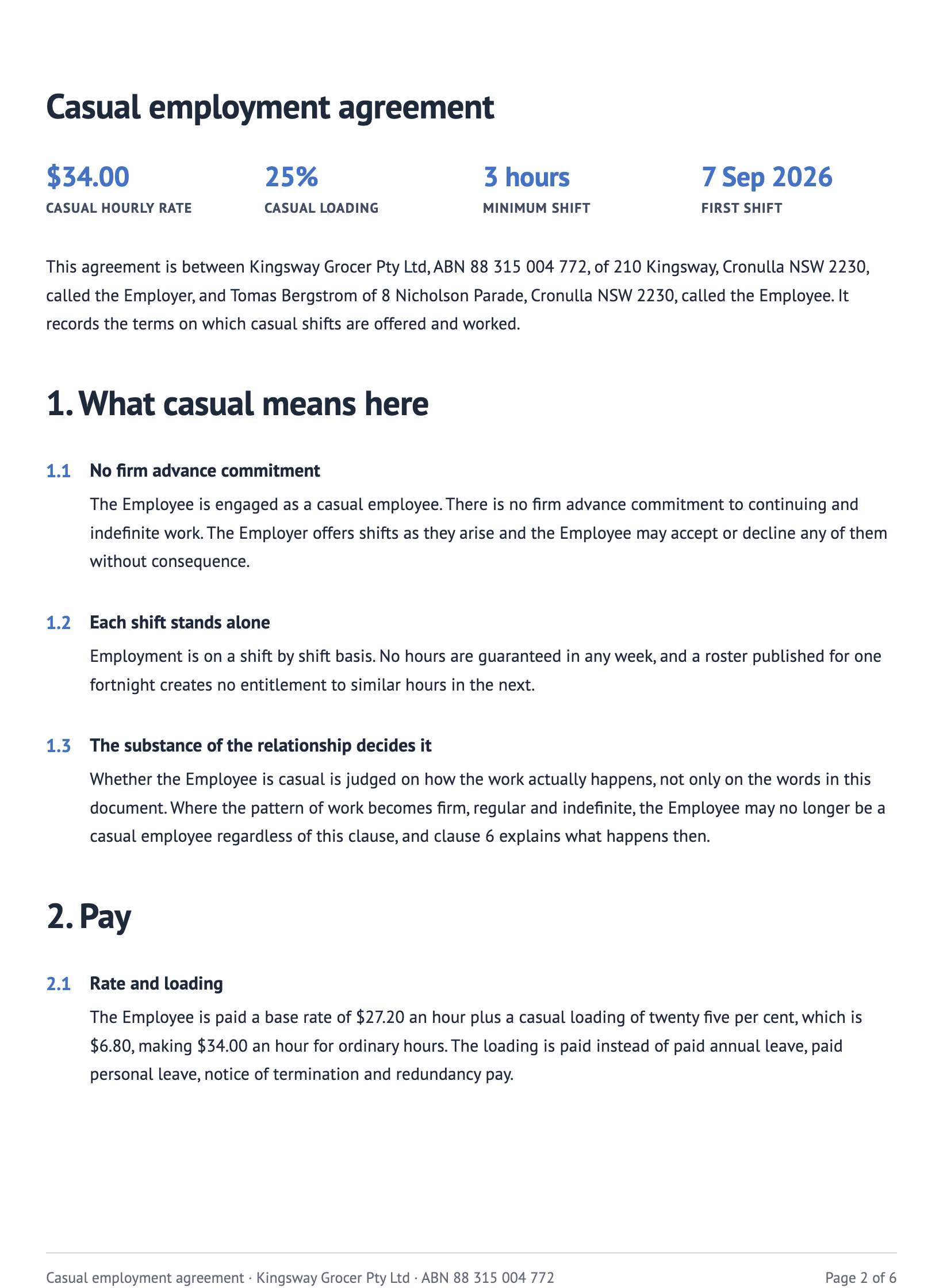
Casual employment agreements carry this clause after pay and loading. When asking the AI document generator for one, say whether the employer is a small business, so the 6 or 12 month period is right, and ask for the consultation, 21 day reply, refusal grounds and no reduction of hours terms.
Documents that carry this clause
Questions people ask
What replaced casual conversion in Australia?
The employee choice pathway, from 26 August 2024. Instead of employers offering conversion, an eligible casual who believes they no longer meet the casual definition gives written notice, and the employer consults and replies within 21 days, accepting or refusing on limited grounds.
When can a casual ask to become permanent?
After at least 6 months of employment, or 12 months if the employer is a small business with fewer than 15 employees, and only if the employee believes they no longer meet the casual definition. After a refusal, they can give another notice after a further 6 months.
Can my employer refuse my notice?
Only if you still meet the definition of a casual employee, or there are fair and reasonable operational grounds, such as substantial changes to how work is organised or significant impacts on the business. The refusal must be in writing with reasons within 21 days.
Do I lose my casual loading if I convert?
Yes. A permanent employee does not get the casual loading, but gains paid annual leave, paid personal leave, notice of termination and redundancy pay. Whether that is better depends on your hours and how much you value paid leave. Compare both before deciding.
Can my employer cut my shifts after I give notice?
Reducing hours or ending employment to avoid the pathway, or because you used it, can be adverse action under the Fair Work Act. The employee can bring a general protections claim, and penalties can apply to the employer. Keep records of rosters.
Put the clause in a finished document
The button opens the document generator with a starting description already filled in. Change it to match your own agreement before you run it.
Create a document with OneCraftRelated clauses
- Fixed term clause for an Australian employment contractFixed term clause sample for Australian employment contracts: start and end dates, the reason for the term, early ending, and the 2 year and one renewal limits.
- Secondment clause: sample for a three party secondmentSecondment clause sample for a three party secondment: who employs and pays, who directs the work, safety duties, confidentiality, IP, recall and the return.
- Probation period clause in an employment contractA probation period clause sets a trial period, a review and the notice during it. Australian sample wording, extension rules and the minimum employment period.
- Remuneration clause: the pay terms in an employment contractA remuneration clause sets what an employee is paid, how often and what the figure includes. Australian sample wording, package and hourly variants.
For everything the document generator can do, see the document maker.
Step by step in the builder: Create a document with AI, then Document builder components.
Written and checked by the OneCraft team. Last checked .