Contract clause
Change of control provision: when the other party is taken over
A change of control provision gives a party rights, such as to terminate or to require consent, when the other party comes under the control of someone new, for example after a takeover. The contracting company stays the same, so without the clause the contract simply continues with the new owner behind it.
Selling a company does not assign its contracts; the company is still the party. That is exactly why customers, suppliers and joint venture partners write change of control clauses: they want a say if a competitor ends up owning the business they deal with.
Indunil Asanka · Co-founder
3 min read · Published
Sample clause
Written for a reseller agreement between Tidewell Systems, a fictional software vendor, and a regional reseller that distributes its products.
Change of Control. (a) A Change of Control of a party occurs when any person, alone or with its associates, acquires: (i) more than 50% of the voting shares in that party or in any company that controls it; or (ii) the power to appoint or remove a majority of that party's board. (b) A party must notify the other in writing within 10 business days after a Change of Control. (c) Within 60 days after receiving that notice, the other party may terminate this agreement by giving 30 days' written notice. (d) A Change of Control does not include a transfer within the same corporate group, or a change in the holders of shares in a company listed on a recognised stock exchange unless a person acquires control as defined in paragraph (a).
Sample wording, not legal advice.
Variants
Consent required
Contracts where the identity of the owner is critical, such as exclusive distribution or joint ventures.
A party must not undergo a Change of Control without the prior written consent of the other party, which may be withheld if the proposed controller is a competitor of the other party.
Termination right
Most commercial contracts, where the other party needs an exit if the new owner is unwelcome.
If a party undergoes a Change of Control, the other party may terminate this agreement by giving at least 30 days' written notice within 60 days after becoming aware of the Change of Control.
Notice only
Contracts where the parties need to know about a change but do not want it to put the contract at risk.
Each party must notify the other in writing within 10 business days after it undergoes a Change of Control, giving the identity of the new controller. A Change of Control does not otherwise affect this agreement.
What to negotiate
The threshold
More than 50% of voting shares is the common test, but control can be acquired with less, through board appointment rights or a shareholders' agreement. Definitions often add board control, as the sample does. Australia's Corporations Act has its own concept of control, including practical influence over financial and operating policies, which some contracts adopt.
Listed company carve outs
Shares in listed companies change hands every day, so a clause triggered by any transfer would be unworkable. Listed parties usually exclude ordinary trading and limit the trigger to someone actually gaining control, which in Australia often coincides with the takeover thresholds in the Corporations Act.
Intra group transfers
A group restructure, moving a subsidiary under a different parent within the same group, changes the immediate holder but not the ultimate owner. Parties usually exclude intra group transfers, sometimes only while the new holder stays in the group, so that an internal reorganisation does not hand the other party an exit.
The risk of leaving it out
Without a change of control provision, a contract continues automatically when the other party is sold, even to a competitor of yours, because no assignment occurs. A business can find its key supplier, distributor or software provider owned by a rival with no right to leave. For sellers, these clauses in their customer contracts are a key due diligence issue.
Defining control
Three common definitions. Voting control: holding more than 50% of voting rights, directly or through intermediate companies. Board control: the power to appoint or remove a majority of directors, which can exist with a minority shareholding. Economic or practical control: the capacity to determine financial and operating policies, as in section 50AA of the Corporations Act 2001, which looks at practical influence rather than formal rights. The sample combines voting and board control, which covers most acquisitions without the uncertainty of a practical influence test. Law checked on 21 October 2026. This page explains how the clause works and is not legal advice.
Change of control and assignment
An assignment transfers the contract from one party to another. A change of control leaves the contract with the same party, while ownership of that party changes. An assignment clause therefore does not catch a share sale, which is why separate change of control wording is needed. Some contracts deem a change of control to be an assignment, which brings the assignment restrictions into play; that is a drafting choice, not the default.
A due diligence checklist
For a buyer of a company, check: which contracts contain change of control provisions; what each one does, whether consent, termination or notice; the definition of control and whether the proposed deal triggers it; deadlines for notice; whether the counterparty is likely to use the right; and the revenue at risk. Material contracts with consent requirements may need consents as conditions precedent to completion, and the purchase price may reflect the risk of losing contracts after the sale.
Takeovers and public companies
In Australia, acquisitions of more than 20% of a listed company are regulated by Chapter 6 of the Corporations Act, and ASIC and the Takeovers Panel oversee them. In the UK, the Takeover Code governs offers for public companies. Change of control clauses in a target's material contracts can affect a takeover and are usually disclosed in the bidder's and target's documents.
Documents that carry this clause
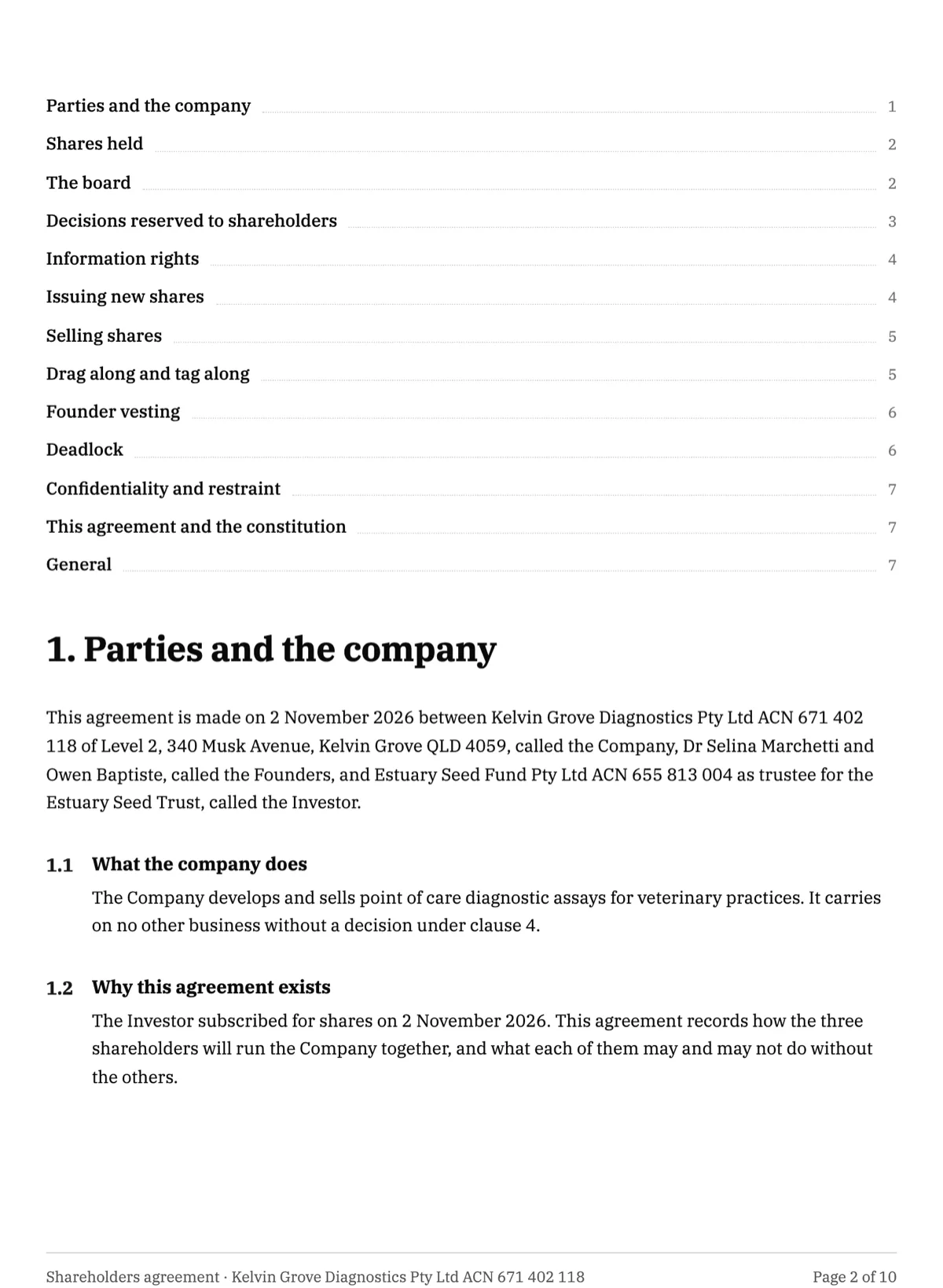 Shareholders agreement template for a company after a seed roundA shareholders agreement template sets out who owns what, who sits on the board, which decisions need shareholder consent, how shares are sold, and how a deadlock ends. This one is filled in for a Queensland veterinary diagnostics company that has just taken $1.5 million from one seed fund, leaving the two founders with 80 per cent between them. Its central number is an 85 per cent consent threshold for eight reserved matters, and the page below shows what that number does and does not protect.
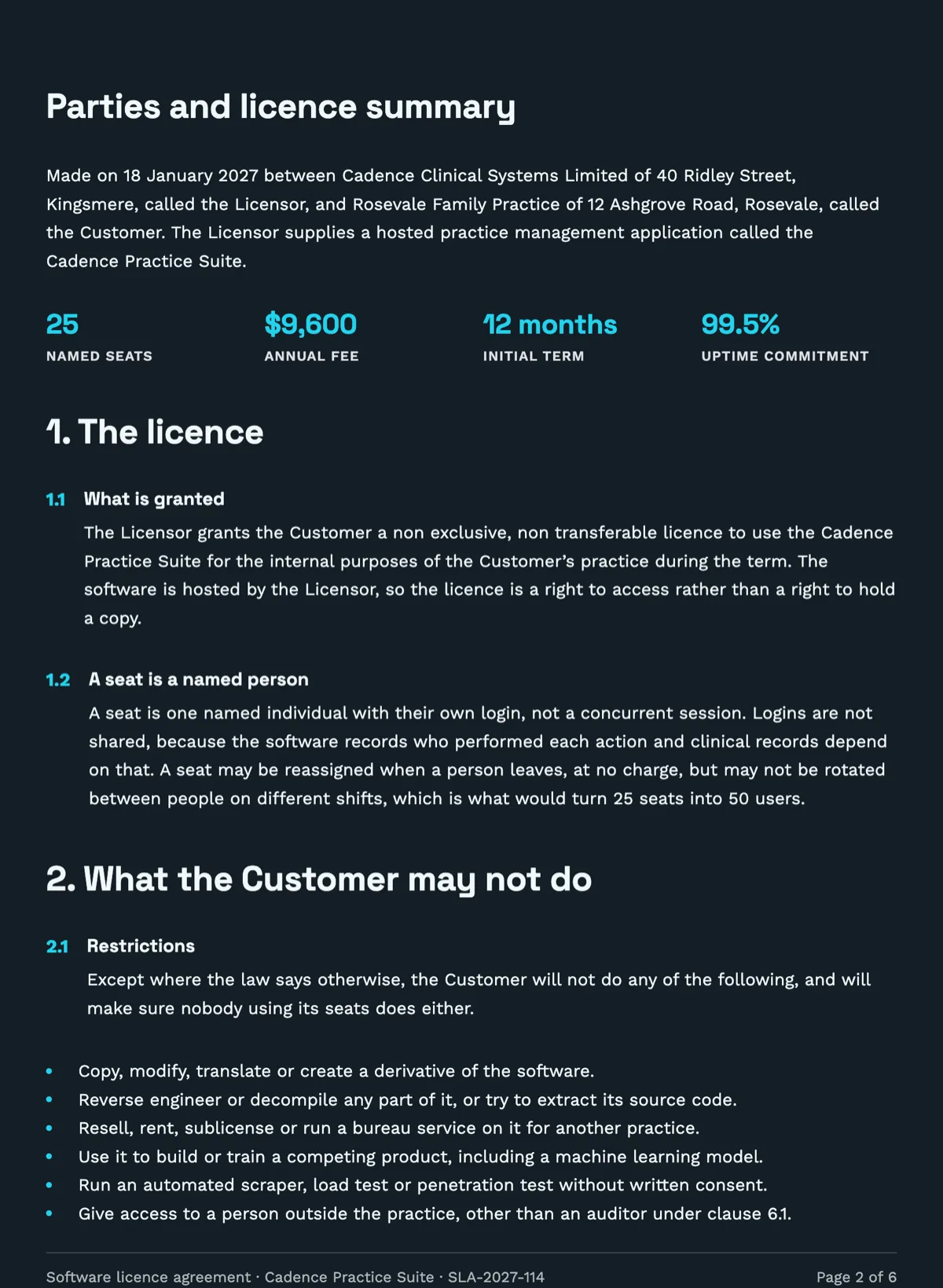 Software licence agreement template with seats, term and supportA software licence agreement has to answer three questions before anything else: what a seat is, what happens when the software is down, and who gets the data at the end. This one licenses a hosted practice management suite to a medical practice for 25 named users at $9,600 a year, with a support table, uptime credits and a 30 day export.
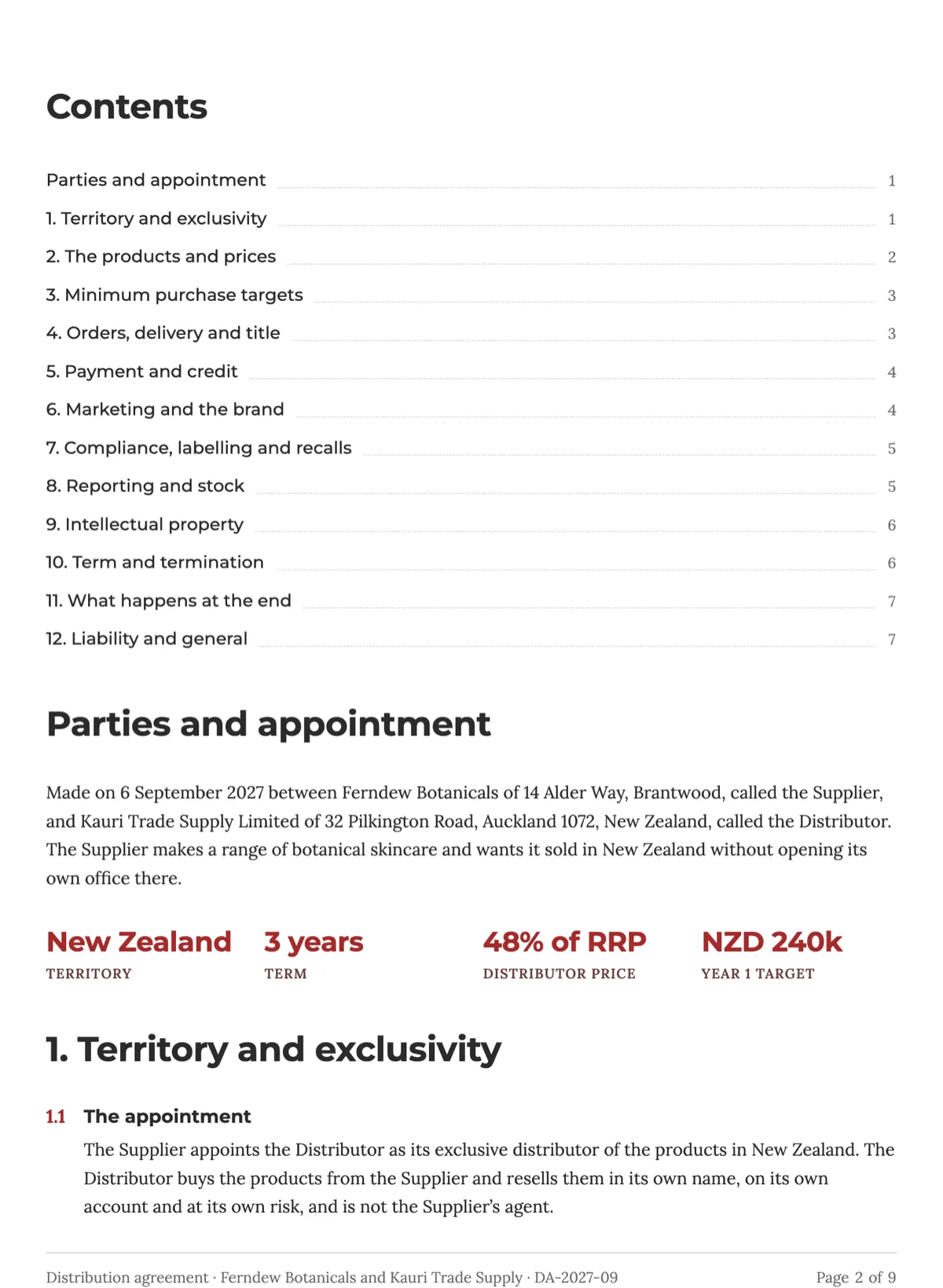 Distribution agreement template with territory and targetsAn exclusive distribution agreement is a trade: a territory in exchange for volume. This one appoints a New Zealand distributor for a skincare range at 48 per cent of recommended retail, with purchase targets rising from NZD 240,000 to NZD 420,000 across three years, and exclusivity that converts to non exclusive if a target is missed by more than 15 per cent.
Questions people ask
What counts as a change of control?
Whatever the clause defines, most often someone acquiring more than 50% of the voting shares, or the power to appoint a majority of the board, directly or through a parent company. Some clauses use broader tests of practical control. Transfers within a corporate group are often excluded.
Is a change of control an assignment?
Not ordinarily. The contracting company remains the same party; only its ownership changes. That is why an assignment clause does not, by itself, catch a share sale. A contract can say a change of control is treated as an assignment, which then applies the assignment restrictions.
Can a change of control clause stop a sale?
It cannot stop the sale of shares between the shareholders and the buyer, but it can make the sale less attractive if key contracts can be terminated, or require consents before completion. Buyers often make consents from important counterparties a condition of the deal.
Does an IPO trigger a change of control?
Usually not, unless someone acquires control through it. Many clauses exclude public listings and trading in listed shares, focusing on a person gaining control. Check the definition, because a broadly drafted clause may be triggered by a significant restructure before listing.
How long does a party have to act on a change of control?
As long as the clause allows, commonly 30 to 90 days from notice or from becoming aware of the change. After that, the right usually lapses. Notice obligations help start the clock, so the other party cannot sit on a termination right indefinitely.
Put the clause in a finished document
The button opens the document generator with a starting description already filled in. Change it to match your own agreement before you run it.
Create a document with OneCraftRelated clauses
- Assignment clause: who else may step into the contract's benefitsAn assignment clause controls whether a party can transfer its rights under a contract. Sample consent wording, a change of control trigger and three variants.
- Drag along clause: making minority shareholders join a saleA drag along clause lets majority shareholders make minorities join a sale of the company. Sample wording with a 75 percent threshold, protections and variants.
- Tag along clause: letting minority shareholders join a saleA tag along clause lets minority shareholders join a sale on the same terms as the seller. Sample wording with a 25 percent trigger, pro rata tag and variants.
- Termination for convenience clause: exiting on notice at a known priceA termination for convenience clause lets a party end a contract on notice with no breach. Sample retainer wording, mutual and one sided versions, exit costs.
For everything the document generator can do, see the document maker.
Step by step in the builder: Create a document with AI, then Document builder components.
Written and checked by the OneCraft team. Last checked .