Contract clause
Class action waiver clause: individual claims only
A class action waiver clause requires each customer or employee to bring claims individually, usually in arbitration, and not as part of a class or collective action. In the United States, the Supreme Court has held such waivers in arbitration agreements generally enforceable under the Federal Arbitration Act.
A single customer rarely sues over a $15 overcharge, but a class of a million customers might. A class action waiver, paired with arbitration, removes the class route, which is why it is one of the most consequential paragraphs in consumer terms of service.
Nuwan Madhusanka · Co-founder
3 min read · Published
Sample clause
Written for terms of service for Pinecone Meal Kits, a fictional US meal kit subscription company.
Arbitration and Class Action Waiver. (a) You and Pinecone agree that any dispute arising out of or relating to these Terms or your subscription will be resolved by binding individual arbitration under the Consumer Rules of the American Arbitration Association, except that either party may bring an individual claim in small claims court. (b) YOU AND PINECONE AGREE THAT EACH MAY BRING CLAIMS AGAINST THE OTHER ONLY IN AN INDIVIDUAL CAPACITY, AND NOT AS A PLAINTIFF OR CLASS MEMBER IN ANY CLASS, COLLECTIVE OR REPRESENTATIVE PROCEEDING. (c) Pinecone will pay all arbitration filing and arbitrator fees for claims under $10,000. (d) You may opt out of this section by emailing optout@example.com within 30 days after first accepting these Terms. (e) If paragraph (b) is found unenforceable for any claim, that claim will proceed in court and not in arbitration.
Sample wording, not legal advice.
Variants
Consumer waiver in arbitration
Subscription and online services, where arbitration with a class waiver is common in US consumer terms.
All disputes will be resolved by individual arbitration. You waive any right to participate in a class action or class wide arbitration, and the arbitrator may award relief only to you individually.
Employment waiver
US employers with arbitration agreements, following the Supreme Court's 2018 decision allowing employment class waivers.
The Employee and the Company agree to resolve covered claims only by individual arbitration, and waive any right to bring or join a class or collective action, to the fullest extent permitted by law, except claims that by law cannot be required to be arbitrated.
Waiver with an opt out
Businesses wanting a stronger argument that the waiver was voluntary.
You may reject this arbitration agreement and class action waiver by sending written notice within 30 days after you first agree to these Terms. Rejecting it will not affect any other part of these Terms or your use of the service.
What to negotiate
The Federal Arbitration Act
In AT&T Mobility v. Concepcion, decided in 2011, the Supreme Court held that the Federal Arbitration Act preempts state rules treating class waivers in consumer arbitration agreements as unconscionable. In Epic Systems v. Lewis, decided in 2018, it held that employment arbitration agreements with class waivers are enforceable despite the National Labor Relations Act. Those decisions make the waiver strong, but only when it sits inside an enforceable arbitration agreement.
California PAGA limits
California's Private Attorneys General Act lets employees bring representative claims for Labor Code penalties on behalf of the state. In Viking River Cruises v. Moriana, decided in 2022, the Supreme Court allowed individual PAGA claims to be compelled to arbitration, and the Supreme Court of California later held in Adolph v. Uber that the representative part can continue in court. Employers in California cannot fully eliminate representative PAGA claims through a waiver.
Mass arbitration fees
Because businesses usually pay arbitration fees, thousands of coordinated individual claims can produce large fee bills, a tactic known as mass arbitration. Businesses have responded with batching rules and provider rules for mass filings. Consumers and their lawyers have used the same tactic as leverage. Any waiver should be paired with fee terms that work at scale.
The risk of leaving it out
Without a class action waiver, a business with many customers faces the possibility of class litigation for small, widespread claims, with large potential damages and costs. With an aggressive waiver, it faces arguments that the arbitration agreement is unconscionable, regulatory scrutiny, and possible mass arbitration. The decision is a commercial one with legal limits.
The cases and the limits
AT&T Mobility v. Concepcion (2011): class waivers in consumer arbitration agreements enforceable; state unconscionability rules aimed at them are preempted. American Express v. Italian Colors (2013): a waiver enforceable even where individual claims would cost more than they recover. Epic Systems v. Lewis (2018): employment class waivers in arbitration enforceable. Viking River Cruises v. Moriana (2022): individual PAGA claims may be compelled to arbitration. Adolph v. Uber (California, 2023): non individual PAGA claims stay in court. And by federal statute since 2022, sexual assault and sexual harassment disputes cannot be forced into arbitration at the claimant's election. Law checked on 21 October 2026. This page explains how the clause works and is not legal advice.
Why the waiver needs arbitration
A class action waiver standing alone in a contract, without arbitration, has much weaker protection, because the Federal Arbitration Act is what preempts state rules against it. Courts in some states have refused to enforce stand alone class waivers in consumer contracts. That is why the sample sends disputes to arbitration and also provides that if the waiver fails for a claim, that claim goes to court rather than to class arbitration.
Opt outs and small claims
An opt out window, where a customer can reject arbitration by sending a notice, supports the argument that agreeing was voluntary. A small claims carve out lets either side use a fast, cheap court for small matters. Both are common features of consumer arbitration agreements and make them easier to defend.
Outside the United States
Australia and the UK treat these terms very differently. In Australia, terms restricting a consumer's or small business's ability to take legal action can be challenged under the unfair contract terms regime, and representative proceedings are available in the Federal Court. In the UK, the Consumer Rights Act 2015 assesses fairness, and collective actions exist in the Competition Appeal Tribunal. US style waivers should not be copied into terms governed by those laws without advice.
Documents that carry this clause
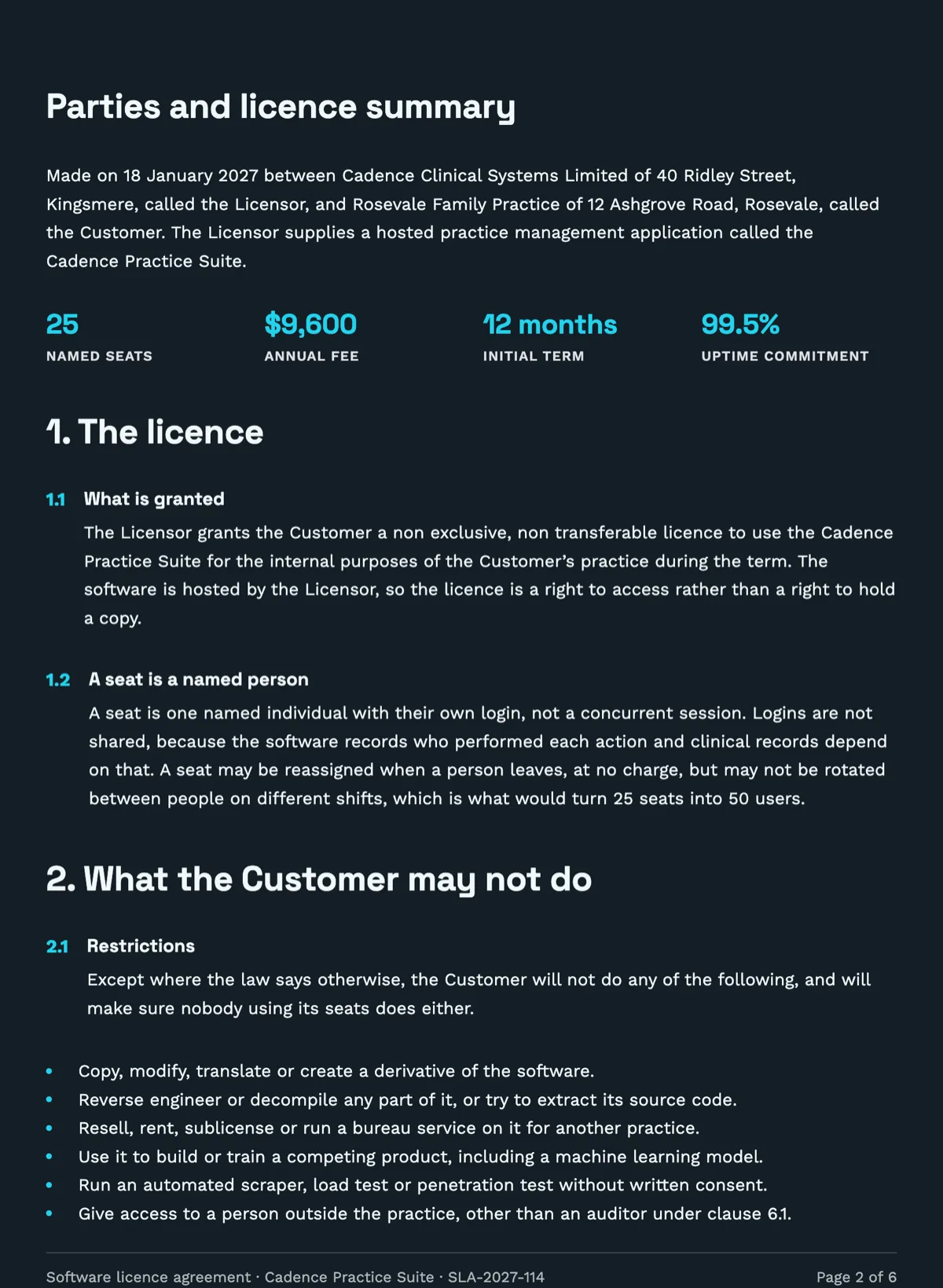 Software licence agreement template with seats, term and supportA software licence agreement has to answer three questions before anything else: what a seat is, what happens when the software is down, and who gets the data at the end. This one licenses a hosted practice management suite to a medical practice for 25 named users at $9,600 a year, with a support table, uptime credits and a 30 day export.
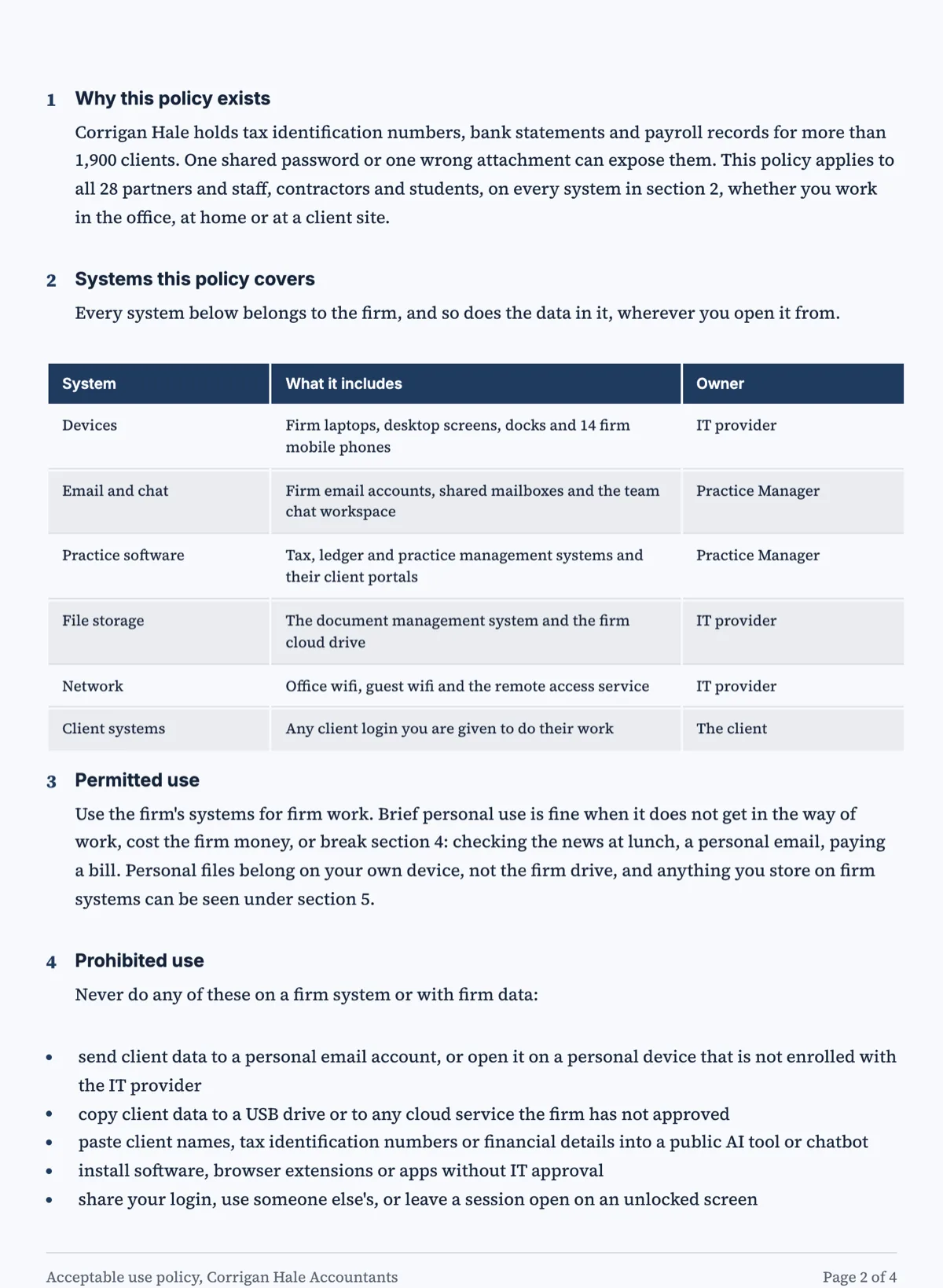 Acceptable use policy template with an honest monitoring noticeAn acceptable use policy has to say which systems it covers, what staff may and may not do with them, what the organisation monitors, and what happens when the rules are broken. This four page policy for a 28 person accounting firm holding records for 1,900 clients does that, with a monitoring table that says what is logged, for how long, and what is never watched.
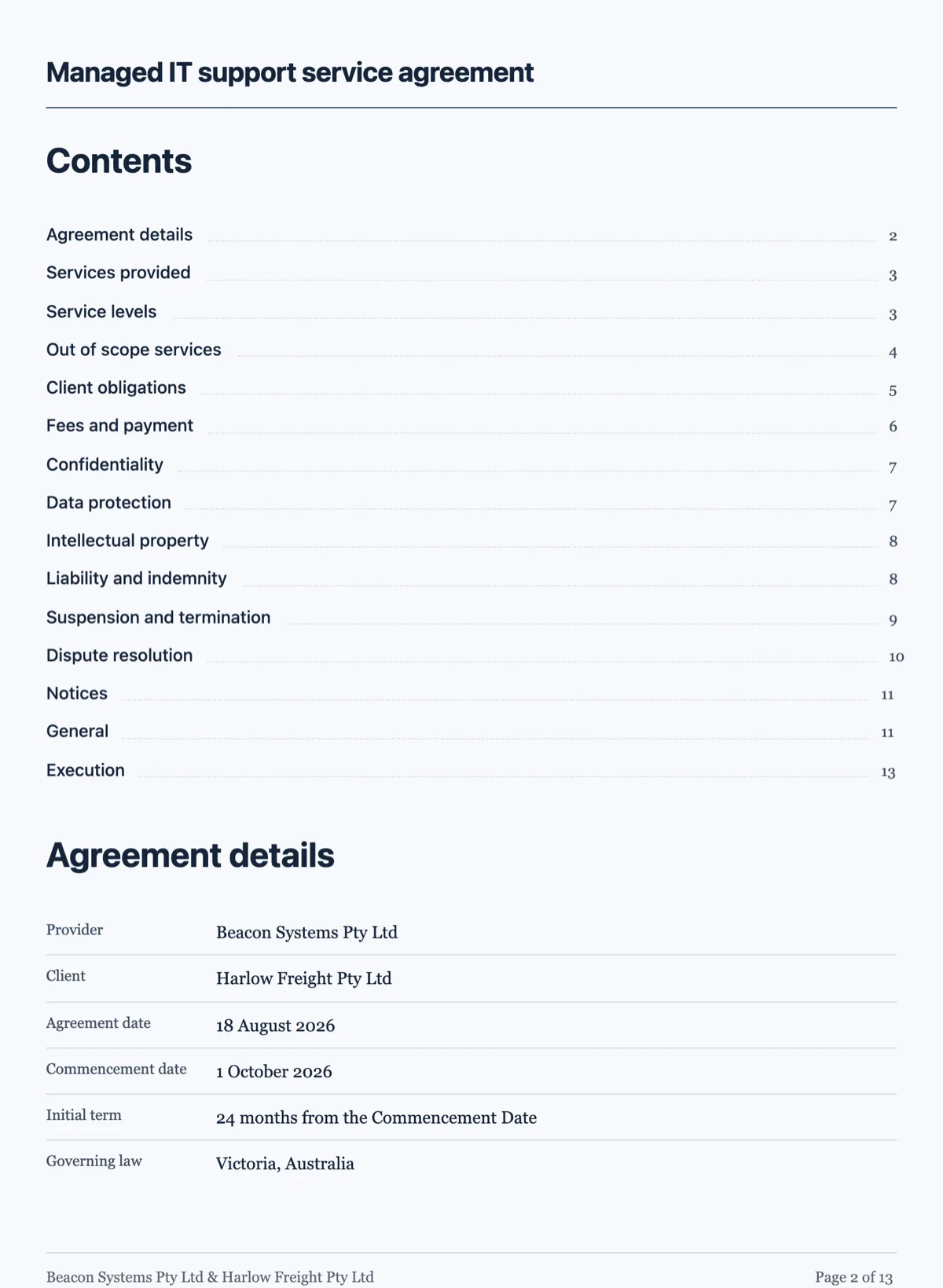 Service agreement template with scope, service levels and an exitA service agreement template has to say what is supplied, how well, for what fee, who is liable for what, and how either side gets out. This one is filled in for Beacon Systems supporting Harlow Freight's IT for an initial 24 months from 1 October 2026 at $8,400 a month plus GST, with 40 hours included and $220 an hour beyond them. Twelve numbered clauses cover the services, a four level severity table, client duties, fees with a CPI adjustment, confidentiality, privacy, IP, a liability cap, termination and a three step dispute ladder under Victorian law.
Questions people ask
Are class action waivers legal?
In the United States, generally yes when they are part of an enforceable arbitration agreement, following AT&T Mobility v. Concepcion and Epic Systems v. Lewis. There are limits, such as California representative PAGA claims and sexual harassment disputes. Outside the US, similar terms may be unfair or ineffective.
Can I opt out of a class action waiver?
Only if the terms give you an opt out, usually by sending a notice within a set period, often 30 days after first agreeing. If you opt out in time, the arbitration agreement and waiver do not apply to you. Without an opt out clause, you generally cannot remove it.
Do class action waivers apply to employees?
Yes, in arbitration agreements, after Epic Systems v. Lewis held that employment class and collective action waivers are enforceable. Some claims cannot be forced into arbitration, such as sexual assault and harassment disputes at the employee's election, and California representative PAGA claims partly remain in court.
What is mass arbitration?
It is when many individuals file separate arbitration claims at once against a business whose terms require individual arbitration and make the business pay the fees. The fee exposure can be large, which creates pressure to settle. Arbitration providers and businesses have adopted rules to manage mass filings.
Does a class action waiver stop government enforcement?
No. It binds the parties to the contract, not regulators. A government agency, such as a state attorney general or federal regulator, can still bring an enforcement action seeking relief for many consumers, regardless of what the consumer terms say.
Put the clause in a finished document
The button opens the document generator with a starting description already filled in. Change it to match your own agreement before you run it.
Create a document with OneCraftRelated clauses
- Arbitration clause: a private, binding decision instead of a courtAn arbitration clause sends disputes to a private arbitrator instead of a court. Sample wording with a Sydney seat, plus institutional, ad hoc and US variants.
- Jury waiver clause: giving up a jury trial before a disputeA jury waiver clause for an Atlanta equipment lease: a conspicuous, separately initialled waiver, why it uses capitals, and why California and Georgia refuse.
- Forum selection clause: choosing the court in a US contractA forum selection clause for a Delaware software licensor and a Texas customer: exclusive Wilmington venue, consent to jurisdiction, and how courts enforce it.
- Dispute resolution clause: the ladder before anyone goes to courtA dispute resolution clause sets the steps parties must take before suing. Sample three tier ladder with day counts, and negotiation, mediation and arbitration.
For everything the document generator can do, see the document maker.
Step by step in the builder: Create a document with AI, then Document builder components.
Written and checked by the OneCraft team. Last checked .