Contract clause
Conflict of interest clause: disclose, record and step back
A conflict of interest clause requires a person to disclose any personal interest, relationship or benefit that could influence, or appear to influence, their decisions for the business, and to stay out of decisions where the conflict arises. It applies to employees, contractors and board members.
A conflict of interest is not misconduct in itself; hiding one usually is. The clause turns a vague duty of loyalty into concrete steps: what to disclose, by when, to whom, and what to do next.
Indunil Asanka · Co-founder
3 min read · Published
Sample clause
Written for an employment contract between Greyfriars Property Group, a fictional Melbourne developer, and a project manager who approves subcontractor tenders.
Conflicts of Interest. (a) The Employee must disclose to the General Manager in writing, within 5 business days of becoming aware of it, any actual or potential conflict of interest, including: (i) any financial interest in a supplier, contractor or tenderer; (ii) any gift, hospitality or benefit offered by a supplier, contractor or tenderer worth more than $150; (iii) any family or close personal relationship with a person in a tenderer's business. (b) Once a conflict is disclosed, the Employee must not take part in any decision affected by it unless the General Manager approves in writing. (c) The Company will record each disclosure and the action taken in its conflicts register. (d) A failure to disclose may be treated as misconduct.
Sample wording, not legal advice.
Variants
Employee clause
Staff who buy, approve, hire or recommend, where interests in suppliers or candidates matter most.
The Employee must avoid any situation in which their personal interests conflict, or could reasonably be seen to conflict, with the interests of the Company, and must promptly disclose any such situation to their manager and follow the manager's directions about managing it.
Contractor clause
Consultants and contractors who may also work for the client's competitors or suppliers.
The Consultant must tell the Client in writing before accepting any engagement that would create a conflict with the Services, including work for a competitor or a party in a matter the Consultant is advising on, and must not accept it without the Client's consent.
Board member clause
Directors of companies and responsible persons of charities, who have statutory duties as well as contractual ones.
A Director who has a material personal interest in a matter that relates to the affairs of the Company must give the other Directors notice of the interest and, unless the other Directors resolve otherwise, must not be present while the matter is considered or vote on it.
What to negotiate
What must be disclosed
A clause that requires disclosure of anything that could affect judgment is broad, which is the point, but staff need examples to apply it. Listing financial interests, gifts above a set value, and family relationships, as the sample does, gives a workable starting point. Employees should ask whether the clause covers interests of family members, and whether small shareholdings in listed companies count.
The register
Disclosure only helps if someone records it and decides what to do. A conflicts register, kept by a named person, records the conflict, the date, the decision on managing it and who made the decision. Boards keep a register of interests for directors. The register is also evidence, if a decision is later questioned, that the conflict was managed rather than ignored.
Consequences
Most clauses make failure to disclose a disciplinary matter, and serious or deliberate failures can justify dismissal. Employers should apply the clause consistently, because selective enforcement weakens it. Employees should note the time limit for disclosure, since late disclosure can itself be a breach.
The risk of leaving it out
Without a clause, an employer relies on the general duty of fidelity and good faith, which is harder to apply to everyday situations such as gifts from a supplier or a relative tendering for work. Undisclosed conflicts in purchasing and hiring are a common route to fraud and favouritism, and are often discovered only after money has been lost.
The disclosure register
A simple register table carries six columns: date disclosed; person disclosing; nature of the interest, such as a 20% share in a tiling subcontractor; decisions affected, such as the bathroom package tender; action agreed, such as excluded from evaluation and approval; and approved by, with the date. For gifts, a separate gifts and benefits register with the value and whether it was accepted or declined is common. Reviewing the register at each tender or major purchase, rather than once a year, is what makes it useful. Law checked on 21 October 2026. This page explains how the clause works and is not legal advice.
Directors and charities
Company directors in Australia have statutory duties under the Corporations Act 2001, including the duty to disclose a material personal interest in a matter relating to the company's affairs under section 191, and duties not to improperly use their position or information. ASIC's guidance on directors' duties explains them. Charities registered with the ACNC must meet governance standard 5, which requires responsible persons to disclose and manage conflicts of interest. A board conflict clause should sit consistently with those duties.
Conflicts and outside work
A conflict of interest clause is about disclosure and decision making; a moonlighting clause controls whether an employee may work elsewhere at all. They overlap when outside work is for a supplier or competitor. Many employers keep both, with the moonlighting clause requiring consent for outside work and the conflict clause requiring disclosure of any interest the outside work creates.
A conflict of interest policy
Larger organisations put the detail, such as gift thresholds, examples and the approval process, in a policy and keep the contract clause short, referring to the policy. That allows the thresholds to be updated without changing every contract. The policy should still be provided to the employee, and the contract should say whether the policy forms part of it.
Documents that carry this clause
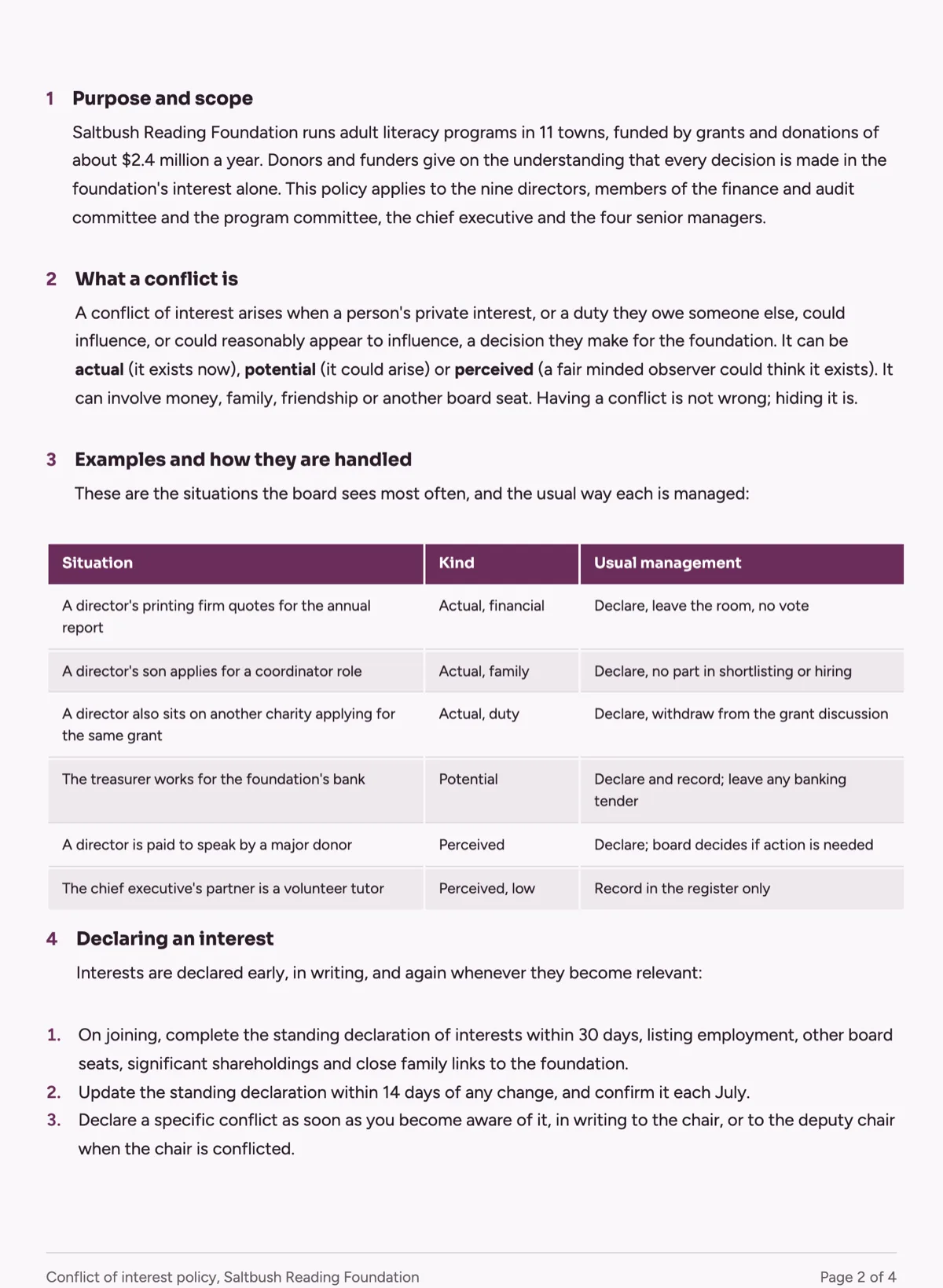 Conflict of interest policy template for a not for profit boardA conflict of interest policy has to help directors recognise a conflict, declare it early and know what happens next, so decisions stay in the organisation's interest and funders can see that they do. This four page policy for a literacy charity board does that with six worked examples, five declaration rules, five management options and a register of interests.
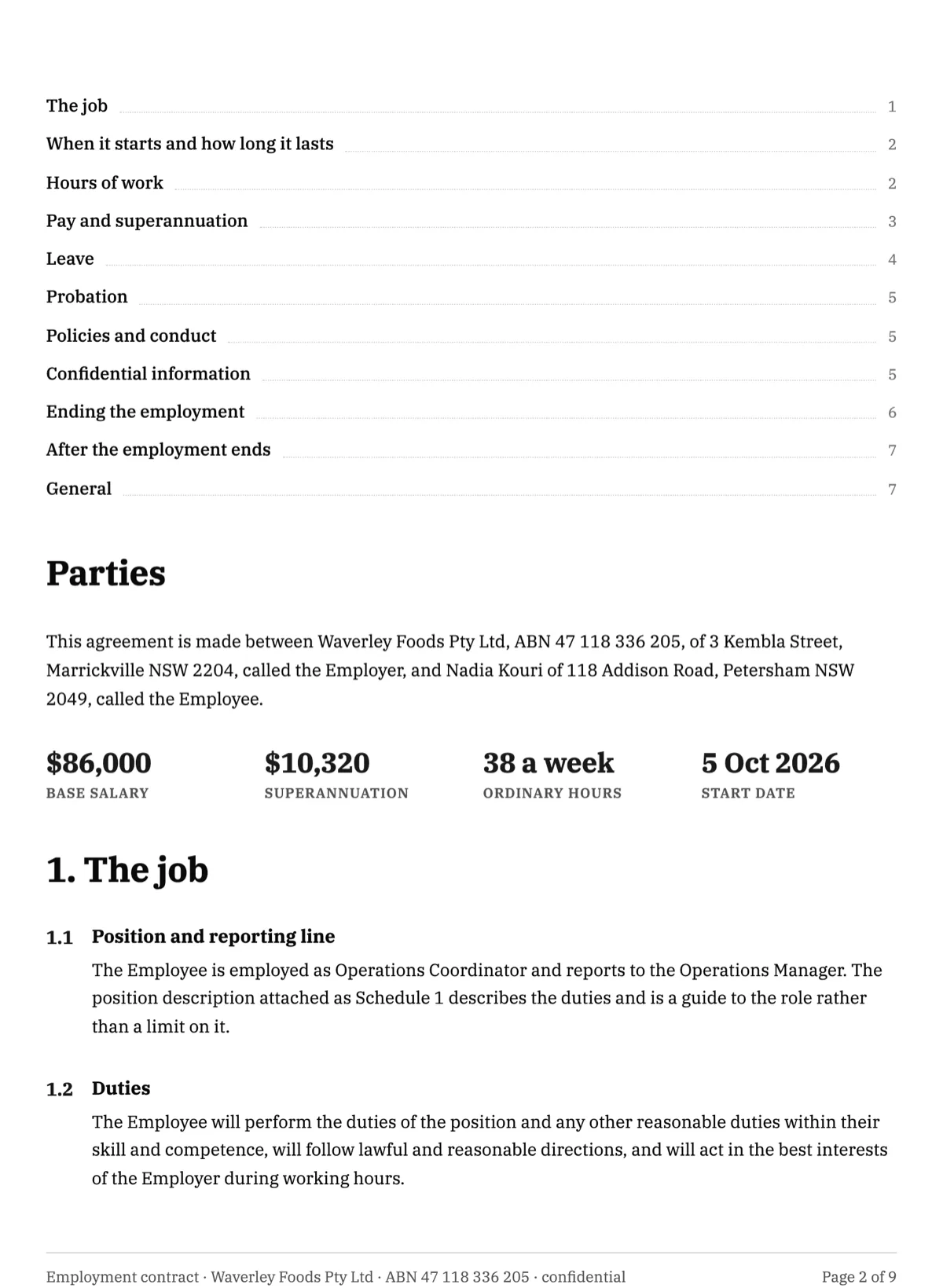 Employment contractA full time ongoing contract for an operations coordinator on $86,000 plus $10,320 of superannuation. Eleven numbered clauses, a leave table drawn from the National Employment Standards, and a notice table that scales with service.
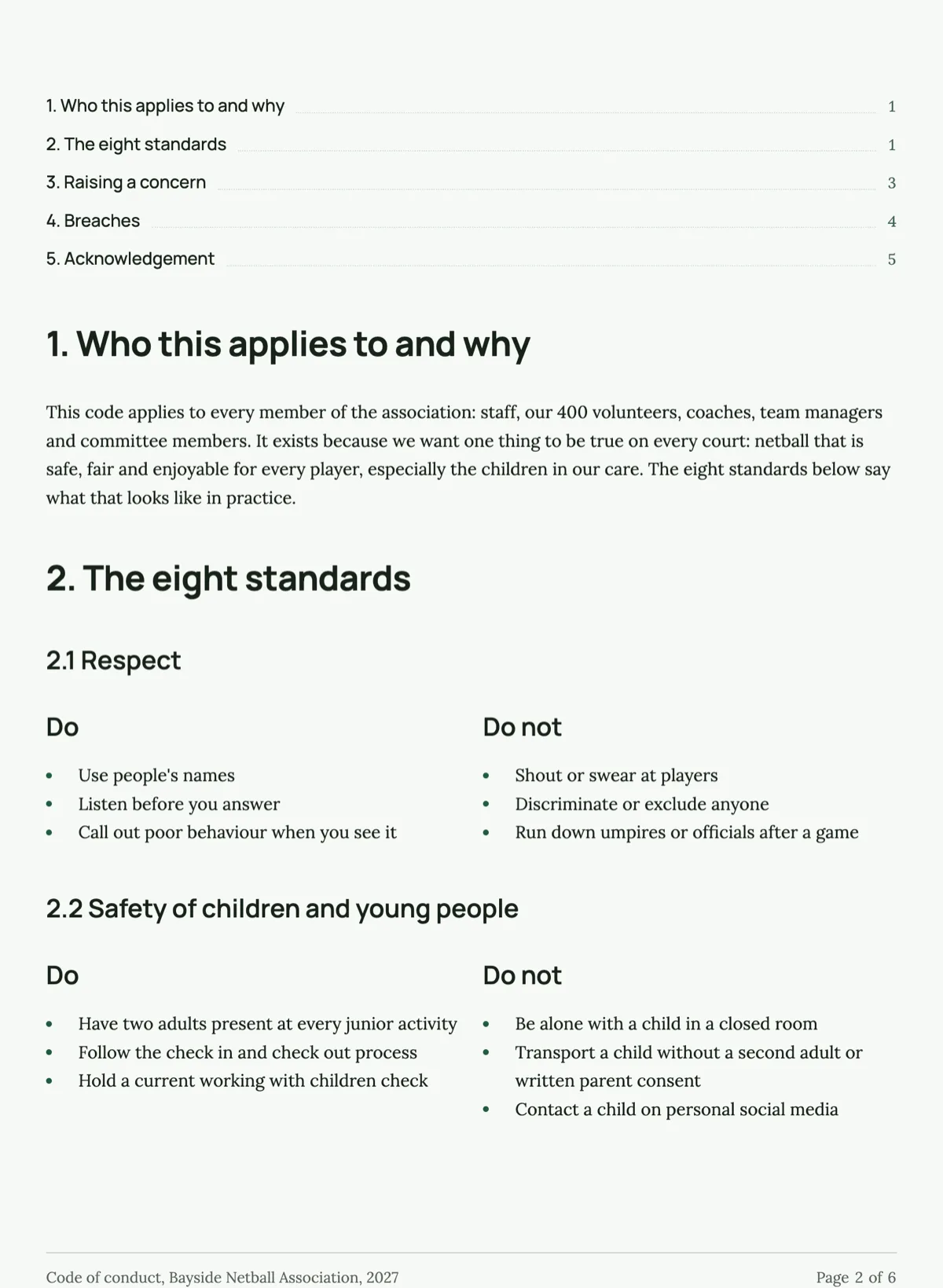 Code of conduct template with a do and do not list for each standardA code of conduct is read once at induction and again when something goes wrong, and it has to work both times. This one keeps eight standards, gives each a short list of what to do and what not to do, sets the gift threshold and the conflict declaration as numbers and tables, and ends with how to raise a concern and what follows a breach.
Questions people ask
What should a conflict of interest clause say?
It should define what counts as a conflict with examples, say who to disclose to and by when, require the person to stay out of affected decisions unless approved, say that disclosures are recorded, and state the consequences of failing to disclose. Thresholds for gifts and hospitality are usually included.
Does a conflict of interest clause stop me having a second job?
Not by itself. It requires you to disclose a second job if it creates a conflict, such as working for a supplier or competitor, and may lead to restrictions. Whether you may take outside work at all is usually governed by a separate moonlighting or outside work clause.
What happens if I do not disclose a conflict?
Most clauses treat it as misconduct, which can lead to a warning or, for serious or deliberate cases, dismissal. If the failure caused the business a loss, or involved dishonesty, there may also be legal claims. Disclosing late is better than not at all, but can still be a breach.
Is a conflict of interest always a problem?
No. Many conflicts are minor and can be managed, for example by having someone else make the decision. The problem is an undisclosed or unmanaged conflict. The purpose of the clause is to bring conflicts into the open so they can be handled before they affect a decision.
Do family members' interests count?
Usually, yes. Clauses commonly cover the interests of spouses, partners, children and other close relatives, because an interest held through family can influence judgment just as much as your own. Check the definition in your clause, and if you are unsure whether an interest counts, disclose it and let the business decide.
Put the clause in a finished document
The button opens the document generator with a starting description already filled in. Change it to match your own agreement before you run it.
Create a document with OneCraftRelated clauses
- Moonlighting clause: second jobs and side workA moonlighting clause for second jobs and side work: written consent refused only for competition, confidentiality or fatigue, with hours reported for safety.
- Confidentiality clauseA confidentiality clause inside a wider contract, not a standalone NDA. Sample consulting wording, mutual and one way variants, the tail period and exceptions.
- Non solicitation clause for clients and staffA non solicitation clause stops a former employee approaching clients or staff. Australian sample wording for clients and staff, with three variants.
For everything the document generator can do, see the document maker.
Step by step in the builder: Create a document with AI, then Document builder components.
Written and checked by the OneCraft team. Last checked .