Contract clause
Moonlighting clause: second jobs and side work
A moonlighting clause controls whether and how an employee may work for someone else, or run their own business, while employed. Most modern clauses require consent or notice rather than banning outside work outright, and limit refusals to genuine concerns such as competition, confidentiality and fatigue.
Plenty of employees drive rideshare at weekends, tutor in the evenings or run a small business on the side. A moonlighting clause decides which of those an employer needs to know about, and which it can say no to.
Nuwan Madhusanka · Co-founder
3 min read · Published
Sample clause
Written for an employment contract between Southbank Legal Support, a fictional Brisbane legal services firm, and a full time paralegal.
Outside Work. (a) While employed, the Employee must not undertake any other paid or unpaid work, or carry on any business, without first obtaining the Company's written consent. (b) The Company will not unreasonably refuse consent, and may refuse only where the outside work: (i) competes with the Company or is for a client or competitor of the Company; (ii) creates a real risk of misuse of the Company's confidential information; or (iii) would, together with the Employee's hours with the Company, risk the Employee's health or safety through fatigue. (c) The Employee must tell the Company of the average weekly hours of any approved outside work and of any material change to them. (d) The Company may withdraw consent on reasonable notice if circumstances change.
Sample wording, not legal advice.
Variants
Consent needed
Employers with confidential client work or safety risks from fatigue, where they need to know before outside work starts.
The Employee must not take up any other employment or engagement without the Company's prior written consent, which will not be unreasonably withheld.
Notice only
Lower risk roles where the employer only needs to know about outside work, not approve it.
The Employee must notify the Company in writing before starting any other employment or business activity, giving the nature of the work and expected weekly hours. Notice does not require approval unless the activity competes with the Company.
Ban during probation
New starters, where an employer wants full attention during training and probation, with the normal rule applying afterwards.
During the Probation Period, the Employee must not undertake any other paid work. After the Probation Period, outside work is permitted with the Company's written consent under clause 11.
What to negotiate
Reasonableness
An outright ban on all outside work, including unpaid volunteering or unrelated weekend jobs, is harder to justify, may be an unreasonable restraint, and is often ignored in practice. A consent rule with listed grounds for refusal, as in the sample, protects the employer's real interests and is easier to enforce. Part time employees in particular should resist bans, since they may need a second job to earn a living.
Fatigue rules
Employers have work health and safety duties, and a worker doing long hours across two jobs can be a safety risk, especially in driving, machinery, healthcare and security roles. Asking for weekly hours of outside work lets the employer manage that risk. In the UK, the 48 hour average weekly limit applies to total hours across all jobs, so employers need to know about second jobs for compliance as well.
US state laws on off duty conduct
Several US states have laws protecting lawful off duty activities, which can limit how far an employer may control what employees do outside work, although these laws vary and do not generally prevent restrictions on working for competitors. Employers operating in the US should check the state rules before relying on a broad clause.
The risk of leaving it out
Without a moonlighting clause, an employee can generally take other work as long as they do not breach their duties of fidelity and confidentiality or work for a competitor in a way that harms the employer. The employer may not learn of a second job until a problem arises, such as fatigue, a conflict with a client, or excess hours.
Rules on second jobs by country
In Australia, no statute stops an employee having a second job; the limits come from the contract, the duty of fidelity, and work health and safety law, and the Fair Work Ombudsman notes that employment contracts can include terms about outside work. In the UK, contract terms govern second jobs, and the Working Time Regulations limit total weekly hours across jobs to an average of 48 unless the worker opts out. In the US, at will employment gives employers wide latitude, subject to state laws protecting some off duty activities. In each, restrictions on working for a direct competitor are the most widely accepted. Law checked on 21 October 2026. This page explains how the clause works and is not legal advice.
What counts as outside work
Clauses should say whether they cover unpaid work, volunteering, board positions, running a business, investments and creative work such as writing or content creation. Many employers exclude passive investments and unpaid community work. Side work that uses the employer's equipment, time or information is a separate problem, often covered by IP and confidentiality clauses rather than the moonlighting clause.
Asking for consent
An employee seeking consent should describe the work, the hours, whether any client or competitor is involved, and how they will keep it separate. A written answer protects both sides. Employers should respond promptly and give reasons if refusing, tied to the grounds in the clause. Refusing without a reason, or for reasons outside the clause, invites a dispute.
Moonlighting and conflicts of interest
Where outside work could affect decisions in the main job, such as working for a supplier, the conflict of interest clause also applies and requires disclosure. Many employers handle both in one approval: consent to the outside work, conditions on it, and a record in the conflicts register if an interest is created.
Documents that carry this clause
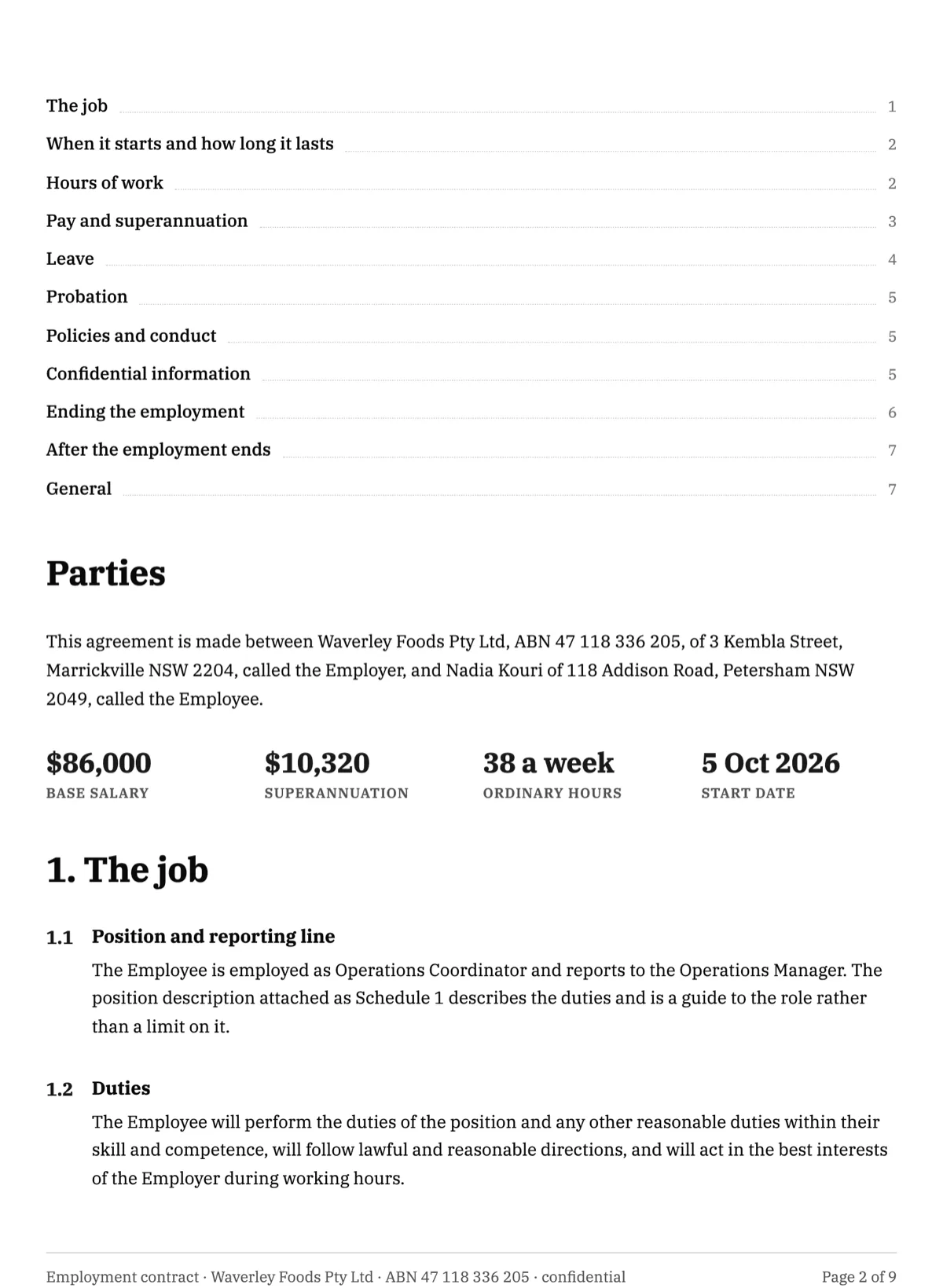 Employment contractA full time ongoing contract for an operations coordinator on $86,000 plus $10,320 of superannuation. Eleven numbered clauses, a leave table drawn from the National Employment Standards, and a notice table that scales with service.
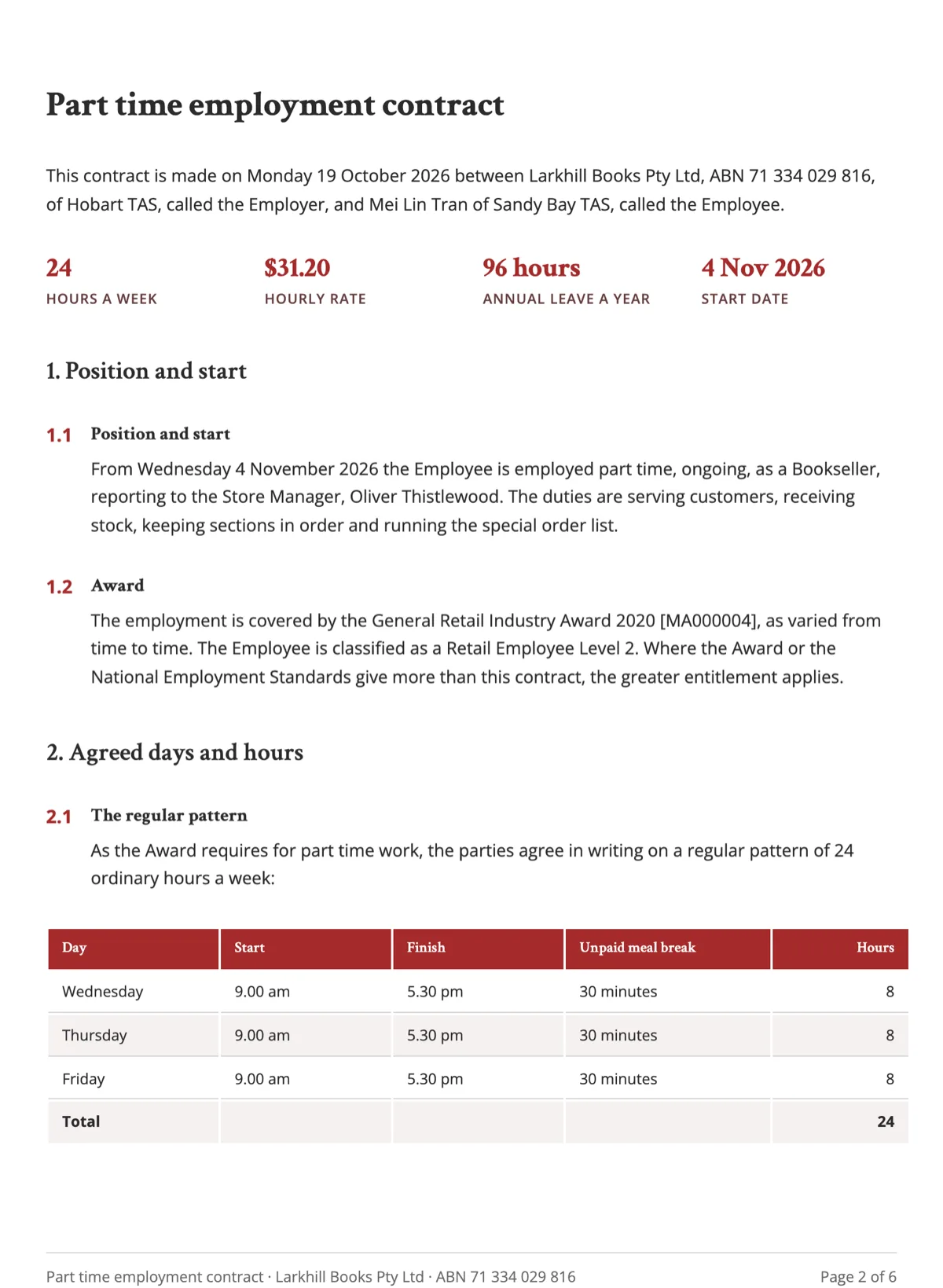 Part time employment contract template with set hours and pro rata leaveA part time employment contract template has to do something a full time contract does not: fix the regular days and hours in writing, because Australian awards require it for part time staff, and show how every leave entitlement is scaled to those hours. This one does both for a bookseller working 24 hours over three days.
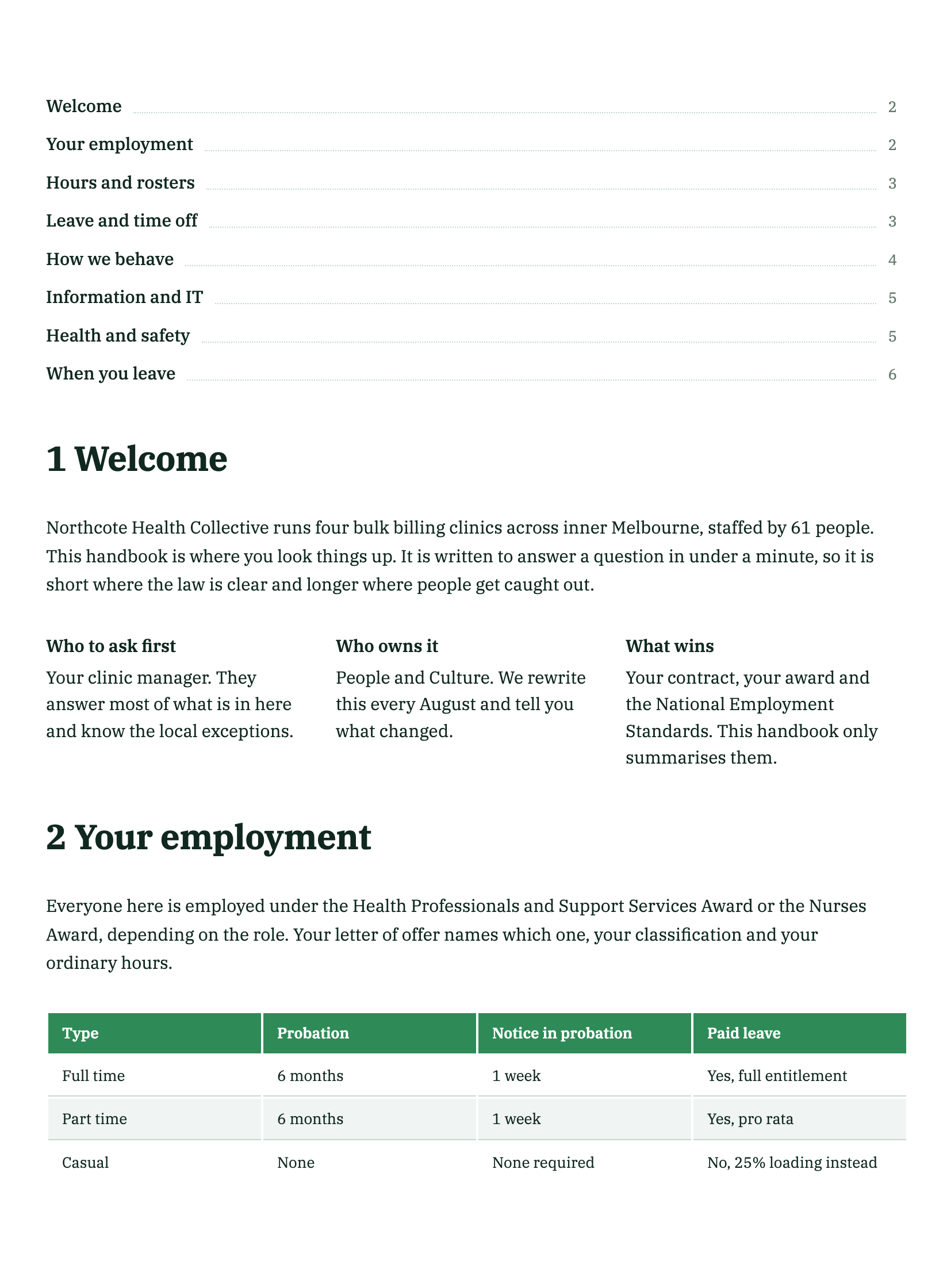 Employee handbookThe handbook a new starter actually reads in their first week, written for a four clinic health provider with 61 staff. Eight sections, each answering a question in under a minute: what kind of employment you are on, when you work, what leave you get, how we expect people to behave in front of patients, what you may and may not do with a patient record, the five safety rules, and how notice works when you go. It says plainly that the award and the National Employment Standards win wherever the handbook differs from them.
Questions people ask
Can my employer stop me having a second job?
Only to the extent your contract allows and the restriction is reasonable. Many contracts require consent for outside work, and refusals are usually justified only for competition, confidentiality, conflicts or safety. Without any clause, you can generally take a second job that does not compete or misuse your employer's information.
Do I have to tell my employer about side work?
If your contract has a moonlighting or outside work clause, yes, as it requires. Even without one, you should disclose side work that could conflict with your role, involve a client or competitor, or affect your hours and safety. Telling your employer early avoids it looking like you hid something.
Is a moonlighting ban enforceable?
A complete ban is harder to enforce than a consent rule, especially for part time staff or work unrelated to the employer's business, because it can be an unreasonable restraint. Bans on working for competitors, or on outside work that causes fatigue in safety critical roles, are much more likely to be upheld.
Can I work for a competitor in my spare time?
Usually not. Working for a direct competitor while employed can breach your duty of fidelity even without a clause, and most moonlighting clauses expressly forbid it. It also risks misuse of confidential information. Ask your employer first if the work is in the same field.
Does a second job affect my working time limits?
In the UK, yes: the 48 hour average weekly limit applies to your total hours across all jobs unless you opt out. In Australia, there is no single weekly cap across jobs, but employers have safety duties, so long combined hours in safety critical roles can lead to restrictions.
Put the clause in a finished document
The button opens the document generator with a starting description already filled in. Change it to match your own agreement before you run it.
Create a document with OneCraftRelated clauses
- Conflict of interest clause: disclose, record and step backA conflict of interest clause for a developer's project manager: disclose supplier interests, gifts and family links within 5 business days, then step back.
- Restraint of trade clause: building a cascade for a business saleA restraint of trade clause limits competing after a business sale or exit. How an Australian cascading restraint is built, with sale and shareholder variants.
- Confidentiality clauseA confidentiality clause inside a wider contract, not a standalone NDA. Sample consulting wording, mutual and one way variants, the tail period and exceptions.
- Working time opt out clause: the 48 hour week in the UKA UK working time opt out clause for a sous chef: a separate signed agreement to exceed the 48 hour average, cancellable on 7 days' notice, and who cannot.
For everything the document generator can do, see the document maker.
Step by step in the builder: Create a document with AI, then Document builder components.
Written and checked by the OneCraft team. Last checked .