Contract clause
Working time opt out clause: the 48 hour week in the UK
A working time opt out is a worker's written agreement to work more than an average of 48 hours a week, the limit set by regulation 4 of the Working Time Regulations 1998. It must be voluntary, in writing, signed by the worker, and the worker can cancel it by giving notice.
UK law caps the working week at an average of 48 hours, and lets an adult worker sign that cap away. The opt out only works if it is genuinely voluntary, so where and how it is signed matters as much as what it says.
Nuwan Madhusanka · Co-founder
4 min read · Published
Sample clause
Written for a separate opt out agreement offered to a sous chef by Ouseburn Kitchens, a fictional Newcastle restaurant group, alongside the employment contract.
Opt Out of the 48 Hour Average Weekly Limit. 1. I, the Worker named below, agree that the limit of an average of 48 hours' work a week in regulation 4(1) of the Working Time Regulations 1998 does not apply to my employment with Ouseburn Kitchens Ltd. 2. I understand that I do not have to sign this agreement, and that I will not be dismissed or treated less favourably if I do not sign it or if I later cancel it. 3. I may end this agreement at any time by giving the Company 7 days' written notice. 4. This agreement applies from the date signed until I end it. 5. The Company will keep a record of this agreement and of the hours I work. Signed by the Worker, and dated.
Sample wording, not legal advice.
Variants
Indefinite opt out
The usual form, where the worker opts out until they choose to cancel.
I agree that the 48 hour average weekly limit does not apply to me. This agreement continues until I give at least 7 days' written notice to end it.
Fixed period opt out
Seasonal peaks, such as a restaurant's summer or a retailer's Christmas, where longer hours are expected only for a while.
I agree that the 48 hour average weekly limit does not apply to me from 1 November to 31 January. After 31 January the limit applies again unless I sign a new agreement. I may end this agreement earlier by giving 7 days' written notice.
Extended cancellation notice
Roles where cover is hard to arrange at short notice and the employer wants longer warning, up to the legal maximum.
I agree that the 48 hour average weekly limit does not apply to me. I may end this agreement by giving 3 months' written notice, which is the longest notice period the Working Time Regulations allow.
What to negotiate
Signing must be voluntary
GOV.UK guidance says an employer can ask a worker to opt out but cannot sack or treat them unfairly for refusing, and the Employment Rights Act 1996 protects workers from detriment for refusing to sign. That is why the sample is a separate document and says refusal carries no penalty. An opt out buried in the main contract, signed as a condition of getting the job, is open to challenge as not freely given.
Record keeping
The employer must keep a record of each worker who has opted out, and must still keep records showing compliance with the parts of the regulations that cannot be opted out of, such as rest breaks, daily and weekly rest and night work limits. The sample commits to recording hours, which also protects the employer if a worker later says they worked excessive hours without agreement.
Workers who cannot opt out
The opt out is available only to workers aged 18 and over. Under 18s have separate limits of 8 hours a day and 40 hours a week. Some sectors cannot opt out, including airline staff, workers on ships and boats, many road transport workers and security guards on vehicles carrying high value goods, because their hours are governed by sector specific rules.
The risk of leaving it out
Without an opt out, a worker must not work more than an average of 48 hours a week over the reference period, normally 17 weeks. An employer that relies on long hours without valid opt outs risks enforcement action and claims, and a worker cannot be required to work over the limit. For kitchens and other businesses with long shifts, that can make a rota unworkable.
How the 48 hour average works
Regulation 4 of the Working Time Regulations 1998 limits average weekly working time to 48 hours, including overtime, averaged over a reference period of 17 weeks unless a longer period is agreed in limited cases. A worker can work 60 hours in one week if other weeks are shorter, as long as the average stays within 48. Working time includes job related training and time travelling as part of the job, but not normal commuting or rest breaks where no work is done. Law checked on 21 October 2026. This page explains how the clause works and is not legal advice.
Opt out checklist
Before relying on an opt out, check: the worker is 18 or over; the worker is not in an excluded sector; the agreement is in writing and signed by the worker; it was offered separately, without pressure, and refusing it carried no consequence; it states how the worker can cancel and the notice, which is 7 days unless the agreement sets longer, up to a maximum of 3 months under regulation 5; the employer keeps a record of who has opted out; and hours worked are still recorded for the protections that cannot be waived.
What an opt out does not change
An opt out removes only the 48 hour average. Workers keep their rights to rest breaks of 20 minutes when working more than six hours, daily rest of 11 consecutive hours, weekly rest, paid annual leave, and the limits on night work. A chef who has opted out still cannot lawfully be rostered for back to back shifts that break the 11 hour daily rest rule, unless an exception applies and compensatory rest is given.
Second jobs
The 48 hour limit applies to total working time across all jobs, so a worker with two jobs that together exceed 48 hours on average should opt out with at least one employer. Employers who know a worker has another job should ask about total hours, which ties in with a moonlighting clause requiring outside work to be disclosed.
Documents that carry this clause
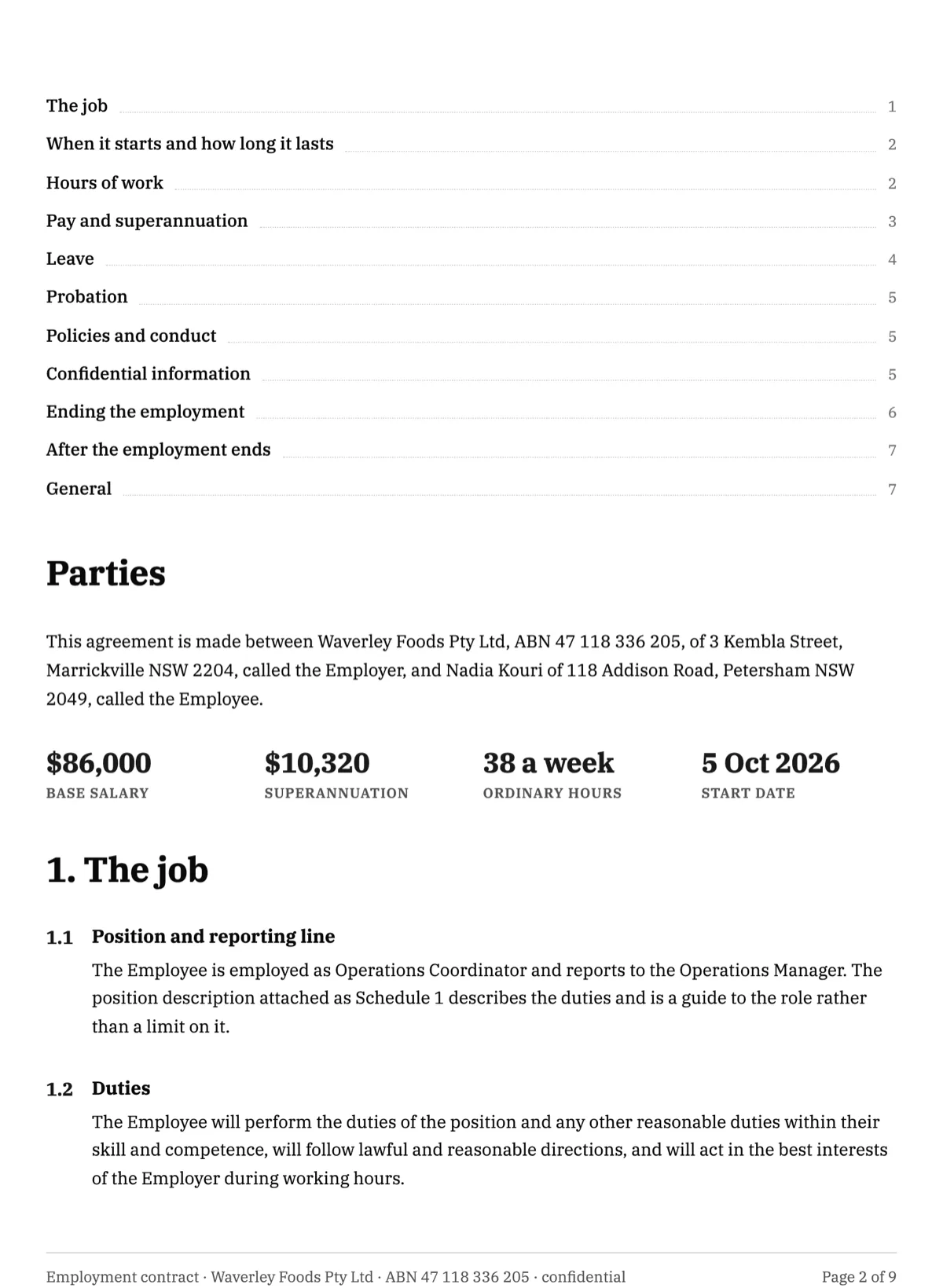 Employment contractA full time ongoing contract for an operations coordinator on $86,000 plus $10,320 of superannuation. Eleven numbered clauses, a leave table drawn from the National Employment Standards, and a notice table that scales with service.
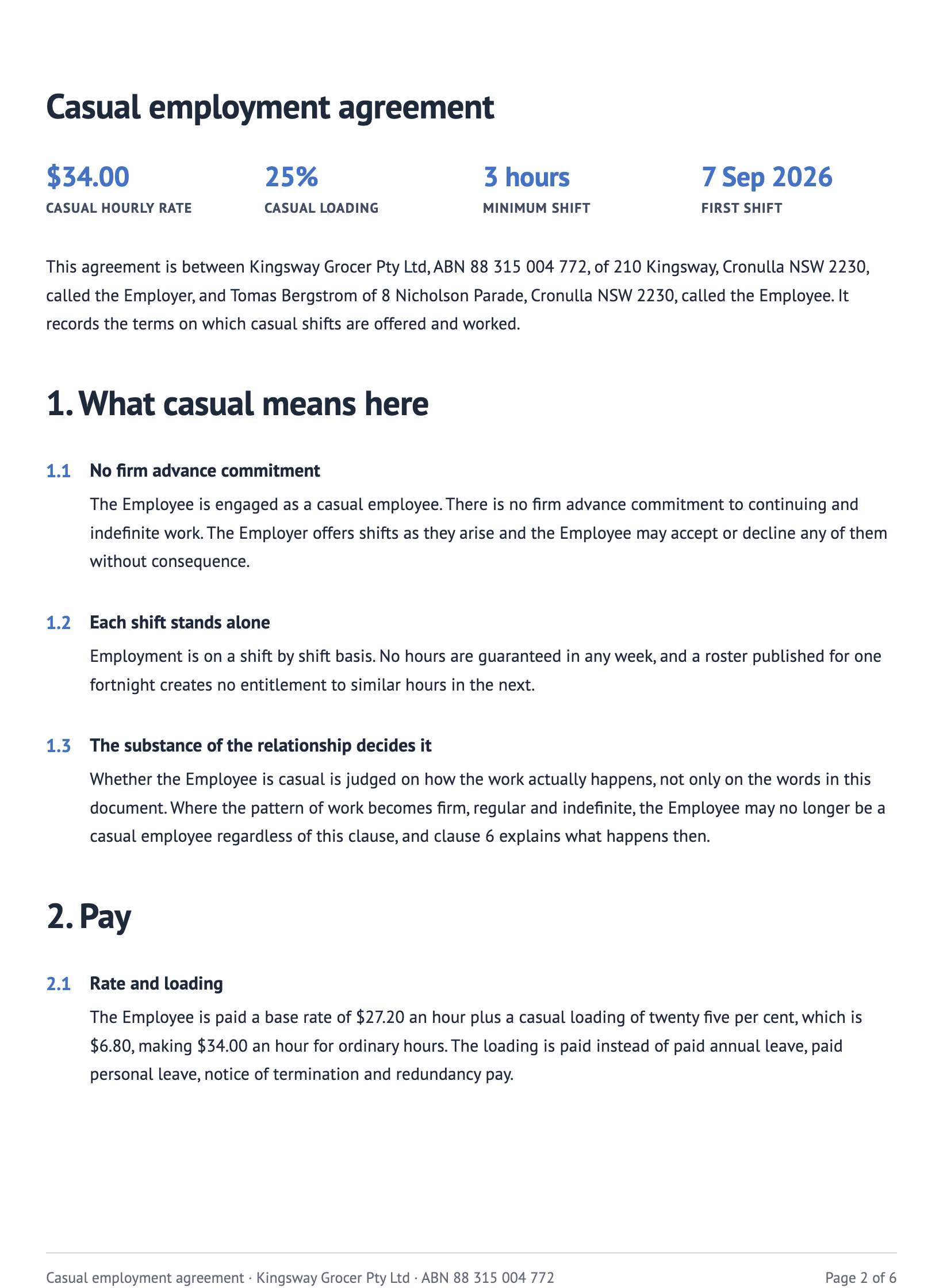 Casual employment agreementA retail assistant is paid $34.00 an hour, which is a base of $27.20 plus a twenty five per cent loading. The agreement shows how every other rate is built from that base, and what the loading is paid instead of.
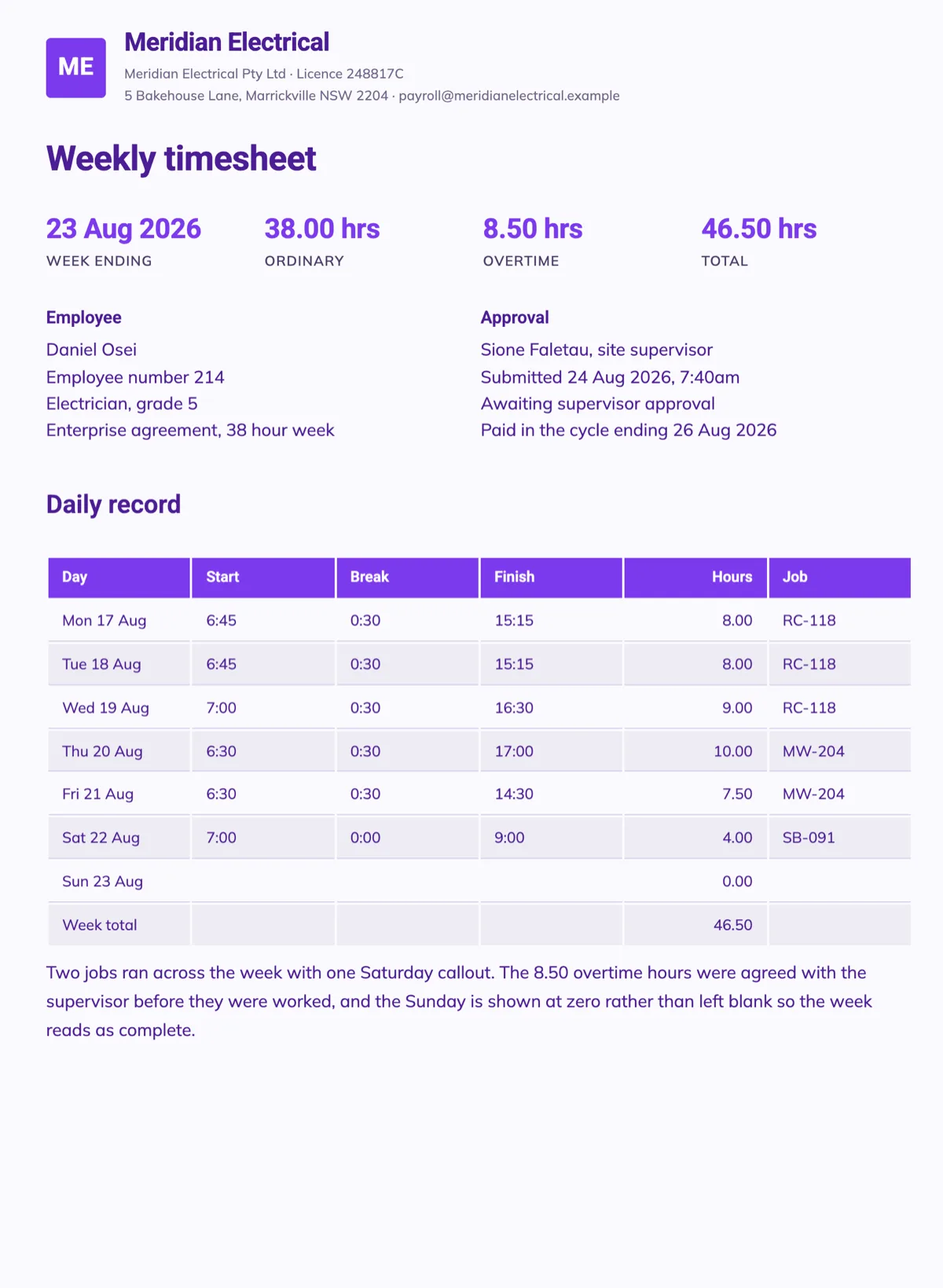 Weekly timesheetAn electrician records a week across two jobs and a Saturday callout. The same 46.50 hours are counted twice, once for the pay run and once for the customers, and the sheet only works if both agree.
Questions people ask
Can my employer make me sign the 48 hour opt out?
No. Your employer can ask, but you can refuse, and you cannot be dismissed or treated unfairly for refusing. If you were told you must sign to get or keep the job, the opt out may not be valid, and treating you badly for refusing is unlawful detriment.
How do I cancel my opt out?
Give your employer written notice. The notice period is 7 days unless your agreement sets a longer one, which cannot exceed 3 months. After the notice ends, the 48 hour average applies again and your employer must not require you to work beyond it.
Who cannot opt out of the 48 hour week?
Workers under 18, who have their own limits, and workers in sectors with their own rules: airline staff, workers on ships and boats, many road transport workers, other staff who travel in and operate vehicles covered by drivers' hours rules, and security guards on vehicles carrying high value goods.
Does the opt out mean no limit at all on my hours?
It removes the weekly average, but other protections remain: 11 hours' rest between working days, rest breaks, weekly rest and paid holiday. Your employer also has health and safety duties, so excessive hours that harm your health can still breach the law even with an opt out.
How is the 48 hour average calculated?
Add up your working hours over the reference period, normally 17 weeks, and divide by the number of weeks. Weeks of leave are not counted as working time, so the hours from the weeks after the period are added to replace them. GOV.UK has a guide to the calculation.
Put the clause in a finished document
The button opens the document generator with a starting description already filled in. Change it to match your own agreement before you run it.
Create a document with OneCraftRelated clauses
- Overtime clause: paid, time off or built into salaryAn overtime clause says whether extra hours are paid, given as time off or absorbed in salary. Australian sample wording with an annual reconciliation.
- Leave entitlements clause in an employment contractA leave entitlements clause lists annual, personal and other leave in an employment contract. Australian sample wording, NES minimums and three variants.
- Remote work clause: hybrid, fully remote or by requestA remote work clause sets where an employee works, on which days and on what conditions. Sample hybrid wording, fully remote and UK variants, and what to agree.
- Moonlighting clause: second jobs and side workA moonlighting clause for second jobs and side work: written consent refused only for competition, confidentiality or fatigue, with hours reported for safety.
For everything the document generator can do, see the document maker.
Step by step in the builder: Create a document with AI, then Document builder components.
Written and checked by the OneCraft team. Last checked .