Contract clause
Earn out clause: part of the price paid on future performance
An earn out clause makes part of the price for a business depend on how the business performs after the sale, usually measured by revenue, profit or milestones over one to three years. It bridges a gap between what the seller thinks the business is worth and what the buyer will pay up front.
Sellers believe in next year's growth; buyers pay for last year's results. An earn out splits the difference by paying for the growth if it happens, and the clause has to make sure the measurement is fair once the buyer is running the business.
Indunil Asanka · Co-founder
4 min read · Published
Sample clause
Written for the sale of Bellbird Analytics, a fictional Brisbane software business, by its two founders to a larger software group.
Earn Out. (a) In addition to the Completion Payment of $1,200,000, the Buyer must pay the Sellers up to $800,000 as follows: (i) $400,000 if Recurring Revenue for the 12 months after Completion is at least $1,500,000, or a proportionate amount between $1,200,000 and $1,500,000; (ii) $400,000 if Recurring Revenue for the following 12 months is at least $1,900,000, or a proportionate amount between $1,500,000 and $1,900,000. (b) Recurring Revenue is calculated under the accounting policies in Schedule 7, consistently with the Company's last audited accounts. (c) Within 60 days after each period, the Buyer must give the Sellers a statement with its calculation, and the Sellers may dispute it within 30 days, after which an independent accountant decides as expert. (d) Until the end of the second period, the Buyer must operate the Company in good faith and must not take action with the main purpose of reducing the Earn Out.
Sample wording, not legal advice.
Variants
Revenue earn out
Growing businesses where revenue is a fair measure and the buyer will change costs after the sale.
The Earn Out Payment for each Earn Out Period equals 40% of the amount by which Revenue for that period exceeds $1,200,000, up to a total of $800,000 over both periods.
EBITDA earn out
Established businesses where profit is the real measure of value and the sellers keep running the business.
The Earn Out Payment equals five times the amount by which EBITDA for the Earn Out Year exceeds $300,000, capped at $1,000,000, where EBITDA is calculated under Schedule 7 and excludes the Buyer's group charges.
Milestone earn out
Businesses whose value depends on specific events, such as a product launch, a regulatory approval or a major contract.
The Buyer must pay $500,000 within 20 business days after the Company obtains approval of its device from the Therapeutic Goods Administration, if approval is obtained within 18 months after Completion.
What to negotiate
The buyer's conduct of the business
Once the buyer owns the business, it controls everything that affects the earn out, from pricing to staffing. Sellers ask for covenants: run the business in the ordinary course, keep it as a separate unit with its own accounts, fund it adequately, do not divert customers or revenue to the buyer's other businesses, and do not take steps intended to reduce the earn out. Buyers resist anything that stops them integrating the business, so the list is usually a negotiation.
Accounting policies
The measure must be calculated consistently with how the business was run before the sale, or a change in revenue recognition can wipe out the earn out. Attach the policies and an illustrative calculation as a schedule. Decide in advance how acquisitions, disposals and the buyer's overhead charges are treated.
Acceleration on resale
Sellers often ask that the full earn out becomes payable if the buyer sells the business, changes it fundamentally, or breaches the conduct covenants. Buyers may accept acceleration on resale or insolvency but resist it for ordinary integration decisions. An acceleration clause gives the sellers a simple remedy without proving what the earn out would have been.
The risk of leaving it out
Without an earn out, the parties must agree a single price at completion, which may mean the seller accepts less than it believes the business is worth, or the buyer overpays for growth that never comes. A poorly drafted earn out is worse than none: disputes over the calculation and the buyer's conduct are among the most common post sale disputes.
A worked earn out table for two years
Year 1: recurring revenue of $1,410,000 against a target of $1,500,000 and a floor of $1,200,000. The sellers reached 70% of the way from floor to target, so they receive 70% of $400,000, which is $280,000. Year 2: recurring revenue of $1,950,000, above the $1,900,000 target, so they receive the full $400,000. Total earn out: $680,000 of a possible $800,000, and total price $1,880,000. A proportionate scale, as in the sample, avoids an all or nothing cliff where $1 of revenue changes the price by $400,000. Law checked on 21 October 2026. This page explains how the clause works and is not legal advice.
Conduct covenants sellers ask for
The usual list: keep the business as a separately accounted unit; run it in the ordinary course and broadly as before; maintain adequate working capital and staffing; do not move customers, contracts or revenue to other group companies; do not change prices or terms materially without consent; keep the founders in their roles if their work drives the earn out; give the sellers information to monitor performance; and act in good faith. Delaware courts have enforced earn out covenants and held buyers liable for acting to avoid an earn out, but where the contract gives the buyer discretion, courts generally will not add obligations the parties did not agree.
Tax treatment in Australia
In Australia, the Income Tax Assessment Act 1997 includes look through rules for qualifying earnout rights, so that earn out payments can be treated as part of the capital proceeds for the sale of the business rather than as a separate asset, subject to conditions such as the earn out ending within five years. The tax position should be checked with an adviser before the structure is agreed, because it affects both sides.
Disputes
An expert determination process, with a short timetable and an independent accountant deciding the calculation, resolves most earn out disputes faster and more cheaply than court. The clause should say whether the expert decides only the numbers or also whether the buyer breached its covenants, which is usually a question for a court or arbitrator.
Documents that carry this clause
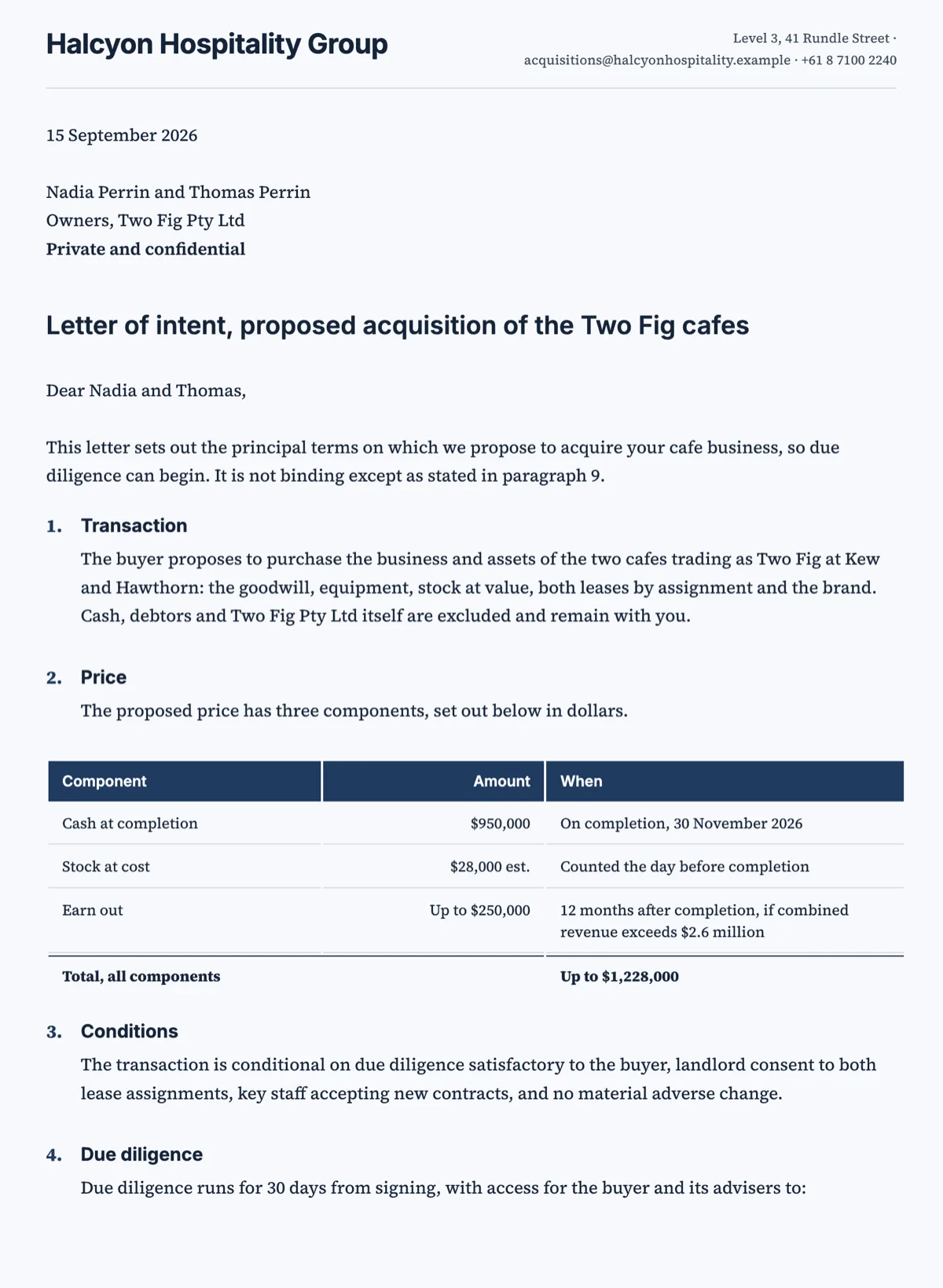 Letter of intent template for buying a businessA letter of intent is the deal on one page, written before either side has spent money on lawyers, and its only binding parts are the promises that make spending that money safe. This example records a cafe acquisition of up to $1,228,000 with an earn out, gives the buyer 45 days of exclusivity, and numbers the paragraphs that bind.
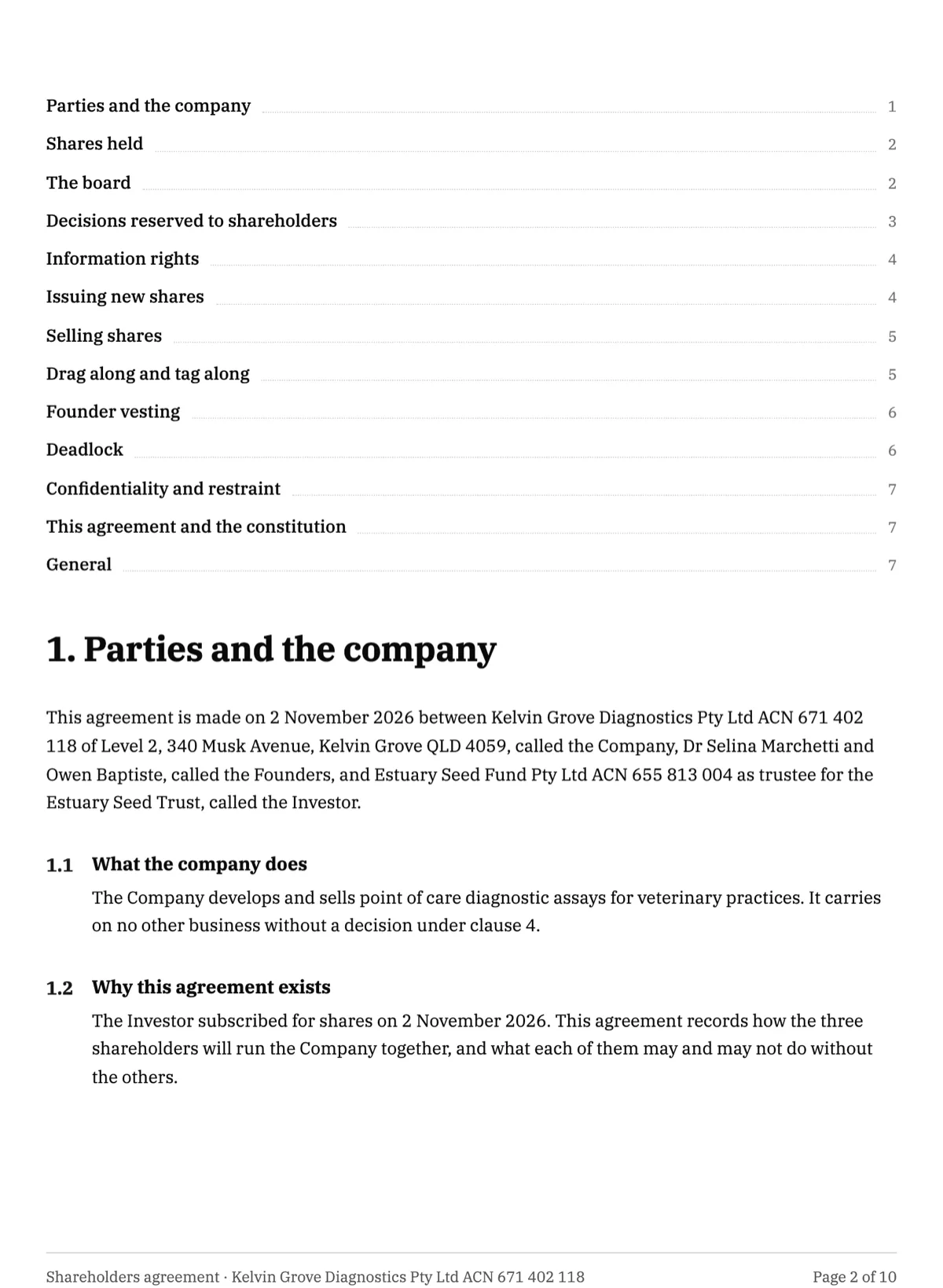 Shareholders agreement template for a company after a seed roundA shareholders agreement template sets out who owns what, who sits on the board, which decisions need shareholder consent, how shares are sold, and how a deadlock ends. This one is filled in for a Queensland veterinary diagnostics company that has just taken $1.5 million from one seed fund, leaving the two founders with 80 per cent between them. Its central number is an 85 per cent consent threshold for eight reserved matters, and the page below shows what that number does and does not protect.
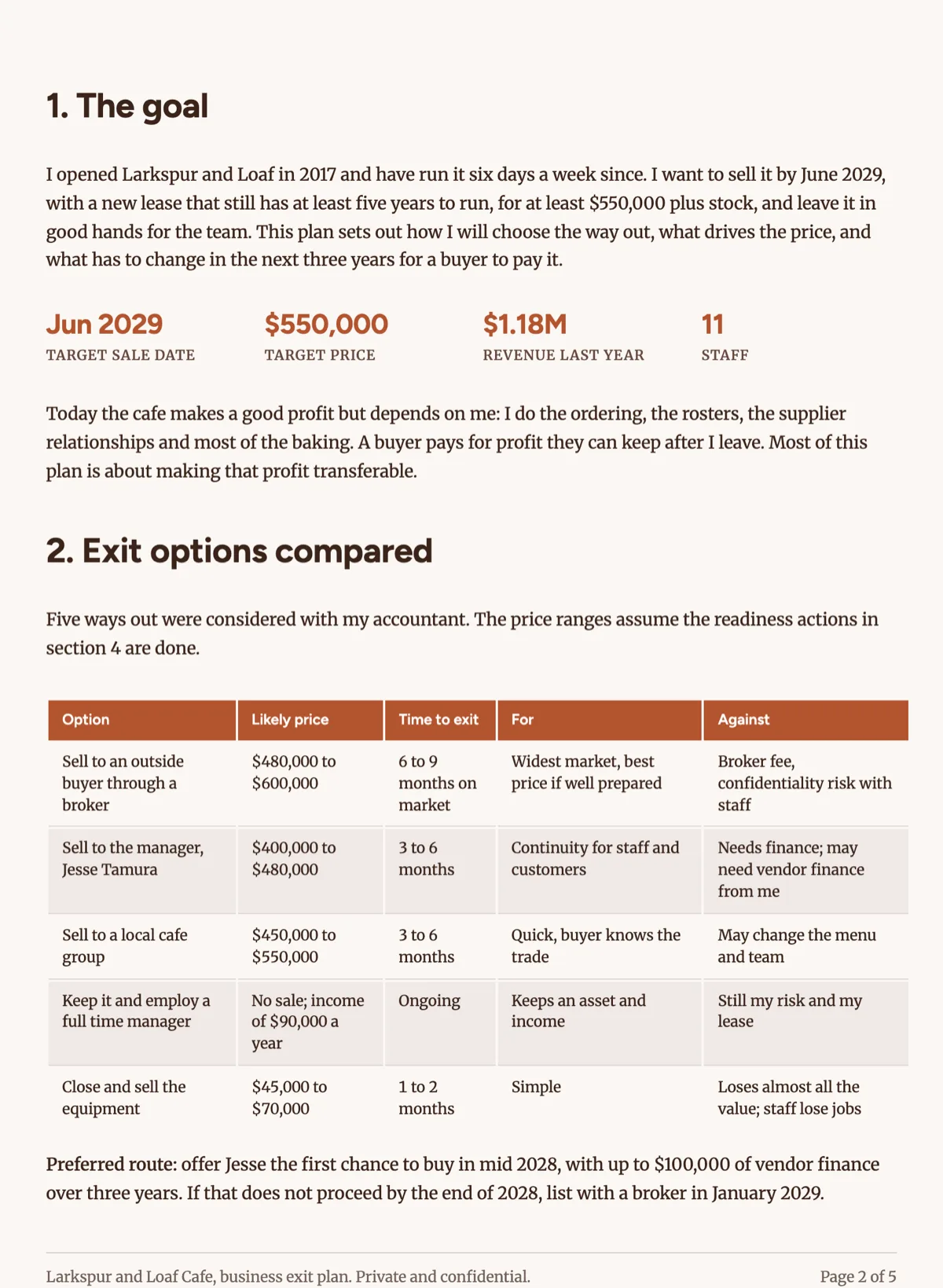 Business exit plan template with options, valuation and timelineA business exit plan has to choose a way out, show what the business is worth and why, and list what must change before a buyer will pay that price. This five page plan for a cafe owner selling in mid 2029 compares five exit options, works from $200,000 of adjusted earnings to a $550,000 target, and sets readiness actions, a timeline, advisers and the net proceeds.
Questions people ask
How does an earn out work?
Part of the price is paid at completion and the rest later, depending on how the business performs against agreed measures, such as revenue or profit, over a set period. After each period, the buyer calculates the result and pays any earn out due, and the seller can dispute the calculation.
What protects the seller in an earn out?
Clear definitions and accounting policies, covenants about how the buyer will run the business, information rights to monitor performance, an expert process for disputes, and acceleration if the buyer sells the business or breaches the covenants. Security, such as a guarantee from the buyer's parent, can also help.
How are earn out disputes resolved?
Usually by an independent accountant acting as an expert on the calculation, under a short timetable set in the clause. Disputes about whether the buyer breached its conduct obligations usually go to court or arbitration. Clear schedules and an illustrative calculation reduce the scope for disputes.
How long do earn outs usually last?
Commonly one to three years. Longer periods give the buyer more time to change the business and make the measurement less reliable, while shorter ones may not capture the growth the seller is paid for. In Australia, the look through tax rules for earnouts require the earn out to end within five years.
Is revenue or profit better for an earn out?
Revenue is harder for a buyer to manipulate, because costs and group charges do not affect it, so sellers often prefer it. Profit reflects value better, so buyers often prefer it. Where sellers keep running the business, a profit measure with tightly defined adjustments is common.
Put the clause in a finished document
The button opens the document generator with a starting description already filled in. Change it to match your own agreement before you run it.
Create a document with OneCraftRelated clauses
- Milestone payment clause: paying by stageA milestone payment clause splits the price into stages released on acceptance. Sample wording for a four stage software build, variants and what to negotiate.
- Audit rights clauseAn audit rights clause lets a customer inspect a supplier's records or systems to check compliance. Sample with a yearly audit on 20 days notice, and variants.
- Dispute resolution clause: the ladder before anyone goes to courtA dispute resolution clause sets the steps parties must take before suing. Sample three tier ladder with day counts, and negotiation, mediation and arbitration.
- Exit clause in a shareholders agreement: planning the sale or listingAn exit clause in a shareholders agreement sets when and how owners pursue a sale or listing. Sample wording with an exit window, exit events and variants.
For everything the document generator can do, see the document maker.
Step by step in the builder: Create a document with AI, then Document builder components.
Written and checked by the OneCraft team. Last checked .