Contract clause
Joint and several liability clause: each liable for the whole
A joint and several liability clause makes two or more parties each liable for the whole of an obligation, so the other party can recover the full amount from any one of them, from some, or from all together. The parties then sort out their shares between themselves.
When two people sign a lease or a loan together, the lender or landlord does not want to chase each for half. A joint and several liability clause lets it recover everything from whichever of them can pay, and leaves the co signers to settle up with each other.
Indunil Asanka · Co-founder
3 min read · Published
Sample clause
Written for a residential tenancy in Fitzroy, Melbourne, rented by two fictional co tenants, Priya Raman and Tom Whitlam, with the same wording used for two co borrowers of a vehicle loan.
Joint and Several Liability. (a) If a party to this agreement consists of more than one person, each of those persons is jointly and severally liable for every obligation of that party. (b) The Landlord may recover the whole of any amount owing from any one or more of those persons, and may sue one without suing the others. (c) A release of, compromise with, or extension of time given to one of those persons does not release or affect the liability of the others. (d) A notice given to any one of those persons is treated as given to all of them.
Sample wording, not legal advice.
Variants
Joint and several
Leases, loans and guarantees with more than one obligor, where the creditor wants to recover from whoever can pay.
Where two or more persons are the Borrower, their obligations under this agreement bind them jointly and each of them severally, and the Lender may enforce them against all or any of them.
Several only
Consortia and joint ventures where each party should answer only for its own share.
The obligations of the Members under this agreement are several and not joint. Each Member is liable only for its own obligations and is not responsible for any failure of another Member.
Several with named proportions
Shared costs where each party agrees a fixed share, such as co owners of equipment.
Each Owner is liable for the costs of maintaining the Equipment in the following proportions only: Owner A 60% and Owner B 40%. No Owner is liable for any share of another Owner.
What to negotiate
Contribution between the parties
If one co tenant pays all the rent arrears, they can usually recover the other's share from them under the general law of contribution, but that is a separate claim the creditor is not involved in. Co signers can make a side agreement setting out who pays what and how one reimburses the other, which avoids relying on the general law if the relationship breaks down.
Releases
At common law, releasing one joint debtor could release the others, so creditors include a clause preserving their rights against the rest when they settle with one. Co signers should know that if the creditor releases their partner, they may remain liable for the whole amount. The sample's paragraph (c) is the creditor's protection.
Notice to each
A clause deeming notice to one to be notice to all is convenient for the creditor but risky for a co signer who has moved out or separated. Co signers can ask that notices of default or claims be sent to each of them at their own address, so no one learns of a debt only when it is enforced.
The risk of leaving it out
Without the clause, the general law may still make co signers jointly liable, but questions arise: whether each can be sued for the whole, whether releasing one releases the others, and whether each must be served. The clause removes those doubts for the creditor. For co signers, its presence is a reason to understand they may end up paying everything.
Who pays what, under each form
Suppose two co tenants owe $6,000 in rent arrears and one has no money. Joint and several: the landlord can recover the full $6,000 from the tenant who can pay, who can then claim $3,000 from the other. Several only: the landlord can recover only $3,000 from each, and loses the $3,000 the insolvent tenant owes. Several with proportions, say 60 and 40: the landlord can recover $3,600 from one and $2,400 from the other, and nothing more from either. The choice decides who bears the risk that one party cannot pay. Law checked on 21 October 2026. This page explains how the clause works and is not legal advice.
Co tenants in Australia
In residential tenancies, co tenants who sign one agreement are generally jointly and severally liable for the tenancy obligations, including rent and damage, as tenancy authorities such as NSW Fair Trading explain. If one co tenant leaves, the others usually remain liable for the whole rent unless the agreement is changed. Victoria's Residential Tenancies Act 1997 and other state laws provide processes for a co tenant to leave or be removed from a tenancy.
Guarantees and partnerships
Guarantors who guarantee together, such as two directors, are usually made jointly and severally liable, so the lender can pursue either for the full guaranteed amount. Partners in a general partnership are, under partnership law, liable for the firm's debts, which is one reason businesses incorporate. The guarantor clause page covers guarantees in more detail.
Proportionate liability is different
In Australia, proportionate liability legislation can limit a defendant's liability for certain economic loss claims to its share of responsibility. That operates on claims for negligence and some other breaches, not on contractual debts like rent or loan repayments, and parties can contract out of it in some states. The proportionate liability clause page explains that regime.
Documents that carry this clause
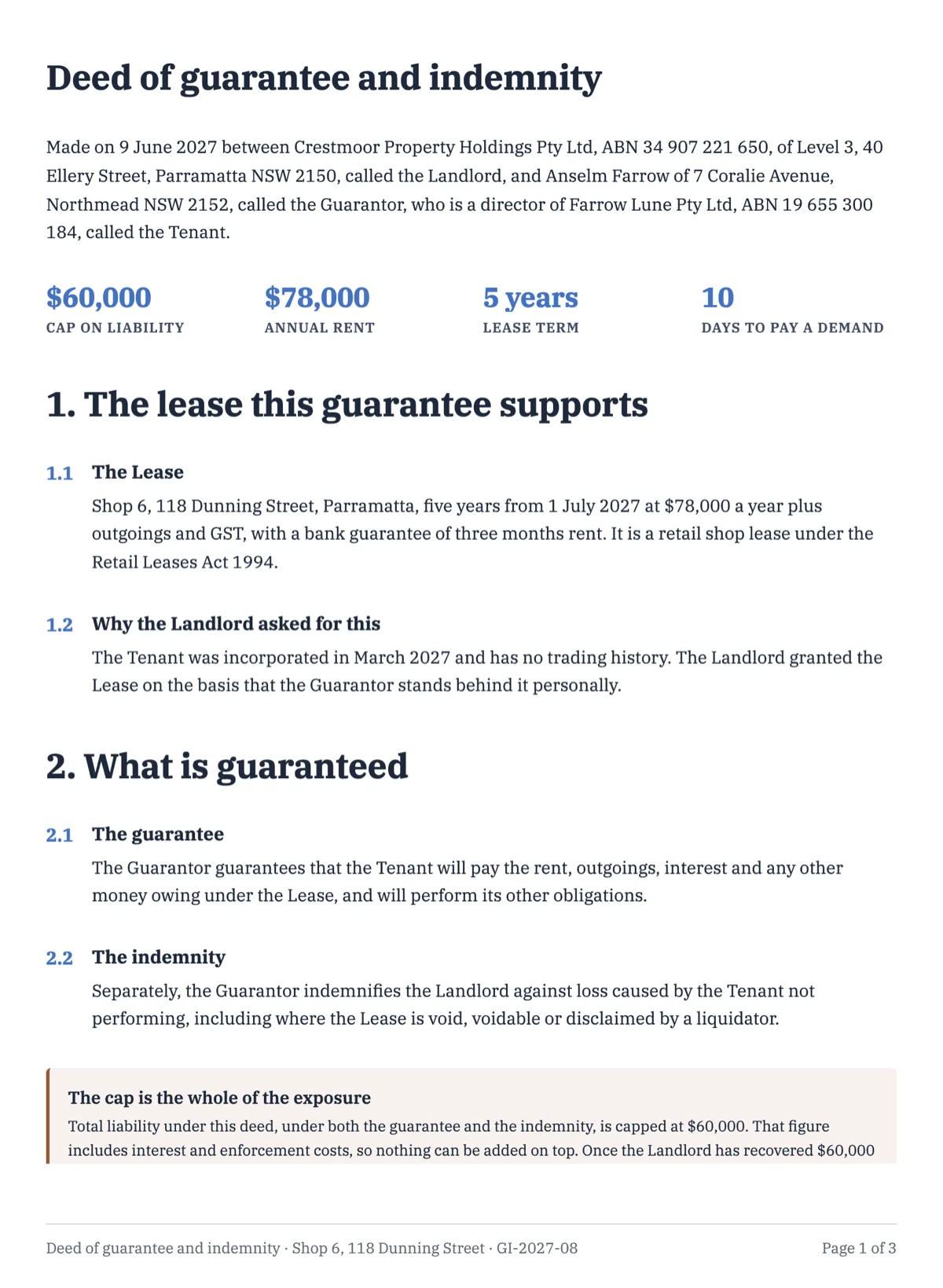 Personal guarantee template with a cap and a notice of demandA director asked to guarantee a lease wants to know one number: the most this can cost me. This three page deed answers it in a callout, capping the guarantor at $60,000 including interest and enforcement costs, then sets out the two steps the landlord has to take before a demand can be made at all.
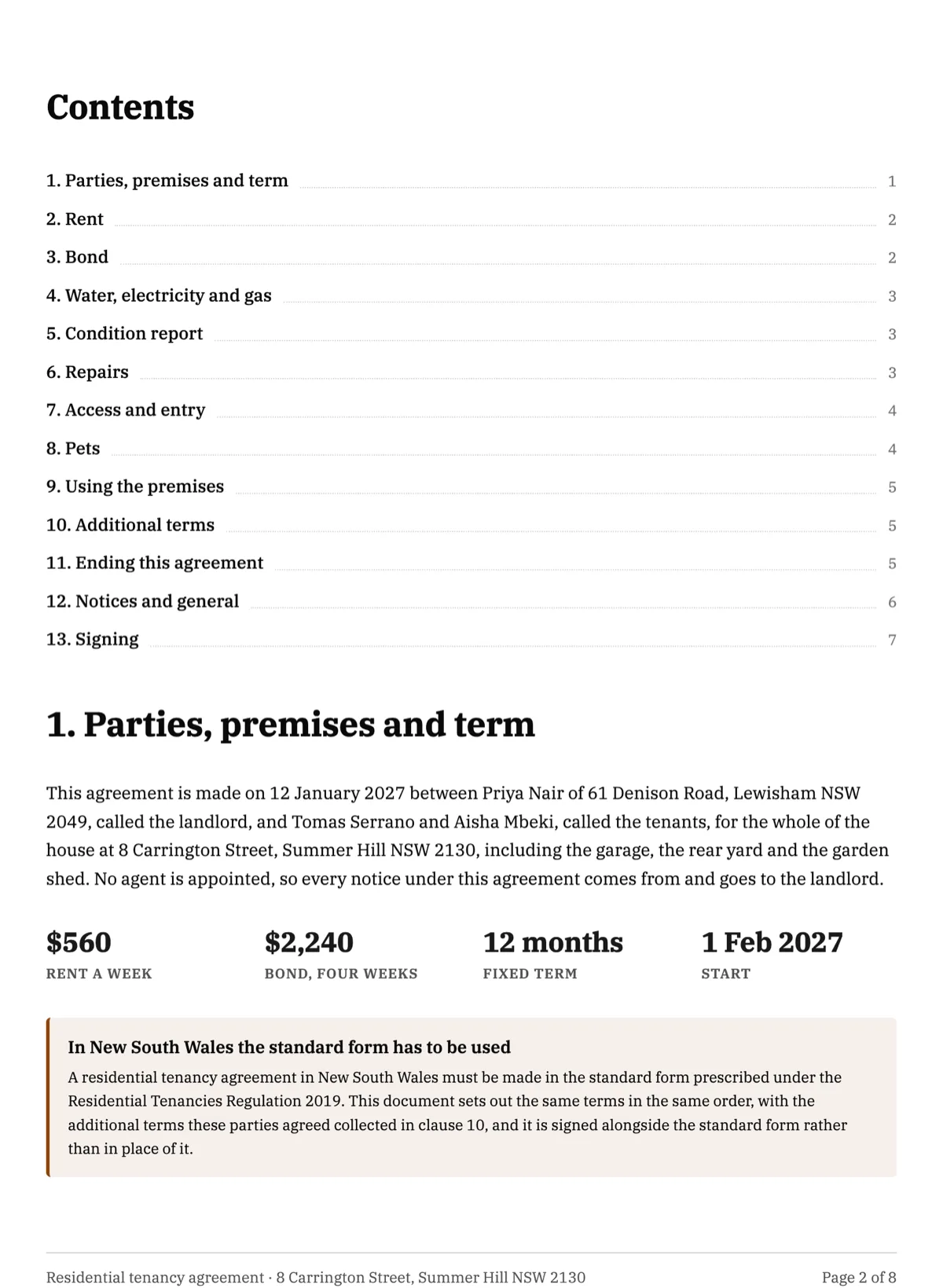 Residential lease agreement template for a New South Wales fixed termA residential tenancy is the one agreement where most of the terms are set by statute rather than by the parties, so the useful part of a template is the additional terms and the numbers. This one is a 12 month New South Wales fixed term at $560 a week, with the bond, the entry notice periods and the break fee written out exactly as the Act sets them.
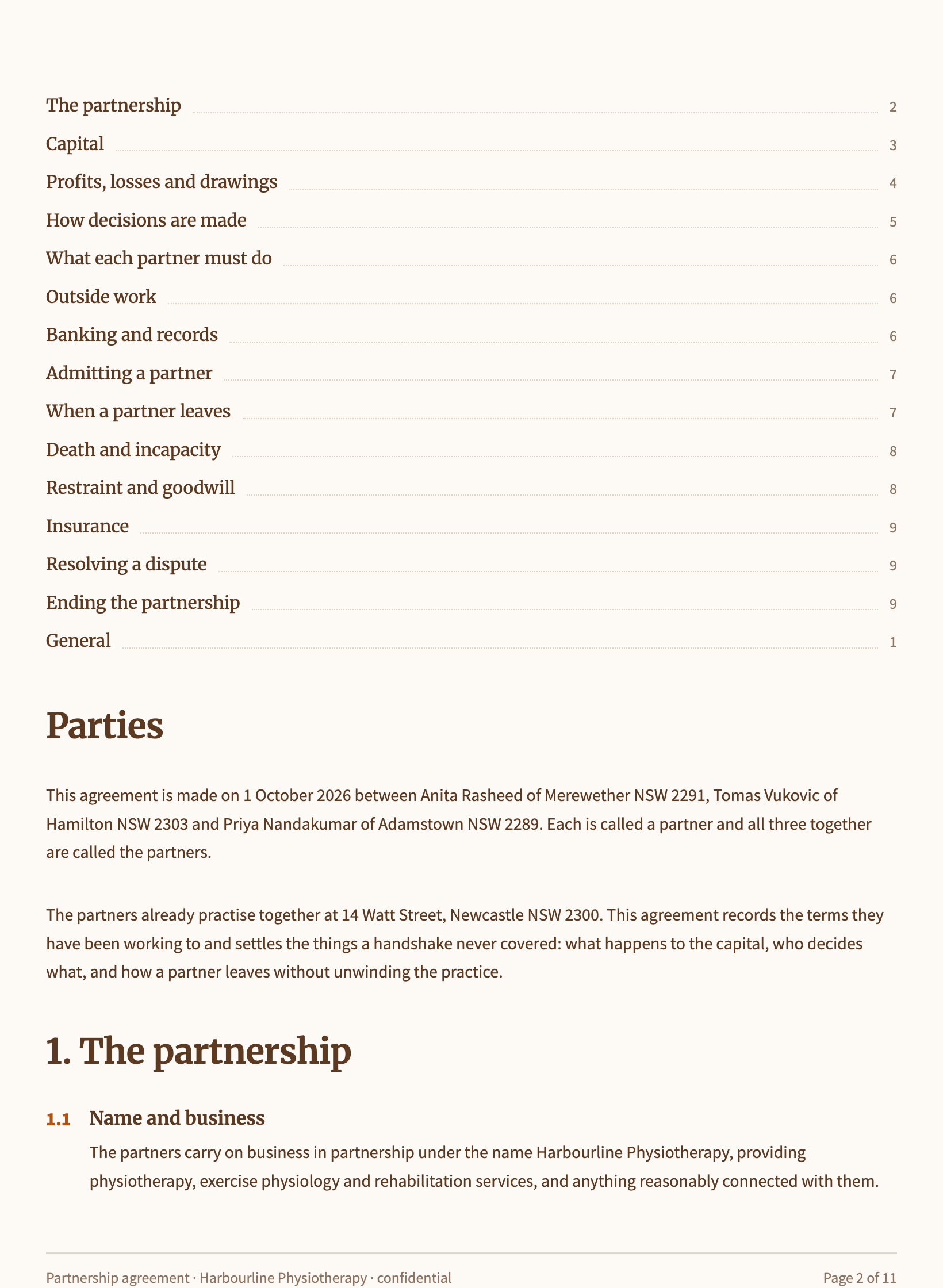 Partnership agreement templateThree physiotherapists have run one Newcastle practice together since 2024 without anything in writing. This agreement records what the handshake never covered: uneven capital sitting beside uneven hours, the six decisions no partner can make alone, and what a leaving partner is owed.
Questions people ask
What does jointly and severally liable mean?
It means each of the people bound is liable for the whole obligation, not just a share. The creditor can recover the full amount from any one of them, from several, or from all together, and they must sort out their shares between themselves.
Can a landlord chase just one tenant for all the rent?
Yes, if the tenants are jointly and severally liable, which is usual where they signed one agreement. The landlord can recover all the rent owed from any one tenant. That tenant can then try to recover the others' shares from them directly.
Can I recover my share from the other party?
Usually, yes. If you paid more than your share of a joint and several debt, the general law of contribution generally lets you recover the excess from the others. A written side agreement about shares makes this easier. Recovery can be hard if the other person has no money.
Does a release of one co signer release the others?
Not if the contract says it does not, as most do. Without such wording, the common law rule that releasing one joint debtor releases the others could apply. Co signers should assume they remain liable for the whole debt even if the creditor settles with their partner.
What is the difference between joint and joint and several?
Under purely joint liability, the obligation is a single shared one and, traditionally, all the joint obligors had to be sued together. Joint and several liability adds separate individual liability, so each can be sued alone for the whole. Modern contracts almost always use joint and several.
Put the clause in a finished document
The button opens the document generator with a starting description already filled in. Change it to match your own agreement before you run it.
Create a document with OneCraftRelated clauses
- Guarantor clause in a leaseA guarantor clause for a student tenancy with a parent as guarantor: rent and obligations for the fixed term, a 12 week cap, and renewal only with new consent.
- Proportionate liability clause: paying only your shareA proportionate liability clause decides whether a wrongdoer pays only its share. Australian sample wording, the state by state position on contracting out.
- Indemnity clause: promising to cover someone else's lossAn indemnity clause is a promise to cover the other party's loss from a named event. Australian sample wording, three variants and what each side negotiates.
For everything the document generator can do, see the document maker.
Step by step in the builder: Create a document with AI, then Document builder components.
Written and checked by the OneCraft team. Last checked .