Contract clause
Guarantor clause in a lease
A guarantor clause makes a third person, the guarantor, liable to pay rent and meet the tenant's other obligations if the tenant does not. It sets what the guarantor is liable for, any cap, when the landlord can call on the guarantee, and when the guarantor's liability ends.
Students and first time renters often have no rental history, so landlords ask a parent to stand behind the lease. The guarantor clause decides how far that promise reaches, and whether it quietly continues when the lease is renewed.
Nuwan Madhusanka · Co-founder
3 min read · Published
Sample clause
Written for a residential tenancy in Canberra between a fictional landlord and a university student, with the student's parent as guarantor.
Guarantee. (a) In consideration of the Landlord granting this tenancy, the Guarantor guarantees to the Landlord the payment of rent and other money payable by the Tenant, and the performance of the Tenant's obligations, during the fixed term ending 31 December 2027. (b) The Guarantor's total liability under this clause is limited to an amount equal to 12 weeks' rent at the rate applying when the claim is made. (c) The Landlord must give the Guarantor written notice of any default by the Tenant within 14 days of it occurring, and must give the Tenant the opportunity to remedy it before claiming against the Guarantor. (d) This guarantee does not extend to any renewal, extension or new agreement unless the Guarantor signs a fresh guarantee for it.
Sample wording, not legal advice.
Variants
Residential guarantor
Tenants without a rental history, such as students, where a family member supports the application.
The Guarantor guarantees the Tenant's obligations under this residential tenancy agreement during the fixed term, including payment of rent and the cost of repairing damage caused by the Tenant, and agrees that the Landlord may recover those amounts from the Guarantor if the Tenant does not pay them.
Commercial director guarantee
Commercial leases to small companies, where the landlord asks the directors to guarantee personally.
Each Guarantor jointly and severally guarantees to the Landlord the payment of all money and the performance of all obligations of the Tenant under this Lease, and indemnifies the Landlord against any loss if the Tenant's obligations are unenforceable.
Capped guarantee
Guarantors who will help but need to know the most they could ever owe.
The total amount the Guarantor can be required to pay under this guarantee, for all claims, is limited to $9,000, and the Guarantor's liability ends 3 months after the Tenant vacates the Premises.
What to negotiate
A cap
An uncapped guarantee can expose a parent to every amount a tenant owes, including large damage claims. A cap tied to a number of weeks of rent, as in the sample, keeps the risk proportionate. Landlords accept caps more readily when the guarantor is an individual and the bond already covers some risk.
Continuing liability
Many guarantees say they continue through any renewal or extension, which can bind a guarantor to a lease they never saw. Under the general law, a material variation of the lease without the guarantor's consent may release them, but relying on that is uncertain. A clause limiting the guarantee to the current term, with a fresh guarantee needed for any renewal, avoids the problem.
Notice of default
A guarantor who first hears of a default when months of arrears are claimed has lost the chance to help. The clause should require the landlord to tell the guarantor promptly about a default, so the guarantor can talk to the tenant or pay before the debt grows.
The risk of leaving it out
Without a guarantee, a landlord renting to someone with no income history relies only on the bond and the tenant's ability to pay. For the tenant, being unable to offer a guarantor can mean missing out on a property. For the guarantor, an unclear clause can mean liability far larger and longer than they intended, which is the main risk the drafting should address.
What a guarantor can be liable for and when it ends
Typical liabilities, depending on the clause: unpaid rent; utility charges the tenant must pay; repair of damage beyond fair wear and tear; cleaning and rubbish removal at the end; and break lease costs. Typical end points: the end of the fixed term; the date the tenant vacates and the landlord's claims are settled; a set period after vacating; or never, for continuing guarantees. A guarantee usually cannot be withdrawn part way through the term without the landlord's agreement, so the end point should be agreed before signing. Law checked on 21 October 2026. This page explains how the clause works and is not legal advice.
Guarantees in residential tenancies
Residential tenancies are governed by each state and territory's law, such as the ACT's Residential Tenancies Act 1997, and some laws restrict the security a landlord can take, such as limits on bonds. Tenancy authorities and renting information services in each jurisdiction can explain whether guarantees are permitted and how they interact with the bond rules. Landlords should check that a guarantee does not amount to extra security beyond what the law allows.
Joint and several guarantors
Where two or more people guarantee, such as both parents or several company directors, they are usually jointly and severally liable, meaning the landlord can recover the whole amount from any one of them. The guarantor who pays may then seek a contribution from the others. The joint and several liability clause page explains the effect in more detail.
Before signing as a guarantor
Read the lease as well as the guarantee, because the guarantee covers the tenant's obligations under it. Check the cap, the end date, whether it covers renewals, and whether you will be told about defaults. Keep a copy of both documents. Independent legal advice is sensible for a commercial guarantee, where amounts can be large.
Documents that carry this clause
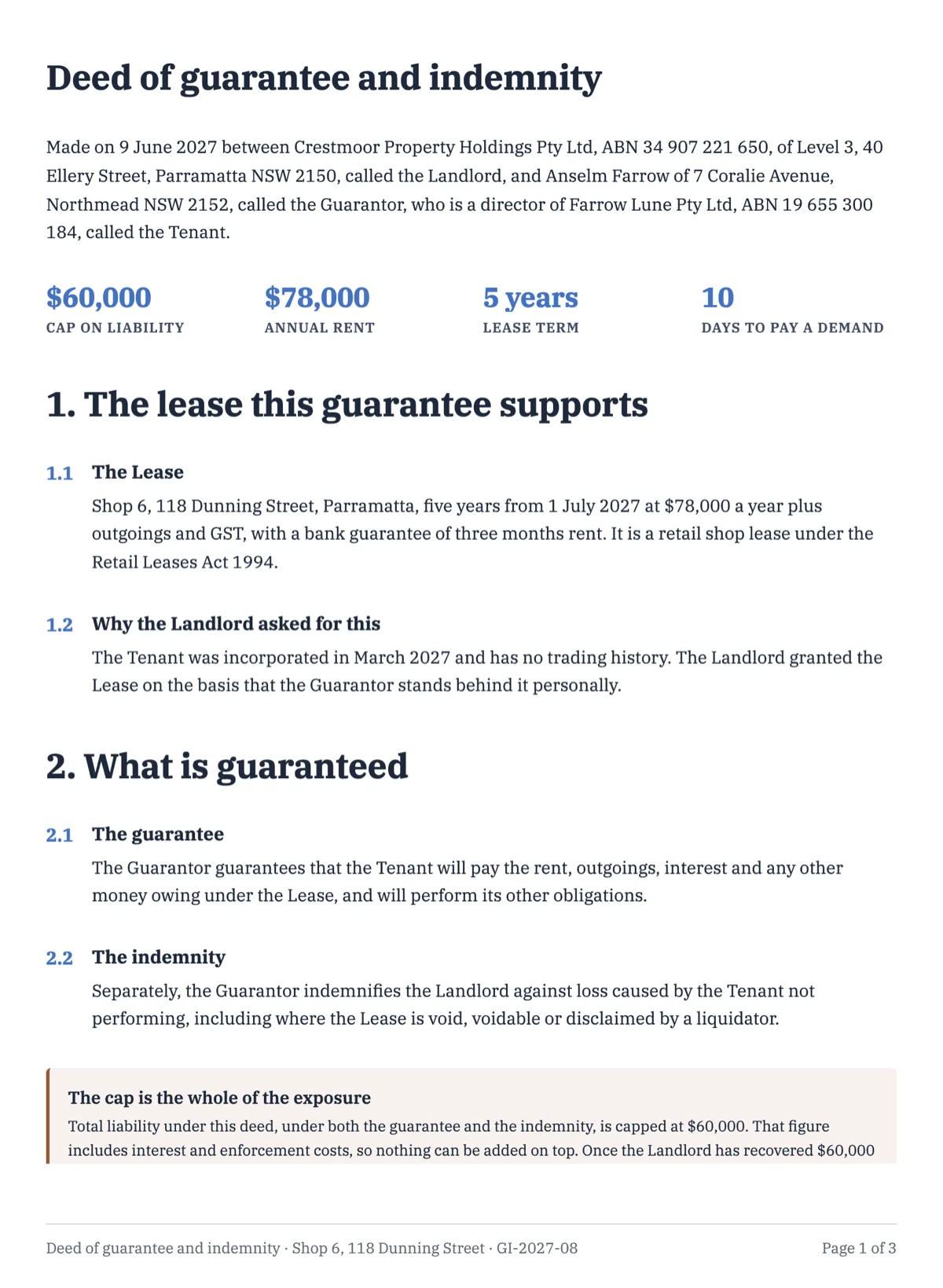 Personal guarantee template with a cap and a notice of demandA director asked to guarantee a lease wants to know one number: the most this can cost me. This three page deed answers it in a callout, capping the guarantor at $60,000 including interest and enforcement costs, then sets out the two steps the landlord has to take before a demand can be made at all.
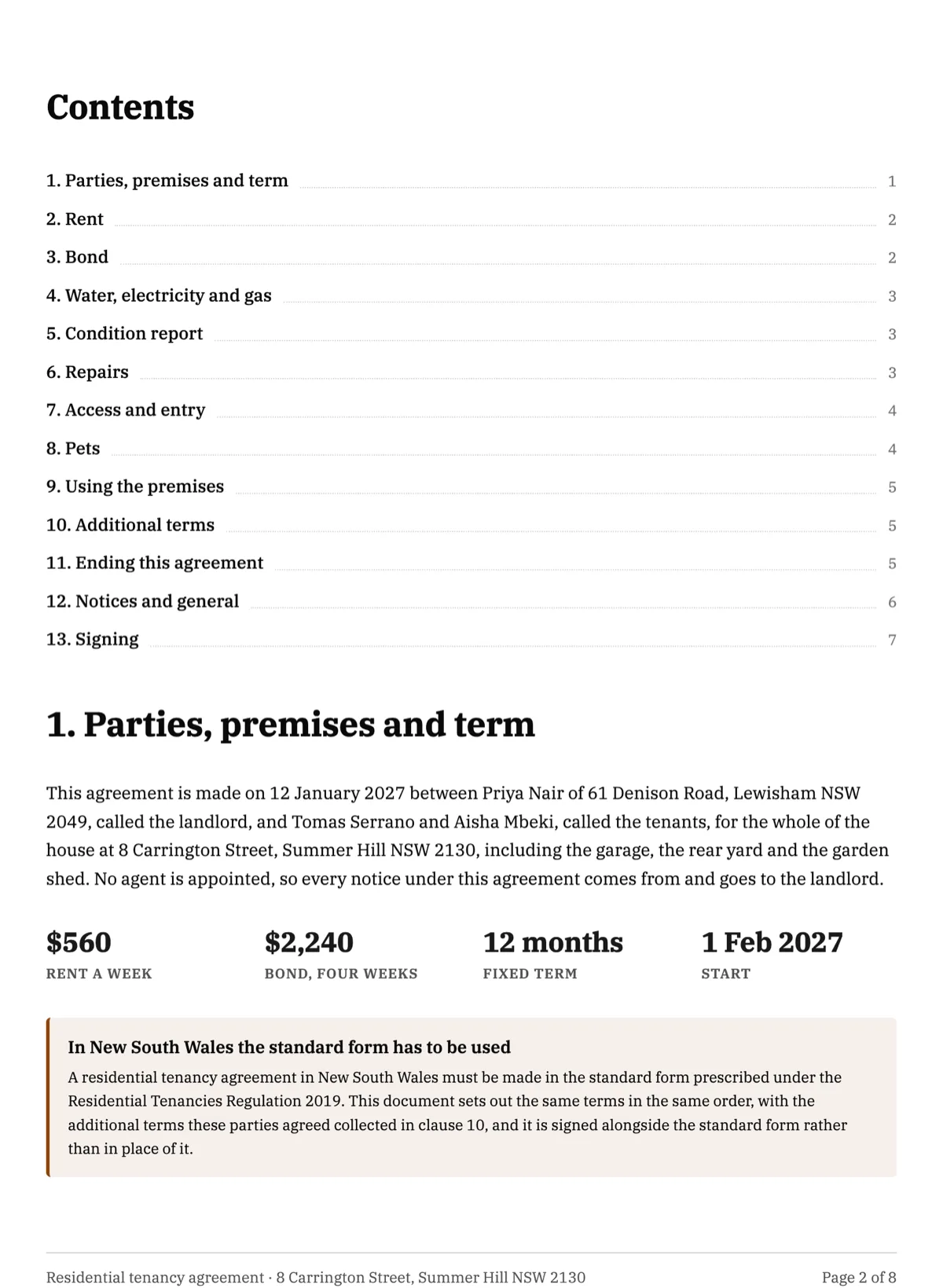 Residential lease agreement template for a New South Wales fixed termA residential tenancy is the one agreement where most of the terms are set by statute rather than by the parties, so the useful part of a template is the additional terms and the numbers. This one is a 12 month New South Wales fixed term at $560 a week, with the bond, the entry notice periods and the break fee written out exactly as the Act sets them.
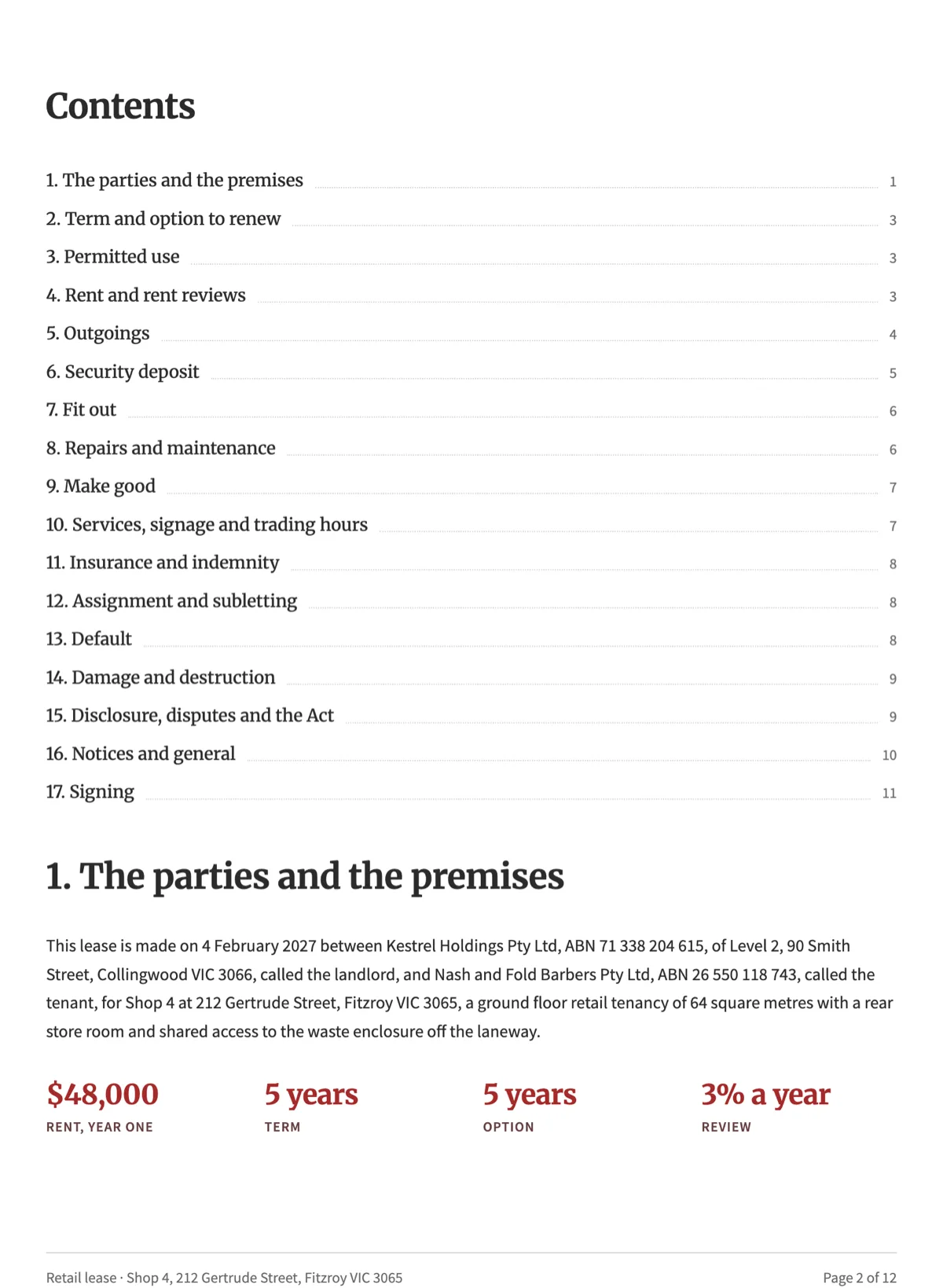 Commercial lease agreement template with outgoings and fit out termsA retail lease is decided by three numbers and two clauses: the rent, the review, the outgoings, the fit out contribution and the make good. This 12 page Victorian lease sets all five out in the open, including the outgoings the landlord is not allowed to recover at all.
Questions people ask
What does a guarantor on a lease have to pay?
Whatever the guarantee covers, usually unpaid rent and other money the tenant owes under the lease, such as repair costs for damage, if the tenant does not pay. A cap limits the total. Without a cap, the guarantor can be liable for everything the tenant owes under the lease.
Does a guarantee continue if the lease is renewed?
Only if the guarantee says so, or the guarantor agrees to the new lease. Many guarantees are written to cover renewals and extensions, which is why guarantors should check. A clause limiting the guarantee to the current fixed term, with a fresh guarantee for any renewal, protects the guarantor.
Can a guarantor withdraw?
Usually not during the term, without the landlord's agreement, because the guarantee was given in exchange for the landlord granting the lease. A guarantor may be able to limit future liability for a continuing guarantee by notice, if the guarantee allows it. Check the wording.
Can the landlord claim from the guarantor before the tenant?
It depends on the clause. Many guarantees let the landlord claim from the guarantor as soon as the tenant defaults, without suing the tenant first. A clause requiring notice and a chance for the tenant to fix the default first, as in the sample, gives the guarantor more protection.
Is a guarantor the same as a co-tenant?
No. A co-tenant has the right to live in the property and is directly liable under the lease. A guarantor has no right to occupy and is liable only if the tenant does not pay or perform. Both can be liable for the full amount, but the guarantor's liability is secondary.
Put the clause in a finished document
The button opens the document generator with a starting description already filled in. Change it to match your own agreement before you run it.
Create a document with OneCraftRelated clauses
- Bond clause in a lease: amount, lodgement and returnA bond clause in a lease sets the security amount, where it is held and when it comes back. Victorian sample wording, NSW and retail lease variants.
- Joint and several liability clause: each liable for the wholeA joint and several liability clause for co tenants and co borrowers: each liable for the whole amount, releases that do not free the others, and who pays what.
- Indemnity clause: promising to cover someone else's lossAn indemnity clause is a promise to cover the other party's loss from a named event. Australian sample wording, three variants and what each side negotiates.
- Break lease clause: what a tenant pays to leave earlyA break lease clause for an Australian residential tenancy: the NSW fixed break fee by term elapsed, and the Victorian and Queensland rule of rent until re-let.
For everything the document generator can do, see the document maker.
Step by step in the builder: Create a document with AI, then Document builder components.
Written and checked by the OneCraft team. Last checked .