Contract clause
Break lease clause: what a tenant pays to leave early
A break lease clause sets what a residential tenant must pay to end a fixed term tenancy early. In New South Wales the fee is fixed by law according to how much of the term has passed; in Victoria and Queensland the tenant is generally liable for rent until the property is re-let and reasonable re-letting costs.
Leaving a fixed term lease early is not illegal, but it costs money, and how much depends on which state the home is in. New South Wales sets a fixed fee; most other states make the tenant cover the landlord's actual loss.
Indunil Asanka · Co-founder
4 min read · Published
Sample clause
Written for a 12 month residential tenancy in Newcastle, New South Wales, where the fictional tenant Sam Heller needs to leave after 5 months for a job interstate.
Ending the Fixed Term Early. (a) If the Tenant ends this agreement before the end of the fixed term, other than for a reason the law allows without penalty, the Tenant must pay a break fee of: (i) 4 weeks' rent, if less than 25% of the fixed term has expired; (ii) 3 weeks' rent, if 25% or more but less than 50% has expired; (iii) 2 weeks' rent, if 50% or more but less than 75% has expired; (iv) 1 week's rent, if 75% or more has expired. (b) The break fee is the only amount payable for ending the fixed term early, apart from rent up to the date the Tenant gives vacant possession and any amount for damage. (c) This clause applies only to a fixed term of 3 years or less.
Sample wording, not legal advice.
Variants
New South Wales fixed break fee
NSW residential tenancies with a fixed term of 3 years or less, where the law sets the fee schedule.
If the tenant ends the fixed term early, the tenant must pay the break fee set by section 107 of the Residential Tenancies Act 2010 (NSW), which depends on the proportion of the fixed term that has expired, and no other compensation for ending the agreement early.
Re-letting costs, Victoria and Queensland
States without a fixed fee, where the tenant covers the landlord's actual loss while the landlord tries to re-let.
If the tenant leaves before the fixed term ends, the tenant must pay rent until a new tenant moves in or the fixed term ends, whichever is earlier, and a fair share of advertising and letting fees, and the landlord must take reasonable steps to find a new tenant.
No clause, general damages
Leases that are silent, where the general law of damages and the state Act decide what is owed.
This agreement does not set a break fee. If the tenant ends it early, the landlord may claim compensation for loss caused, as allowed by the residential tenancies law, and must take reasonable steps to reduce that loss.
What to negotiate
Fees
In NSW the break fee cannot be more than the schedule for fixed terms of 3 years or less, and landlords cannot add extra fees for ending early. In states without a fixed fee, tenants can ask the landlord to agree a fixed amount in advance, which gives certainty, though any agreed amount must comply with the state law and cannot exceed what the law allows.
Advertising and letting costs
Where the tenant pays re-letting costs, the usual approach is a proportion of the letting fee matching the time left on the lease, plus reasonable advertising. A tenant leaving with two months of a twelve month lease left should not pay a full letting fee. Ask for receipts and check the amounts against what the state authority describes as reasonable.
Rent until re-let
Tenants in states without a fixed fee keep paying rent until a new tenant moves in or the term ends, but the landlord must try to re-let and cannot wait out the lease. Tenants can help by finding a suitable replacement tenant, which the landlord should consider reasonably. Agree in writing the date rent stops.
The risk of leaving it out
In NSW, the statutory break fee applies to fixed terms of 3 years or less even if the agreement does not repeat it, so leaving it out mainly causes confusion. In other states, a lease silent on breaking early leaves the parties to argue about compensation under the general law. A clear clause tells both sides what to expect before anyone needs to leave.
State by state
New South Wales: under the Residential Tenancies Act 2010, for fixed terms of 3 years or less, the break fee is 4, 3, 2 or 1 weeks' rent depending on whether less than 25%, 25% to 50%, 50% to 75% or more than 75% of the term has expired. Victoria: under the Residential Tenancies Act 1997, a renter who leaves early may be liable for rent until the property is re-let, and for reasonable re-letting costs, and can apply to VCAT if the amount is disputed. Queensland: the Residential Tenancies Authority explains that a tenant who breaks a lease may be liable for rent until a new tenant moves in and for a share of re-letting costs, with the landlord obliged to minimise the loss. Other states follow the compensation approach with their own details. Law checked on 21 October 2026. This page explains how the clause works and is not legal advice.
Leaving without penalty
Some reasons let a tenant end a fixed term without a break fee or compensation. In NSW they include domestic violence, offered social housing, the landlord putting the property up for sale without disclosing it, and needing to move to an aged care facility. Queensland allows a tenant experiencing domestic and family violence to end a tenancy by notice. Victoria allows family violence and other hardship grounds through VCAT. Check the state authority's list before paying a fee that may not be owed.
Worked example
Sam Heller pays $560 a week on a 12 month NSW lease and leaves after 5 months. Just over 41% of the term has expired, which falls in the 25% to 50% band, so the break fee is 3 weeks' rent, $1,680, plus rent up to the date Sam hands back the keys. If the same tenancy were in Queensland, Sam would instead pay rent until a new tenant moved in, perhaps 3 weeks, plus a share of advertising and letting fees for the 7 months remaining.
Commercial leases are different
This clause concerns residential tenancies. Commercial and retail leases usually have no right to leave early at all unless the lease contains a break clause, which is a negotiated option to end on a set date. The separate break clause page covers that commercial option.
Documents that carry this clause
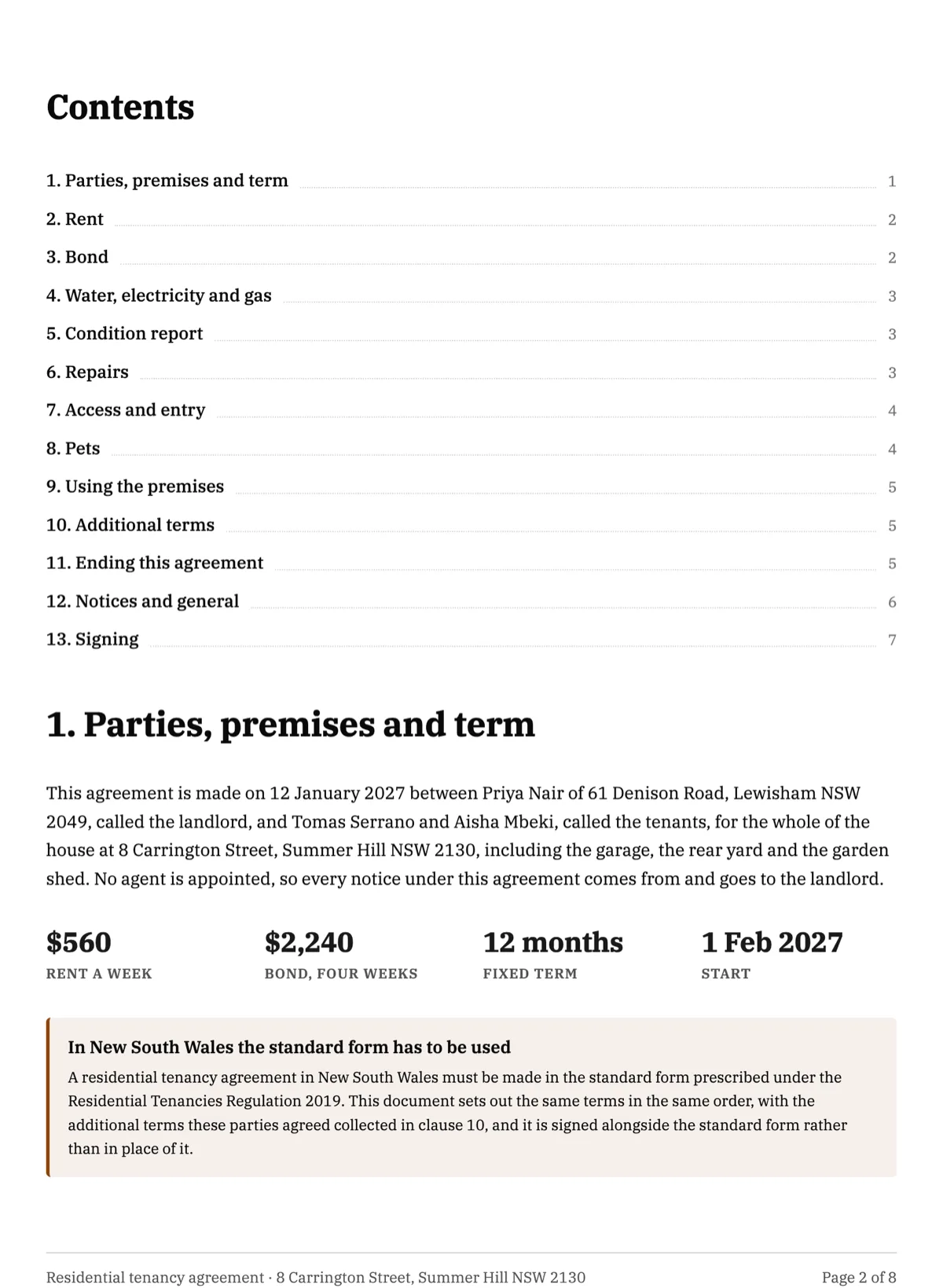 Residential lease agreement template for a New South Wales fixed termA residential tenancy is the one agreement where most of the terms are set by statute rather than by the parties, so the useful part of a template is the additional terms and the numbers. This one is a 12 month New South Wales fixed term at $560 a week, with the bond, the entry notice periods and the break fee written out exactly as the Act sets them.
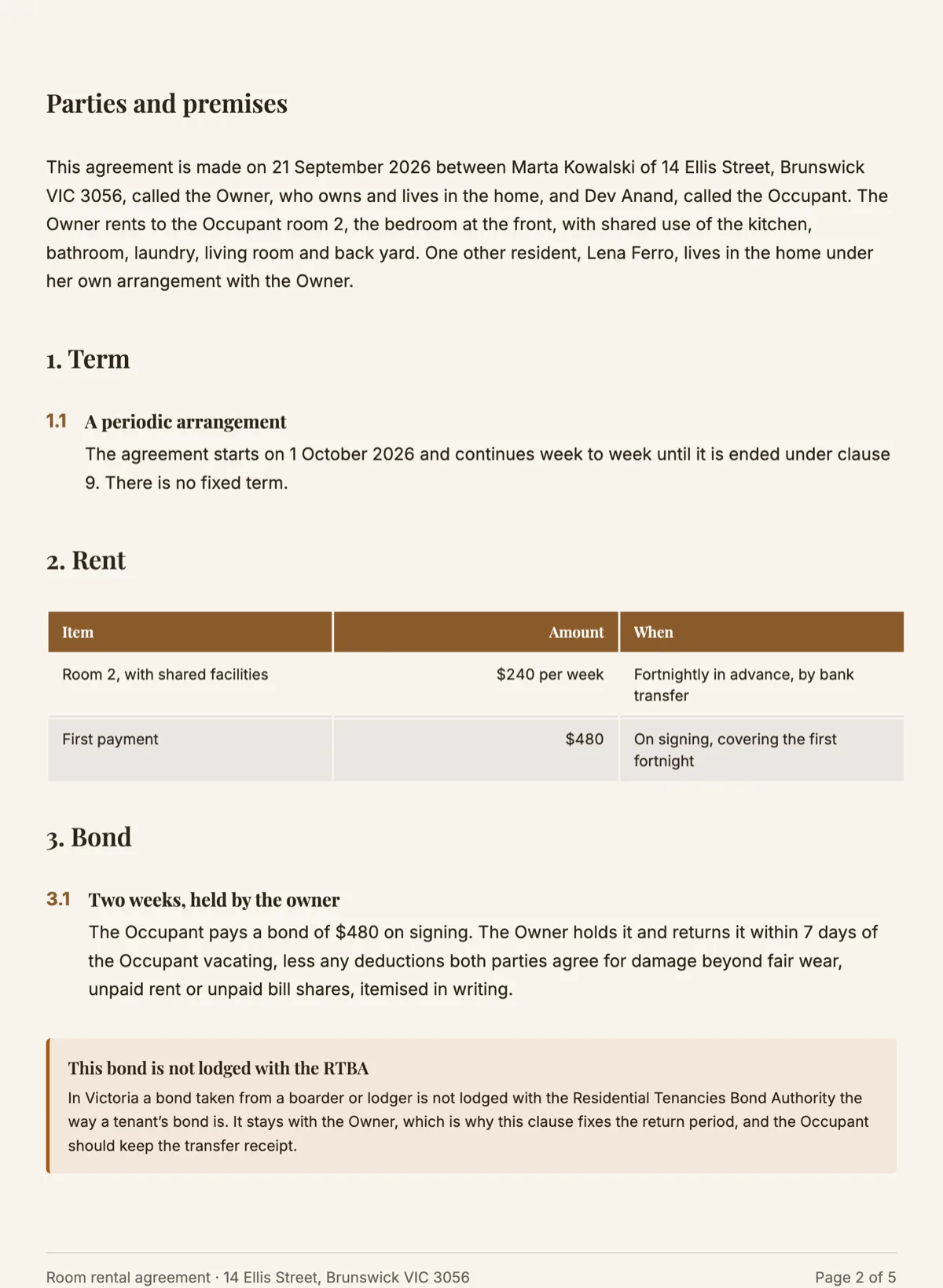 Room rental agreement template for one room in a shared homeRenting a room is not the same as renting a house, and most templates copy a residential lease and hope. This one is written for one room with shared kitchen and bathroom, prices the bills split, lists the rules that matter, and says plainly that the occupant is a boarder or lodger and what that changes.
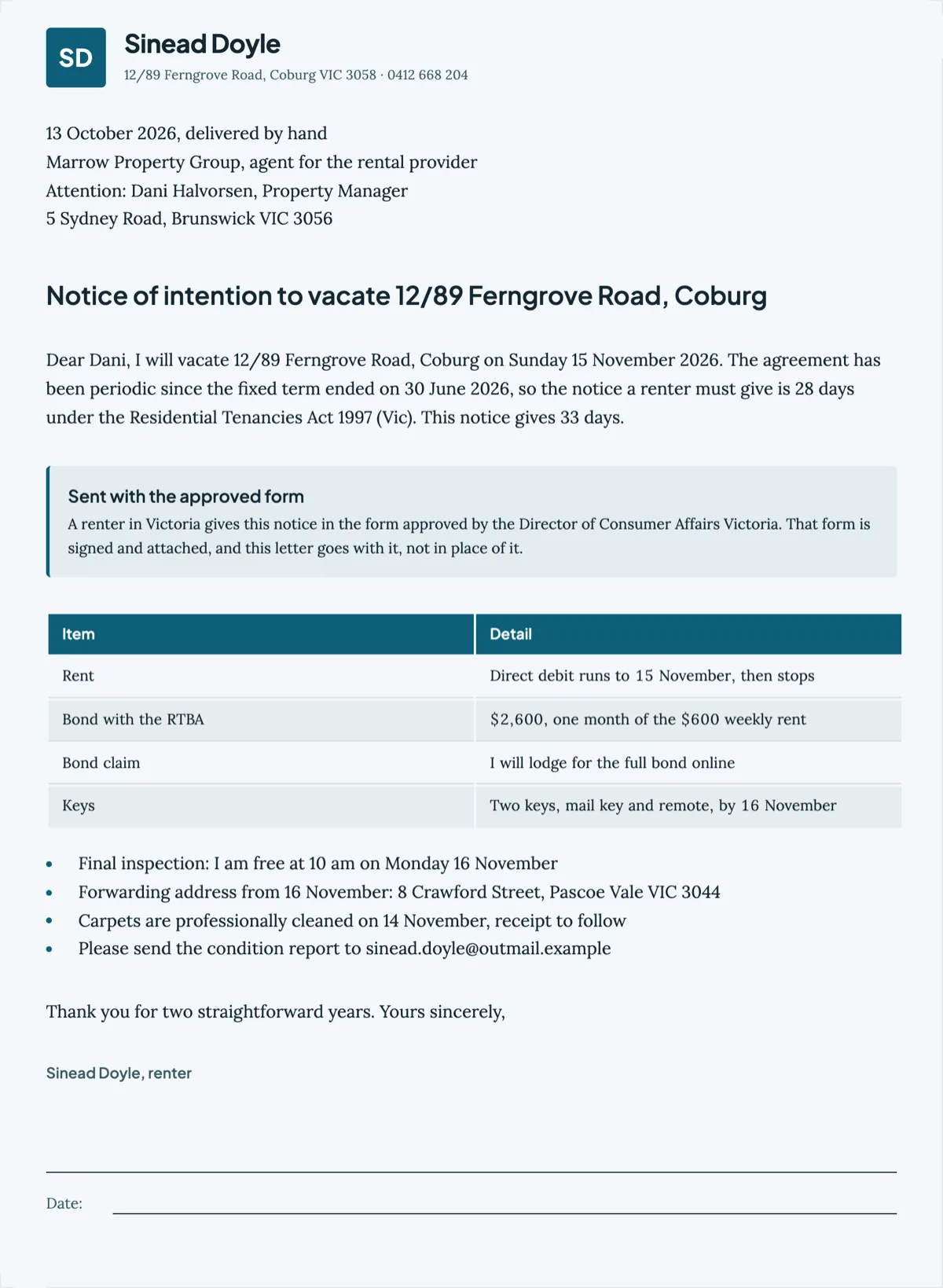 Notice to vacate template for a tenant giving notice on a periodic leaseA renter ending a periodic agreement has to give the right number of days and prove later that the notice arrived. This one dates the notice, counts 33 days against a 28 day requirement, says it travels with the approved form, and settles rent, bond, keys and the final inspection on the same page.
Questions people ask
How much does it cost to break a lease in NSW?
For fixed terms of 3 years or less, the break fee is set by law: 4 weeks' rent if less than a quarter of the term has passed, 3 weeks if a quarter to a half, 2 weeks if a half to three quarters, and 1 week after that. You also pay rent until you give vacant possession.
Do I pay rent until a new tenant moves in?
In states without a fixed break fee, such as Victoria and Queensland, usually yes, until a new tenant moves in or the fixed term ends, whichever is first. The landlord must take reasonable steps to re-let. In NSW, the fixed break fee replaces that liability for terms of 3 years or less.
Can I break a lease for domestic violence?
Yes, in most states, without a break fee or compensation. NSW allows a domestic violence termination notice, Queensland allows a tenant experiencing domestic and family violence to end the tenancy by notice, and other states have processes through their tribunals or authorities. Contact the state authority or a support service for the steps.
Can the landlord keep my bond for breaking the lease?
The landlord can claim from the bond for amounts legally owed, such as the break fee or unpaid rent, but must follow the state bond claim process. You can dispute a claim you do not agree with. The bond cannot be kept simply because you left early if nothing is owed.
Does finding a replacement tenant help?
Often. In states where you pay rent until the property is re-let, finding a suitable replacement tenant can shorten that period, and landlords should not unreasonably refuse a suitable applicant. In NSW the fixed fee still applies, but the landlord may agree to reduce or waive it.
Put the clause in a finished document
The button opens the document generator with a starting description already filled in. Change it to match your own agreement before you run it.
Create a document with OneCraftRelated clauses
- Break clause in a commercial leaseA break clause lets a party end a lease early on a set date and conditions. UK sample wording for England and Wales, variants, and why breaks fail.
- Early termination fee clauseAn early termination fee clause charges for ending a contract before the term ends. Sample wording, sliding scales, the penalty test and unfair terms limits.
- Holding over clause: staying on after the lease expiresA holding over clause sets the terms when a tenant stays on after a lease expires. Victorian retail sample wording, residential and UK variants, notice rules.
- Bond clause in a lease: amount, lodgement and returnA bond clause in a lease sets the security amount, where it is held and when it comes back. Victorian sample wording, NSW and retail lease variants.
For everything the document generator can do, see the document maker.
Step by step in the builder: Create a document with AI, then Document builder components.
Written and checked by the OneCraft team. Last checked .