Contract clause
No shop clause: exclusivity while the buyer does its diligence
A no shop clause stops a seller, for a set period, from seeking, encouraging or negotiating offers from other buyers while the proposed buyer investigates the business and negotiates the final agreement. It is usually binding even when the rest of a letter of intent is not.
A buyer spends real money on lawyers, accountants and management time once it agrees terms in principle. A no shop clause is how it makes sure the seller is not using that work to shop for a better price elsewhere.
Nuwan Madhusanka · Co-founder
4 min read · Published
Sample clause
Written for a letter of intent from Granite Peak Brands, a fictional outdoor products group, to buy Sawtooth Outfitters, a fictional outdoor gear retailer.
Exclusivity. (a) For 60 days from the date of this letter (the Exclusivity Period), the Seller and its shareholders, directors, employees and advisers must not, directly or indirectly, solicit, encourage, discuss or negotiate any proposal from any person other than the Buyer to acquire any shares in or material assets of the Company, or provide any information to any such person for that purpose. (b) The Seller must promptly tell the Buyer of any approach it receives during the Exclusivity Period, including the identity of the person and the main terms proposed. (c) If the Buyer is still actively pursuing the transaction and has delivered a draft purchase agreement, the Exclusivity Period extends by 15 days. (d) This paragraph and paragraphs on confidentiality and costs are legally binding. The rest of this letter is not.
Sample wording, not legal advice.
Variants
No shop
Private company acquisitions, where the seller agrees not to seek other buyers but may receive unsolicited approaches.
During the Exclusivity Period the Seller must not solicit or initiate any proposal for the acquisition of the Company from any third party, and must notify the Buyer of any unsolicited approach within 2 business days.
No talk
Buyers with leverage who want to stop the seller even listening to other bidders.
During the Exclusivity Period the Seller must not solicit, respond to, discuss, negotiate or provide information in connection with any proposal from a third party to acquire the Company, whether or not the proposal was solicited.
Go shop with a break fee
Deals where the seller wants to test the market after signing, accepting a fee if it takes a better offer.
For 30 days after signing, the Company may solicit alternative proposals. If within that period it enters into an agreement for a superior proposal, it must pay the Buyer a break fee of 1.5% of the purchase price.
What to negotiate
Length
Sixty to ninety days is common for a private acquisition, long enough for diligence and drafting. Sellers should resist long periods without milestones, and tie any extension to the buyer actively progressing, such as delivering a draft agreement, as the sample does. A buyer that is slow should not be able to keep the seller off the market indefinitely.
Binding when the rest is not
Letters of intent are usually non binding on price and terms, but the exclusivity, confidentiality and costs paragraphs are commonly made binding. The letter should say so expressly. A no shop in a letter that is entirely non binding gives the buyer little protection.
Fiduciary out for a board
Directors of a company, especially a listed company, have duties to shareholders that may require them to consider a superior proposal. In public deals, no shop clauses usually include a fiduciary out allowing the board to engage with an unsolicited superior proposal. Regulators also limit deal protection: in Australia the Takeovers Panel scrutinises lock up devices, and in the UK the Takeover Code restricts offer related arrangements.
The risk of leaving it out
Without a no shop clause, a seller can use a buyer's offer to draw out a better price from another bidder, while the buyer continues paying for diligence. Buyers will often refuse to start serious work without exclusivity, so omitting it can slow or end a deal. Sellers, in turn, risk being locked up too long if the clause has no time limit.
No shop, no talk and go shop compared
A no shop stops the seller seeking offers but usually allows it to listen to unsolicited ones, often with a duty to tell the buyer. A no talk goes further and stops the seller even discussing approaches, which is strong protection for the buyer but can be hard to justify for a board with fiduciary duties. A go shop does the opposite for a short period after signing: the seller may actively look for a better offer, and pays the buyer a break fee if it accepts one. Delaware courts have examined these provisions in many takeover cases, generally upholding reasonable deal protections that do not prevent a board from meeting its duties. Law checked on 21 October 2026. This page explains how the clause works and is not legal advice.
Private and public deals
In a private sale, the seller is often the owner, and the no shop is a straightforward commercial term. In a public company deal, directors must act in shareholders' interests, so exclusivity is subject to more scrutiny and usually comes with a fiduciary out. The UK Takeover Code generally prohibits offer related arrangements between an offeror and the target, and in Australia the Takeovers Panel has guidance on lock up devices such as no shop, no talk and break fees, so public deal protection follows those rules.
Reporting approaches
A duty to tell the buyer about other approaches lets it judge whether the seller is being approached and on what terms. Sellers often limit what must be disclosed, for example the existence and main terms of an approach but not the bidder's identity, to protect the other party's confidentiality. The clause should state the time for notice.
Remedies for breach
If a seller breaches a binding no shop, the buyer may claim damages, typically its wasted costs, or in some cases an injunction stopping the seller dealing with another bidder. Many letters of intent add a cost reimbursement or break fee for breach of exclusivity, which avoids proving loss. A break fee must not be so large that it operates as a penalty.
Documents that carry this clause
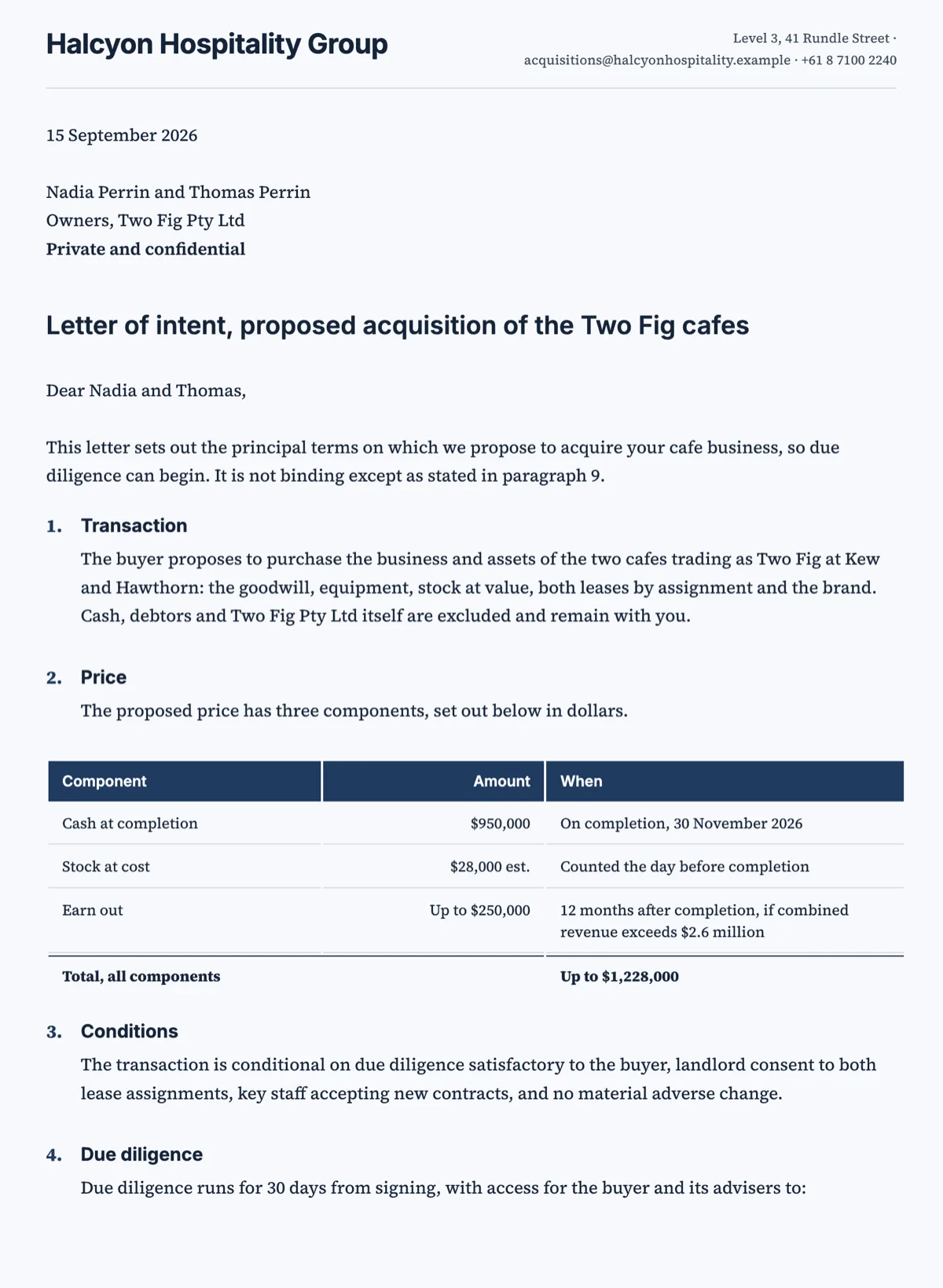 Letter of intent template for buying a businessA letter of intent is the deal on one page, written before either side has spent money on lawyers, and its only binding parts are the promises that make spending that money safe. This example records a cafe acquisition of up to $1,228,000 with an earn out, gives the buyer 45 days of exclusivity, and numbers the paragraphs that bind.
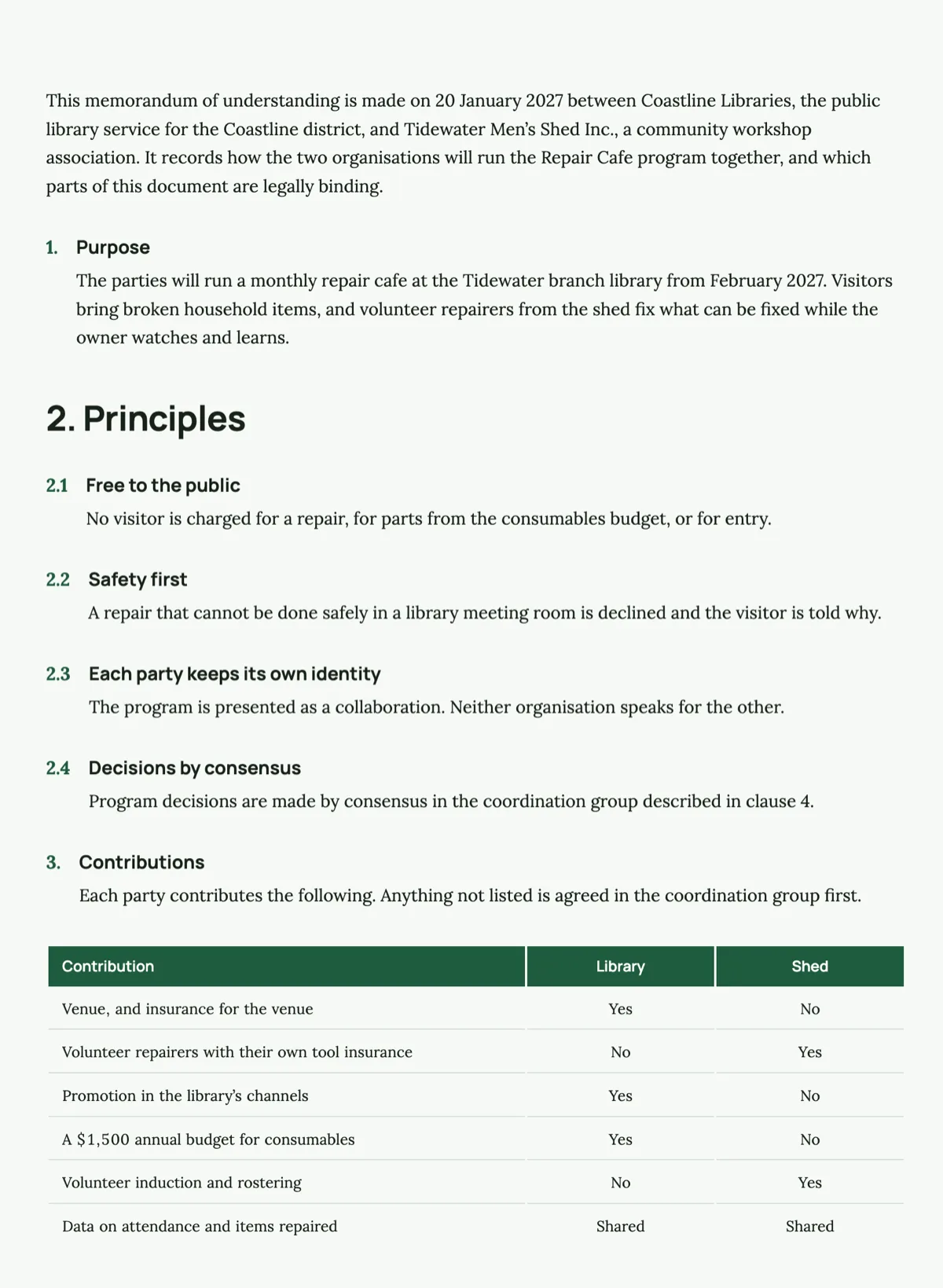 Memorandum of understanding template that says which clauses bindAn MOU is useful because it is not a contract, and dangerous when nobody says which parts are. This one records a collaboration between a library service and a men's shed in plain words, puts each side's contribution in a table, and marks the three clauses that legally bind, where a letter of intent or a mutual NDA would bind by design.
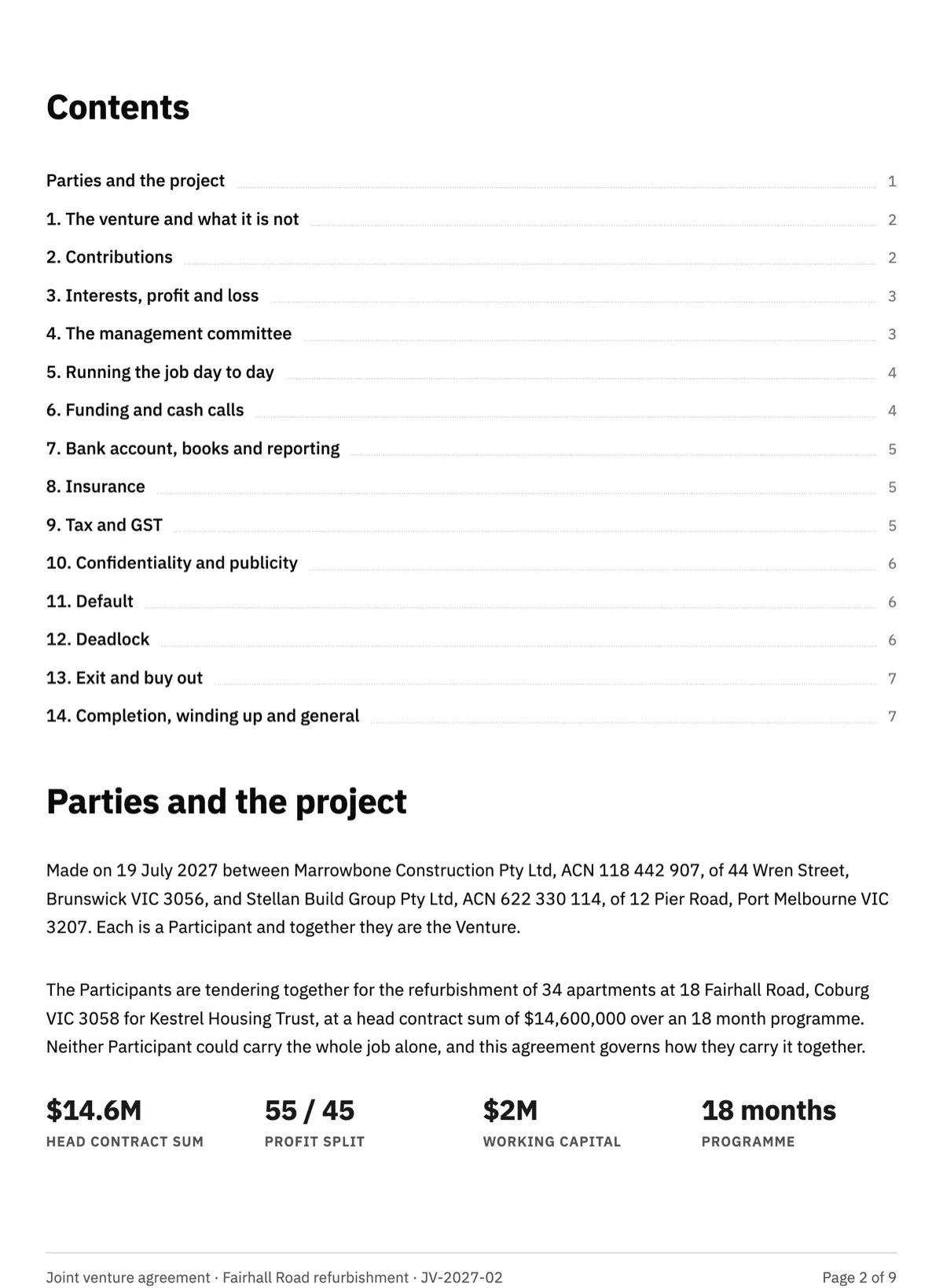 Joint venture agreement template with contributions and splitAn unincorporated joint venture has no company to fall back on, so everything a company structure would supply has to be written down. This one puts two builders together for a single $14.6 million refurbishment, splits it 55/45, and sets out who funds it, who decides, how a deadlock breaks and how either of them gets out.
Questions people ask
Is a no shop clause binding in a non binding letter of intent?
It can be, if the letter says so. Most letters of intent state that price and deal terms are not binding but that exclusivity, confidentiality and costs are. Without express wording, a court may treat the whole letter, including the no shop, as non binding.
How long does a no shop last?
As long as the clause says, commonly 30 to 90 days for private deals. Many clauses allow an extension if the buyer is progressing, such as by delivering a draft agreement. Sellers should avoid open ended exclusivity and ask for the period to end early if the buyer drops its price or stops engaging.
What is a go shop?
A go shop is a provision, usually in a signed merger agreement, allowing the target company to actively seek better offers for a short period after signing. If it accepts a superior offer during that window, it usually pays the original buyer a reduced break fee. It is the opposite of a no shop.
Can a seller talk to someone who approaches it unsolicited?
Under a no shop, usually yes, though it must often tell the buyer. Under a no talk clause, no. Public company boards typically keep a fiduciary out allowing them to engage with an unsolicited superior proposal. Check the wording, because the difference between solicit and discuss matters.
What happens if the seller breaches the no shop?
The buyer can claim damages, often its wasted transaction costs, and in some cases seek an injunction. Many letters of intent include an agreed cost reimbursement or break fee for breach of exclusivity, so the buyer does not have to prove its loss.
Put the clause in a finished document
The button opens the document generator with a starting description already filled in. Change it to match your own agreement before you run it.
Create a document with OneCraftRelated clauses
- Exclusivity clause: dealing only with each other, within limitsAn exclusivity clause commits a party to deal only with the other for a period. Australian venue catering sample, supply and territory variants, ACCC limits.
- Confidentiality clauseA confidentiality clause inside a wider contract, not a standalone NDA. Sample consulting wording, mutual and one way variants, the tail period and exceptions.
- Condition precedent clause: what must happen before completionA condition precedent clause for buying a Melbourne cafe: landlord consent and licence transfer before completion, who must satisfy them, and a long stop date.
- Material adverse change clause: when a buyer or lender can walk awayA material adverse change clause for buying a medical device maker: the definition, carve outs for the economy, industry and pandemics, and Akorn v Fresenius.
For everything the document generator can do, see the document maker.
Step by step in the builder: Create a document with AI, then Document builder components.
Written and checked by the OneCraft team. Last checked .