Contract clause
Material adverse change clause: when a buyer or lender can walk away
A material adverse change clause, also called a material adverse effect clause, lets a buyer or lender refuse to complete, or treat a default as having occurred, if the target or borrower suffers a serious and lasting decline between signing and completion. Carve outs exclude general risks the buyer agreed to bear.
Between signing a deal and closing it, things can go wrong. A MAC clause decides which bad news lets a buyer walk away. Courts set the bar high: in decades of Delaware litigation, a buyer has rarely succeeded, and Akorn v Fresenius in 2018 stands out because it did.
Nuwan Madhusanka · Co-founder
4 min read · Published
Sample clause
Written for an agreement for a fictional private equity fund to acquire Redwood Medical Devices, a fictional US maker of surgical instruments.
Material Adverse Effect. (a) Material Adverse Effect means any event, change or effect that, alone or together with others, has had or would reasonably be expected to have a material adverse effect on the business, results of operations or financial condition of the Company and its subsidiaries taken as a whole, other than any effect arising from: (i) general economic, political or financial market conditions; (ii) conditions generally affecting the surgical instruments industry; (iii) any pandemic or epidemic, or measures taken by governments in response; (iv) changes in law or accounting standards after the date of this agreement; or (v) the announcement of the transaction, except, in the case of (i) to (iv), to the extent the Company is disproportionately affected compared with other participants in its industry. (b) It is a condition to the Buyer's obligation to close that no Material Adverse Effect has occurred since the date of this agreement.
Sample wording, not legal advice.
Variants
Acquisition MAC
Public and private M&A, where the clause is a closing condition with carve outs negotiated in detail.
The Buyer is not obliged to complete if, between signing and completion, a Material Adverse Effect has occurred, as defined in clause 1.1, excluding the matters listed in the carve outs.
Lending MAC
Loan agreements, where a material adverse change can be an event of default or a condition to drawing.
An Event of Default occurs if any event or circumstance occurs which the Lender reasonably considers has had or is reasonably likely to have a material adverse effect on the Borrower's business, assets or financial condition or its ability to perform its payment obligations.
MAC as a warranty, not a condition
Deals where the buyer wants a damages claim rather than a walk away right.
The Seller warrants that, since the Accounts Date, there has been no material adverse change in the financial position or prospects of the Company. A breach of this warranty gives rise to a claim for damages and does not entitle the Buyer to refuse to complete.
What to negotiate
Carve outs
Sellers push for carve outs so the buyer bears general risks: the economy, the industry, changes in law, natural disasters, pandemics, and the effect of announcing the deal. Buyers accept these but add the disproportionate effect exception, so that if the target is hit much harder than its industry, the carve out does not protect the seller. After 2020, pandemic carve outs became standard.
Disproportionate effect
The disproportionate effect wording asks whether the target suffered worse than comparable businesses. That requires an industry comparison, which can be argued over. Buyers should define the comparison group; sellers should ensure only the excess impact counts, not the whole effect.
Durational significance
Delaware courts have held that a MAC must be durationally significant: a decline that would be measured in years, not a short term dip, viewed from the perspective of a reasonable acquirer. A bad quarter is unlikely to qualify. Buyers who want a lower bar should define specific measurable triggers, such as revenue falling below a set level, rather than rely on the general wording.
The risk of leaving it out
Without a MAC clause, a buyer that has signed must complete even if the business has collapsed in the meantime, subject only to any specific conditions and warranties. For sellers, a MAC clause without carve outs gives the buyer a broad, uncertain exit. Most deals with a gap between signing and completion include one, carefully negotiated.
The carve outs and the Delaware cases
Typical carve outs: general economic conditions; industry wide conditions; changes in law and accounting standards; acts of war, terrorism and natural disasters; pandemics; the announcement or pendency of the deal; and failure to meet projections, though not the underlying cause. In Akorn v Fresenius, decided by the Delaware Court of Chancery in 2018 and affirmed by the Delaware Supreme Court, the buyer validly terminated after the target suffered a dramatic, sustained fall in performance and serious regulatory compliance failures, the first such finding in Delaware. In the pandemic cases of 2020 and 2021, including AB Stable VIII v MAPS, the courts held pandemic effects fell within carve outs, though a buyer succeeded on a separate ordinary course covenant. Law checked on 21 October 2026. This page explains how the clause works and is not legal advice.
The English approach
English courts also set a high bar. In Grupo Hotelero Urvasco v Carey Value Added, decided in 2013, the court held a lender relying on a MAC in a loan must show a significant change in the borrower's financial condition that is not merely temporary, judged mainly from its financial information, and that the lender could not rely on circumstances it knew about when the agreement was made. That approach is similar in spirit to Delaware's durational significance test.
MAC clauses in loans
Lenders include MAC events of default or drawdown conditions, but rarely rely on them alone, because calling a default on a MAC is a high risk decision that can expose the lender to a claim if it is wrong. Borrowers should resist subjective wording such as in the opinion of the lender, and seek to limit the clause to their ability to pay.
Specific triggers instead
Because general MAC clauses are hard to invoke, parties often add specific conditions: revenue or EBITDA above a stated level, retention of key customers, no regulatory action of a stated kind. These give certainty that the general clause cannot, and the general MAC remains as a backstop for the unexpected.
Documents that carry this clause
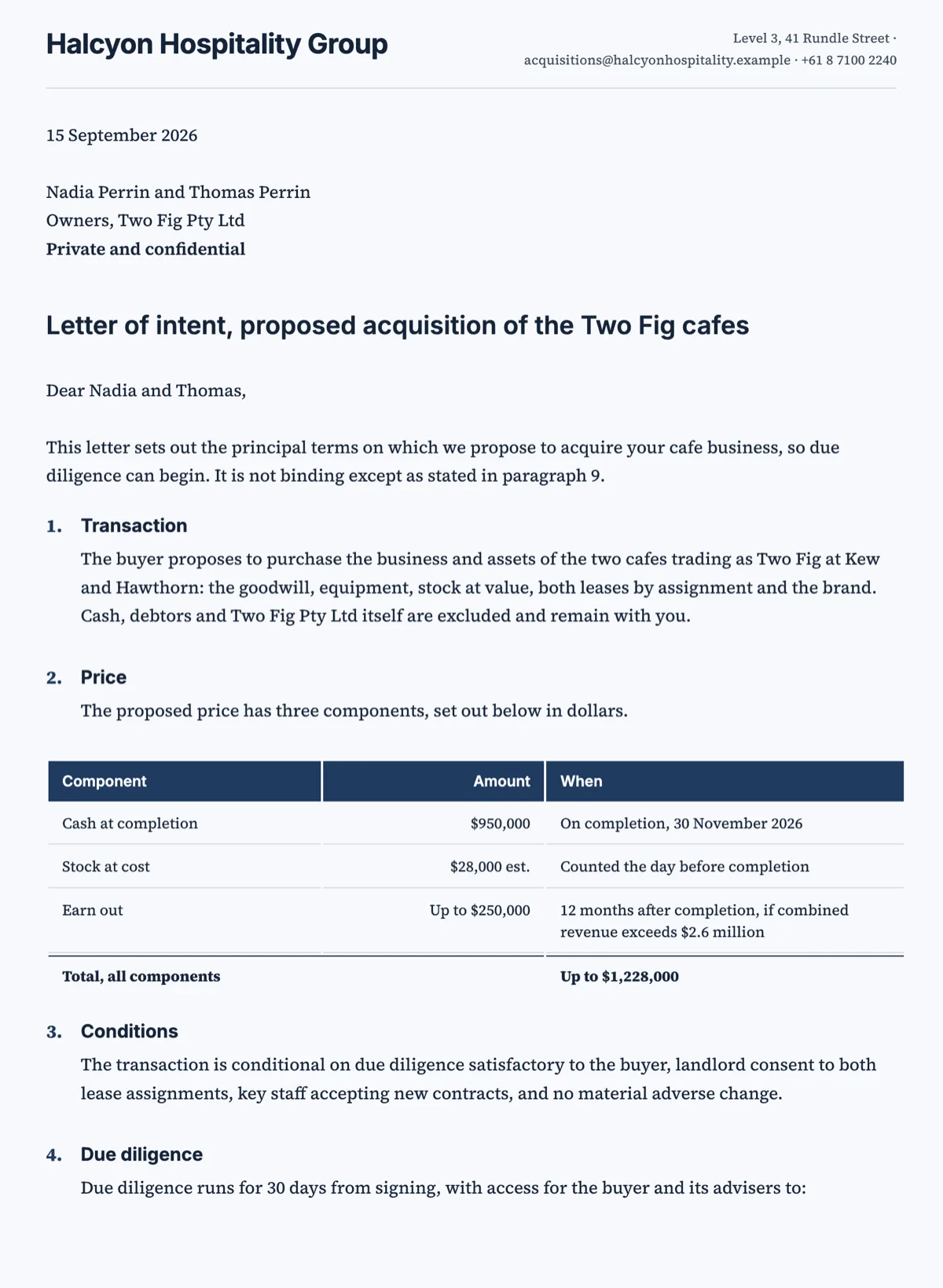 Letter of intent template for buying a businessA letter of intent is the deal on one page, written before either side has spent money on lawyers, and its only binding parts are the promises that make spending that money safe. This example records a cafe acquisition of up to $1,228,000 with an earn out, gives the buyer 45 days of exclusivity, and numbers the paragraphs that bind.
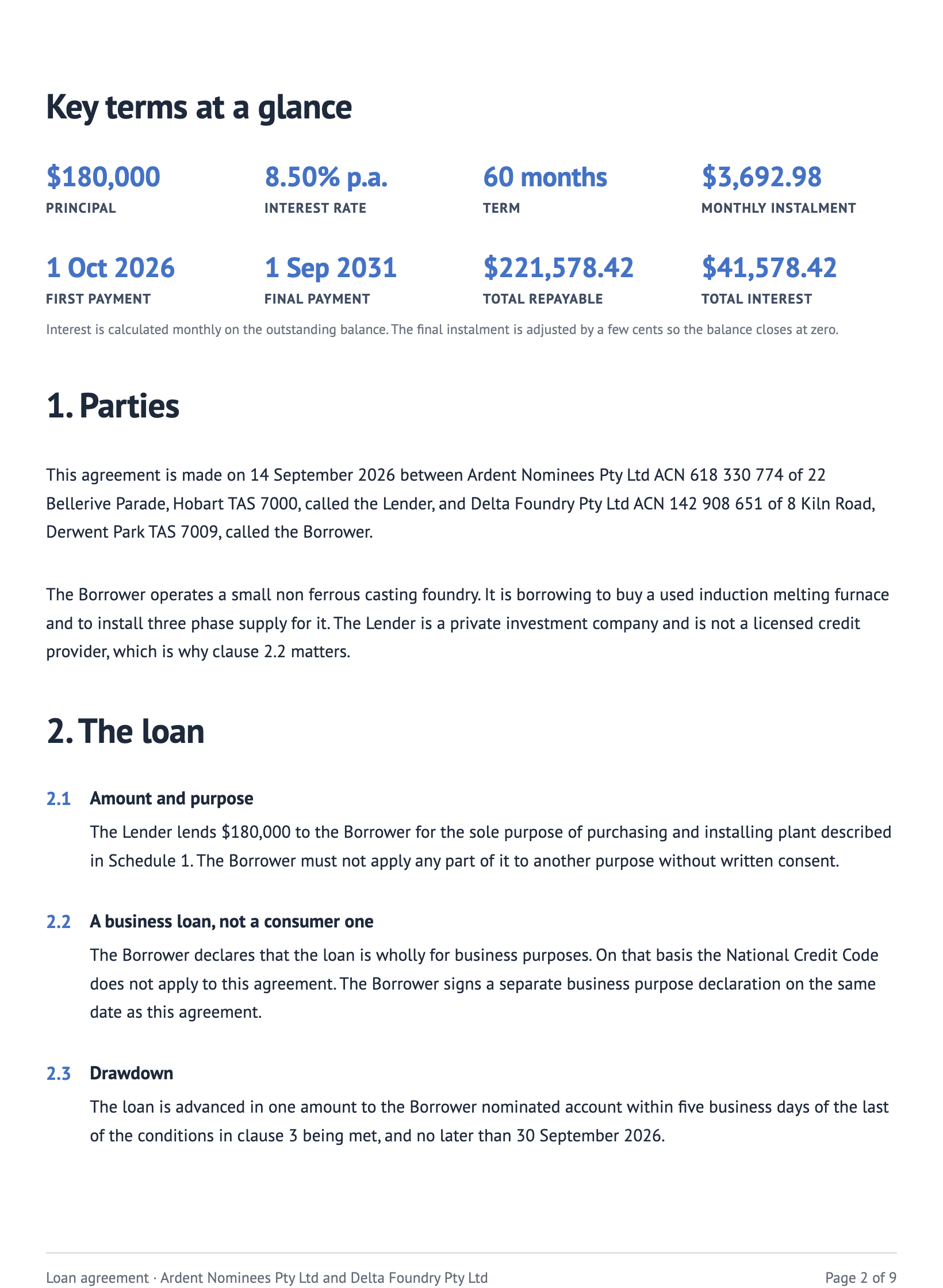 Loan agreement templateA Tasmanian foundry is borrowing $180,000 from a private investment company to buy a used induction furnace. The lender is not a bank, so everything a bank would take for granted has to be written down: what has to happen before the money moves, what is registered over what, and how long the borrower gets to fix a default.
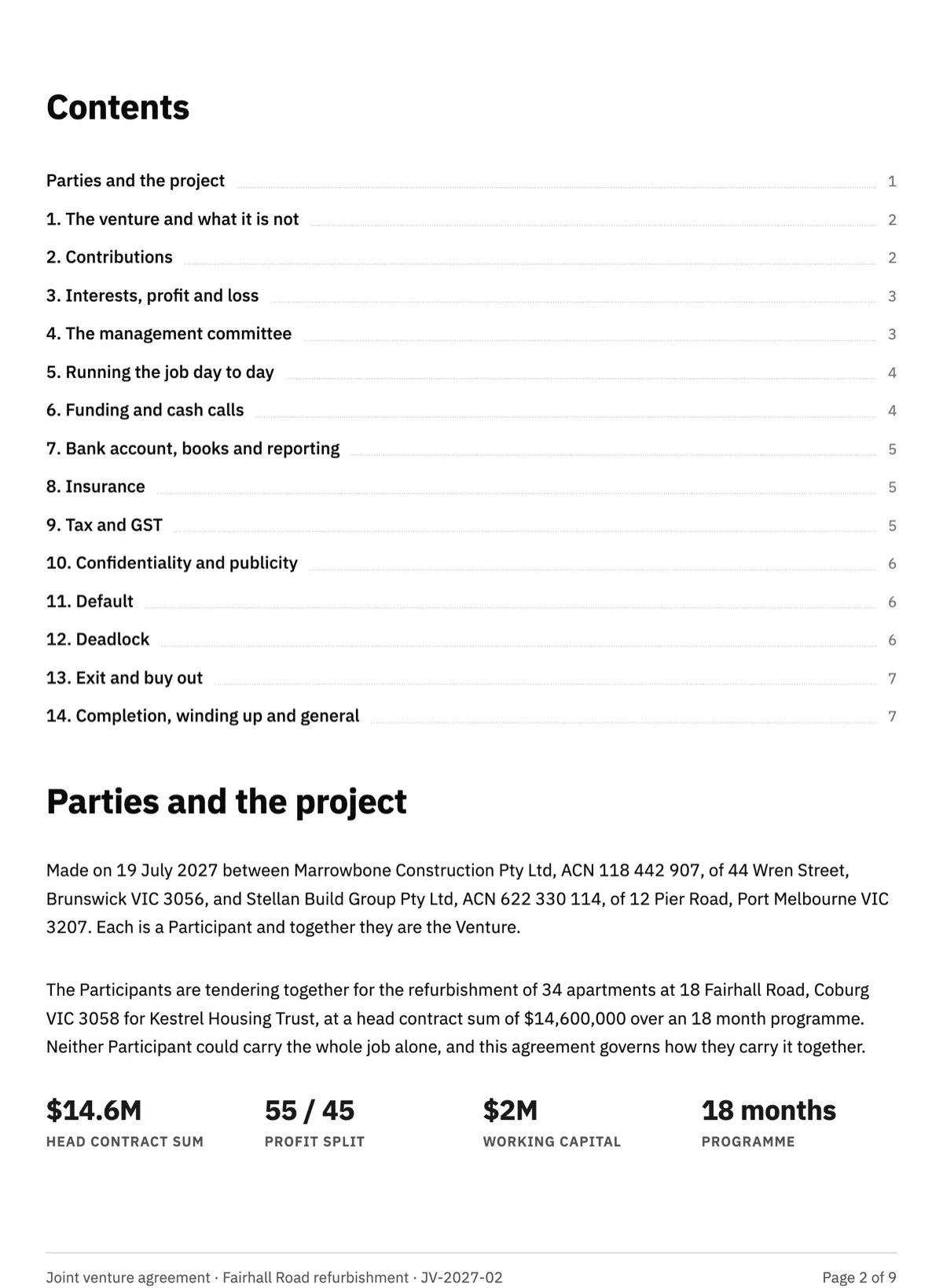 Joint venture agreement template with contributions and splitAn unincorporated joint venture has no company to fall back on, so everything a company structure would supply has to be written down. This one puts two builders together for a single $14.6 million refurbishment, splits it 55/45, and sets out who funds it, who decides, how a deadlock breaks and how either of them gets out.
Questions people ask
What counts as a material adverse change?
A serious, lasting decline in the target's business, results or financial condition, as defined in the clause and not excluded by its carve outs. Courts look for an effect that is significant to a reasonable buyer over a period of years. A short term dip or a missed quarter usually does not qualify.
Has a MAC clause ever been enforced?
Rarely, but yes. In Akorn v Fresenius in 2018, the Delaware courts upheld a buyer's termination because the target had suffered a dramatic and lasting decline plus serious regulatory problems. In most other litigated cases, buyers failed to show a MAC.
What is a MAC clause in a loan?
It is a provision making a material adverse change in the borrower an event of default, or a condition the lender relies on before advancing money. Lenders seldom call a default on a MAC alone because of the risk of being wrong, but it gives them leverage in negotiations.
Are pandemics excluded from MAC clauses?
In most deals signed since 2020, yes, expressly, and often with a disproportionate effect exception so the seller is protected only to the extent its business suffered like others in its industry. In the pandemic cases, courts found pandemic effects fell within existing carve outs for general conditions or calamities.
What is the difference between MAC and MAE?
They are used largely interchangeably. Material adverse effect is more common in US agreements, while material adverse change appears more often in English and Australian ones. What matters is how the clause defines the term, the carve outs it lists and whether it is a condition or a warranty, not the label.
Put the clause in a finished document
The button opens the document generator with a starting description already filled in. Change it to match your own agreement before you run it.
Create a document with OneCraftRelated clauses
- Condition precedent clause: what must happen before completionA condition precedent clause for buying a Melbourne cafe: landlord consent and licence transfer before completion, who must satisfy them, and a long stop date.
- Force majeure clause: excusing performance when events interveneA force majeure clause excuses performance during events outside either party's control. Sample wording with a sixty day exit, variants and notice duties.
- No shop clause: exclusivity while the buyer does its diligenceA no shop clause for a letter of intent to buy a retailer: 60 days of exclusivity, no soliciting other offers, reporting approaches, and go shop compared.
- Warranty clause: promising a standard and backing itA warranty clause promises a fact is true or that work meets a standard. Australian sample wording for a ninety day defects warranty, variants and remedies.
For everything the document generator can do, see the document maker.
Step by step in the builder: Create a document with AI, then Document builder components.
Written and checked by the OneCraft team. Last checked .