Contract clause
Condition precedent clause: what must happen before completion
A condition precedent clause says a party's obligation to perform, often to complete a purchase, does not arise until named events happen, such as a consent being given or a licence transferred. It sets who must work to satisfy each condition, who can waive it, and a long stop date after which either party can end the contract.
Many deals can be signed before they can be finished: the landlord has not yet approved the lease transfer, the licence is still in someone else's name. A condition precedent clause lets the parties commit now and complete only when those pieces fall into place.
Nuwan Madhusanka · Co-founder
4 min read · Published
Sample clause
Written for the purchase of Laneway Espresso, a fictional Melbourne cafe business, by a new owner from the founder.
Conditions Precedent. (a) Completion is conditional on: (i) the Landlord consenting in writing to the assignment of the Lease to the Buyer on terms reasonably acceptable to the Buyer (the Lease Condition); and (ii) the food business registration for the Premises being transferred to, or issued in the name of, the Buyer (the Licence Condition). (b) The Seller must use reasonable endeavours to satisfy the Lease Condition and the Buyer must use reasonable endeavours to satisfy the Licence Condition, and each must keep the other informed of progress. (c) The Lease Condition may be waived only by the Buyer. The Licence Condition may be waived only by agreement of both parties. (d) If the Conditions are not satisfied or waived by 5.00 pm on 30 April 2027 (the Long Stop Date), either party may end this agreement by written notice, and the Seller must refund the deposit.
Sample wording, not legal advice.
Variants
Conditions to completion
Most sales, where the contract is binding when signed but completion waits for the conditions.
Completion will not occur unless and until each of the Conditions in Schedule 1 has been satisfied or waived under clause 3.4, and the parties' obligations to complete are conditional on them.
Conditions to the contract taking effect
Arrangements that should not bind the parties at all until approval is given, such as a regulator's approval.
Apart from clauses 1, 3, 12 and 14, which bind the parties from the date of this agreement, this agreement does not take effect unless and until the Condition is satisfied.
Conditions only one party can waive
Conditions that protect one party, such as finance or satisfactory due diligence for a buyer.
The Due Diligence Condition is for the benefit of the Buyer only and may be waived only by the Buyer by written notice to the Seller before the Long Stop Date.
What to negotiate
Who must satisfy each condition
Each condition should name the party responsible and the effort required. A seller is usually best placed to obtain a landlord's consent; a buyer to get its own licence or finance. Without an allocation, a party may do nothing and then rely on the condition failing to escape a deal it no longer wants. Courts may imply a duty to cooperate, but express drafting is safer.
Reasonable endeavours or best endeavours
The level of effort matters. Reasonable endeavours generally requires one reasonable course of action, balancing the party's own interests; best endeavours requires more, and may require taking steps against the party's interests. All reasonable endeavours sits between them. Parties should pick the standard deliberately and, where possible, list specific steps such as applying within 5 business days.
The long stop date
A long stop date gives certainty: if the conditions are not met by then, the deal can end. Too short, and a slow landlord can kill a good deal; too long, and the parties are tied up while the business changes. The clause should say whether the date can be extended and what happens to any deposit if the contract ends.
The risk of leaving it out
Without a condition precedent clause, a buyer who signs an unconditional contract must complete even if the landlord refuses to transfer the lease, leaving it with a business it cannot trade from. Without a long stop date, a conditional contract can stay alive indefinitely, preventing the seller from selling to anyone else.
A conditions tracker
A tracker table keeps a conditional deal moving. Columns: condition; responsible party; first step and deadline, such as landlord consent application lodged by 15 March; status; who can waive; and evidence of satisfaction, such as the signed deed of assignment. For Laneway Espresso, the lease condition sits with the seller, who applies to the landlord with the buyer's financial and references, and the licence condition sits with the buyer, who applies to the council. Updating the tracker weekly and sharing it avoids surprises at the long stop date. Law checked on 21 October 2026. This page explains how the clause works and is not legal advice.
Conditions in Australian business sales
For many small business sales in Australia, the key conditions are the landlord's consent to assign the lease, transfer of licences and permits, and sometimes finance. For retail premises, state retail leases laws, such as Victoria's Retail Leases Act 2003, regulate when a landlord can withhold consent to an assignment and the information it can ask for. business.gov.au's guidance on buying an existing business lists the checks a buyer should make, many of which become conditions in the contract.
Waiver
A condition that protects only one party, such as due diligence for a buyer, is usually waivable by that party alone. A condition required by law, such as a regulatory approval, usually cannot be waived at all, because completing without it would be unlawful. The clause should say who can waive each condition, as the sample does, so there is no argument when one party wants to proceed without it.
Conditions and contract terms
Lawyers distinguish conditions precedent to the contract coming into existence from conditions precedent to performance. The difference affects whether the parties are bound to try to satisfy the condition and whether either can walk away beforehand. Most commercial clauses are conditions to performance, with express duties to cooperate, which is the structure the sample uses.
Documents that carry this clause
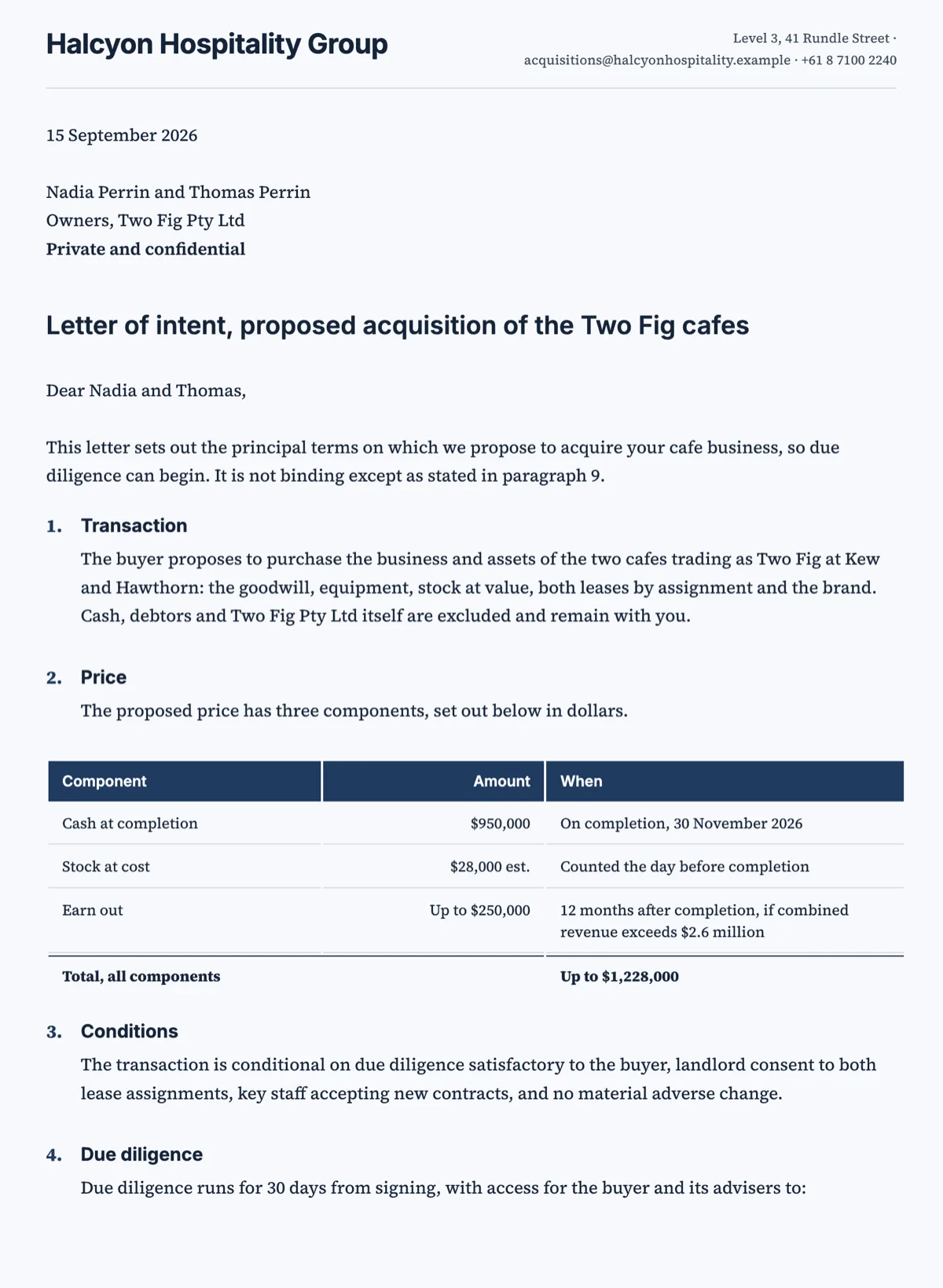 Letter of intent template for buying a businessA letter of intent is the deal on one page, written before either side has spent money on lawyers, and its only binding parts are the promises that make spending that money safe. This example records a cafe acquisition of up to $1,228,000 with an earn out, gives the buyer 45 days of exclusivity, and numbers the paragraphs that bind.
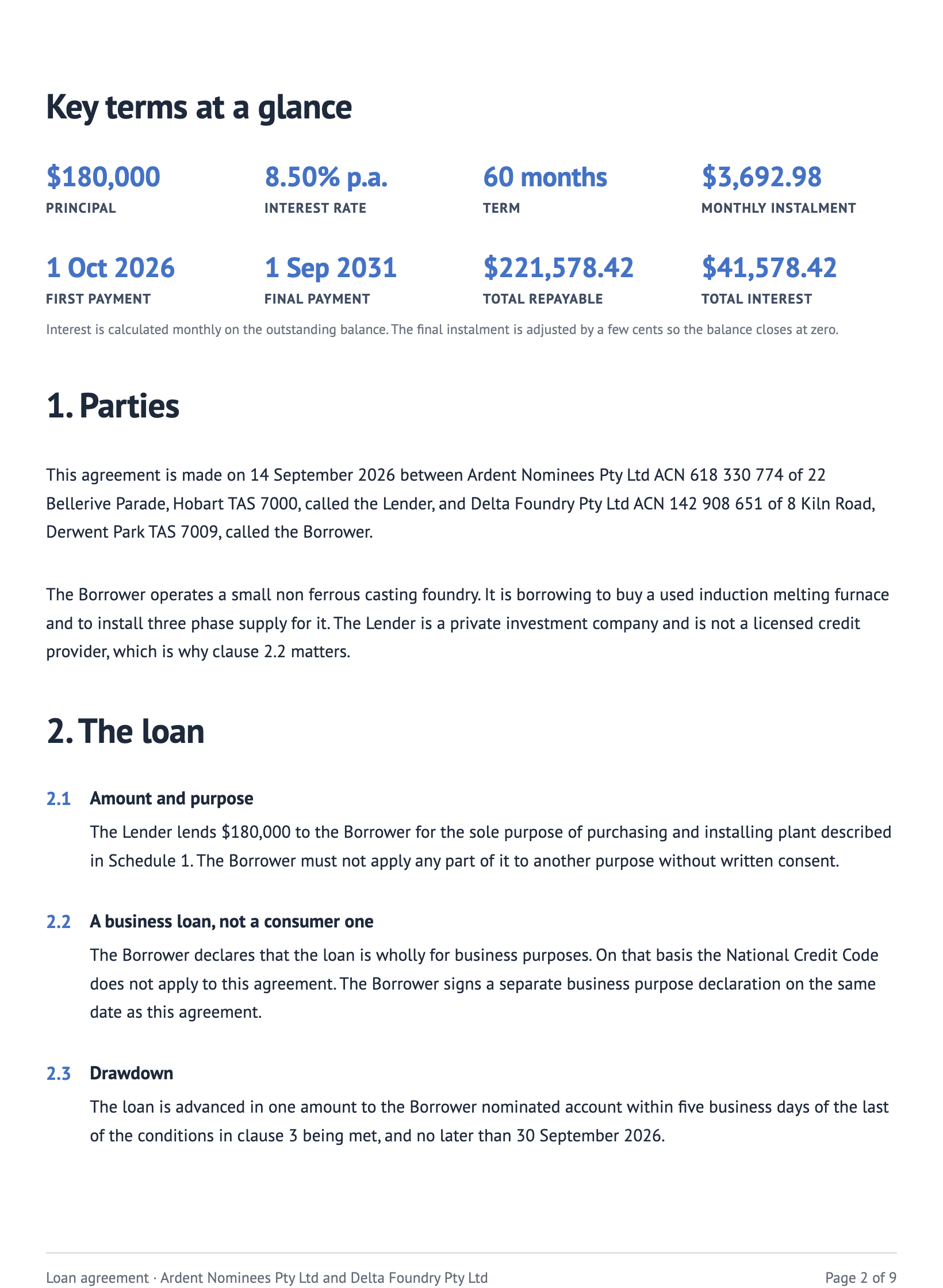 Loan agreement templateA Tasmanian foundry is borrowing $180,000 from a private investment company to buy a used induction furnace. The lender is not a bank, so everything a bank would take for granted has to be written down: what has to happen before the money moves, what is registered over what, and how long the borrower gets to fix a default.
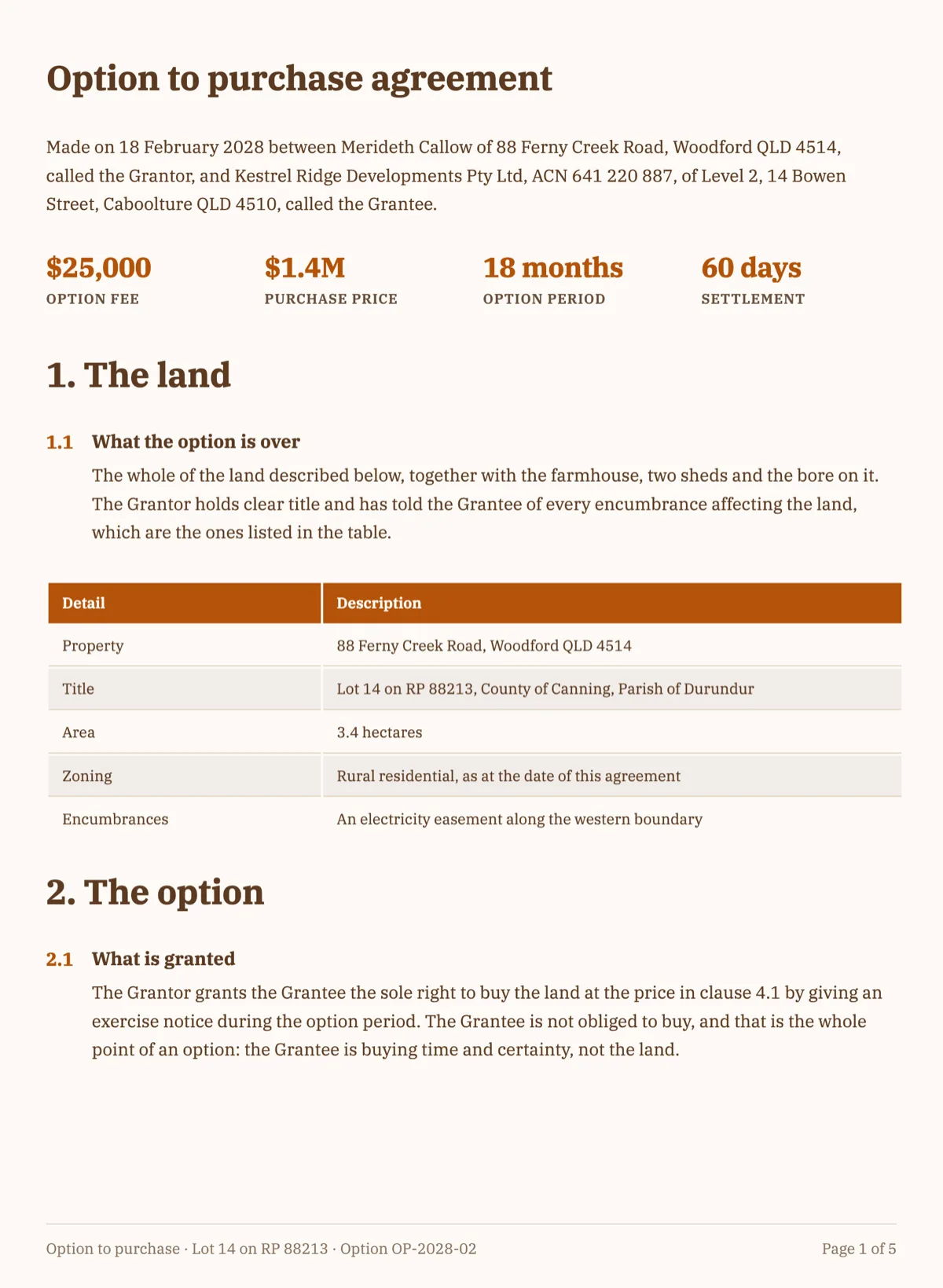 Option to purchase agreement with a fee, a window and a caveatAn option to purchase buys time rather than land. The grantee pays a fee for the exclusive right to buy at a fixed price within a set window, and can walk away without buying anything. This one gives a developer 18 months over a 3.4 hectare block at Woodford for $25,000, at a fixed price of $1,400,000.
Questions people ask
What is a condition precedent in a contract?
It is an event that must happen before a party is obliged to perform, such as a consent, a licence or finance approval. If it does not happen by the date the contract sets, the party is not obliged to perform and, usually, either party can end the contract.
Who can waive a condition precedent?
Whoever the contract says. A condition included to protect one party can usually be waived by that party alone. Conditions that protect both, or that are required by law, typically need both parties or cannot be waived. If the contract is silent, waiver can be disputed, so state it.
What happens if a condition is not met?
If it is not satisfied or waived by the long stop date, the contract usually allows either party to end it, often with any deposit refunded. Neither party is liable for not completing, unless one of them breached a duty to try to satisfy the condition.
What is a long stop date?
It is the deadline for the conditions to be satisfied or waived. If they are not met by then, the parties can end the contract. It stops a conditional deal hanging indefinitely. Many clauses allow the date to be extended by agreement or automatically if a condition is close to being satisfied.
Does a condition precedent mean the contract is not binding?
Usually the contract is binding from signing, but the obligation to complete waits for the conditions. Some clauses go further and make the contract itself take effect only when a condition is met, apart from a few clauses that bind immediately. The wording decides which applies.
Put the clause in a finished document
The button opens the document generator with a starting description already filled in. Change it to match your own agreement before you run it.
Create a document with OneCraftRelated clauses
- No shop clause: exclusivity while the buyer does its diligenceA no shop clause for a letter of intent to buy a retailer: 60 days of exclusivity, no soliciting other offers, reporting approaches, and go shop compared.
- Material adverse change clause: when a buyer or lender can walk awayA material adverse change clause for buying a medical device maker: the definition, carve outs for the economy, industry and pandemics, and Akorn v Fresenius.
- Term clause in a contract: start date, length and expiryA term clause in a contract says when it starts, how long it runs and how it ends. Sample managed services wording, fixed, rolling and completion variants.
- Deposit clause: what happens to money paid up frontA deposit clause takes money up front and says what happens to it. Australian sample wording, refundable and non refundable variants, and the unfair terms risk.
For everything the document generator can do, see the document maker.
Step by step in the builder: Create a document with AI, then Document builder components.
Written and checked by the OneCraft team. Last checked .