Contract clause
Option to purchase clause: sample, option fee and exercise
An option to purchase clause gives one party, the grantee, the right but not the obligation to buy property from the owner, the grantor, at an agreed price within an option period. The grantee usually pays an option fee for the right and exercises it by written notice, which creates a binding contract of sale.
An option to purchase locks in a price and a window: the owner promises to sell, and the buyer pays an option fee for the right to decide later. It suits buyers who need time for finance, approvals or due diligence, and owners who want a committed party without signing a contract of sale today.
Indunil Asanka · Co-founder
3 min read · Published
Sample clause
Written for option over a rural lot in Queensland, Lot 14 on RP 88213, granted by fictional owners to a fictional grazing business planning to buy after a season.
Grant and Exercise of Option. (a) In return for the Option Fee of $15,000, the Grantor grants the Grantee an option to buy the Land for the Price of $1,180,000 on the terms of the Contract in Annexure A. (b) The Grantee may exercise the option only by giving the Grantor written notice, signed by the Grantee, with the signed Contract, at any time before 5.00 pm on 30 June 2028. (c) On exercise, the Contract becomes binding, and the Option Fee is credited towards the deposit payable under it. (d) If the option is not exercised by that time, it lapses, the Grantor keeps the Option Fee, and the Grantee must withdraw any caveat it has lodged within 5 business days. (e) During the Option Period the Grantor must not sell, lease or grant any other interest in the Land, and must keep it in its present condition, fair wear excepted.
Sample wording, not legal advice.
Variants
Call option for a buyer
The usual form: the buyer may choose to buy, and the seller must sell if the buyer exercises.
The Grantor grants the Grantee the right to require the Grantor to sell the Land to the Grantee at the Price by notice given within the Option Period.
Put and call option
Off the plan and development deals where both sides want certainty, but a contract cannot be signed yet.
The Grantor grants the Buyer a call option exercisable during the Call Period, and the Buyer grants the Grantor a put option exercisable during the Put Period, each requiring the other to enter the Contract at the Price.
Option in a lease
A tenant who wants the right to buy the leased premises during or at the end of the lease.
Provided the Tenant is not in breach, the Tenant may buy the Premises for $640,000 by written notice given at least 3 months before the end of the Term.
What to negotiate
The fee and what happens to it
The option fee pays for the owner taking the property off the market. The clause should say whether the fee is credited to the price or deposit if the option is exercised, and that it is kept by the owner if not. A large non refundable fee with a long period favours the owner; a small fee credited on exercise favours the buyer.
Exercise exactly as written
Courts treat option exercise strictly: the notice must be given in the way, by the person and within the time the option requires. Missing the deadline by an hour, or sending notice to the wrong address, can mean the option has lapsed. The clause should say who signs, how notice is given, and the deadline including time and place.
Protect the option
An option gives the grantee an interest in the land that can usually be protected by a caveat on the title, so the owner cannot sell to someone else during the period. The clause should allow the caveat and require it to be withdrawn if the option lapses, as the sample does, and stop the owner granting other interests.
The risk of leaving it out
Without a written option, a buyer who has spent money on approvals and due diligence has no right to buy if the owner changes their mind or receives a better offer. A loosely written option, on the other hand, can leave an owner unable to sell for years, unsure whether it was exercised, and arguing about the fee.
Option, contract and the cooling off question
An option is not yet a sale: it is a promise to sell if the grantee chooses. The contract of sale is usually attached and becomes binding on exercise. In some states, exercising an option can affect cooling off rights and the timing of disclosure for residential property, so the state's conveyancing rules and the attached contract need to be checked together. Law checked on 21 October 2026. This page explains how the law works and is not legal advice.
Caveats and the title
In Queensland the grantee can protect the option by lodging a caveat with Titles Queensland, which records the claim on the title and stops other dealings being registered without notice to the caveator. Other states have similar systems. A caveat lodged without a proper interest can expose the caveator to compensation, so the option document should support it, and the caveat should be withdrawn promptly if the option lapses.
Duty and tax on options
State duty can apply to the grant of an option, to its assignment, or to the transfer that follows exercise, and the rules differ between states; Queensland's transfer duty rules are administered by the Queensland Revenue Office. The option fee can also have income tax and GST consequences for the grantor. The option example records price, deposit and GST terms in their own section so each can be checked.
Where the clause sits in a generated document
Option to purchase agreements, leases with a purchase option and development agreements carry this clause. When asking the AI document generator for one, give the fee and its treatment, the price, the option period and deadline, how notice is given, the attached contract terms, caveat rules and the grantor's promises during the period.
Documents that carry this clause
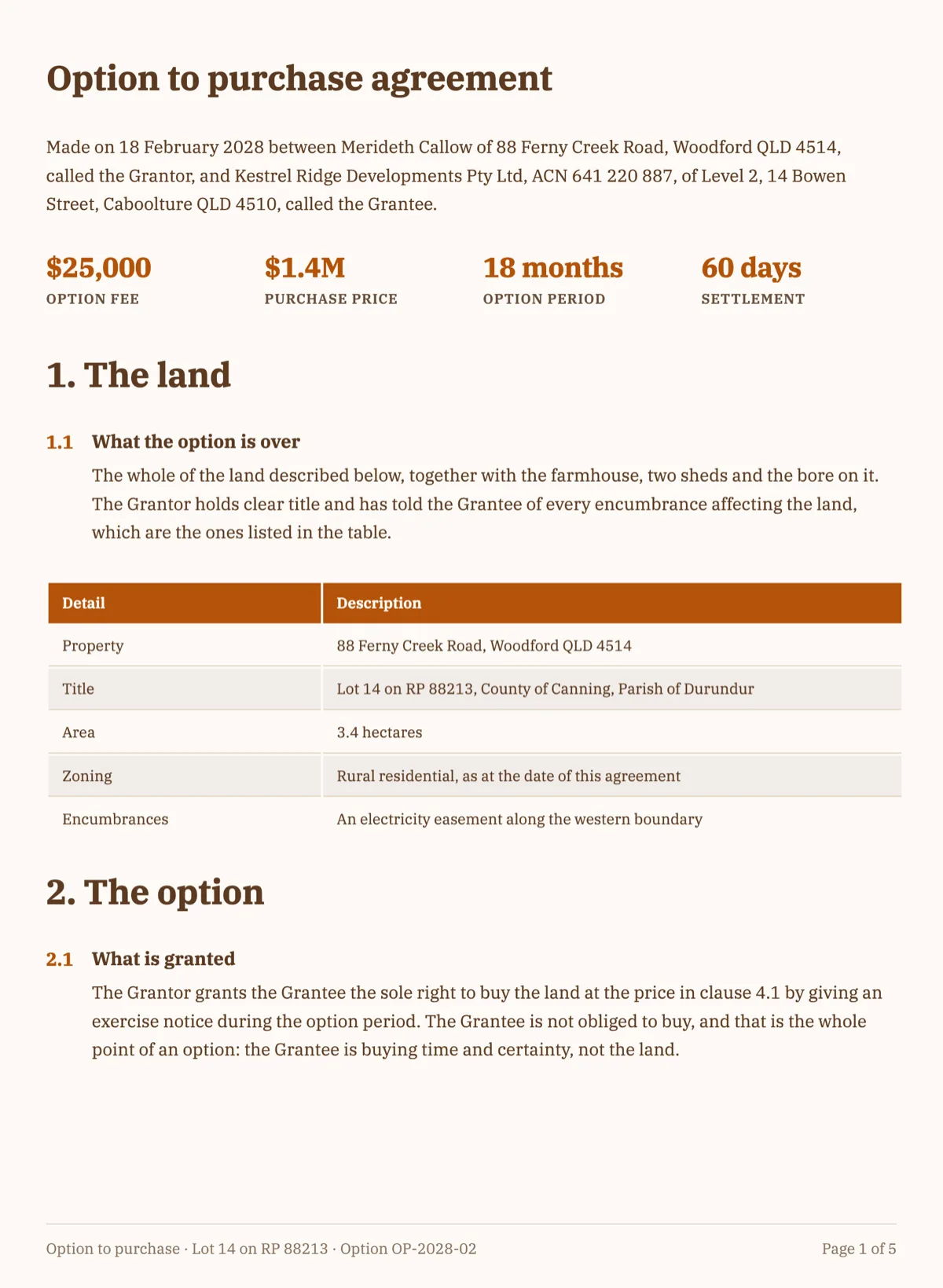 Option to purchase agreement with a fee, a window and a caveatAn option to purchase buys time rather than land. The grantee pays a fee for the exclusive right to buy at a fixed price within a set window, and can walk away without buying anything. This one gives a developer 18 months over a 3.4 hectare block at Woodford for $25,000, at a fixed price of $1,400,000.
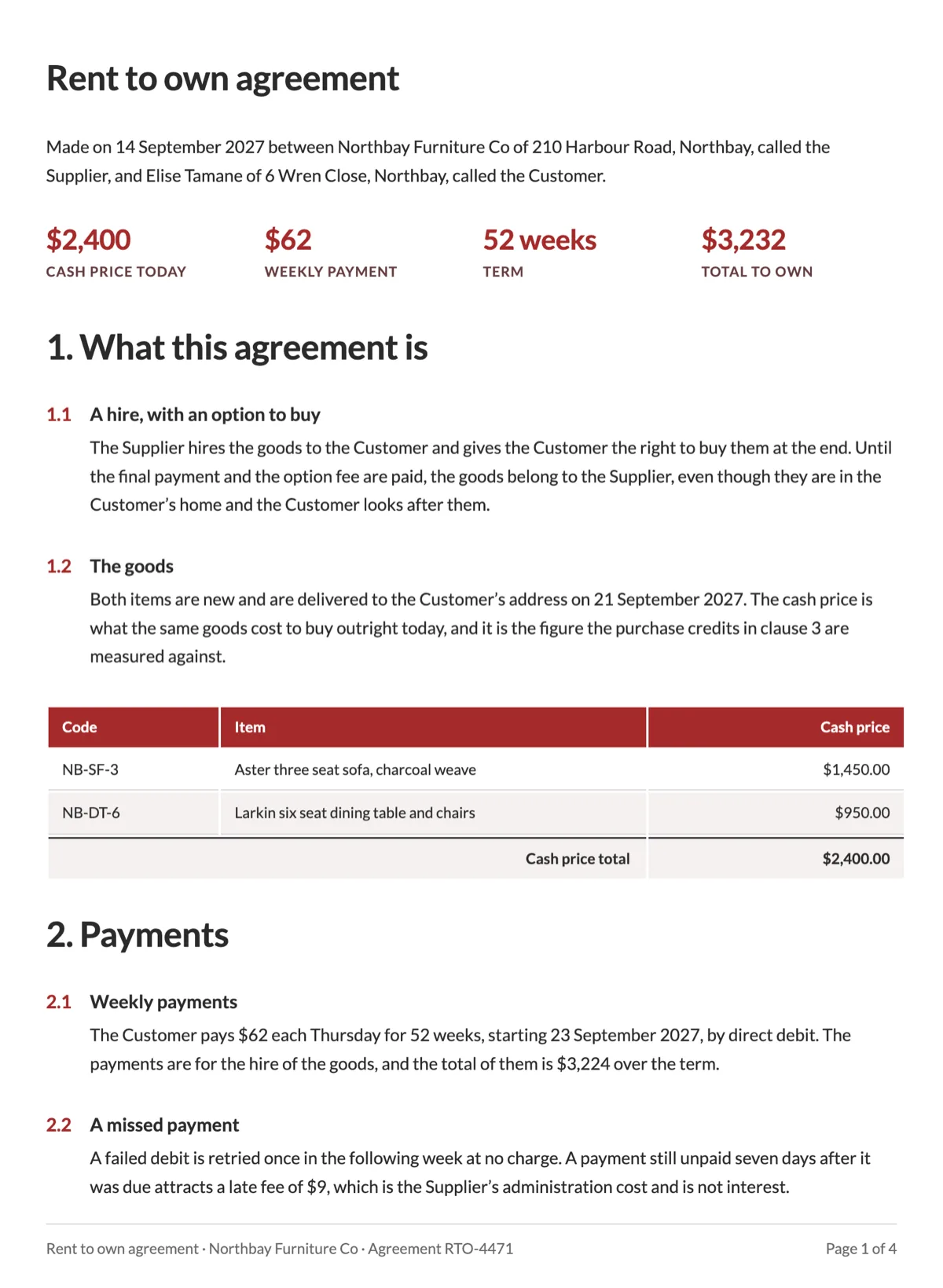 Rent to own agreement template with credits, price and defaultA rent to own agreement is a hire with an option to buy at the end, so the goods stay with the supplier until the last payment. This one covers a $2,400 sofa and dining set paid off at $62 a week for 52 weeks, with a table showing what has been credited and what the payout figure is at four points in the term.
Questions people ask
What is an option to purchase clause?
It gives the grantee the right, but not the obligation, to buy property at an agreed price within a set period. The grantee usually pays an option fee and exercises the option by written notice, which turns an attached contract of sale into a binding sale.
What happens to the option fee if the option lapses?
Usually not. The fee pays the owner for keeping the property off the market, so it is kept if the option lapses. If the option is exercised, the agreement normally credits the fee towards the deposit or the price. The clause should state both outcomes.
How do I exercise an option to purchase?
Exactly as the option requires: usually a signed written notice delivered to the grantor's address before the deadline, sometimes with a signed contract and the deposit. Courts are strict, so a late or wrongly delivered notice may fail to exercise the option.
Can I put a caveat on the property during the option?
Usually yes, because an option to purchase gives the grantee an interest in the land. A caveat warns others of the claim and stops dealings being registered without notice. It must be withdrawn if the option lapses, or the owner may seek compensation.
What is a put and call option?
A pair of options: the buyer has a call option to require the sale, and the seller has a put option to require the purchase, usually in later windows. It locks in a deal for both sides without signing a contract of sale at the start.
Put the clause in a finished document
The button opens the document generator with a starting description already filled in. Change it to match your own agreement before you run it.
Create a document with OneCraftRelated clauses
- Vacant possession clause: sample for sales and leasesVacant possession clause sample for property sales and leases: what vacant means, chattels and rubbish, tenants who must leave, and the buyer's remedies.
- Stamp duty clause: who pays duty in an Australian contractStamp duty clause sample for Australian contracts: who pays transfer duty, duty on leases and vehicles, shared purchases, late payment interest and indemnities.
- Right of first refusal clause: matching an outside offer for sharesA right of first refusal clause lets shareholders match an outside offer before shares are sold. Sample wording with 20 business days and a ROFO comparison.
- Option to renew clause: the right to a further termAn option to renew clause gives a tenant the right to a further lease term if exercised in time. Victorian retail sample wording, variants and the notice rules.
For everything the document generator can do, see the document maker.
Step by step in the builder: Create a document with AI, then Document builder components.
Written and checked by the OneCraft team. Last checked .