Contract clause
Vacant possession clause: sample for sales and leases
A vacant possession clause requires the seller or outgoing occupier to hand over property empty of people, and of goods and rubbish that would stop the buyer or new occupier using it, by completion or the end of a lease. It sets what counts as vacant and what happens if the property is not.
Vacant possession means handing over a property with nobody living or trading in it and nothing left behind that gets in the way of using it. A vacant possession clause in a sale contract or option makes it a condition of settlement, and the seller must sort out any tenant first, within the tenancy law's notice rules.
Nuwan Madhusanka · Co-founder
3 min read · Published
Sample clause
Written for option to purchase a rural property in Queensland, with a farmhouse and sheds, granted by fictional owners to a fictional grazing business.
Vacant Possession. (a) On completion, the Grantor must give the Grantee vacant possession of the Land, free of any lease, licence or agistment and of any person in occupation. (b) Vacant possession means that the farmhouse, sheds and paddocks are empty of all occupants and of all goods, vehicles, machinery, rubbish and livestock, other than the fixtures and the chattels listed in Schedule 3. (c) The Grantee may inspect the Land within 2 business days before completion to confirm vacant possession. (d) If vacant possession is not given on completion, the Grantee may delay completion until it is, and the Grantor must pay the Grantee's reasonable costs caused by the delay, including agistment for the Grantee's stock. (e) The Grantor is responsible for ending any existing occupancy in accordance with the law.
Sample wording, not legal advice.
Variants
Sale subject to an existing tenancy
An investment property sold with the tenant staying, where vacant possession is expressly not given.
The Property is sold subject to the residential tenancy agreement dated 1 March 2026. The Seller does not give vacant possession, and the Buyer takes an assignment of the Seller's rights from completion.
End of a commercial lease
A tenant leaving at the end of a lease, where vacant possession is part of the make good and return of premises.
At the end of the Term the Tenant must give vacant possession of the Premises, having removed its fit out, stock and signage and made good any damage caused by the removal.
Residential sale with personal items
A home sale where the buyer wants it clear that the seller's belongings and rubbish are removed.
On settlement the Seller must give vacant possession and leave the Property clean and free of the Seller's belongings, rubbish and garden waste, other than the inclusions listed in the Contract.
What to negotiate
Define what must be removed
Vacant possession is about people and things that stop the buyer using the property. Courts have held that substantial rubbish or goods can breach it, but small items may not. A list of what stays, such as fixtures and named chattels, and a general duty to remove everything else, avoids argument at the inspection.
Tenants must leave lawfully
If a tenant is in the property, the seller must end the tenancy under the state's tenancy law, with the right ground and notice, before vacant possession can be given. Sale of the property is a ground in some states and limited in others. Sellers should check the notice periods before agreeing a settlement date.
Remedies if it is not vacant
A buyer usually has the right to refuse to complete until vacant possession is given, and to claim costs caused by the delay. The clause can add a pre settlement inspection and specific costs, such as agistment or storage, so the buyer does not have to prove them from scratch.
The risk of leaving it out
A sale contract silent on vacant possession may leave a buyer completing with a tenant still in place, or with sheds full of the seller's machinery, and the cost of removing them. A seller that promises vacant possession without checking the tenancy notice rules may be unable to deliver it on time and face a delay claim.
What vacant possession means
Vacant possession is generally understood to mean the property is free of people in occupation and of any legal right of occupation, and of goods or rubbish that substantially prevent or interfere with the buyer's use of it. It does not mean the property must be perfectly clean. Standard form contracts in each state deal with it, and many make it a term unless the contract says the property is sold subject to a tenancy. Law checked on 21 October 2026. This page explains how the law works and is not legal advice.
Ending a residential tenancy first
A seller who has a tenant must give notice to vacate on a ground the state's law allows, with the right notice period and form. In Victoria, Consumer Affairs Victoria sets out the notices rental providers may give and their periods, and other states have their own rules. The notice to vacate example shows a landlord ending a periodic tenancy because the sale requires vacant possession, with the ground and dates stated.
Rural property
On farms, vacant possession usually covers stock, agistment arrangements, machinery and hay as well as houses. The option example requires the farmhouse and sheds standing, the bore working and vacant possession given, and stops the grantor removing fixtures or felling mature trees without consent, because those items are part of what the buyer is paying for.
Where the clause sits in a generated document
Contracts of sale, options to purchase, leases and notices to vacate carry this clause or refer to it. When asking the AI document generator for one, say whether vacant possession is given, list the inclusions that stay, set the inspection right and the costs the seller pays if it is late.
Documents that carry this clause
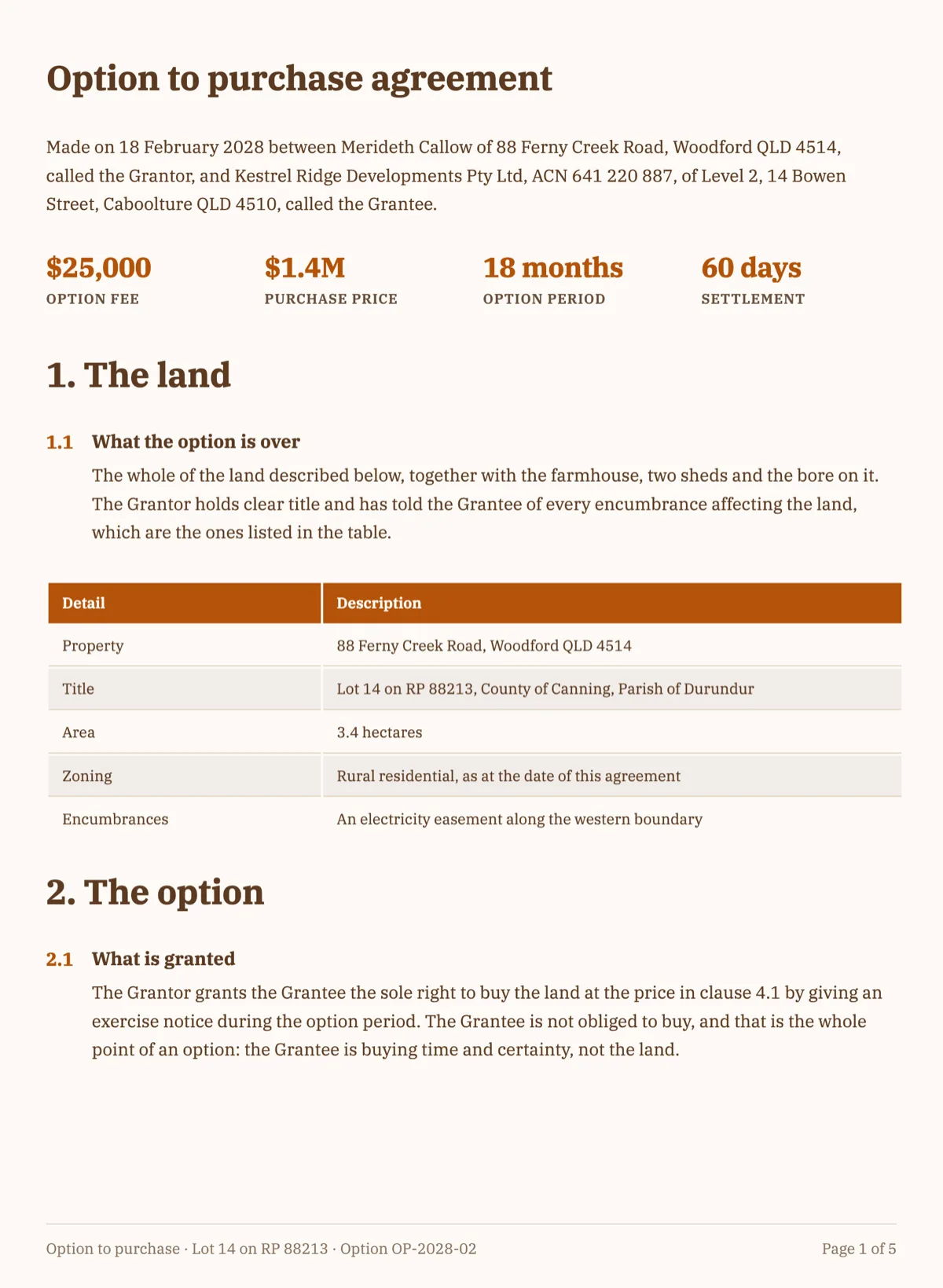 Option to purchase agreement with a fee, a window and a caveatAn option to purchase buys time rather than land. The grantee pays a fee for the exclusive right to buy at a fixed price within a set window, and can walk away without buying anything. This one gives a developer 18 months over a 3.4 hectare block at Woodford for $25,000, at a fixed price of $1,400,000.
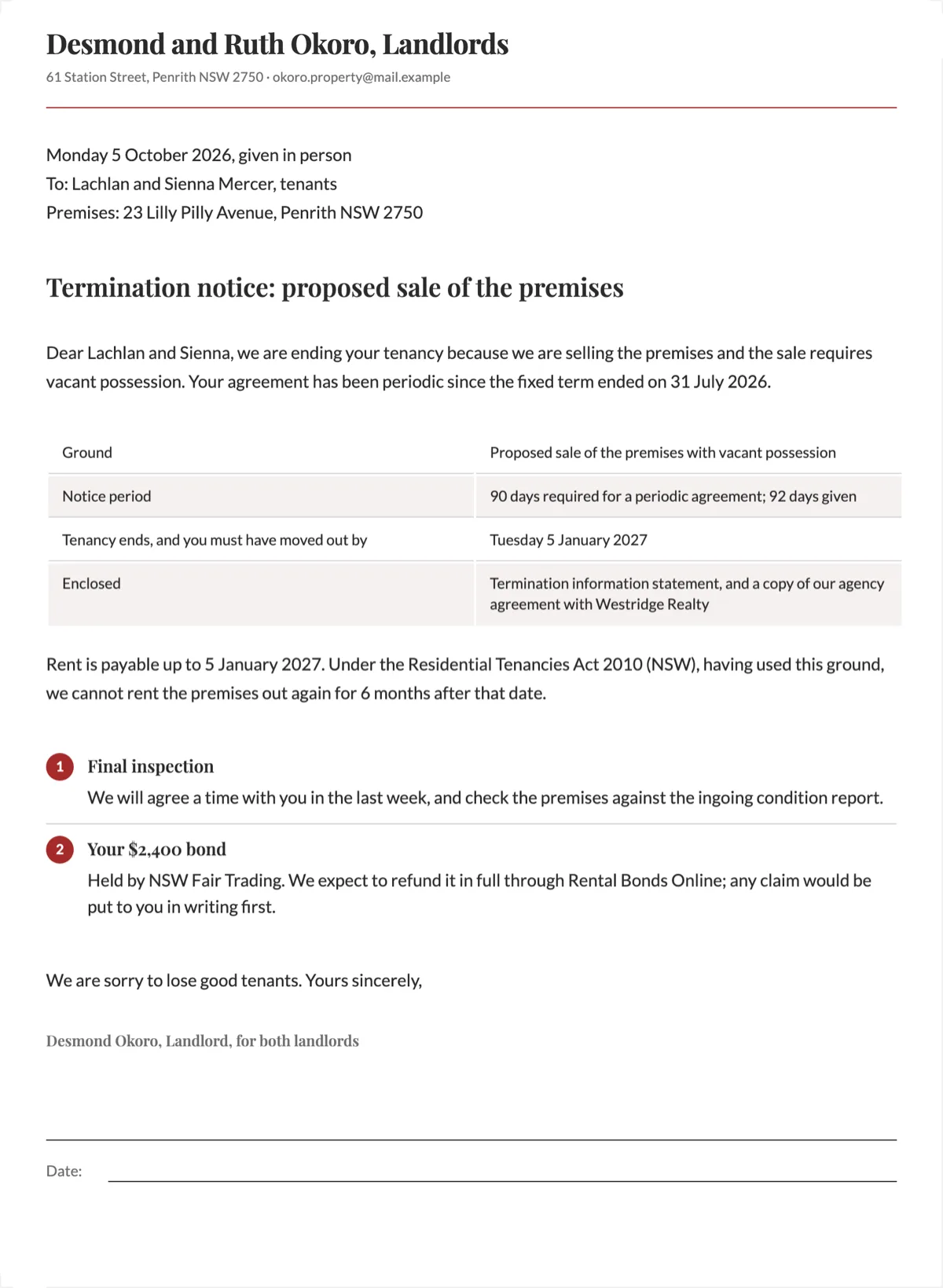 Landlord notice to vacate template for the sale of the propertyA landlord notice to vacate template ends a tenancy in writing, giving the ground, the notice period and the date the tenants must leave. Since May 2025 a New South Wales landlord can only end a tenancy on a listed ground, so the notice has to name it, give the right period for the type of agreement and attach the evidence the ground requires.
Questions people ask
What does vacant possession mean?
It means the property is handed over with no one occupying it, no one with a right to occupy it, and no goods or rubbish that would substantially interfere with using it. Fixtures and agreed inclusions stay. The contract can define it more precisely.
Can a buyer refuse to settle if the property is not vacant?
If the contract requires vacant possession, the buyer can generally refuse to complete until it is given, and may claim losses caused by the delay. Minor items left behind may not justify refusing; substantial occupation or rubbish usually does. Inspect before settlement.
Can I sell a house with a tenant in it?
Yes, either with the tenant staying, in which case the contract says the property is sold subject to the tenancy, or with vacant possession, in which case the seller must end the tenancy lawfully before settlement under the state's notice rules.
How much notice does a tenant get when a property is sold?
It depends on the state and the type of tenancy. Some states allow sale as a ground for ending a periodic tenancy with a set notice period; others restrict it or require longer notice. Check the state regulator before agreeing a settlement date.
Does vacant possession mean the property must be clean?
Not necessarily. Vacant possession is about occupants and things that get in the way of using the property. A contract can add a cleaning or rubbish removal obligation, which is common in residential sales, and the clause should say so.
Put the clause in a finished document
The button opens the document generator with a starting description already filled in. Change it to match your own agreement before you run it.
Create a document with OneCraftRelated clauses
- Stamp duty clause: who pays duty in an Australian contractStamp duty clause sample for Australian contracts: who pays transfer duty, duty on leases and vehicles, shared purchases, late payment interest and indemnities.
- Relocation clause in a lease: a retail sampleRelocation clause sample for a retail lease: moving a tenant to comparable premises, written notice, fit out costs, and the right to end the lease instead.
- Make good clause: what a tenant leaves behindA make good clause sets the condition a tenant leaves the premises in at the end of a lease. Victorian retail sample wording, scope checklist and variants.
- Holding over clause: staying on after the lease expiresA holding over clause sets the terms when a tenant stays on after a lease expires. Victorian retail sample wording, residential and UK variants, notice rules.
For everything the document generator can do, see the document maker.
Step by step in the builder: Create a document with AI, then Document builder components.
Written and checked by the OneCraft team. Last checked .