Contract clause
Public holiday clause for an Australian employment contract
A public holiday clause sets what happens when a public holiday falls on a day an employee would normally work: whether they are paid for the day off, when the employer may ask them to work, the employee's right to refuse an unreasonable request, and the pay for working it.
In Australia employees are entitled to be absent on a public holiday, and paid at their base rate for the ordinary hours they would have worked that day. An employer may ask them to work if the request is reasonable, and they may refuse if it is not or their refusal is reasonable. A public holiday clause applies those rules to the employee's own pattern.
Indunil Asanka · Co-founder
3 min read · Published
Sample clause
Written for part time employment contract for a pharmacy assistant at Merri Creek Pharmacy Pty Ltd, a fictional Melbourne pharmacy, working Wednesday to Friday.
Public Holidays. (a) The Employee is entitled to be absent on a public holiday. If a public holiday falls on a Wednesday, Thursday or Friday, the Employee is paid their base rate for the ordinary hours they would have worked that day. (b) The Employer may ask the Employee to work on a public holiday, giving as much notice as possible and at least 14 days' notice for Christmas Day, Boxing Day and New Year's Day. (c) The Employee may refuse the request if it is not reasonable, or if the refusal is reasonable, having regard to section 114(4) of the Fair Work Act 2009. (d) Hours worked on a public holiday are paid at the public holiday rate in the Award. (e) A public holiday falling on a day the Employee does not normally work carries no payment and does not change the Employee's pattern of hours.
Sample wording, not legal advice.
Variants
Full time salaried employee
Salaried staff on a Monday to Friday week, where public holidays falling on weekdays are simply paid days off.
The Employee is paid for public holidays that fall on a working day. Work on a public holiday is by agreement, and the Employee receives a substitute day off within 4 weeks.
Casual employee
Casual employees, who are not paid for public holidays they do not work but may refuse to work them.
The Employee is not paid for a public holiday they do not work. If rostered on a public holiday, the Employee is paid the casual public holiday rate in the Award and may refuse the shift if the request is unreasonable.
Substituting the day
Workplaces open on public holidays, where the award or agreement allows a different day to be treated as the holiday by agreement.
By written agreement, the Employer and the Employee may substitute another day for a public holiday, in which case the substitute day is treated as the public holiday for all purposes.
What to negotiate
Reasonable request, reasonable refusal
Section 114 lists the factors for deciding whether a request to work, or a refusal, is reasonable: the nature of the workplace and the work, the employee's personal circumstances including family responsibilities, whether the employee could expect the request, whether they are paid a penalty rate or loading, the type of employment, the notice given and the notice of refusal. A hospital and a law firm will reach different answers.
Part time patterns
Part time employees are paid for a public holiday only if it falls on a day they would normally work. An employer must not change a roster to avoid paying for a public holiday. Recording the agreed pattern, as the sample does, makes it clear which holidays are paid.
Penalty rates and loadings
The NES gives the right to the day off and the base rate for it. The pay for working on a public holiday comes from the award or agreement, often double time or more, and for casuals the loading is added. The clause should point to the award rather than restate figures that change.
The risk of leaving it out
A contract silent on public holidays still leaves the employee with the NES rights, but invites disputes about whether a part time employee is paid for a holiday, whether a refusal to work was reasonable, and which rate applies. Underpaid public holiday hours are a common finding in Fair Work Ombudsman audits.
The NES rules
Under section 114 of the Fair Work Act 2009, an employee is entitled to be absent on a public holiday, and an employer may request, on reasonable grounds, that the employee work. Under section 116, an employee absent on a public holiday is paid at their base rate of pay for the ordinary hours they would have worked. Public holidays are the national days in the Act and those declared by each state and territory, so the list differs between states. Law checked on 21 October 2026. This page explains how the law works and is not legal advice.
Days that move
When a public holiday falls on a weekend, states often declare a substitute or additional day on the following Monday, and the Fair Work Ombudsman lists the public holidays in each state each year. An employee who does not work weekends may get the substitute Monday as a paid day off. Awards and agreements may also let employers and employees agree to swap a public holiday for another day, as the substitution variant does.
The sample's three cases
The pharmacy assistant works Wednesday to Friday. If Anzac Day falls on a Thursday, she is paid her base rate for the hours she would have worked and stays home, unless she agrees to a reasonable request to work, in which case she is paid the award's public holiday rate. If Australia Day falls on a Monday, she is not paid for it, because she would not have worked that day. If she is asked to work Christmas Day with two days' notice, her refusal is very likely reasonable.
Where the clause sits in a generated document
Employment contracts, part time agreements and casual agreements carry a public holiday clause beside leave. When asking the AI document generator for one, give the employee's days, the notice for requests to work, the award that sets the rate and any substitution arrangement.
Documents that carry this clause
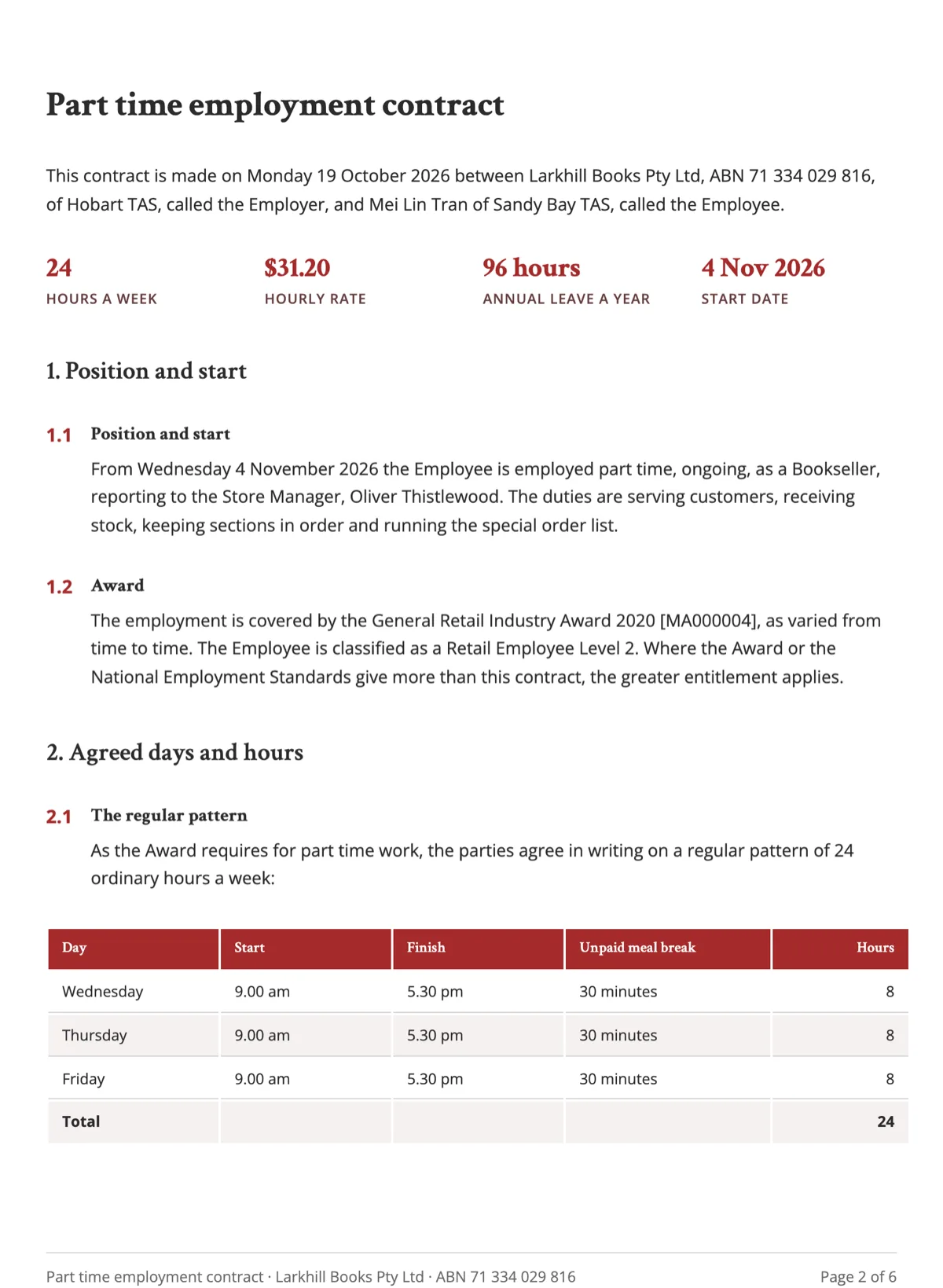 Part time employment contract template with set hours and pro rata leaveA part time employment contract template has to do something a full time contract does not: fix the regular days and hours in writing, because Australian awards require it for part time staff, and show how every leave entitlement is scaled to those hours. This one does both for a bookseller working 24 hours over three days.
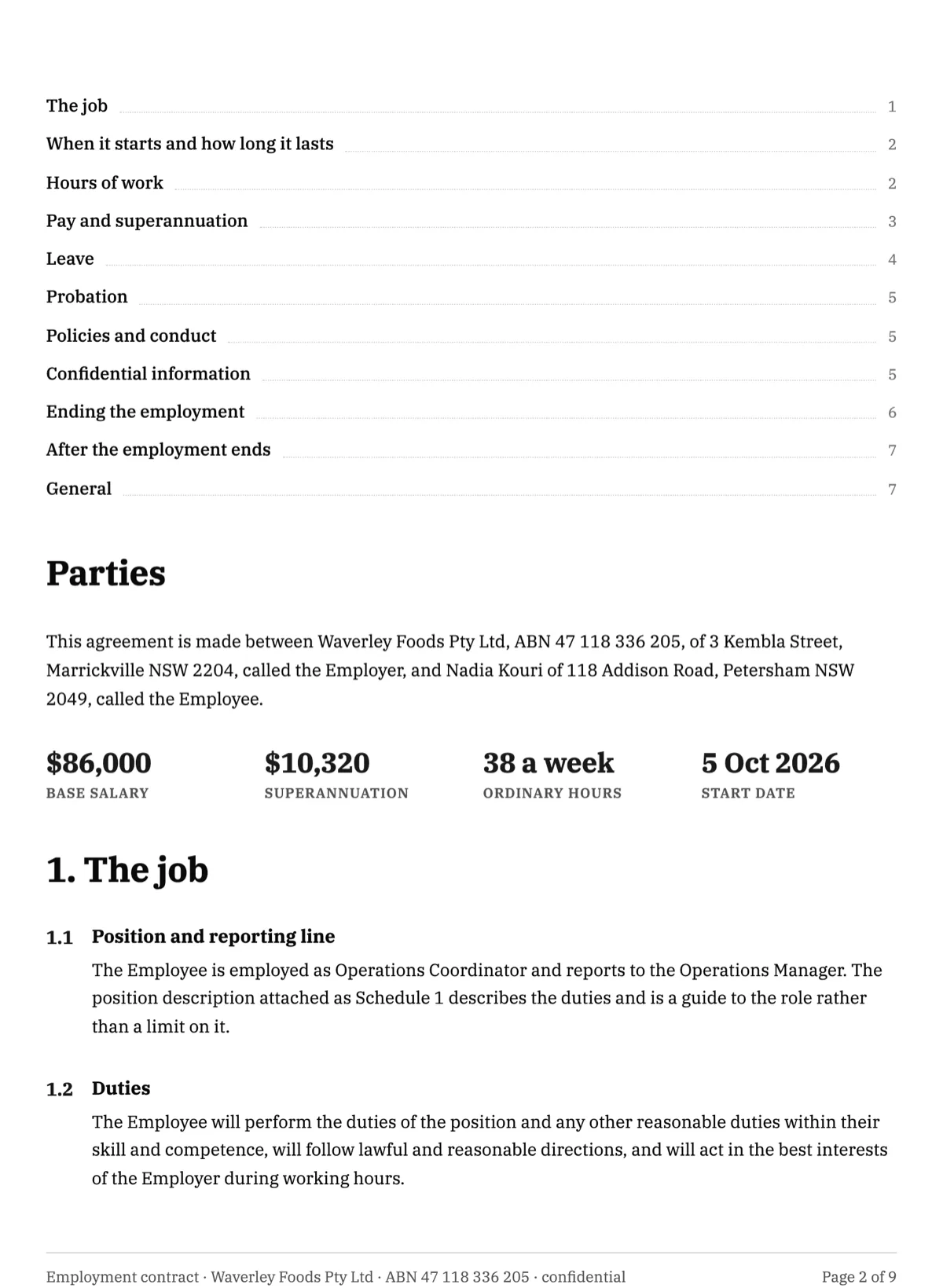 Employment contractA full time ongoing contract for an operations coordinator on $86,000 plus $10,320 of superannuation. Eleven numbered clauses, a leave table drawn from the National Employment Standards, and a notice table that scales with service.
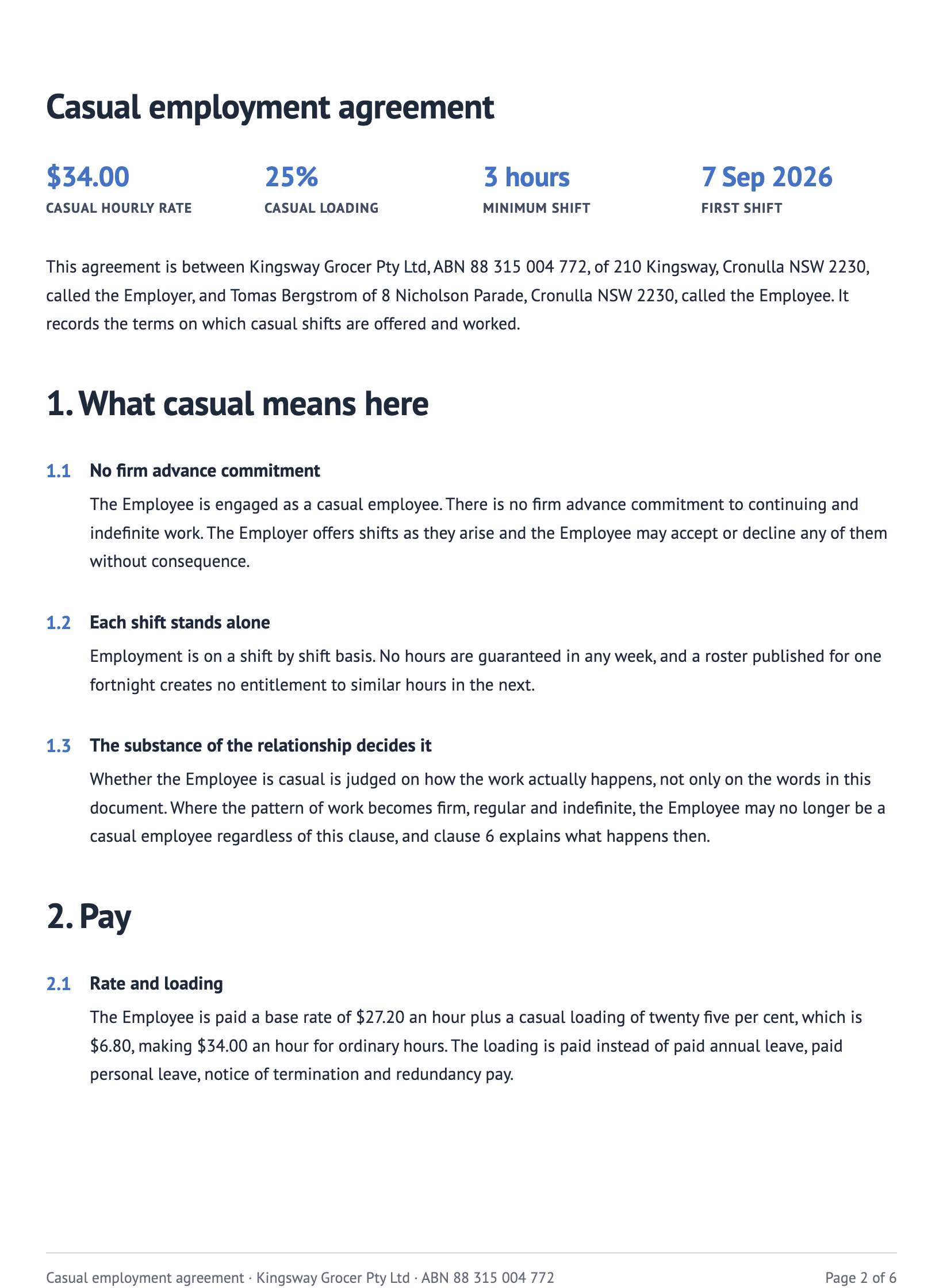 Casual employment agreementA retail assistant is paid $34.00 an hour, which is a base of $27.20 plus a twenty five per cent loading. The agreement shows how every other rate is built from that base, and what the loading is paid instead of.
Questions people ask
Do I get paid for a public holiday in Australia?
If you are a full time or part time employee and the public holiday falls on a day you would normally work, you are paid your base rate for the ordinary hours you would have worked. Casuals are not paid for public holidays they do not work.
Can my employer make me work on a public holiday?
Your employer can ask, and the request must be reasonable. You can refuse if the request is not reasonable or your refusal is reasonable, judged by factors such as the type of business, your family responsibilities, notice given and the pay offered.
What rate do I get for working a public holiday?
The rate comes from your award or enterprise agreement, often double time or double time and a half, with casual loading added for casuals. The National Employment Standards set the right to the day off and the base rate for it, not the penalty rate.
Do part time employees get public holidays?
Yes, if the public holiday falls on a day they would normally work under their agreed pattern. A public holiday on a day they do not work is not paid. Employers must not change a part time roster to avoid paying for a public holiday.
What happens when a public holiday falls on a weekend?
States often declare a substitute or extra public holiday on the following weekday. Employees who would normally work that weekday get the substitute day off with pay. The Fair Work Ombudsman publishes the list of public holidays in each state each year.
Put the clause in a finished document
The button opens the document generator with a starting description already filled in. Change it to match your own agreement before you run it.
Create a document with OneCraftRelated clauses
- Casual conversion clause under the employee choice pathwayCasual conversion clause for Australian casual contracts: the employee choice pathway since August 2024, the 6 and 12 month rules and the 21 day reply.
- Fixed term clause for an Australian employment contractFixed term clause sample for Australian employment contracts: start and end dates, the reason for the term, early ending, and the 2 year and one renewal limits.
- Leave entitlements clause in an employment contractA leave entitlements clause lists annual, personal and other leave in an employment contract. Australian sample wording, NES minimums and three variants.
- Overtime clause: paid, time off or built into salaryAn overtime clause says whether extra hours are paid, given as time off or absorbed in salary. Australian sample wording with an annual reconciliation.
For everything the document generator can do, see the document maker.
Step by step in the builder: Create a document with AI, then Document builder components.
Written and checked by the OneCraft team. Last checked .