Contract clause
Royalty clause: sample for licences and franchises
A royalty clause sets what a licensee or franchisee pays the owner for using a trade mark, copyright work, patent or business system, usually a percentage of sales, and says what the percentage is measured on, when it is paid, the minimum payable, and how the owner can check the figures.
A royalty clause turns a licence into income for the owner: a percentage of the licensee's sales, sometimes a fixed fee per unit, paid on a regular cycle with a report. The rate matters, but disputes usually turn on the base the rate is applied to, the minimum, and the owner's right to audit.
Indunil Asanka · Co-founder
3 min read · Published
Sample clause
Written for trade mark licence from The Ravens, a fictional football club, to Fowbrook Apparel, a fictional sportswear maker, for licensed merchandise.
Royalties. (a) Rate. The Licensee pays the Licensor a royalty of 8 per cent of Net Sales of Licensed Products. (b) Net Sales. Net Sales means the gross amount invoiced for Licensed Products, less GST, credits for returned goods and trade discounts shown on the invoice, but with no deduction for freight, commissions or bad debts. (c) Minimum. The Licensee pays a minimum royalty of $12,000 in the first Contract Year, credited against royalties earned that year. Any shortfall is paid within 30 days after the year ends. (d) Reports and payment. Within 20 days after each quarter, the Licensee sends a report of units sold, gross sales, deductions and Net Sales by product, with payment of the royalty. (e) Audit. The Licensor may audit the Licensee's records once a year on 10 business days' notice. If an underpayment of more than 5 per cent is found, the Licensee pays the cost of the audit.
Sample wording, not legal advice.
Variants
Franchise royalty on gross sales
A franchise system where the franchisor charges a weekly royalty and a separate marketing levy on the franchisee's gross sales.
The Franchisee pays a royalty of 6 per cent and a marketing fund levy of 2.5 per cent of Gross Sales each week, by direct debit every Tuesday, with the weekly sales report from the point of sale system.
Per unit royalty
Products with a stable price, music or print runs, where a fixed amount per unit is simpler than a percentage.
The Licensee pays a royalty of $1.20 for each copy of the Licensed Work sold, other than copies returned for credit within 90 days.
Royalty free licence
A licence back of background rights to a client, or a licence granted as part of a larger deal, where no separate royalty is intended.
The licence in this clause is granted royalty free, and no amount is payable for it beyond the fees for the services under this agreement.
What to negotiate
Argue the base, not just the rate
An 8 per cent royalty on net sales after generous deductions can be worth less than 6 per cent on gross sales. Licensees want freight, commissions and bad debts deducted; owners want a narrow list. Defining Net Sales with a closed list of deductions, as the sample does, removes most later disputes.
Minimums and performance
A minimum royalty protects an owner that has granted exclusivity and cannot license anyone else. Licensees should ask for a ramp up in the first year, credit of the minimum against earned royalties, and a right to give up exclusivity rather than pay a minimum the market cannot support.
Audit and the cost trigger
Royalties depend on the licensee's own records, so the owner needs a right to audit. A common compromise limits audits to once a year on notice, and moves the audit cost to the licensee only if the underpayment found exceeds a threshold such as 5 per cent.
The risk of leaving it out
A licence or franchise without a clear royalty clause leaves the owner without a reliable income stream and with no right to check the licensee's figures. A vague base invites the licensee to deduct whatever it can, and the absence of a minimum lets an exclusive licensee sit on the rights while paying almost nothing.
Where royalties appear
Royalties are paid under trade mark licences, such as merchandise featuring a club's marks; copyright licences for music, books, images and software; patent licences for technology; and franchise agreements for the right to run a business under the franchisor's brand and system. The trade mark licence and franchise disclosure examples show the two common shapes: a percentage of the licensee's net sales with a yearly minimum, and a weekly percentage of the franchisee's gross sales with a separate marketing levy.
Registered rights and the licence
A trade mark registered with IP Australia gives the owner exclusive rights in Australia for the goods and services it covers, and the Trade Marks Act 1995 lets the owner authorise others to use it. Use by an authorised user under the owner's control counts as the owner's use, which keeps the registration safe from removal for non use. A royalty clause therefore sits beside quality control and approval clauses in a well drafted licence. Law checked on 21 October 2026. This page explains how the law works and is not legal advice.
GST and withholding
In Australia a royalty paid to a GST registered licensor is usually a taxable supply, so the clause should say whether the rate is GST exclusive and how GST is added. Royalties paid to overseas owners can attract withholding tax, which the licensee must deduct and pay to the tax office; the clause should say who bears it. Both points are best confirmed with an accountant before the first payment.
Where the clause sits in a generated document
Trade mark licences, franchise documents, music and photo licences carry royalty clauses. When asking the AI document generator for one, give the rate, the base and its deductions, the reporting period, the minimum, the audit right and the late payment rule, so each becomes its own numbered sub clause.
Documents that carry this clause
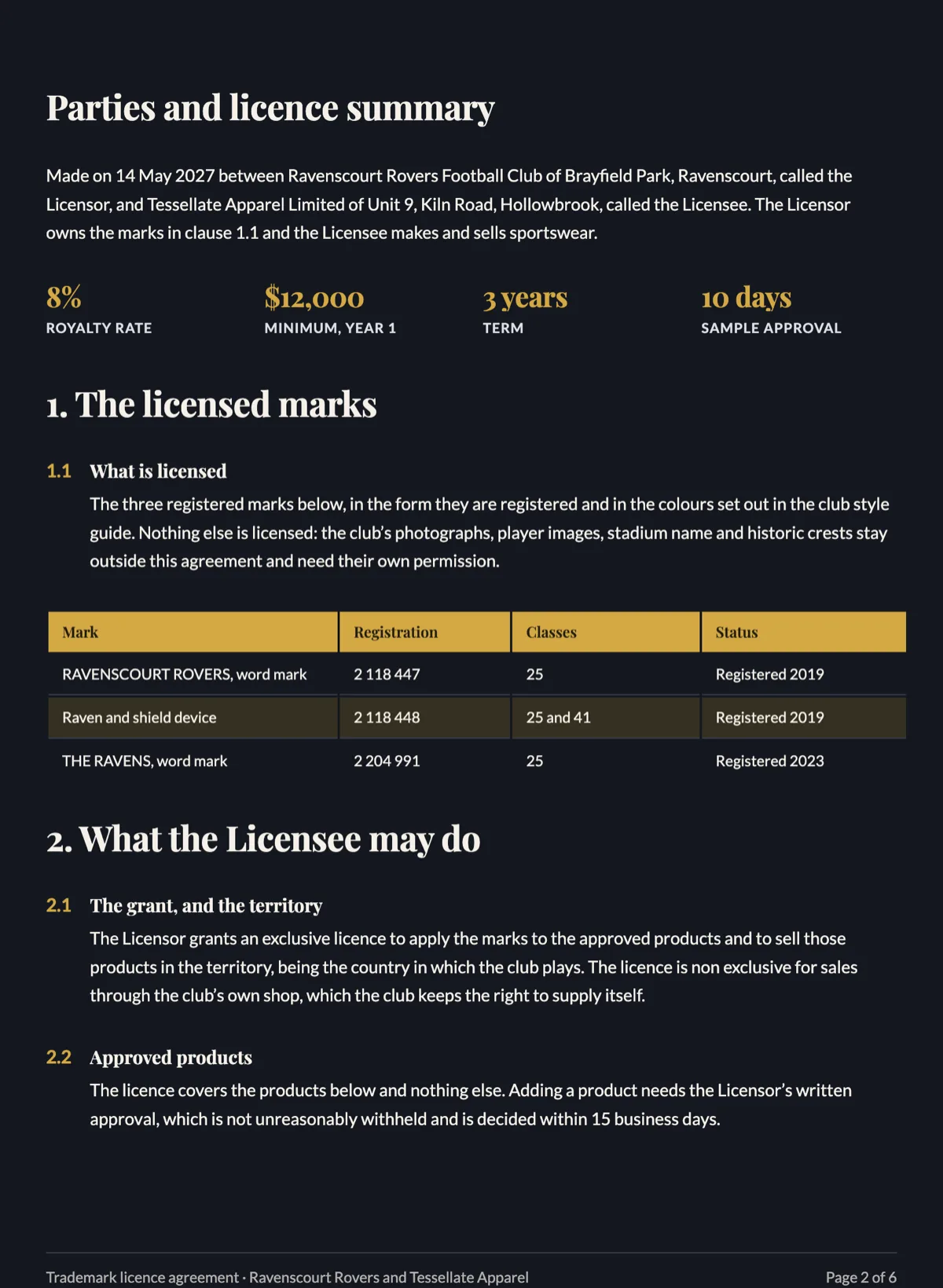 Trademark licence agreement with quality control and royaltiesA trademark licence lets someone else put your mark on their goods, and the clause that keeps it worth doing is quality control. This one licenses three registered marks from a football club to an apparel maker for three years, at 8 per cent of net wholesale sales with a rising minimum, and approval of every pre production sample in ten business days.
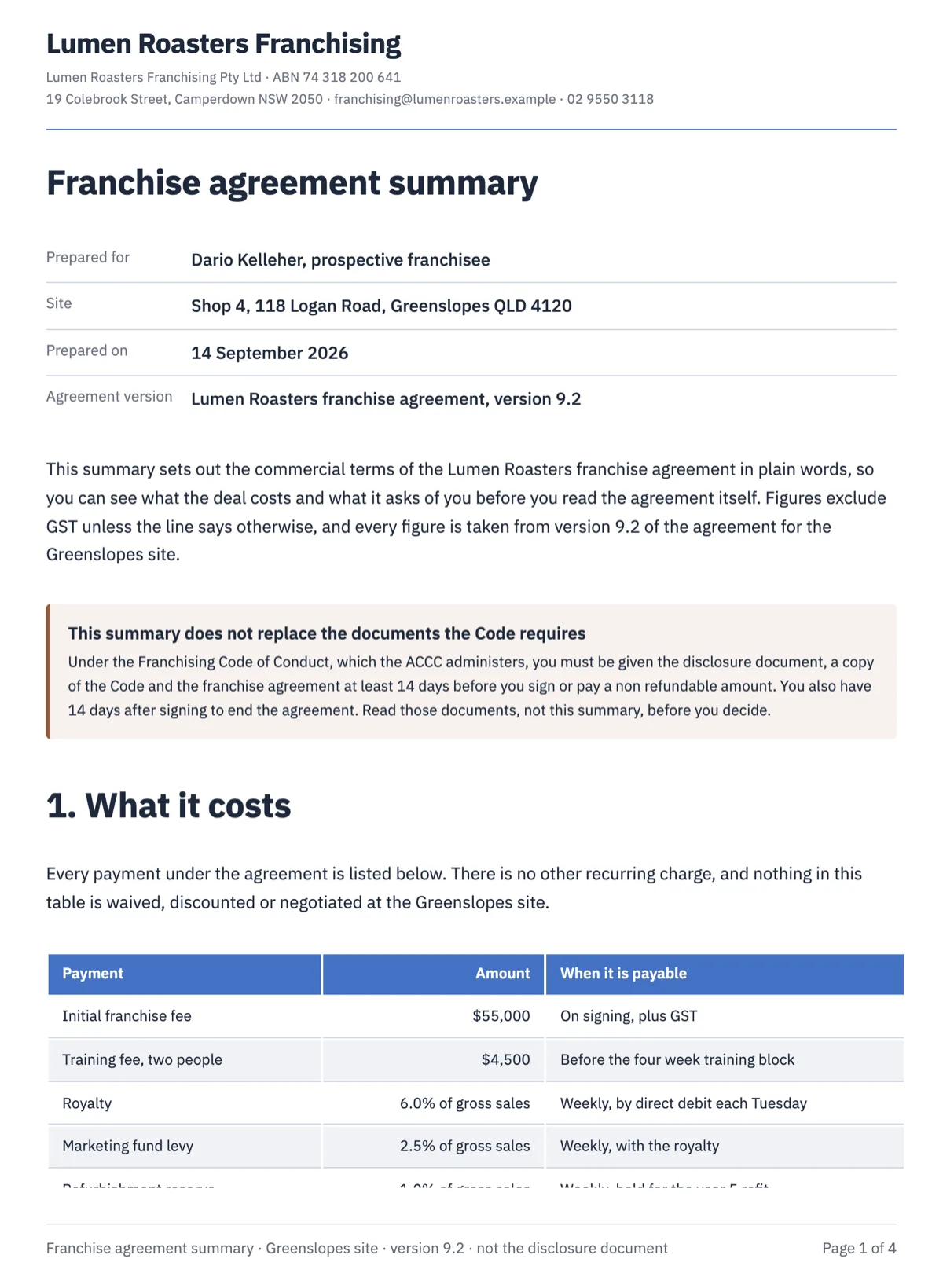 Franchise agreement summary template, with every fee in one tableA prospect reading a franchise agreement for the first time wants one thing before the clauses: the total cost of being in this system for a year. This four page summary puts every payment in a single table, then shows what those percentages come to on the site forecast of $780,000, which is $76,260 a year or 9.8 per cent of gross sales.
Questions people ask
What is a royalty clause?
It is the term in a licence or franchise agreement that sets the payment for using the owner's intellectual property or system, usually a percentage of sales or a fixed amount per unit, with the reporting, payment timing, minimums and audit rights that make it work.
What is a typical royalty rate?
It varies widely by industry and by the value of the right. Merchandise licences for well known brands commonly fall between about 5 and 15 per cent of net sales, and franchise royalties often sit between about 4 and 10 per cent of gross sales, plus marketing levies.
What is the difference between gross and net sales?
Gross sales are the total amount invoiced. Net sales are gross sales less agreed deductions, such as GST, returns and trade discounts. The royalty clause should list the allowed deductions exactly, because each one reduces what the owner is paid.
What is a minimum royalty?
A floor the licensee pays each year whatever its sales, usually credited against royalties earned in that year. It protects an owner that has given exclusive rights and cannot earn from anyone else in the territory. Missing it often lets the owner end exclusivity.
Can the owner check the royalty reports?
Only if the agreement gives a right to inspect or audit the licensee's records. A well drafted clause sets how often, on how much notice, who pays, and what happens if an underpayment is found, including interest on the shortfall.
Put the clause in a finished document
The button opens the document generator with a starting description already filled in. Change it to match your own agreement before you run it.
Create a document with OneCraftRelated clauses
- Default interest clause: sample rate and the penalty testDefault interest clause sample for loans and contracts: the extra rate on overdue amounts, when it runs, simple or compound, and the penalty rule.
- Retainer clause: monthly fee, included hours and rolloverRetainer clause sample for agencies and consultants: the monthly fee, hours included, unused hours, overage rates, the minimum term and notice to end.
- Licence grant clauseA licence grant clause gives permission to use intellectual property without owning it. Sample photo licence wording and the six terms every grant settles.
- Audit rights clauseAn audit rights clause lets a customer inspect a supplier's records or systems to check compliance. Sample with a yearly audit on 20 days notice, and variants.
For everything the document generator can do, see the document maker.
Step by step in the builder: Create a document with AI, then Document builder components.
Written and checked by the OneCraft team. Last checked .