Contract clause
Retainer clause: monthly fee, included hours and rollover
A retainer clause sets a regular fee a client pays to keep a provider available, usually monthly, and says what the fee buys: a number of hours or deliverables, what happens to hours not used, the rate for extra work, how long the arrangement must run and how either side can end it.
A retainer clause trades certainty for availability: the client pays a fixed amount each month and the agency or consultant sets aside capacity for it. The clause has to answer four questions clearly, what the fee covers, what happens to unused time, what extra work costs, and how the arrangement ends.
Indunil Asanka · Co-founder
3 min read · Published
Sample clause
Written for monthly marketing retainer between Fieldnote Studio Pty Ltd, a fictional agency, and Vantage Physio, a fictional clinic.
Retainer. (a) Fee. The Client pays a monthly retainer of $3,480 plus GST, invoiced on the first business day of each month and payable within 14 days. (b) Included work. The retainer covers up to 24 hours of strategy, content and campaign work each month, tracked in 15 minute units and reported with each invoice. (c) Unused hours. Up to 6 unused hours roll over to the next month only. Other unused hours lapse and are not refunded. (d) Extra work. Work beyond the included hours is charged at $160 an hour plus GST, but only after the Studio has told the Client the likely hours and the Client has approved them in writing. (e) Term. The retainer has a minimum term of 6 months. After that either party may end it on 30 days' written notice.
Sample wording, not legal advice.
Variants
Deliverables based retainer
Work that is easier to count in outputs than hours, such as a set number of posts, articles or reports each month.
The retainer covers eight social posts, two blog articles and one monthly performance report. Further deliverables are quoted separately before work starts.
Availability retainer
Advisory or on call services where the client pays to reserve access rather than for a set amount of work.
The retainer secures the Consultant's availability for up to two days a month and a response within one business day. Time used is charged against the retainer at $1,400 a day, and unused days do not carry over.
Drawdown retainer
Professional services where the client pays an amount in advance and fees are drawn from it as work is done.
The Client pays $5,000 in advance. Fees are drawn from it monthly as invoiced, the Client tops it up when it falls below $1,000, and any balance is refunded when the engagement ends.
What to negotiate
Rollover and use it or lose it
Clients dislike paying for hours they did not use; providers need the fee to cover capacity they held. A limited rollover, such as 6 hours into the next month, is a common middle ground. Unused hours lapsing entirely should be stated plainly, because surprise is what turns it into a dispute.
Approval before overage
Extra work at an hourly rate is where retainer invoices grow. A rule that overage is charged only after the client approves an estimate in writing protects the client, and gives the provider a clear record when the invoice is questioned.
Minimum terms and fairness
A minimum term lets the provider plan staff. In a standard form contract with a small business, a long minimum term with no exit, or an automatic renewal without notice, can be challenged as an unfair term. A short minimum and a plain notice period after it is safer.
The risk of leaving it out
A retainer without written terms leaves the client unsure what the monthly fee buys and the provider unsure whether it can charge for extra requests. Months later the argument is about hours that were or were not used, and who agreed to what, usually when one side wants to end the arrangement.
Hours, deliverables or availability
Retainers come in three main shapes. An hours retainer, like the sample, buys a block of time each month and reports what it was used for. A deliverables retainer buys a set list of outputs. An availability retainer buys priority access and a response time. Mixing shapes in one clause causes confusion, so pick one measure and report against it each month, with the invoice.
Retainers and unfair terms
Many retainers are offered on the provider's standard terms to small businesses, which brings them within the Australian Consumer Law's unfair contract terms regime since November 2023 for small businesses with fewer than 100 employees or turnover under $10 million. One sided terms, such as the provider changing the fee at will or a renewal with no reminder, carry penalty risk as well as the risk of being void. Law checked on 21 October 2026. This page explains how the law works and is not legal advice.
Retainers in quotes and proposals
A retainer often starts as a proposal: a monthly line item with the hours or deliverables described beside it. The proposals module prices a monthly retainer as a line item with month as its unit, because it does not create recurring invoices; the retainer agreement then sets the ongoing terms, and each month's invoice is issued in the usual way.
Where the clause sits in a generated document
Retainer agreements, marketing agency agreements and consulting agreements carry this clause. When asking the AI document generator for one, give the fee, the hours or deliverables, the rollover rule, the overage rate with approval, the minimum term and the notice period.
Documents that carry this clause
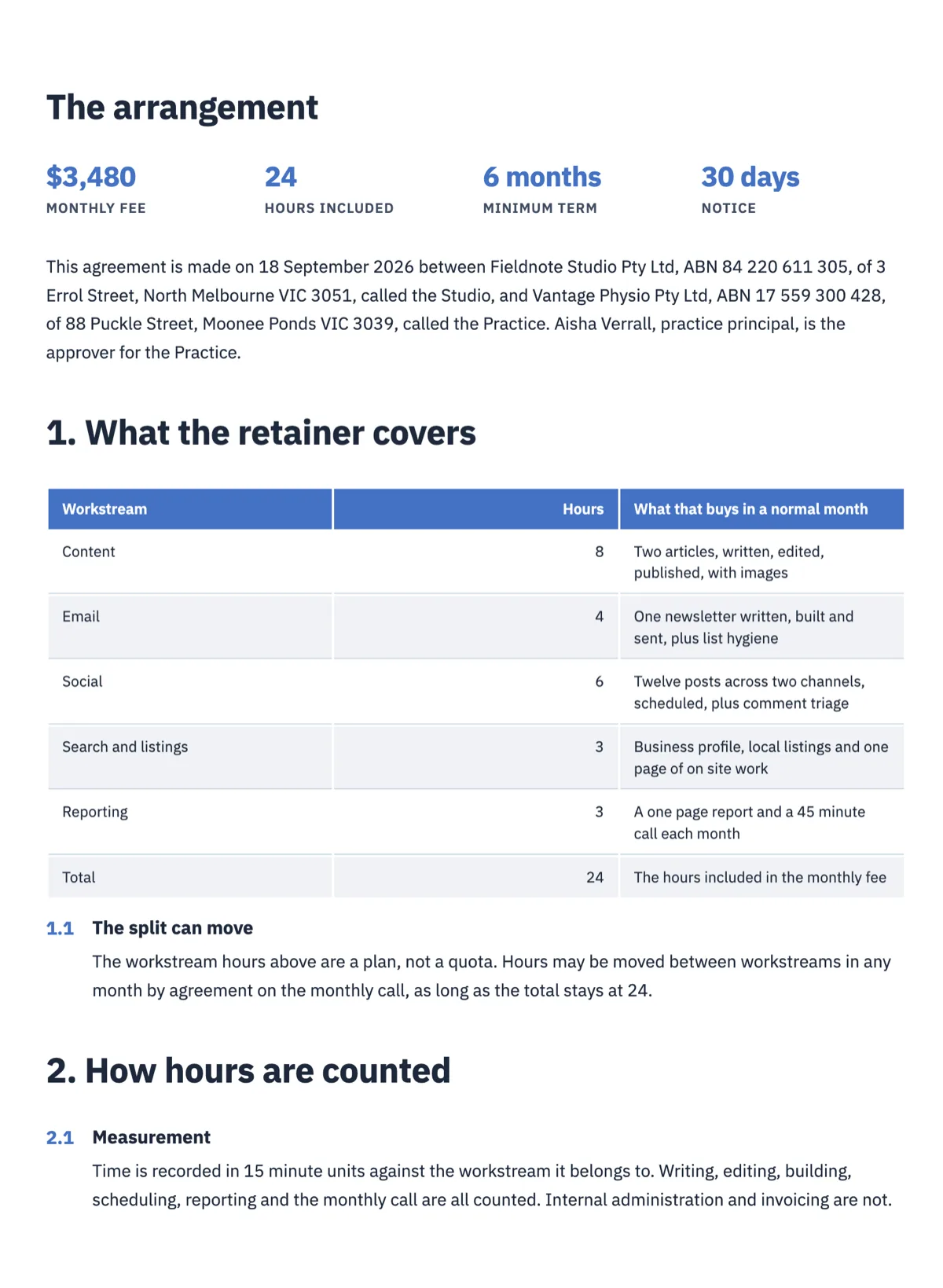 Monthly retainer agreementA studio sells a physio practice twenty four hours a month. Almost every clause exists to answer one question that ordinary contracts duck: what happens to the hours nobody used.
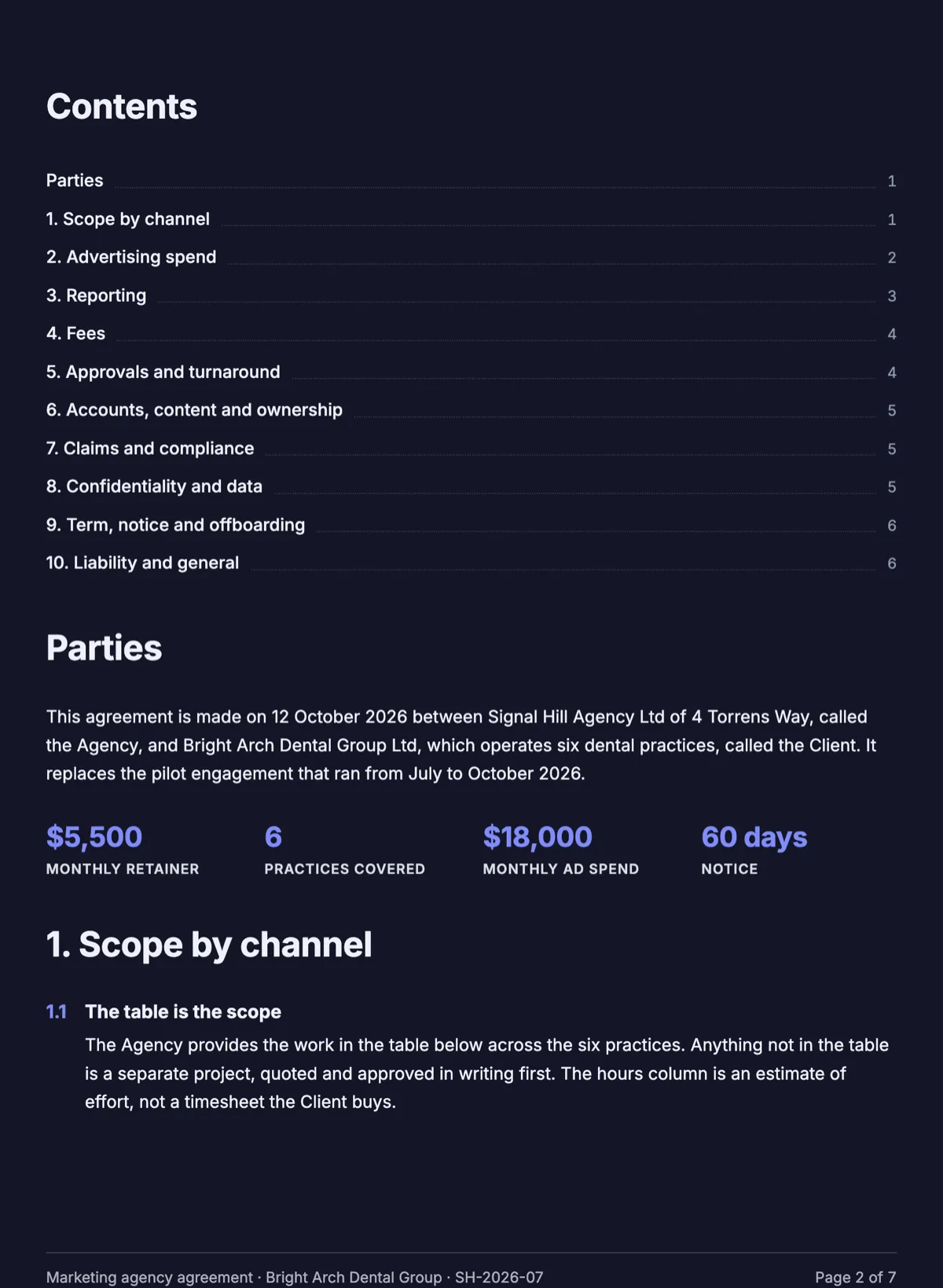 Marketing agency agreement with a channel scope and ad spend held apartThe two things that break an agency relationship are a scope nobody can point at and a fee that quietly includes the advertising budget. This retainer puts the work in a table with the hours and the reported metric for each channel, then keeps every dollar of ad spend in the accounts of the client where it belongs.
Questions people ask
What is a retainer clause?
It is the part of a services agreement that sets a regular fee for keeping the provider available and says what the fee covers, such as hours or deliverables, what happens to unused time, how extra work is charged, and how long the arrangement runs.
Do unused retainer hours roll over?
Only if the agreement says so. Many retainers let a limited number of hours roll into the next month and lapse after that. If the agreement is silent, the client usually has no right to a refund or carry over, which is why the clause should state the rule.
What is a reasonable minimum term for a retainer?
Three to six months is common for agency retainers, long enough for the work to show results and for the provider to plan staffing. After the minimum term, a notice period of 30 days lets either side end the arrangement without a dispute.
Is a retainer the same as a deposit?
No. A deposit is an advance payment towards a specific job, credited against its price. A retainer is a recurring fee for ongoing capacity or work. A drawdown retainer, where fees are drawn from a balance paid in advance, sits between the two.
Can a provider raise the retainer fee?
Only as the agreement allows. A fair clause gives notice, such as 30 days, and lets the client end the arrangement before the new fee applies. A right to raise the fee at will, with no exit, risks being an unfair term in a standard form contract.
Put the clause in a finished document
The button opens the document generator with a starting description already filled in. Change it to match your own agreement before you run it.
Create a document with OneCraftRelated clauses
- Rebate clause: volume rebates and no rebate promisesRebate clause sample: volume rebates on supply agreements, how they are earned and paid, GST adjustments, and the no rebate promise agencies give clients.
- Royalty clause: sample for licences and franchisesRoyalty clause sample for licence and franchise agreements: the rate and base, minimum royalties, reports, audit rights and late payment.
- Minimum purchase commitment clause: buying a set amount or paying anywayA minimum purchase commitment clause makes a buyer take a set volume or pay for the shortfall. Sample quarterly wording, take or pay and true up variants.
- Payment terms clause: when the money is actually dueA payment terms clause fixes when an invoice falls due and how it is paid. Australian sample wording, net 30 and seven day variants, and what to negotiate.
For everything the document generator can do, see the document maker.
Step by step in the builder: Create a document with AI, then Document builder components.
Written and checked by the OneCraft team. Last checked .