Contract clause
Rebate clause: volume rebates and no rebate promises
A rebate clause either gives a buyer money back from the supplier after the sale, usually once purchases reach a volume target, or, in an agency or planning contract, promises the client that the agency keeps no rebate or commission from the suppliers it buys from on the client's behalf.
Rebate clauses come in two forms. In a supply agreement, a volume rebate pays the buyer back a percentage once its purchases pass a target. In an agency, planning or procurement contract, a no rebate clause promises the client that the agent takes nothing from suppliers on the side. Both need exact definitions to work.
Nuwan Madhusanka · Co-founder
3 min read · Published
Sample clause
Written for supply agreement between Ferndew Botanicals, a fictional skincare maker, and a fictional pharmacy group buying its products.
Volume Rebate. (a) Earning the rebate. If the Buyer's purchases of Products, excluding GST and net of credits, reach the thresholds below in a Rebate Year (1 July to 30 June), the Supplier pays the Buyer a rebate on all purchases in that year at the rate shown: $250,000, 2 per cent; $400,000, 3.5 per cent; $600,000, 5 per cent. (b) Payment. The Supplier calculates the rebate within 30 days after the Rebate Year ends, sends a statement, and pays it, or issues a credit note at the Buyer's choice, within a further 14 days. (c) Conditions. The rebate is payable only on invoices paid within terms, and is forfeited if the agreement ends because of the Buyer's breach. (d) GST. The Supplier issues an adjustment note for the GST included in the rebate.
Sample wording, not legal advice.
Variants
No rebate promise to a client
An agency, event planner or procurement agent spending a client's money with third party suppliers.
The Agency takes no commission, rebate, markup or other benefit from any supplier on spend made for the Client. Any trade discount offered by a supplier is passed to the Client in full.
Rebate disclosed and shared
An intermediary that does receive supplier rebates and agrees to disclose and share them with the client.
The Planner discloses every rebate or commission it receives from a supplier on the Client's event and credits 50 per cent of it against the Client's planning fee.
Growth rebate
A supplier rewarding growth over the previous year rather than absolute volume.
If the Buyer's purchases in a Rebate Year exceed its purchases in the previous Rebate Year by more than 15 per cent, the Supplier pays a rebate of 3 per cent on the purchases above that previous year's total.
What to negotiate
Retrospective or stepped
A retrospective rebate, as in the sample, applies the rate reached to all purchases in the year, which creates a strong incentive near each threshold. A stepped rebate applies each rate only to purchases within its band. Buyers prefer retrospective rebates; suppliers often prefer stepped ones because the cost is smoother.
Conditions that cancel the rebate
Suppliers often make rebates conditional on paying on time, staying in the agreement and meeting other terms. Buyers should check that a single late invoice does not forfeit the whole year's rebate, and that ending the agreement without fault does not either.
Secret rebates and trust
When an agent spends a client's money, an undisclosed payment from a supplier can breach the agent's duties and the client's trust. A no rebate clause, or a disclosure and sharing clause, makes the arrangement transparent. The marketing agency and event planning examples both promise the client that no rebate is kept.
The risk of leaving it out
A volume rebate agreed by email or at a sales meeting but never written down leads to arguments over which purchases count, whether the rate is retrospective and when it is paid. For agencies, silence on rebates leaves clients unsure whether recommendations are driven by supplier payments, and an undisclosed rebate can end the client relationship.
Rebates and GST
A volume rebate reduces the price the buyer has paid, so in Australia both sides usually make a GST adjustment: the supplier issues an adjustment note and reduces its GST payable, and the buyer reduces the GST credit it claimed. The clause should say the rebate is GST inclusive or exclusive and that an adjustment note will be issued. The ATO's GST guidance covers adjustment events and adjustment notes. Law checked on 21 October 2026. This page explains how the law works and is not legal advice.
Rebates and competition law
Volume rebates are a normal part of supply, and most are lawful. Rebates can raise competition concerns under the Competition and Consumer Act 2010 when a supplier with market power uses them to tie customers up and exclude rivals, which the misuse of market power provisions address. A rebate that rewards buying only from one supplier is assessed under the exclusive dealing rules, which since 2017 apply a substantial lessening of competition test.
The sample in numbers
The pharmacy group buys $430,000 of Ferndew products, excluding GST, in the Rebate Year. That passes the $400,000 threshold but not $600,000, so the rate is 3.5 per cent on all purchases: a rebate of $15,050 before GST. If the rebate were stepped instead, only purchases between $400,000 and $430,000 would earn 3.5 per cent, and the total would be much lower, which is why the clause must say which method applies.
Where the clause sits in a generated document
Supply and distribution agreements carry volume rebates near the price clause; agency, event planning and procurement contracts carry no rebate promises near the fee clause. When asking the AI document generator for either, state the thresholds or the no rebate promise, the payment timing and the GST treatment.
Documents that carry this clause
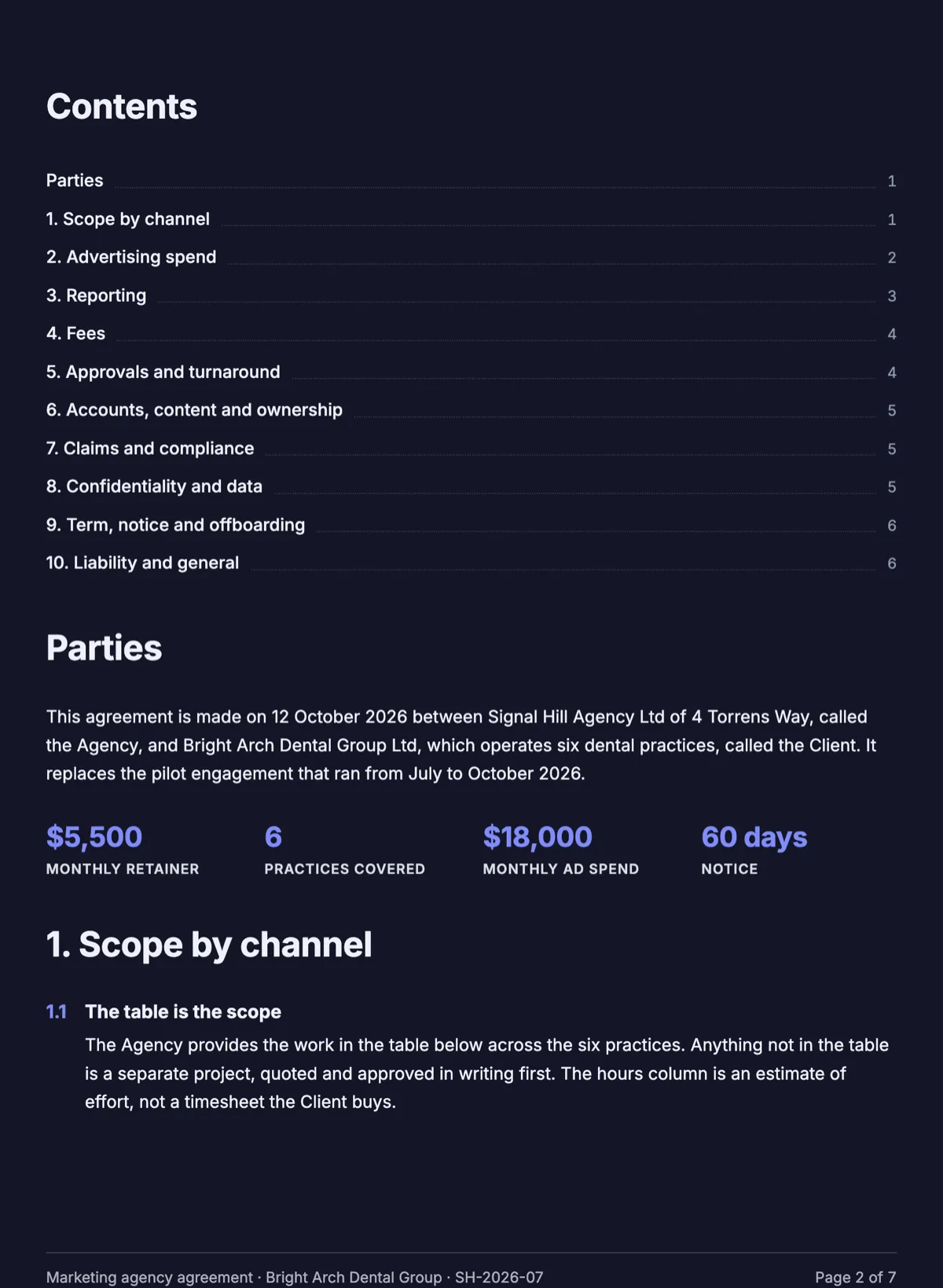 Marketing agency agreement with a channel scope and ad spend held apartThe two things that break an agency relationship are a scope nobody can point at and a fee that quietly includes the advertising budget. This retainer puts the work in a table with the hours and the reported metric for each channel, then keeps every dollar of ad spend in the accounts of the client where it belongs.
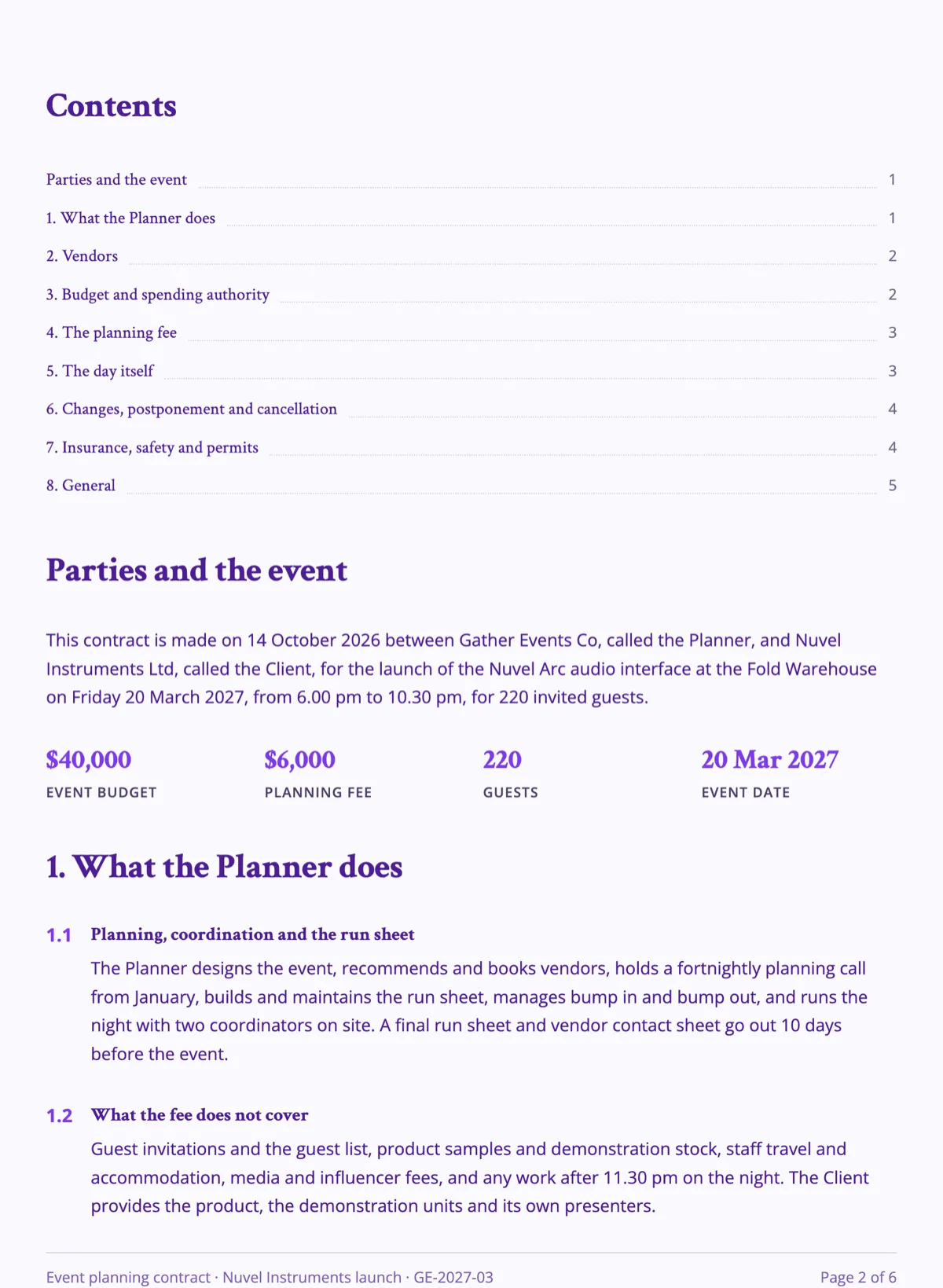 Event planning contract with a vendor table and a spending limitMost event disputes are really one of two arguments: who was actually contracted to the caterer, and who approved the extra $3,000. This contract answers both on the first two pages, with a vendor table that names the contracting party on every line and a spending limit the planner cannot quietly exceed.
Questions people ask
What is a rebate clause?
In a supply agreement it is the term that pays the buyer money back once its purchases reach agreed levels. In an agency or planning contract it is usually a promise that the agency keeps no rebates or commissions from suppliers. Both kinds need precise wording to avoid disputes.
What is a volume rebate?
A payment or credit from a supplier to a buyer when the buyer's purchases over a period pass a set threshold, worked out as a percentage of those purchases. It rewards volume without lowering the list price, and is usually paid after the period ends.
Is a rebate a discount for GST purposes?
In Australia a volume rebate is generally treated as reducing the price of earlier supplies, so it is an adjustment event. The supplier issues an adjustment note, and both parties adjust the GST they reported. The clause should state that an adjustment note will be provided.
Are secret supplier rebates legal?
A supplier paying a rebate to a buyer is normal. An agent secretly taking a payment from a supplier while spending a client's money can breach the agent's duties to the client and, in some cases, laws on secret commissions. Disclosure, or a no rebate promise, avoids the problem.
Do rebates apply to purchases on credit?
Only as the clause says. Many rebate clauses count purchases when invoiced, net of credits and returns, and require the invoices to have been paid within terms. The definition of qualifying purchases is the most important line in the clause.
Put the clause in a finished document
The button opens the document generator with a starting description already filled in. Change it to match your own agreement before you run it.
Create a document with OneCraftRelated clauses
- Royalty clause: sample for licences and franchisesRoyalty clause sample for licence and franchise agreements: the rate and base, minimum royalties, reports, audit rights and late payment.
- Default interest clause: sample rate and the penalty testDefault interest clause sample for loans and contracts: the extra rate on overdue amounts, when it runs, simple or compound, and the penalty rule.
- Price adjustment clause: moving a price after signingA price adjustment clause lets a price move after signing and says how. Australian sample wording with notice and an exit right, plus three variants to compare.
- Most favoured customer clause: promising the best priceA most favoured customer clause promises nobody else gets a better price. Sample wording with a rebate mechanism, three variants and the competition law risk.
For everything the document generator can do, see the document maker.
Step by step in the builder: Create a document with AI, then Document builder components.
Sources
Written and checked by the OneCraft team. Last checked .