Contract clause
Default interest clause: sample rate and the penalty test
A default interest clause adds an extra rate of interest on any amount a borrower or customer pays late, from the due date until it is paid. It compensates the creditor for the cost and risk of being kept out of its money, and must stay proportionate to avoid being struck down as a penalty.
A default interest clause charges an extra rate on overdue amounts, such as 4 per cent a year above the loan rate. Courts accept modest uplifts that reflect the higher credit risk of a borrower in default, but an uplift out of all proportion to that interest can be unenforceable as a penalty.
Nuwan Madhusanka · Co-founder
3 min read · Published
Sample clause
Written for a business loan to Kerfwell Joinery Pty Ltd from Halden Capital Pty Ltd, both fictional, at a fixed rate of 9 per cent a year.
Default Interest. (a) If the Borrower does not pay any amount on its due date, the Borrower must pay interest on that amount at the Default Rate from the due date until it is paid in full, both before and after any judgment. (b) The Default Rate is the interest rate in clause 4.1 plus 4 per cent a year. (c) Default interest accrues daily on a 365 day year, is not compounded, and is payable on demand or with the next instalment. (d) Default interest applies only to the overdue amount, not to the whole loan balance, unless the Lender has declared the whole balance due under clause 9. (e) The parties agree the Default Rate reflects the Lender's increased credit risk and administration costs while an amount is overdue.
Sample wording, not legal advice.
Variants
Fixed rate on a trade invoice
Supply or service terms where a set annual rate applies to overdue invoices, with no underlying loan rate to add to.
Overdue amounts carry interest at 10 per cent a year, calculated daily from the due date until payment, and the Customer pays the Supplier's reasonable costs of recovering them.
Joint venture cash call
A joint venture where a participant that fails to meet a cash call should pay interest to the participant that covers the shortfall.
An unpaid cash call carries interest at 9 per cent a year, is repayable on demand to the Participant that paid it, and is deducted from the defaulting Participant's next distribution.
Statutory rate by reference
Contracts governed by law that already sets a rate for late payment, such as the UK's statutory interest, where the parties adopt it.
Interest on overdue amounts is payable at the rate of statutory interest under the Late Payment of Commercial Debts (Interest) Act 1998 from the day after the due date.
What to negotiate
Keep the uplift modest
Courts in the UK and Australia have accepted default uplifts of a few percentage points as commercially justified, because a borrower in default is a higher credit risk. Large uplifts, or a rate that applies to the whole balance after a single late payment, attract the penalty argument. Recording the reason for the rate, as the sample does, helps.
Overdue amount or whole balance
Applying the default rate only to the amount actually overdue is the fair and safer approach. Applying it to the entire loan because one instalment was late multiplies the cost of a small default and is the kind of term courts scrutinise. Once the loan is accelerated, the whole balance is overdue and the rate can apply to it.
Simple or compound
Simple interest is easy to check and harder to attack. Compounding default interest, monthly or quarterly, increases the cost quickly on long defaults. If compounding is agreed, the clause should say the period. Consumers credit contracts carry their own rules on default rates and fees, which this sample does not address.
The risk of leaving it out
Without a default interest clause, a lender or supplier may only recover the ordinary contract rate, or no interest at all on an invoice, until it sues and gets interest under court rules. Late payers then have little reason to prioritise the debt, and the creditor carries the extra risk of a defaulting customer at no extra return.
Default interest and the penalty rule
A clause requiring a payment on breach is unenforceable as a penalty if it is out of all proportion to the innocent party's legitimate interest, the test the UK Supreme Court set in Cavendish Square v Makdessi in 2015. The High Court of Australia's approach in Paciocco v ANZ in 2016 is similar, asking whether the sum is extravagant or unconscionable compared with the greatest loss that could flow from the breach. A modest increase in rate reflecting higher credit risk usually passes. Law checked on 21 October 2026. This page explains how the law works and is not legal advice.
The sample in numbers
Kerfwell Joinery's loan is at 9 per cent a year, so the default rate is 13 per cent. If a $2,000 instalment is 20 days late, default interest is $2,000 times 13 per cent times 20 over 365, about $14.25, on top of the ordinary interest already built into the instalment. The cost is small for a short delay and grows with a longer one, which is what a proportionate default clause should do.
How it relates to late payment interest
In a loan, default interest is an uplift on an existing interest rate. In a supply contract there is usually no interest until payment is late, so the clause sets a rate from scratch, and the late payment interest clause page covers that form. In the UK, business debts carry statutory interest at 8 per cent over the reference rate unless the contract provides a substantial remedy instead.
Where the clause sits in a generated document
Loan agreements, promissory notes and joint venture agreements carry default interest clauses next to the interest and payment clauses. When asking the AI document generator for one, give the base rate, the uplift, whether it applies to the overdue amount or the balance, and whether it compounds.
Documents that carry this clause
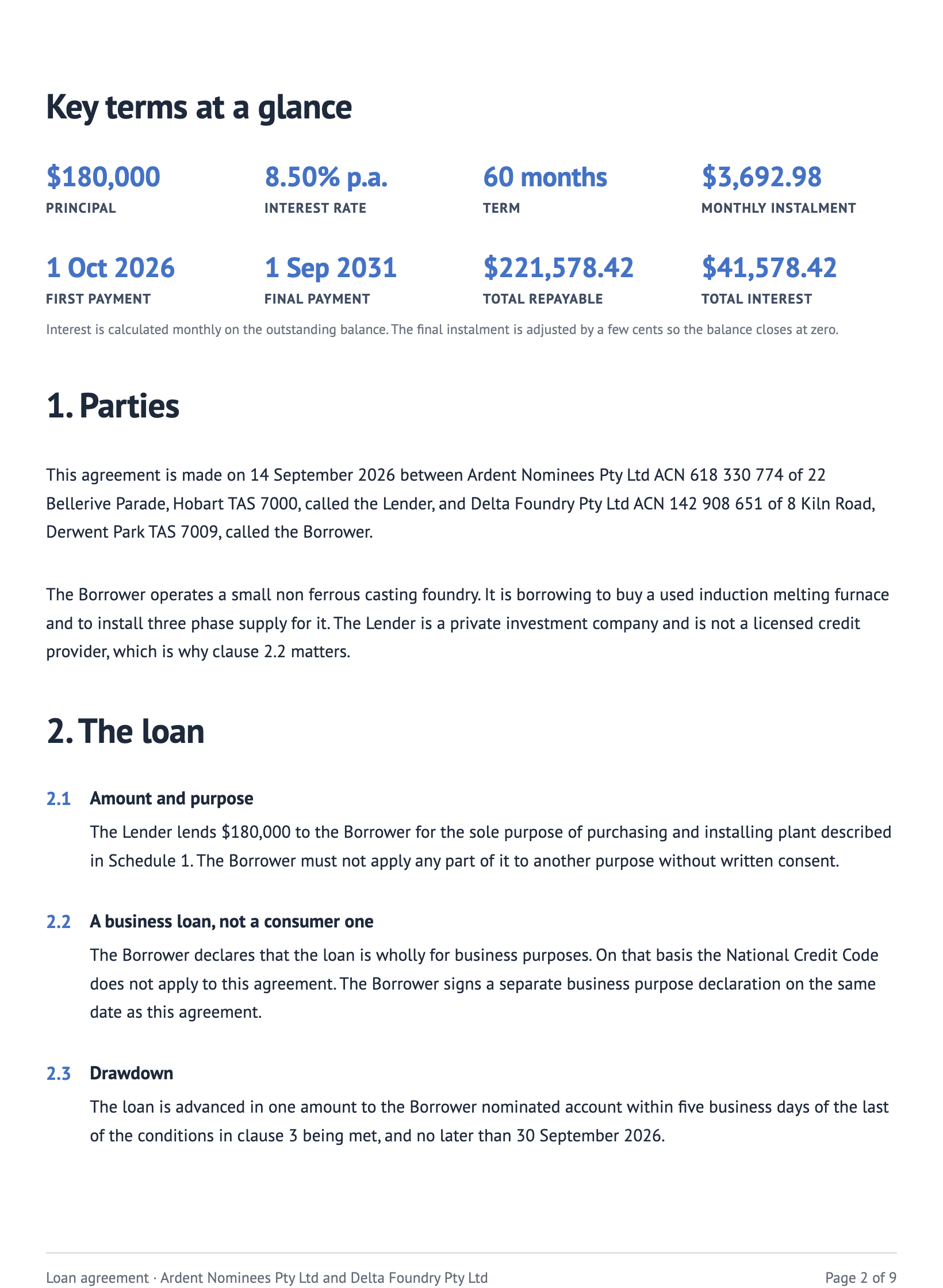 Loan agreement templateA Tasmanian foundry is borrowing $180,000 from a private investment company to buy a used induction furnace. The lender is not a bank, so everything a bank would take for granted has to be written down: what has to happen before the money moves, what is registered over what, and how long the borrower gets to fix a default.
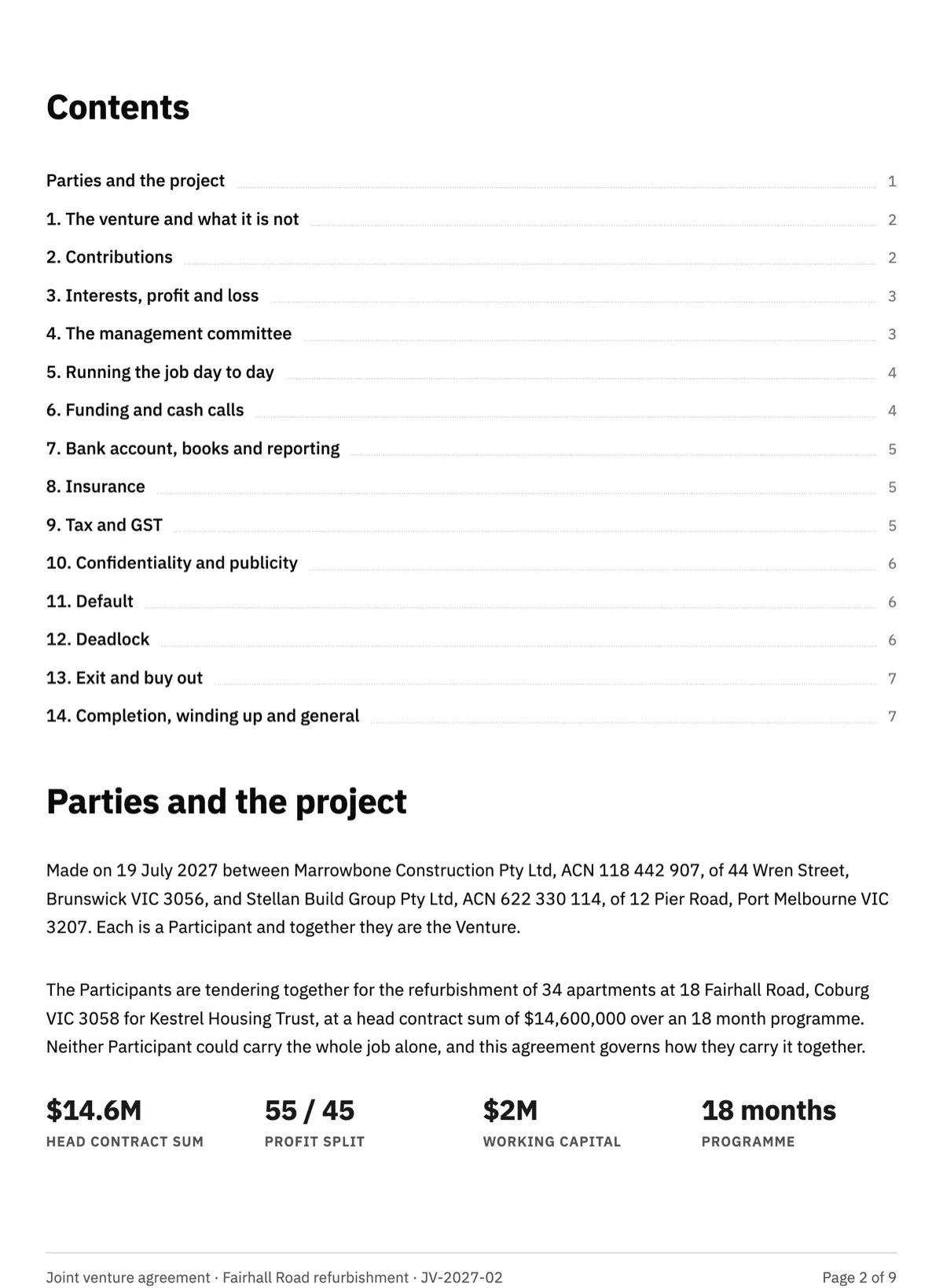 Joint venture agreement template with contributions and splitAn unincorporated joint venture has no company to fall back on, so everything a company structure would supply has to be written down. This one puts two builders together for a single $14.6 million refurbishment, splits it 55/45, and sets out who funds it, who decides, how a deadlock breaks and how either of them gets out.
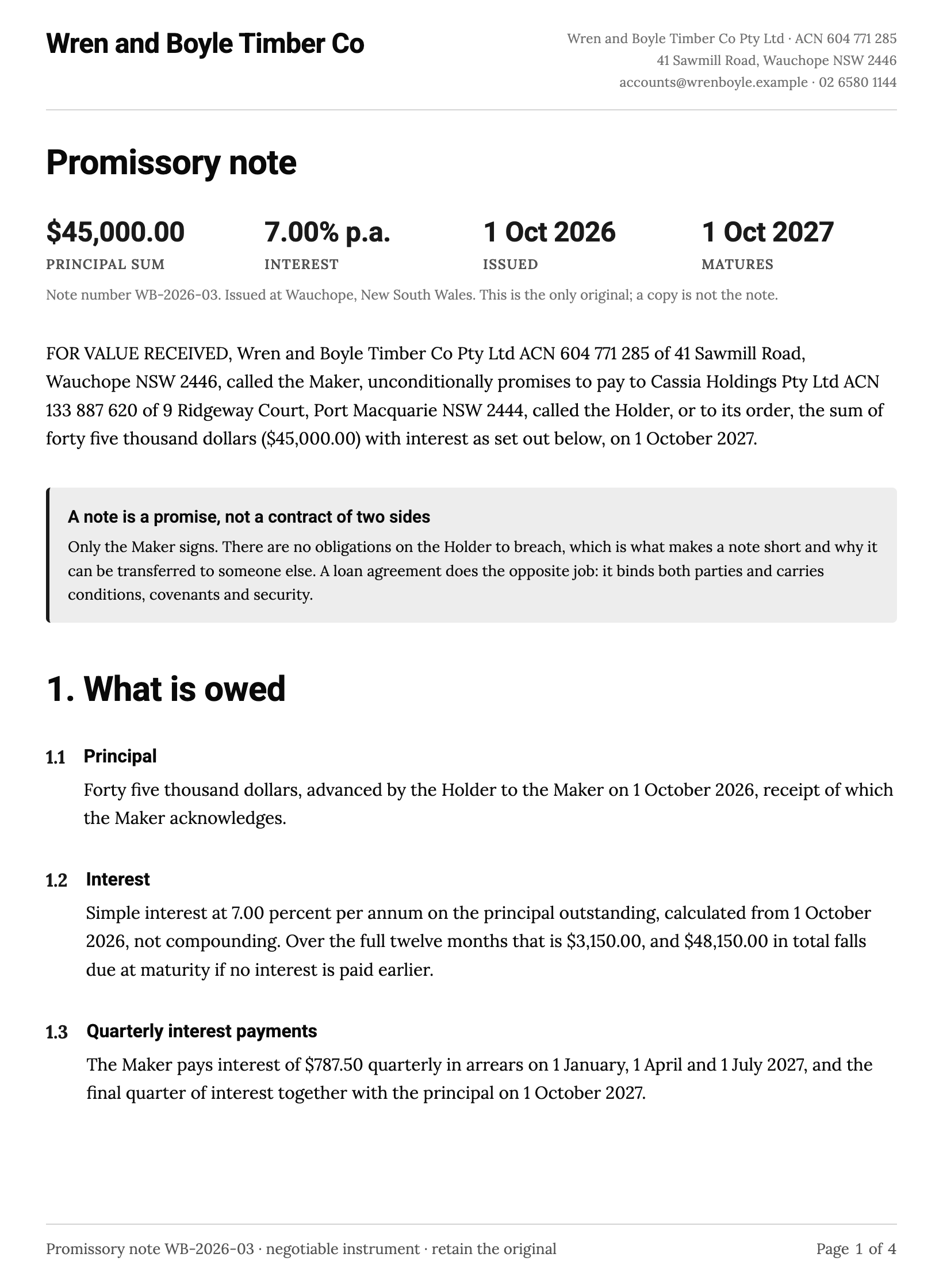 Promissory note templateA timber company owes $45,000 to a private lender and needs one page that says so. No conditions precedent, no covenants, no security. Only the maker signs, which is what keeps a note short and what lets the holder pass it on to somebody else.
Questions people ask
What is default interest?
An extra rate of interest charged on an amount that is paid late, from its due date until it is paid. In loans it is usually a fixed margin above the ordinary rate. It compensates the creditor for the higher risk and cost of a debtor who is in default.
Is a default interest clause a penalty?
Not usually, if the uplift is modest and reflects a legitimate interest such as increased credit risk. A rate out of all proportion to that interest can be unenforceable. Courts in the UK and Australia have upheld uplifts of a few percentage points.
What default interest rate is reasonable?
Commercial loans commonly add 2 to 5 percentage points to the ordinary rate. Trade terms often set a single annual rate around 8 to 12 per cent. The right figure depends on the creditor's real costs and risk, which should be recorded in case the rate is challenged.
Does default interest apply after judgment?
Only if the contract says it continues both before and after judgment, as the sample does. Otherwise, after judgment, interest is usually set by the court's rules at the judgment rate, which may be higher or lower than the contract rate.
Can default interest apply to the whole loan?
It can once the lender has properly accelerated the loan and the whole balance is due. Charging the default rate on the entire balance because one instalment was a few days late, with no acceleration, is more likely to be challenged.
Put the clause in a finished document
The button opens the document generator with a starting description already filled in. Change it to match your own agreement before you run it.
Create a document with OneCraftRelated clauses
- Retainer clause: monthly fee, included hours and rolloverRetainer clause sample for agencies and consultants: the monthly fee, hours included, unused hours, overage rates, the minimum term and notice to end.
- Rebate clause: volume rebates and no rebate promisesRebate clause sample: volume rebates on supply agreements, how they are earned and paid, GST adjustments, and the no rebate promise agencies give clients.
- Late payment interest clause: setting a rate that holdsA late payment interest clause sets what accrues on an overdue invoice. Australian sample wording at 8 percent, cash rate linked and UK statutory variants.
- Penalty clause: the UK test and three worked samplesWhat makes a penalty clause unenforceable in the UK after Cavendish v Makdessi, with three sample charges tested and one redrafted so it holds.
For everything the document generator can do, see the document maker.
Step by step in the builder: Create a document with AI, then Document builder components.
Written and checked by the OneCraft team. Last checked .