Contract clause
Penalty clause: the UK test and three worked samples
A penalty clause is a term that makes a party pay or lose something if it breaches the contract, set at a level that punishes rather than protects. In the UK such a term is unenforceable when the detriment it imposes is out of all proportion to the innocent party's legitimate interest in performance.
Charging for a breach is lawful; punishing it is not. Since the Supreme Court's 2015 decision in Cavendish Square v Makdessi and ParkingEye v Beavis, the question is not whether a sum is a genuine estimate of loss but whether it is out of all proportion to a legitimate interest.
Indunil Asanka · Co-founder
4 min read · Published
Sample clause
Written for hire terms of Severn Plant Hire, a fictional Bristol equipment hire company, for excavators and site plant hired by builders.
Late Return and Default Charges. (a) If the Hirer returns the Equipment after the agreed return date, the Hirer must pay a late return charge for each day or part day of delay equal to the daily hire rate in the Schedule, which reflects the hire income the Owner loses while the Equipment is unavailable to other customers. (b) The Owner may retain from the deposit only the amount needed to cover unpaid hire, cleaning and the reasonable cost of repairing damage beyond fair wear and tear, as shown on an itemised statement given to the Hirer within 14 days of return. (c) The Owner may recover its reasonable costs of recovering the Equipment if it is not returned within 7 days of written demand. (d) Nothing in this clause limits the Owner's right to claim any further loss it proves.
Sample wording, not legal advice.
Variants
Daily charge tied to lost hire
Equipment or venue hire, where late return stops the next booking and the loss is the hire income for each day.
If the Hirer returns the Equipment late, the Hirer must pay for each day or part day of delay an amount equal to the daily hire rate then applying to the Equipment. The parties agree this reflects the Owner's loss of the opportunity to hire the Equipment to another customer.
Deposit forfeiture capped at real loss
Bookings where a deposit is taken and the business wants to keep part of it on cancellation without the forfeiture being struck down.
If the Customer cancels less than 14 days before the start date, the Owner may retain from the deposit the costs it has incurred and the income it cannot replace by rebooking, up to 40% of the deposit, and must refund the balance within 10 business days.
Default fee removed, actual costs instead
Standard terms that carried a large flat fee on any default, which is the shape most likely to fail the test.
If the Customer breaches this agreement, the Customer must pay the Owner's reasonable costs and expenses caused by the breach, including recovery and administration costs, as shown in an itemised invoice.
What to negotiate
Name the legitimate interest
The 2015 test looks for an interest the charge protects, which can go beyond compensation: in ParkingEye it was the efficient use of a car park for all users. A clause that says what it protects, such as hire income lost while equipment is overdue, is easier to defend than a bare number. Keep the reasoning on file when the rate is set.
Primary or secondary obligation
The penalty rule applies only to secondary obligations, the ones triggered by a breach. A price that changes with circumstances, such as a higher rate for a longer hire, is a primary obligation and outside the rule. Drafting a charge as part of the price rather than as a consequence of breach can change its treatment, though courts look at substance, not labels.
Keep the evidence
A business that can show how it calculated a charge, for example average daily utilisation and the hire rate lost, stands far better than one that picked a round figure. Customers negotiating standard terms should ask how a charge was worked out; a supplier that cannot answer has a clause at risk, and a lever for a lower figure.
The risk of leaving it out
Leaving out any charge for late return or default means the business must prove its actual loss each time, which is slow and often not worth the cost for small amounts. Including an oversized charge is worse than leaving it out: if a court strikes it down as a penalty, the business is left to prove its loss anyway, and has spent goodwill and legal costs in the attempt.
The test after Cavendish and ParkingEye
In Cavendish Square Holding BV v Makdessi and ParkingEye Ltd v Beavis, decided together in 2015, the UK Supreme Court replaced the old genuine pre estimate of loss test. A clause is a penalty if it is a secondary obligation that imposes a detriment on the party in breach out of all proportion to any legitimate interest of the innocent party in having the primary obligation performed. In Cavendish, losing deferred consideration for breaching restrictive covenants was upheld because protecting goodwill was a legitimate interest. In ParkingEye, an £85 overstay charge was upheld because managing parking for everyone justified it. Law checked on 21 October 2026. This page explains how the clause works and is not legal advice.
Three clauses tested
Take three charges Severn Plant Hire might write. A late return charge of £95 a day on an excavator whose daily hire rate is £95 protects the hire income lost while the machine is out of circulation, and the amount matches that interest, so it is likely to hold. Forfeiting 40% of every deposit on any late return, however short, bears no relation to what a one hour delay costs, so it is exposed. A flat £2,000 default fee for any breach, from a late payment of £10 to non return of the machine, is the classic penalty shape: one large figure for breaches of very different seriousness. The sample keeps the first, caps the second at real costs and replaces the third.
Penalties and liquidated damages
Liquidated damages are a pre agreed sum payable on a particular breach, usually delay, and they are enforceable unless they cross the penalty line. The two terms describe the same kind of clause before and after the court's verdict: a liquidated damages clause that is out of all proportion is a penalty. The Australian position, set by the High Court in Paciocco v ANZ, is close to the UK test but not identical, and the parent liquidated damages page covers it. In the US, courts generally ask whether the sum was a reasonable forecast of harm that was hard to estimate when the contract was made, a test closer to the old English rule.
Where the clause sits in a generated document
Hire agreements, service contracts and subcontracts all carry some version of this clause. In a document written by the AI document generator, describe the charge and the interest it protects in the prompt, and the clause comes out as a numbered term with sub clauses. The sample's structure, a rate tied to a stated loss, an itemised deposit deduction and a recovery cost clause, is a sensible pattern to ask for.
Documents that carry this clause
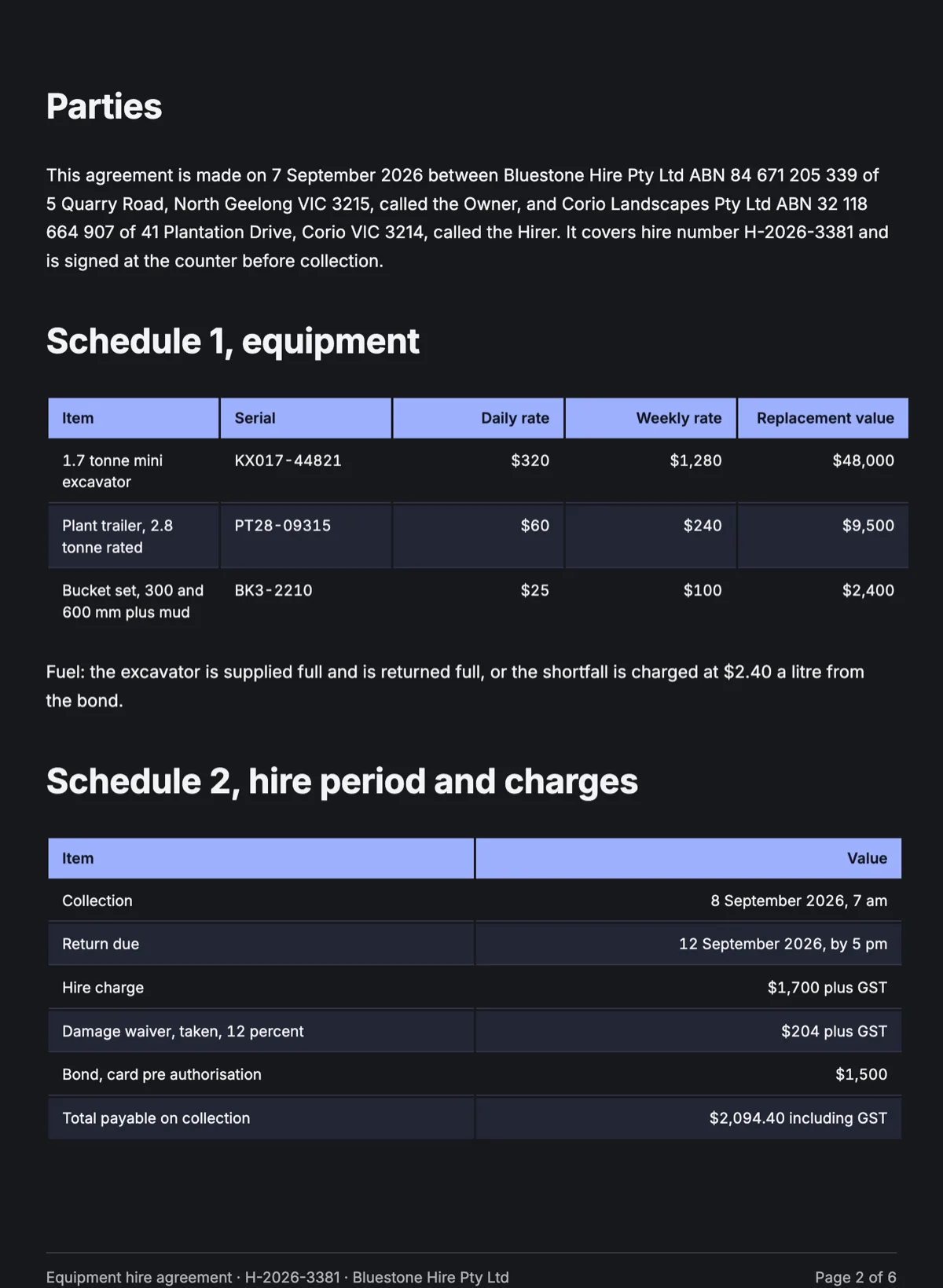 Equipment hire agreement template with the rates in a scheduleA hire agreement is a price list, an insurance decision and a return date, and the argument is always about the day it came back. This one puts the equipment and rates in a schedule, makes the damage waiver a choice with its price, and defines late return in hours so there is nothing to interpret.
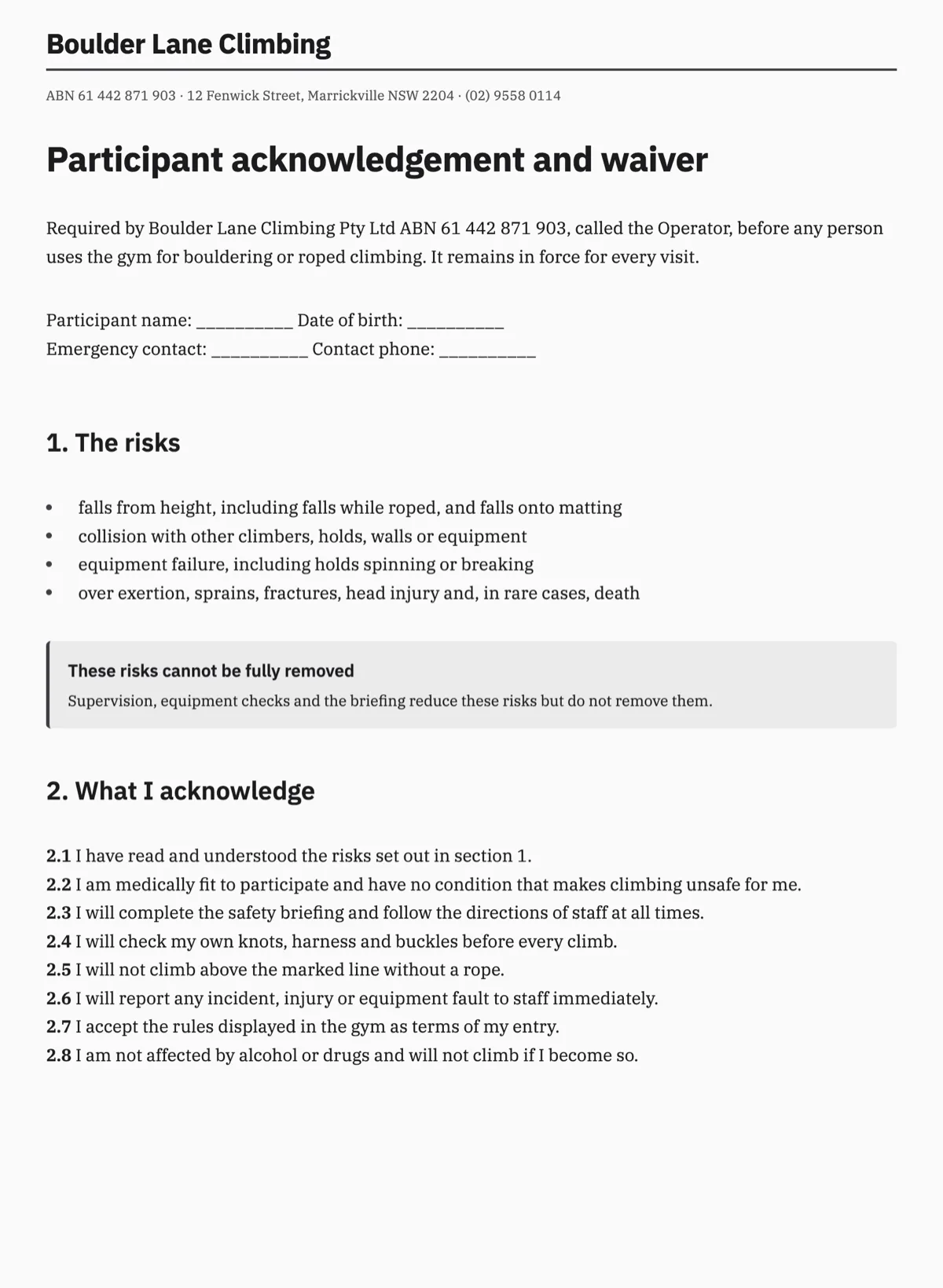 Liability waiver template written for Australian recreational servicesMost waivers in Australia are copies of American forms and exclude things that cannot be excluded, which makes the whole document weaker. This one names the real risks, takes the acknowledgements one by one, and uses the recreational services exclusion the way the consumer law actually permits, with a guardian block for minors.
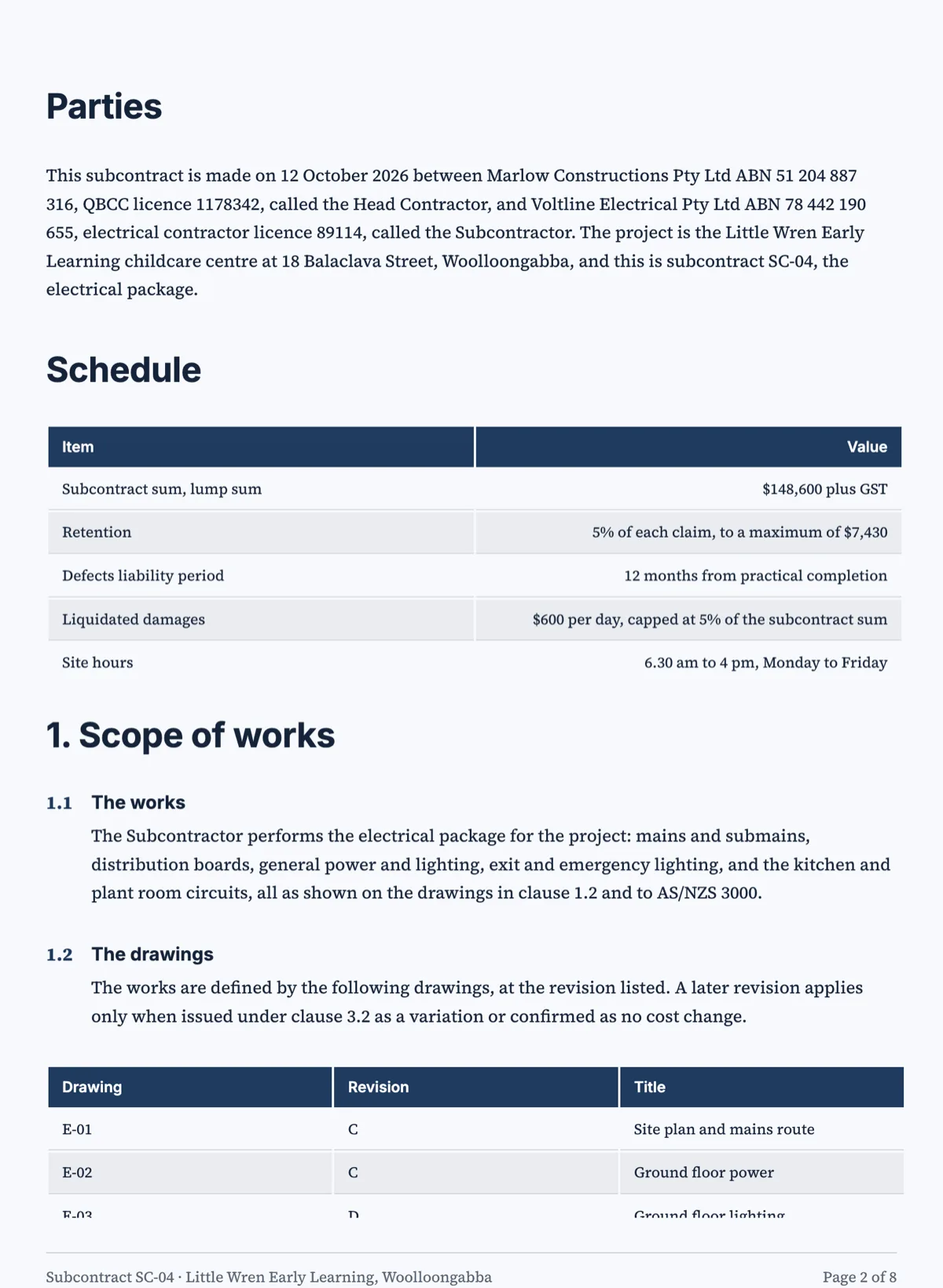 Subcontractor agreement template that flows the head contract downA subcontract exists to pass the head contract's obligations down one level and move the money back up on time. This one names the scope by drawing, sets the progress claim dates against the security of payment rules, holds retention and states the insurances, so the trade knows exactly when it is paid and for what.
Questions people ask
Are penalty clauses illegal in the UK?
They are not illegal, but a clause found to be a penalty cannot be enforced. The party in breach does not pay the stated sum, and the innocent party must prove its actual loss instead. Nothing stops a contract containing a charge for breach; the risk is only that a court refuses to apply it.
Can a deposit be a penalty?
Yes. A modest deposit forfeited on cancellation is usually accepted as a customary arrangement, but a large deposit, or one kept in full whatever the breach, can be treated as a penalty, and in consumer contracts it may also be an unfair term under the Consumer Rights Act 2015. Keeping only real costs avoids both risks.
Does the penalty rule apply to consumer contracts?
Yes, and consumer contracts face a second test as well. The Consumer Rights Act 2015 makes unfair terms not binding on the consumer, and its grey list includes terms requiring a consumer who breaches to pay a disproportionately high sum in compensation. A charge can therefore fail on fairness even where it would survive the penalty test.
Who has to prove a clause is a penalty?
The party that wants to avoid paying. It must show the clause is a secondary obligation and that the detriment is out of all proportion to the other side's legitimate interest. Courts give weight to terms negotiated between businesses of similar strength, so a penalty argument is harder to win in a negotiated commercial deal than against standard consumer terms.
Is a late payment interest charge a penalty?
Usually not, if the rate is commercially reasonable. Interest compensates for the cost of being kept out of money, a clear legitimate interest. Between UK businesses, statutory interest under the Late Payment of Commercial Debts (Interest) Act 1998 runs at 8% over the Bank of England base rate, which is a useful reference point when setting a contractual rate.
Put the clause in a finished document
The button opens the document generator with a starting description already filled in. Change it to match your own agreement before you run it.
Create a document with OneCraftRelated clauses
- Liquidated damages clauseA liquidated damages clause fixes what delay costs before it happens. Sample fit out wording, the Australian penalty test, caps, and what each side negotiates.
- Deposit clause: what happens to money paid up frontA deposit clause takes money up front and says what happens to it. Australian sample wording, refundable and non refundable variants, and the unfair terms risk.
- Early termination fee clauseAn early termination fee clause charges for ending a contract before the term ends. Sample wording, sliding scales, the penalty test and unfair terms limits.
- Exclusion clause: UK sample wording and the statutory limitsHow a UK exclusion clause works under the Unfair Contract Terms Act 1977 and the Consumer Rights Act 2015, with a sample for an IT support firm and the bans.
For everything the document generator can do, see the document maker.
Step by step in the builder: Create a document with AI, then Document builder components.
Written and checked by the OneCraft team. Last checked .