Contract clause
Exclusion clause: UK sample wording and the statutory limits
An exclusion clause is a contract term that removes a party's liability for a particular kind of loss or breach. In the UK it only works if it is part of the contract, its words clearly cover the loss, and it survives the Unfair Contract Terms Act 1977 or, against a consumer, the Consumer Rights Act 2015.
An exclusion clause has to clear three hurdles before it protects anyone: it must have been incorporated, it must cover the loss on a fair reading, and statute must allow it. Some exclusions the law forbids outright; most others must be reasonable.
Nuwan Madhusanka · Co-founder
4 min read · Published
Sample clause
Written for business IT support terms of Kennet Tech Support, a fictional IT services firm in Reading, supplying managed support to small offices.
Exclusions. (a) The Supplier is not liable for loss or corruption of the Customer's data except to the extent the loss is caused by the Supplier's breach of this agreement and could have been avoided by the Customer keeping backups as required by clause 6. (b) The Supplier is not liable for any loss of profit, revenue or business opportunity arising under or in connection with this agreement. (c) Nothing in this agreement excludes or limits liability for death or personal injury caused by negligence, for fraud or fraudulent misrepresentation, or for any other liability that cannot be excluded or limited by law. (d) The Customer confirms it has read this clause, has had the opportunity to negotiate it, and that the exclusions are reflected in the Charges.
Sample wording, not legal advice.
Variants
Business to business, tested for reasonableness
Standard terms between businesses, where UCTA requires most exclusions to be reasonable.
The Supplier is not liable for indirect or consequential loss, or for loss of profit, revenue or data, except where caused by its wilful default. The parties agree these exclusions are reasonable having regard to the Charges, the insurance available to each party and the Customer's ability to protect its own data.
Consumer contract under the Consumer Rights Act 2015
Services sold to individuals, where many exclusions are blocked and the rest must be fair and transparent.
If the Services are not performed with reasonable care and skill, the Customer is entitled to have them performed again or, where that is not possible, to a price reduction. Nothing in these terms affects the Customer's statutory rights. The Supplier is not liable for losses that were not a foreseeable result of its breach.
Exclusion of named heads of loss
Commercial agreements where both sides want certainty about which kinds of loss are out, rather than relying on the phrase consequential loss.
Neither party is liable to the other for loss of profit, loss of revenue, loss of anticipated savings, loss of goodwill or wasted management time, in each case whether direct or indirect.
What to negotiate
Incorporation and notice
An exclusion clause binds only if it was part of the contract when it was made: in a signed document, or brought to the other party's attention before agreement. Terms printed on an invoice sent afterwards come too late. Particularly onerous terms need to be drawn specifically to the other party's attention, so customers should ask where the exclusions are, and suppliers should highlight them.
Contra proferentem and clear words
Courts read an exclusion clause narrowly, and an ambiguity is resolved against the party relying on it. An exclusion of liability for negligence must say so clearly or cover it unmistakably. Suppliers should name the losses they mean to exclude; customers should resist catch all wording such as any loss whatsoever, which invites a fight over its meaning.
The reasonableness guidelines
Under section 11 of UCTA, the clause must be fair and reasonable given what the parties knew when the contract was made. Schedule 2 lists guidelines: bargaining strength, whether the customer received an inducement such as a lower price, whether it knew of the term, and whether it could have gone elsewhere. A customer offered a higher price without the exclusion has a weaker case that it was unreasonable.
The risk of leaving it out
Without exclusions, a supplier's liability for breach runs to every foreseeable loss, including lost profits that can dwarf the contract price. For a small IT firm, one data loss claim from a customer that kept no backups could exceed years of fees. A carefully limited exclusion, paired with a liability cap, is what keeps the price of a low cost service affordable.
What the law bans outright and what must be reasonable
UCTA and the CRA each ban some exclusions completely. A business cannot exclude or restrict liability for death or personal injury caused by negligence, under section 2(1) of UCTA for business contracts and section 65 of the CRA for consumer contracts. Against a consumer, a trader cannot exclude the statutory rights that goods be of satisfactory quality and fit for purpose, or that services be performed with reasonable care and skill. Between businesses, other exclusions of negligence liability, and exclusions in standard terms, must satisfy the reasonableness test. Fraud cannot be excluded at all. Law checked on 21 October 2026. This page explains how the clause works and is not legal advice.
Reading the sample
The sample's first paragraph does not exclude data loss outright; it removes liability only to the extent the customer's own failure to keep backups contributed, which is far more likely to be found reasonable than a blanket exclusion. The second paragraph excludes loss of profit, a common and usually defensible exclusion between businesses. The third preserves the liabilities that cannot be excluded, so the clause never claims more than the law allows, which matters because overreaching drafting can colour how a court views the rest. The last records that the exclusions were priced in, which supports reasonableness.
Exclusion clauses in consumer terms
The CRA 2015 makes an unfair term not binding on a consumer, and requires terms to be transparent and prominent if they are to escape assessment for fairness. The Competition and Markets Authority's guidance on unfair contract terms gives examples of exclusions it considers unfair, such as excluding liability for the trader's own failure to perform. A consumer facing business should write exclusions narrowly, in plain English, and never suggest that statutory rights are removed.
Australia and the US
In Australia the consumer guarantees in the Australian Consumer Law cannot be excluded, and the unfair contract terms regime now applies to small business contracts as well as consumer contracts, with penalties since 2023. The parent pages on exclusion of warranties and consequential loss cover that drafting. In the US, exclusions of implied warranties must meet UCC 2-316 conditions, such as mentioning merchantability conspicuously.
Documents that carry this clause
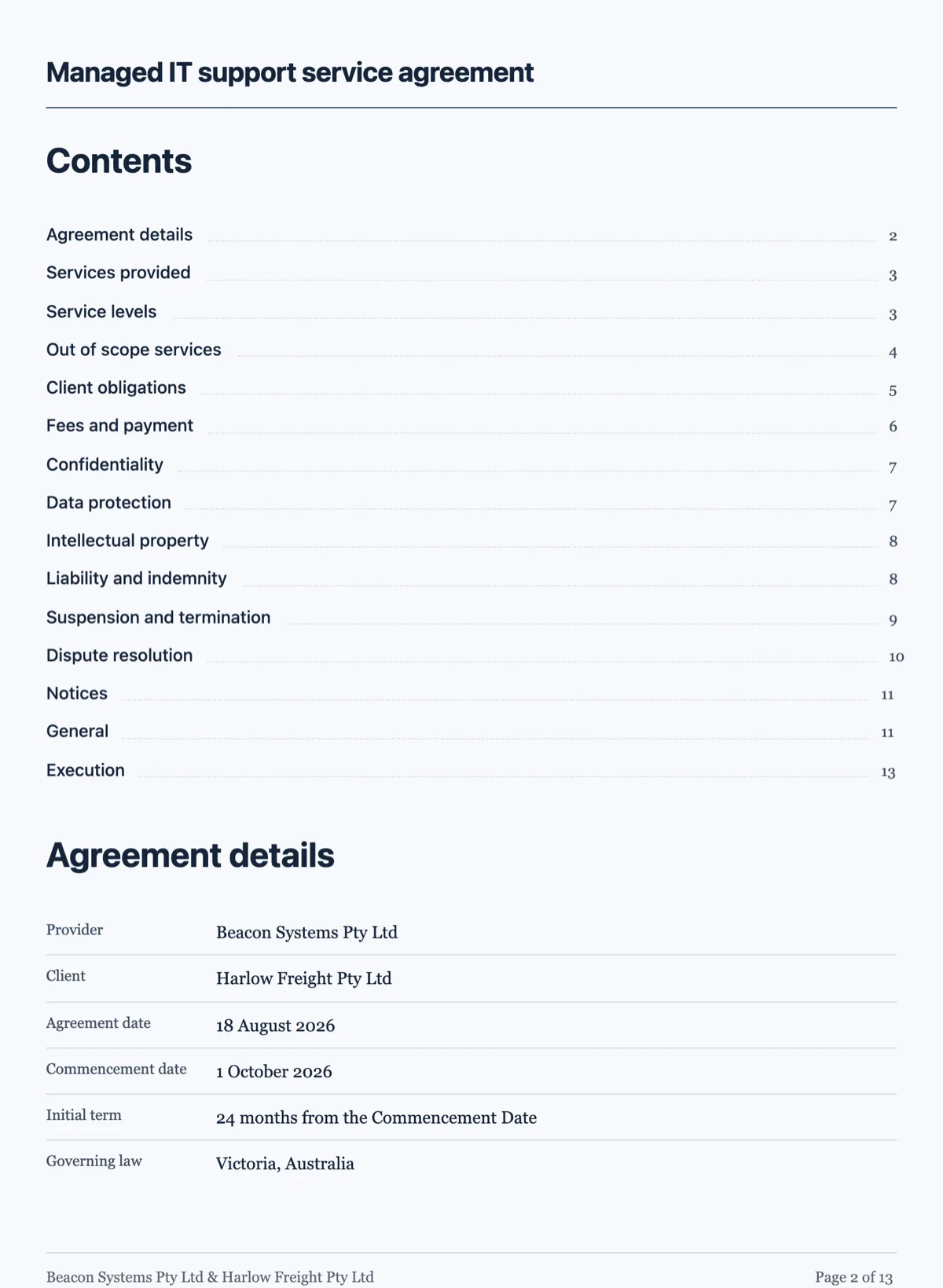 Service agreement template with scope, service levels and an exitA service agreement template has to say what is supplied, how well, for what fee, who is liable for what, and how either side gets out. This one is filled in for Beacon Systems supporting Harlow Freight's IT for an initial 24 months from 1 October 2026 at $8,400 a month plus GST, with 40 hours included and $220 an hour beyond them. Twelve numbered clauses cover the services, a four level severity table, client duties, fees with a CPI adjustment, confidentiality, privacy, IP, a liability cap, termination and a three step dispute ladder under Victorian law.
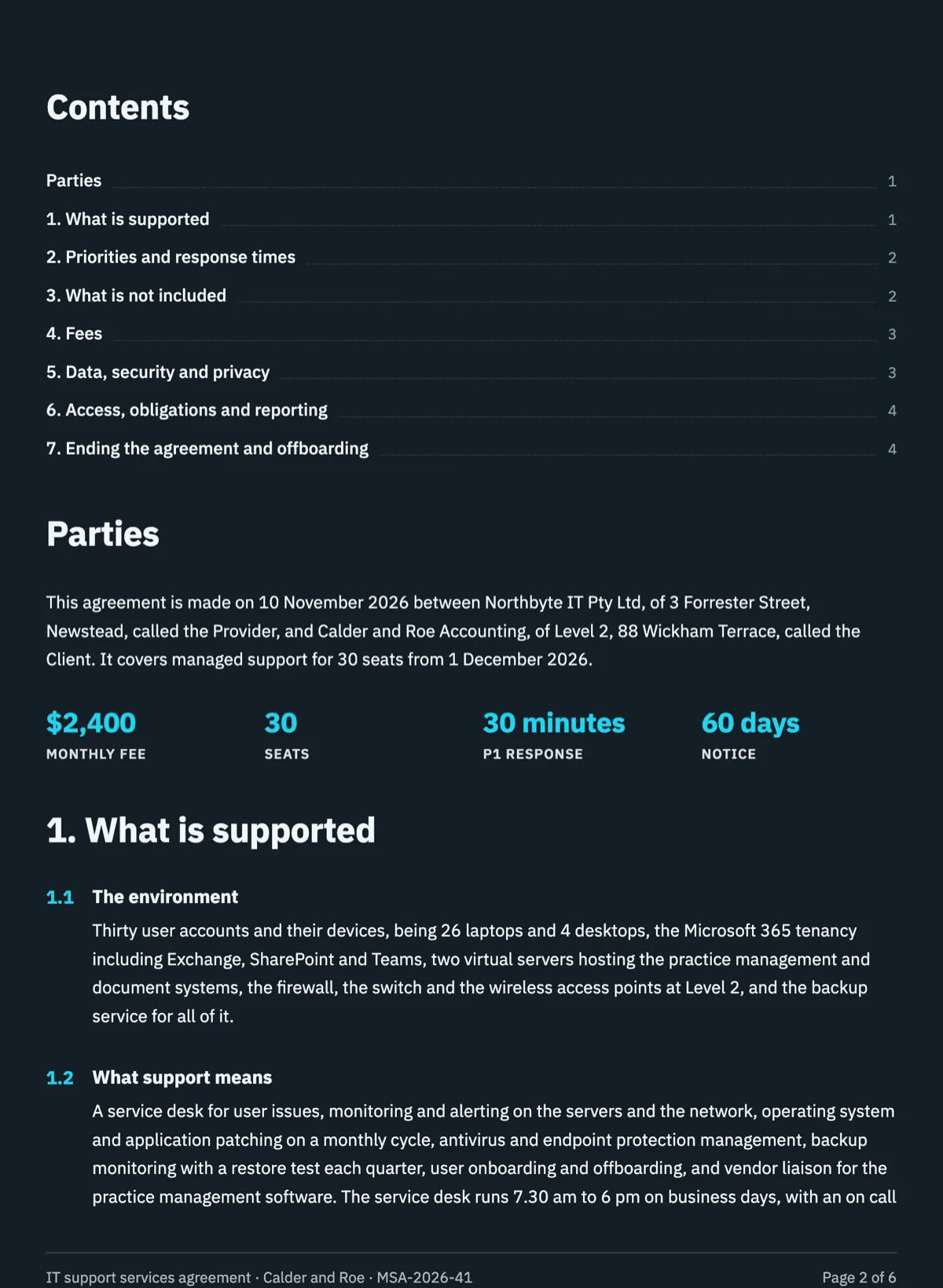 IT support services agreement with response times by priorityManaged support is sold on a monthly fee and judged on how fast the phone gets answered when nobody can work. This agreement grades every ticket into four priorities with a published response and resolution target, credits the fee when the target is missed, and writes down exactly what the provider hands back on the way out.
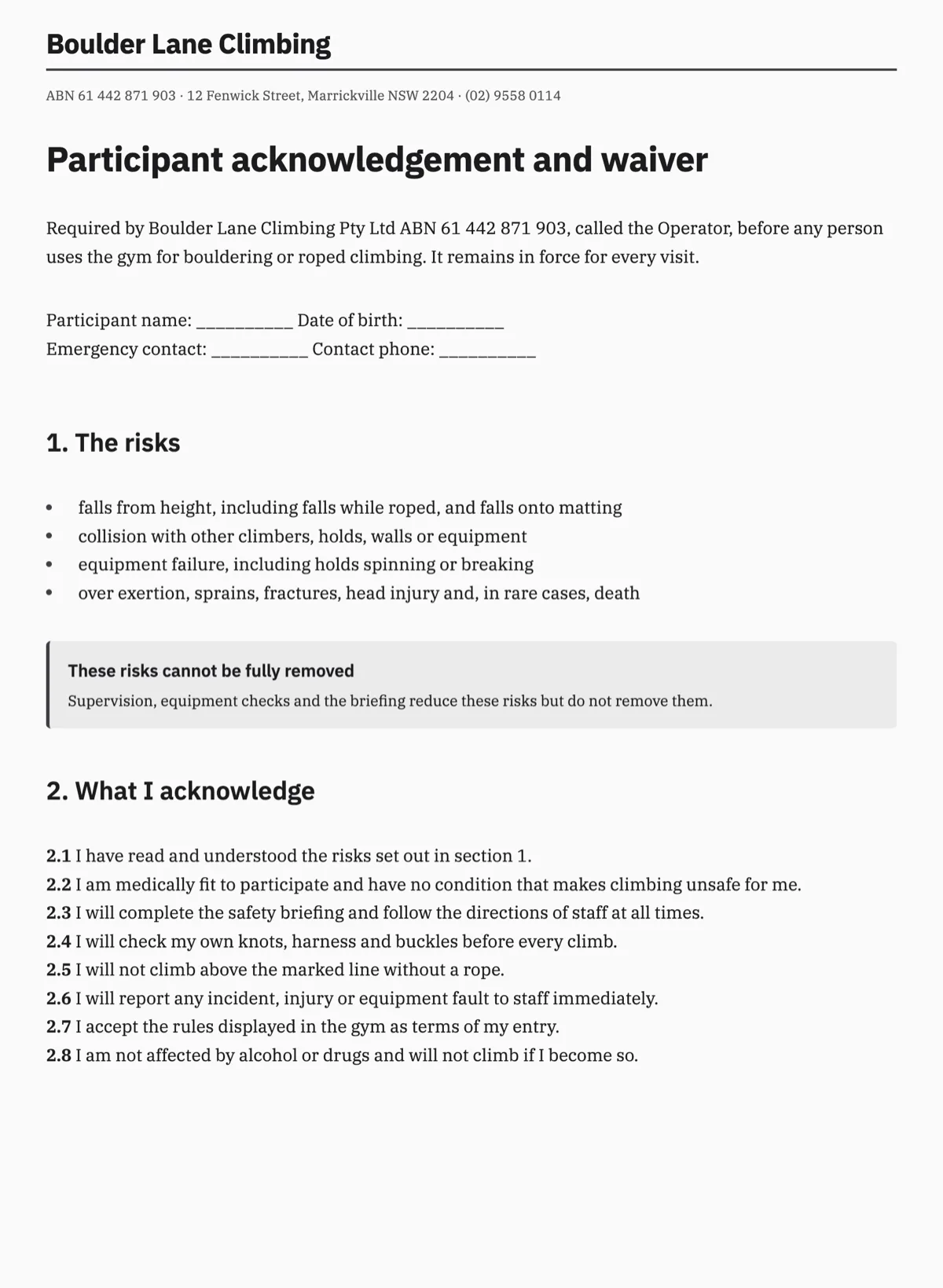 Liability waiver template written for Australian recreational servicesMost waivers in Australia are copies of American forms and exclude things that cannot be excluded, which makes the whole document weaker. This one names the real risks, takes the acknowledgements one by one, and uses the recreational services exclusion the way the consumer law actually permits, with a guardian block for minors.
Questions people ask
Are exclusion clauses legal in the UK?
Yes, within limits. A business can exclude many kinds of liability, but the Unfair Contract Terms Act 1977 and the Consumer Rights Act 2015 ban some exclusions outright, such as liability for death or personal injury caused by negligence, and require others to be reasonable or fair. An exclusion that breaks those rules simply has no effect.
Can a business exclude liability for negligence?
Not for death or personal injury, ever. For other loss, such as damage to property or financial loss, a business can exclude negligence liability towards another business if the clause is reasonable and clearly covers negligence. Towards a consumer, the CRA makes such exclusions very difficult, and most are not binding.
What makes an exclusion clause reasonable?
The test looks at the position when the contract was made: the parties' bargaining strength, whether the customer could have bought without the exclusion at a different price, whether the customer knew of the term, whether insurance was available, and how clearly the clause was drafted. Schedule 2 to UCTA lists these guidelines.
Does an exclusion clause cover the other party's fraud?
No. English law does not allow a party to exclude liability for its own fraud, whatever the wording. Clauses often state this expressly, as the sample does, partly so that the rest of the clause is not read as an attempt to overreach.
What is the difference between an exclusion and a limitation clause?
An exclusion clause removes liability for a type of loss altogether, while a limitation clause caps the amount payable. Both are tested under UCTA, but courts are generally less hostile to limitations, because they leave the injured party with some remedy. Many contracts use both, excluding loss of profit and capping the rest.
Put the clause in a finished document
The button opens the document generator with a starting description already filled in. Change it to match your own agreement before you run it.
Create a document with OneCraftRelated clauses
- Disclaimer of warranties clause: what can and cannot be excludedA disclaimer of warranties clause removes implied warranties as far as the law allows. Australian sample wording with the consumer guarantees carve out.
- Consequential loss clause: excluding indirect and flow on lossA consequential loss clause removes indirect losses such as lost profit from a claim. Australian sample wording, three variants and the naming problem.
- Limitation of liability clause in the UK: caps that holdA UK limitation of liability clause sample for a software supplier: an aggregate cap, a separate data protection cap, how Drax v Wipro reads caps, and UCTA.
- Consumer guarantees clause under the Australian Consumer LawA consumer guarantees clause tells customers the Australian Consumer Law guarantees apply and cannot be excluded. Sample warranty wording and what it must say.
For everything the document generator can do, see the document maker.
Step by step in the builder: Create a document with AI, then Document builder components.
Written and checked by the OneCraft team. Last checked .