Contract clause
Limitation of liability clause in the UK: caps that hold
A limitation of liability clause caps the amount one party can recover from the other for breach of contract, negligence or other claims. In the UK a cap is enforceable if its wording is clear and, where it sits in standard terms or covers negligence, it is reasonable under the Unfair Contract Terms Act 1977.
Most UK commercial contracts cap liability, and most disputes about caps turn on one question: is it one cap for everything, or a cap per claim? The 2023 judgment in Drax v Wipro showed how much money that drafting choice can move.
Indunil Asanka · Co-founder
4 min read · Published
Sample clause
Written for a software services agreement between Fenwick Data, a fictional Newcastle software supplier, and a regional housing association customer.
Limitation of Liability. (a) Subject to paragraph (d), each party's total aggregate liability arising under or in connection with this agreement, whether in contract, tort (including negligence), breach of statutory duty or otherwise, is limited to the greater of £500,000 and 125% of the Charges paid and payable in the 12 months before the event giving rise to the most recent claim. (b) Subject to paragraph (d), the Supplier's total aggregate liability for breach of clause 14 (Data Protection) is limited to £2,000,000, and that liability does not count towards the cap in paragraph (a). (c) Amounts paid under paragraph (a) reduce the amount available for later claims. (d) Nothing in this agreement limits liability for death or personal injury caused by negligence, for fraud, or for any liability that cannot lawfully be limited.
Sample wording, not legal advice.
Variants
Single aggregate cap
The supplier wants a known maximum exposure for the whole life of the contract, often matched to its insurance.
Each party's total aggregate liability for all claims arising under or in connection with this agreement shall not exceed £750,000.
Per claim cap
Long contracts with many independent services, where a customer fears one early claim using up all protection.
Each party's liability in respect of each claim or series of connected claims arising from the same cause shall not exceed £250,000, and there is no limit on the number of claims.
Per contract year cap
Multi year managed services, where liability should refresh each year in line with annual charges.
Each party's total liability for all claims arising in any Contract Year shall not exceed 100% of the Charges paid and payable for that Contract Year, and unused amounts do not carry forward.
What to negotiate
One cap or several
In Drax Energy v Wipro, a clause saying total liability for all claims would not exceed 150% of the preceding year's charges was read as a single aggregate cap of about £11.5 million, not a cap per claim as Drax argued. The lesson is to say plainly which is meant. Customers wanting per claim protection must write it in, and suppliers wanting an aggregate cap should use the words total aggregate liability for all claims.
Reasonableness under UCTA
Where the cap is in one party's standard terms, or limits negligence liability, it must be reasonable. Section 11(4) of UCTA asks about the resources the party had to meet the liability and whether it could have insured. A cap far below the supplier's insurance, or a token figure on a large contract, is the type most at risk. Linking the cap to fees and insurance cover helps.
Separate caps and carve outs
Data protection breaches, IP infringement indemnities and confidentiality breaches can cost far more than ordinary breaches, so customers often ask for them to sit outside the main cap or under a higher one. Suppliers usually accept a separate, higher cap rather than unlimited liability. Check how the caps interact: whether claims under the special cap also use up the general one.
The risk of leaving it out
With no cap, a supplier's exposure is limited only by the rules on remoteness of damage, so a fault in a modest software contract could expose it to the customer's entire business losses. For customers, an absent cap can look like an advantage, but suppliers without one often price the risk in or refuse to contract. A clear cap is usually better for both than a fight about remoteness later.
Three cap shapes, one worked example
Suppose a contract pays £400,000 a year and three claims arise over three years: £300,000 in year one, £250,000 in year two and £200,000 in year three. Under a single aggregate cap of £750,000, the first two claims are paid in full and the third only up to £200,000, so the full total of £750,000 is recovered and nothing remains. Under a per claim cap of £250,000, the first claim is cut to £250,000 and the others paid, giving £700,000. Under a per year cap of 100% of annual charges, each claim fits within its year's £400,000 and all £750,000 is paid. The shape changes the result even when the headline figures look similar. Law checked on 21 October 2026. This page explains how the clause works and is not legal advice.
Why the sample uses the greater of two figures
Tying the cap only to fees paid can produce a tiny cap early in a contract, when little has been paid but a lot of work is at stake. The sample sets the cap at the greater of a fixed sum and a percentage of the last 12 months' charges, so it never falls below £500,000 and grows with the contract. Measuring the 12 months before the event giving rise to the most recent claim, rather than the first, avoids an argument about which period applies when claims arrive over time.
What cannot be capped
Liability for death or personal injury caused by negligence cannot be limited, under section 2(1) of UCTA, and English law does not allow a party to limit liability for its own fraud. The sample's paragraph (d) states those exceptions so the clause never overreaches. Against consumers, the Consumer Rights Act 2015 applies instead and is stricter. The Australian drafting, including the effect of the Australian Consumer Law, is on the parent limitation of liability page.
Insurance and the cap
A cap is only as good as the money behind it. Suppliers should set the main cap at or below their professional indemnity and public liability cover, and check whether the policy limit is per claim or aggregate, so the contract and the policy match. Customers can ask for evidence of insurance and an obligation to keep it in force for the life of the contract and some years after.
Documents that carry this clause
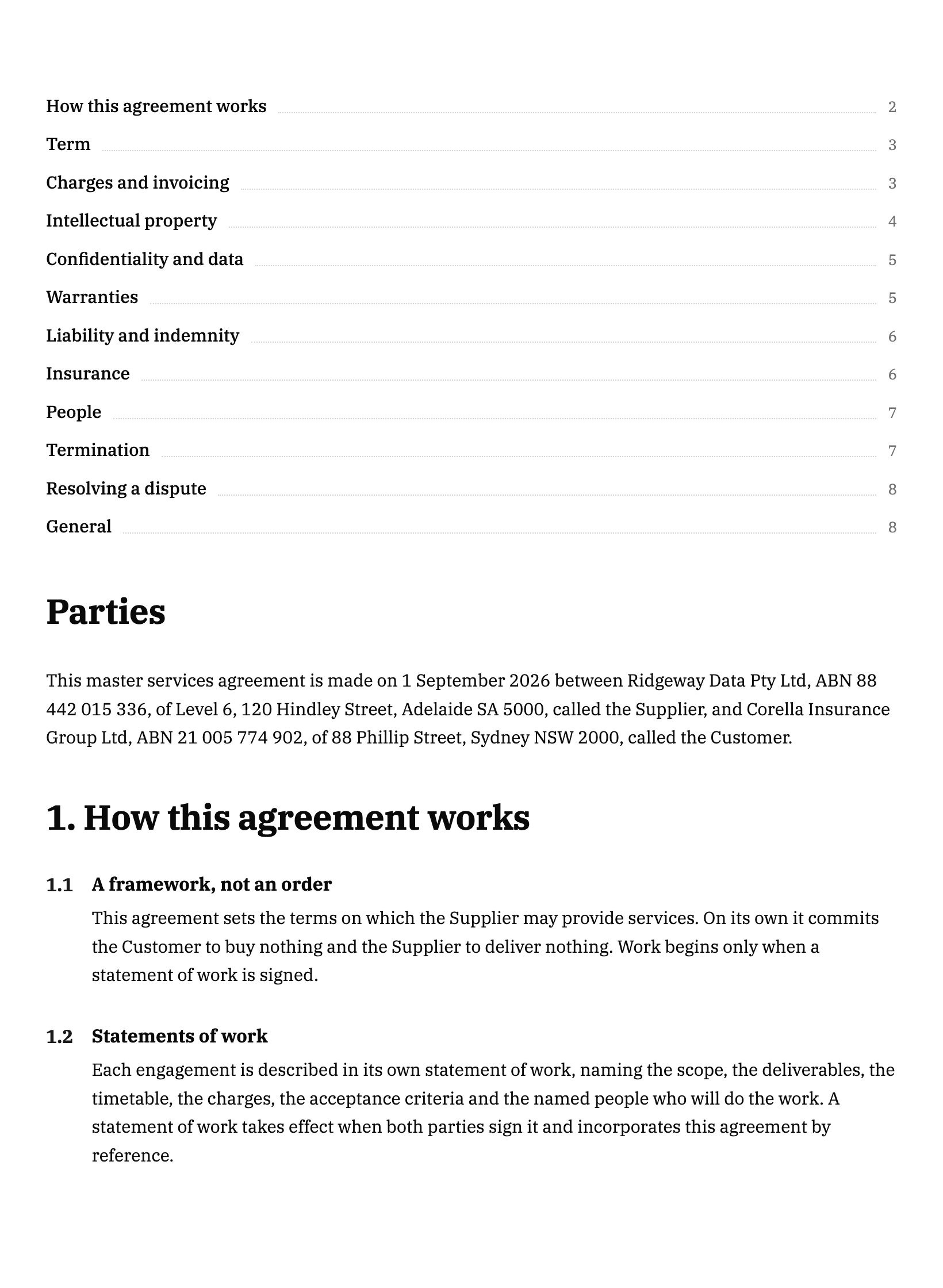 Master services agreementA data consultancy and an insurer sign this once and then buy work under it for three years. It is the rare contract whose whole purpose is to make the next twenty contracts short.
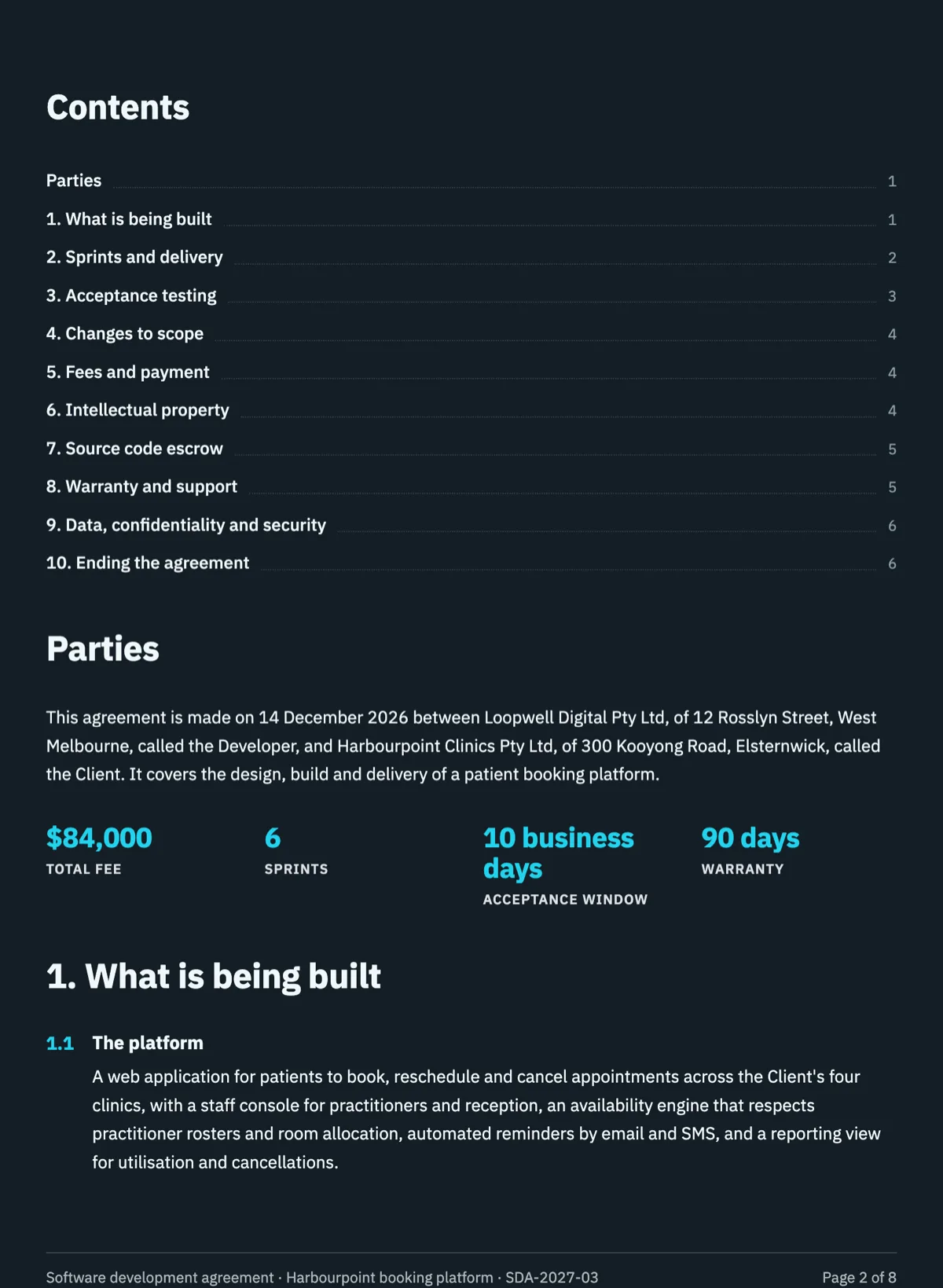 Software development agreement with sprints and an acceptance testCustom software goes wrong in the space between delivered and accepted, where one side thinks a sprint is finished and the other is still writing a list. This agreement fixes a ten business day acceptance window against criteria written before the sprint started, and assigns the intellectual property sprint by sprint as each invoice is paid.
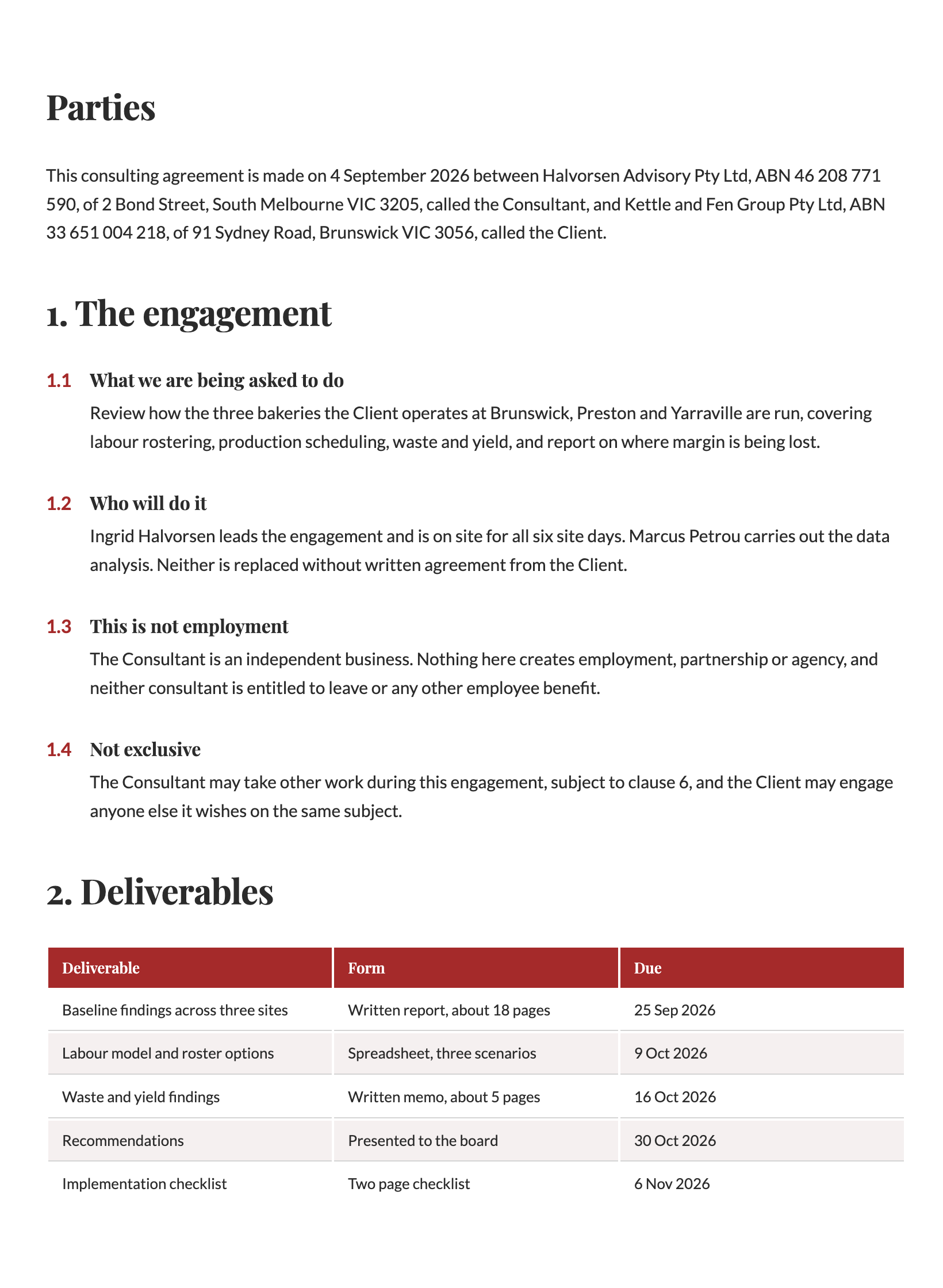 Consulting agreementAn advisory firm reviews three bakeries over seven weeks. What makes this agreement useful is not the fee clause but the two clauses that say what the advice is not.
Questions people ask
What is a reasonable liability cap in the UK?
There is no fixed figure. Common caps run from 100% to 200% of annual or total contract charges, with higher separate caps for data protection and confidentiality. Courts look at what was reasonable when the contract was made, including insurance and bargaining power, so a cap that matches the supplier's cover and the contract's value is easiest to defend.
Is a liability cap per claim or in total?
Whatever the words say, read in context. Phrases such as total aggregate liability for all claims point to one cap for everything, as in Drax v Wipro. Per claim or per event wording gives a fresh cap for each claim. If the clause is unclear, the dispute itself becomes the first claim, so state the intended shape plainly.
Can I cap liability for data breaches?
Yes, between businesses, provided the cap is reasonable. Fines imposed directly on a party by a regulator generally cannot be passed to the other side, but contractual liability for a breach of data protection obligations can be capped. Many contracts give data claims their own higher cap rather than leaving them unlimited.
Does a liability cap apply to indemnities?
Only if the clause says so. Indemnities are often carved out of caps, which can leave a party with unlimited exposure through the back door. Read the cap and every indemnity together, and decide expressly whether each indemnity sits inside the cap, under a separate cap or outside both.
Can a liability cap be challenged after signing?
Yes. The party that wants more can argue the cap does not cover the claim on its wording, or that it fails the UCTA reasonableness test because it was in standard terms or limits negligence. Negotiated caps between businesses of similar strength are rarely overturned, which is why negotiation before signing matters more.
Put the clause in a finished document
The button opens the document generator with a starting description already filled in. Change it to match your own agreement before you run it.
Create a document with OneCraftRelated clauses
- Limitation of liability clause: putting a ceiling on exposureA limitation of liability clause caps what one party can recover. Australian sample wording, cap formulas, variants, the carve outs and the UK test.
- Exclusion clause: UK sample wording and the statutory limitsHow a UK exclusion clause works under the Unfair Contract Terms Act 1977 and the Consumer Rights Act 2015, with a sample for an IT support firm and the bans.
- Consequential loss clause: excluding indirect and flow on lossA consequential loss clause removes indirect losses such as lost profit from a claim. Australian sample wording, three variants and the naming problem.
- Insurance clause: which policies, what amounts, what proofAn insurance clause sets the policies a contractor must hold, the amounts and the proof. Australian sample wording, typical cover levels and three variants.
For everything the document generator can do, see the document maker.
Step by step in the builder: Create a document with AI, then Document builder components.
Written and checked by the OneCraft team. Last checked .