Contract clause
Source code escrow clause: getting the code if the supplier fails
A source code escrow clause requires a software supplier to deposit the source code and related materials with an independent escrow agent, to be released to the customer if a defined event happens, such as the supplier's insolvency or failure to support the software. It protects customers who depend on software they do not own.
A clinic that runs on one supplier's software has a quiet risk: if the supplier fails, nobody can fix the system. Source code escrow is the insurance policy, and like insurance, it only pays out if the deposit is current and the release events fit what actually goes wrong.
Indunil Asanka · Co-founder
3 min read · Published
Sample clause
Written for a software licence from Brightwater Health Tech, a fictional developer of clinic management software, to a group of allied health clinics.
Source Code Escrow. (a) Within 30 days after the Commencement Date, the Licensor must deposit with the Escrow Agent the source code of the Software, its build scripts and instructions, and the names and versions of third party components needed to build it (the Deposit Materials), and must update the deposit within 30 days after each major release and at least every 3 months. (b) The Escrow Agent will release the Deposit Materials to the Licensee if: (i) the Licensor suffers an Insolvency Event; (ii) the Licensor ceases to support the Software during the Support Term; or (iii) a Severity 1 Fault is not fixed within 30 days after the Licensee notifies it. (c) On release, the Licensee may use and modify the Deposit Materials only to support and maintain the Software for its own use under this Licence. (d) The Licensee may request one verification test each year, at its cost, to confirm the Deposit Materials can be built into working Software.
Sample wording, not legal advice.
Variants
Single licensee escrow
A large customer negotiating its own escrow agreement with the supplier and an agent.
The parties will enter into a three party escrow agreement with the Escrow Agent on the Escrow Agent's standard single licensee terms, and the Licensor will deposit the Deposit Materials as required by that agreement.
Multi licensee escrow
Suppliers with many customers, which register each customer as a beneficiary of one deposit.
The Licensor maintains a deposit of the Deposit Materials with the Escrow Agent under a multi licensee agreement and will register the Licensee as a beneficiary within 14 days after the Commencement Date.
Cloud escrow of environments
Software as a service, where source code alone cannot keep the service running.
In addition to the source code, the Licensor will deposit infrastructure as code templates, database schemas, configuration, and access arrangements sufficient to redeploy the Service in the Licensee's own cloud account, and will maintain continuity arrangements with the Escrow Agent for the hosting accounts.
What to negotiate
Release events
Insolvency is the classic event, but customers are more often hurt by a supplier that stays in business and stops supporting the product, or is acquired and abandons it. Customers should ask for release on end of support, failure to fix critical faults, and a change of control that ends support. Suppliers resist subjective triggers, so the events should be measurable.
Verification testing
A deposit that cannot be built is worthless. Escrow agents offer verification at different levels, from checking the files are present and readable, to building the software, to running it and testing it works. Customers relying heavily on the software should pay for build or full verification at least once and after major changes.
Who pays
Escrow fees, deposit updates and verification all cost money. Commonly the customer pays for a single licensee arrangement and verification, while the supplier pays for a multi licensee arrangement as part of its offering. The contract should also oblige the supplier to keep deposits current, because a stale deposit is a common failure.
The risk of leaving it out
Without escrow, a customer whose supplier fails is left with software it cannot fix or update, and only its licence rights, which may end on insolvency. Replacing a core system in a hurry is expensive and disruptive. Escrow does not guarantee a smooth transition, but without it there may be no transition at all.
Release events and verification levels
Release events, from most to least common in contracts: insolvency or liquidation of the supplier; supplier ceasing to carry on business; supplier ceasing to support the software; failure to remedy a critical fault within a set time; assignment of the software to a third party who does not take on support. Verification levels offered by escrow agents: a file listing and integrity check; an inventory confirming the materials are complete; a build test confirming the code compiles into the software; and a full usability test confirming the built software runs and matches the production version. Law checked on 21 October 2026. This page explains how the clause works and is not legal advice.
Escrow for software as a service
With hosted software, the customer may not be able to run the code even if it gets it, because the service depends on cloud accounts, data and operations. SaaS escrow arrangements add deposits of deployment scripts, configuration and data, and sometimes arrangements to keep the hosting accounts running for a period after a release. The UK National Cyber Security Centre's supply chain guidance encourages organisations to understand and manage their dependence on suppliers, of which continuity arrangements are part.
What the customer may do after release
Release gives the customer the materials, but its rights to use them must come from the licence. The clause should grant a licence to use, modify and have others maintain the code for the customer's own use after release, while keeping the supplier's IP otherwise protected. The sample's paragraph (c) does that narrowly.
Choosing an escrow agent
Established escrow agents publish standard agreements and verification services, and many operate internationally. Check that the agent can hold the type of materials involved, offers the verification level needed, and has a clear release process with timeframes and dispute procedures, because a release dispute while systems are failing is the worst time to discover gaps.
Documents that carry this clause
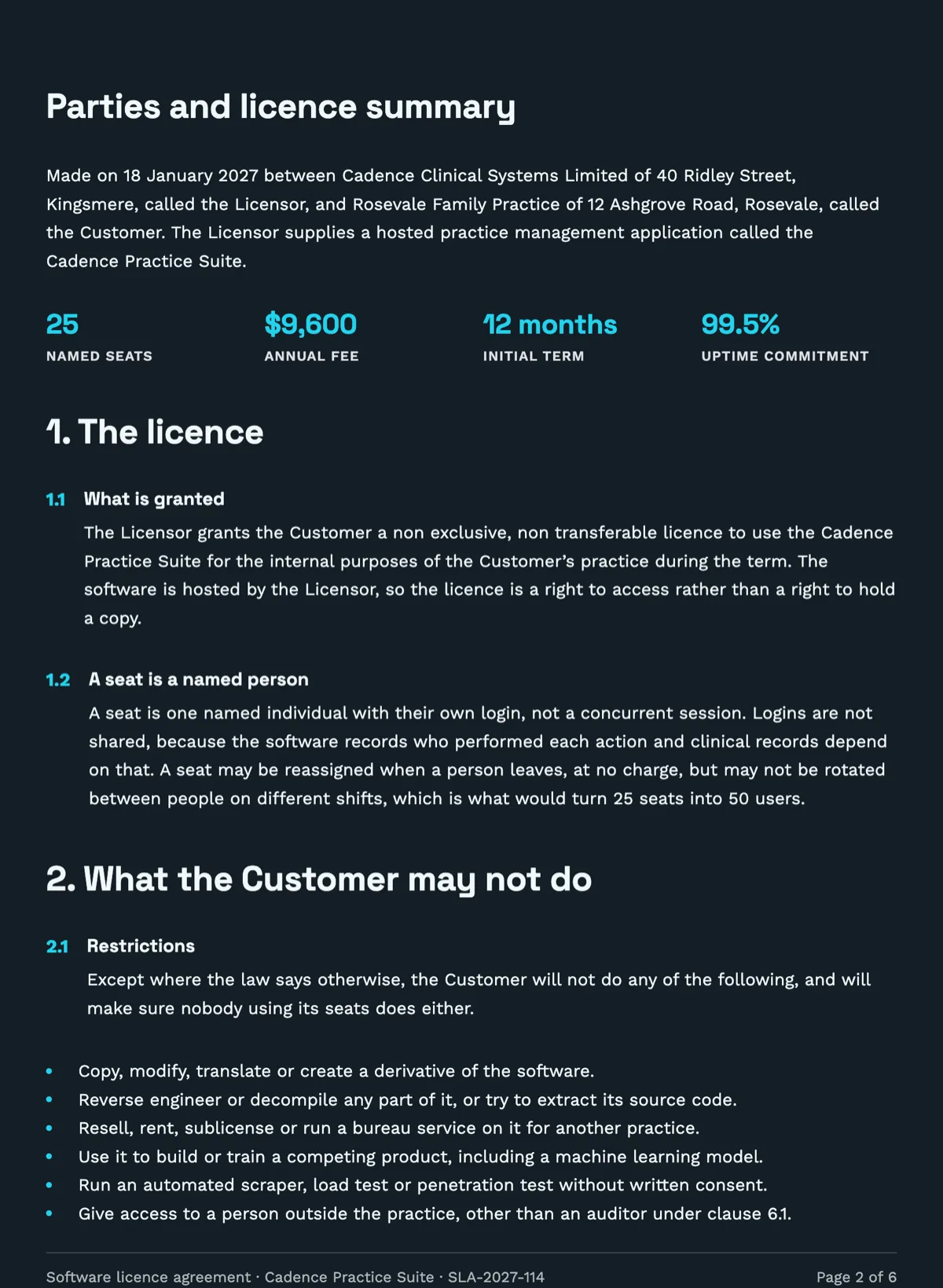 Software licence agreement template with seats, term and supportA software licence agreement has to answer three questions before anything else: what a seat is, what happens when the software is down, and who gets the data at the end. This one licenses a hosted practice management suite to a medical practice for 25 named users at $9,600 a year, with a support table, uptime credits and a 30 day export.
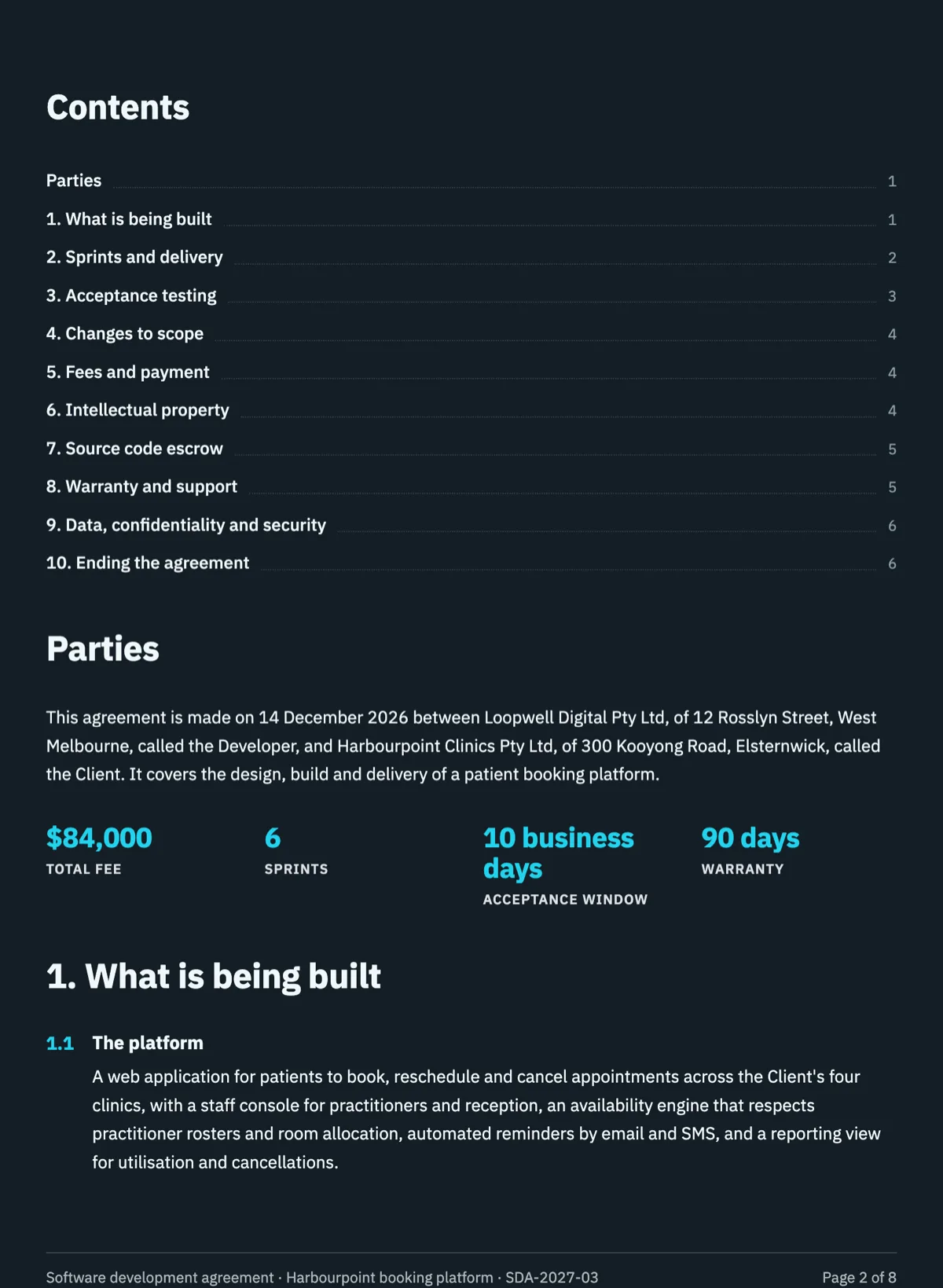 Software development agreement with sprints and an acceptance testCustom software goes wrong in the space between delivered and accepted, where one side thinks a sprint is finished and the other is still writing a list. This agreement fixes a ten business day acceptance window against criteria written before the sprint started, and assigns the intellectual property sprint by sprint as each invoice is paid.
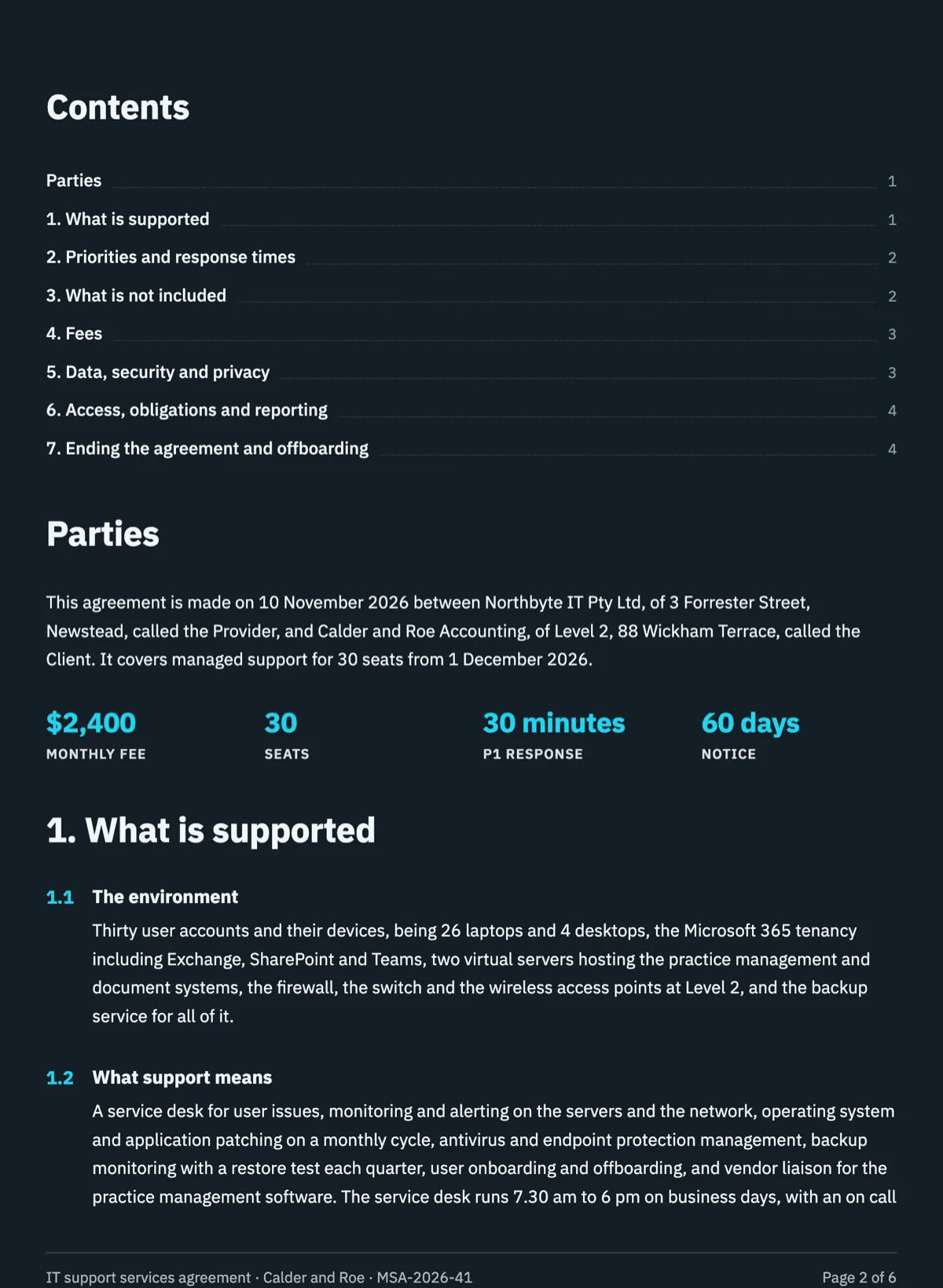 IT support services agreement with response times by priorityManaged support is sold on a monthly fee and judged on how fast the phone gets answered when nobody can work. This agreement grades every ticket into four priorities with a published response and resolution target, credits the fee when the target is missed, and writes down exactly what the provider hands back on the way out.
Questions people ask
What is source code escrow?
It is an arrangement where a software supplier deposits its source code and build materials with an independent escrow agent, to be released to the customer if a defined event occurs, such as the supplier's insolvency or failure to support the software. It lets the customer keep the software running.
When is source code released?
When a release event in the agreement happens and the escrow agent's process is followed, usually including notice to the supplier and a short period to dispute. Common events are insolvency, ceasing business, ending support and failing to fix critical faults within a set time.
Is escrow useful for SaaS?
Source code alone is often not enough for software as a service, because the customer also needs the hosting environment and data. SaaS escrow adds deployment scripts, configuration, data and sometimes continuity of the hosting accounts. Without those, released code may be of limited practical use.
How often should the deposit be updated?
At least with each major release and on a regular schedule, such as every three months. A deposit that is years out of date may not match the software the customer runs. The contract should require updates and ideally periodic verification to confirm they happened.
Who pays for software escrow?
It is negotiable. Customers usually pay for single licensee arrangements and verification testing, while suppliers often fund multi licensee arrangements as part of their product. Ongoing agent fees, the cost of updating deposits and verification charges should all be allocated expressly in the contract so none is overlooked.
Put the clause in a finished document
The button opens the document generator with a starting description already filled in. Change it to match your own agreement before you run it.
Create a document with OneCraftRelated clauses
- Licence grant clauseA licence grant clause gives permission to use intellectual property without owning it. Sample photo licence wording and the six terms every grant settles.
- Transition assistance clause for outsourcing exitsA transition assistance clause sets the help an outgoing supplier must give at exit. Sample wording, free and paid variants, data formats and what to negotiate.
- Termination for insolvency clauseA termination for insolvency clause ends a contract when the other side fails. Sample wording, trigger lists, and the Australian ipso facto stay since 2018.
- Data return and deletion clauseA data return and deletion clause sets what happens to customer data when a service ends: export, deletion, backups and a certificate. Sample, steps, variants.
For everything the document generator can do, see the document maker.
Step by step in the builder: Create a document with AI, then Document builder components.
Written and checked by the OneCraft team. Last checked .