Classic form
AED inspection checklist for the monthly check
An AED inspection checklist confirms the status indicator shows ready, the pads are sealed and in date, the battery is in date, and the cabinet, sign and rescue kit are where people expect them. This leisure centre version also photographs the status screen each month.
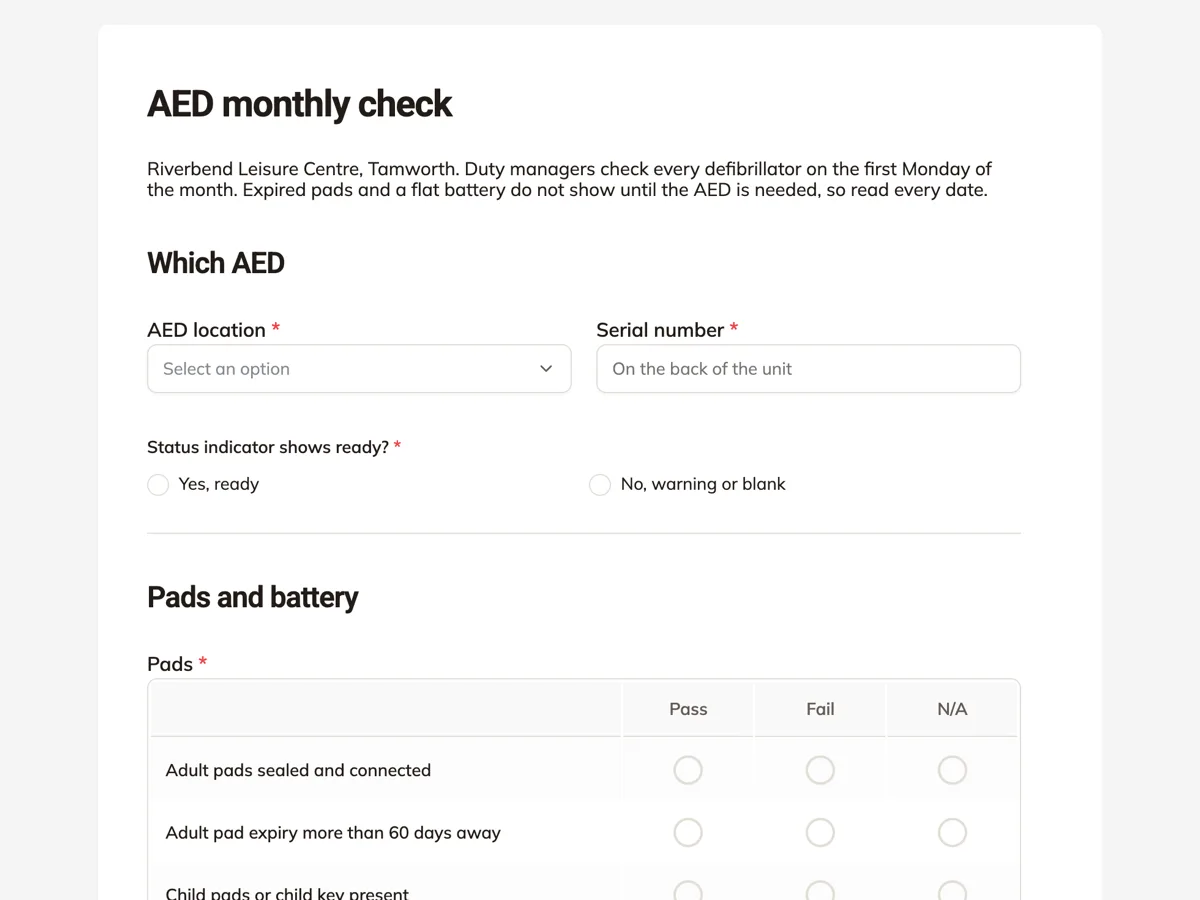
The form itself
A static copy of the finished form, exactly as it renders. Nothing here can be filled in or submitted, so read it as a reference and build your own from the button above.
Every field, and what it collects
The complete field list, in the order respondents meet it.
- AED locationDropdownRequired
- Options: Pool deck, lifeguard station · Gym floor, near reception · Stadium courts, west door · Spare, first aid room
- Serial numberShort textRequired
- Status indicator shows ready?Single choiceRequired
- Options: Yes, ready · No, warning or blank
- PadsRating gridRequired
- Statements:
- Adult pads sealed and connected
- Adult pad expiry more than 60 days away
- Child pads or child key present
- Spare set of adult pads
- Battery expiry dateDateRequired
- Cabinet and signageRating gridRequired
- Statements:
- Cabinet alarm sounds when opened
- AED sign visible from the walkway
- Rescue kit with razor, gloves and towel
- Access clear, nothing stacked in front
- Photo of the status screenPhoto upload
- Photograph the status light or screen so the record shows what it read today.
- Duty managerSignatureRequired
Which AED
Pads and battery
Cabinet and access
What each field on this form collects
The AED location comes from a list of four, three in public areas and a spare in the first aid room, with the serial number beside it. A single choice asks whether the status indicator shows ready. The pads grid has four rows: adult pads sealed and connected, adult pad expiry more than 60 days away, child pads or a child key, and a spare set. A required date takes the battery expiry. The cabinet grid has four rows for the alarm, the sign, the rescue kit and clear access. A photo of the status screen and the duty manager's signature finish the check.
The dates that make an AED fail silently
An AED runs its own self tests and shows a status light or screen, and that is the first thing to read. What the self test cannot show is a pad whose gel has dried past its expiry date or a battery that will expire before the next check. Both look normal in the cabinet. The form asks for the pad expiry as a 60 day threshold rather than a yes or no, so replacements are ordered while there is still time, and asks for the battery date itself. Resuscitation guidance from the Australian and New Zealand Committee on Resuscitation describes how an AED is used; the monthly check is what keeps it usable.
The rescue kit and the cabinet
Pads need bare, dry skin. A razor for a hairy chest, a towel for a wet one at the pool, and gloves for the rescuer are kept with the AED, and they go missing because they are useful for other things. The cabinet alarm row matters in a public building: it tells staff that someone has opened the cabinet, which is how a response starts. The sign and clear access rows exist because a defibrillator nobody can find in the first minutes is no help.
How to adapt this form
An office with one AED drops the location list and adds the floor and building. A sports club that takes its AED to away games adds a question about where it travelled. A council with dozens of public access AEDs adds the address and a question confirming the unit is registered with the local ambulance service, which is a common requirement for public AEDs.
What makes this form work
A threshold, not a yes
Adult pad expiry more than 60 days away is the row, not pads in date. A pad that expires next week passes a yes or no check and fails the day it is needed.
The battery date is typed
Battery expiry is a required date. Typing it each month means the duty manager has to read it, and the responses table shows the date creeping closer.
A photo of the status screen
The photo records what the indicator said today. A check that says ready with a photo of a warning light is a problem a manager can see.
Questions people ask
How often should an AED be checked?
Follow the manufacturer's instructions, which usually call for a regular visual check of the status indicator, pads and battery, often weekly or monthly. Many workplaces check monthly, as this form assumes, and also after every use. Record each check so the history shows the AED was maintained.
When do defibrillator pads expire?
Pads carry an expiry date on the packet, typically two to five years from manufacture depending on the brand. Once used, opened or past the date, they are replaced. Order replacements before the date, which is why this form flags pads expiring within 60 days.
What goes in an AED rescue kit?
Commonly a razor to remove chest hair, gloves, a towel or wipes to dry the skin, scissors to cut clothing and a face shield for rescue breaths. Kits vary by supplier. Check the kit at each inspection, because its contents tend to be borrowed.
Who should do the monthly AED check?
A trained person named in your first aid procedures, often a duty manager or first aid officer. They do not need technical skills; they need to read the status indicator and dates and know who to tell. Rotating the task helps more staff learn where the AEDs are.
Does an AED need to be registered?
Several Australian ambulance services keep registers of public access defibrillators so callers can be directed to the nearest one. Registration is often encouraged rather than required. Check your state ambulance service and record the registration number in your AED records, next to the serial on this form.
Build your own in about a minute
The button below opens the generator with this use case already described. Change the wording to match your own, generate, then edit anything you like.
Make one like thisOther form examples
Pallet racking inspection checklist with damage ratings
A pallet racking inspection checklist looks at load signs, uprights, beams, beam locks, base plates, guards and bracing, then rates the worst damage green, amber or red. This distribution centre version also counts bays offloaded and lists the repairs with due dates.
Hand tool inspection checklist for an electrician's bag
A hand tool inspection checklist works through striking tools, cutting and gripping tools and insulated tools, looking for the damage patterns that cause injuries, and lists anything taken out of service. This version is set up for an electrical contractor, so insulated tools get their own grid.
Ladder inspection checklist with load rating and tag out
A ladder inspection checklist records the ladder's ID, type and rated load, then checks the stiles, rungs, feet, spreaders, labels and, on extension ladders, the guides, rope and locks. This shopfitter version ends with a red tag question so a failed ladder leaves the van the same day.
Want the steps in the builder? Read Date, grid and photo fields, then Email each check to the centre manager. For everything this generator can do, see the form maker.
Written and checked by the OneCraft team. Last checked .