Classic form
Ladder inspection checklist with load rating and tag out
A ladder inspection checklist records the ladder's ID, type and rated load, then checks the stiles, rungs, feet, spreaders, labels and, on extension ladders, the guides, rope and locks. This shopfitter version ends with a red tag question so a failed ladder leaves the van the same day.
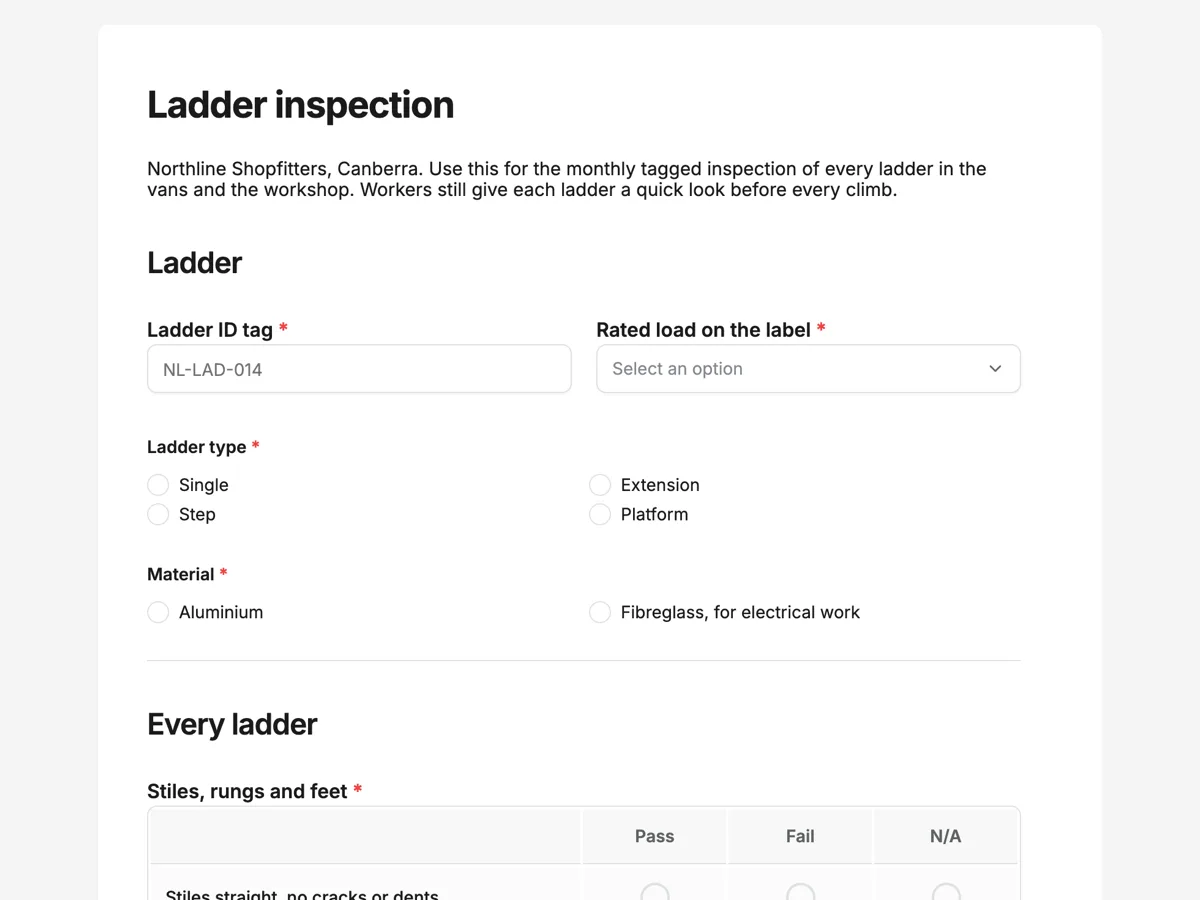
The form itself
A static copy of the finished form, exactly as it renders. Nothing here can be filled in or submitted, so read it as a reference and build your own from the button above.
Every field, and what it collects
The complete field list, in the order respondents meet it.
- Ladder ID tagShort textRequired
- Rated load on the labelDropdownRequired
- Options: 120 kg industrial · 150 kg · 180 kg · No label, treat as failed
- Ladder typeSingle choiceRequired
- Options: Single · Extension · Step · Platform
- MaterialSingle choiceRequired
- Options: Aluminium · Fibreglass, for electrical work
- Stiles, rungs and feetRating gridRequired
- Statements:
- Stiles straight, no cracks or dents
- Rungs or steps tight
- Feet and rubber pads
- Spreaders or locking bars
- Labels and load rating legible
- Extension partsRating gridRequired
- Statements:
- Guide brackets
- Rope and pulley
- Locking hooks engage
- Photo of the damagePhoto upload
- Show the whole stile or rung that failed, and one close up if there is a crack.
- Tagged out of service?Single choiceRequired
- Options: Not needed, passed · Yes, red tag fitted
- Inspected bySignatureRequired
Ladder
Every ladder
Extension ladders only
What each field on this form collects
The ladder ID tag and the rated load from its label come first, with a fourth load option that treats a missing label as a failure. Single choices record the type, single, extension, step or platform, and the material, aluminium or fibreglass for electrical work. The first grid has five rows that apply to every ladder: stiles, rungs or steps, feet and pads, spreaders or locks, and labels. The second grid has three rows only for extension ladders, guides, rope and pulley, and locking hooks, with a paragraph telling everyone else to mark N/A. A damage photo, the tag out question and the inspector's signature close it.
Before use checks and the tagged inspection
Two different checks keep ladders safe. Every worker looks over a ladder before climbing it, which takes seconds and catches obvious damage. A periodic inspection by a nominated person is slower, records the result against the ladder's ID, and catches the slow failures: a stile bent a few millimetres, feet worn smooth, a label sun bleached until the rating cannot be read. This form is the periodic record. WorkSafe Victoria has published alerts on workers seriously injured when ladders failed, and the common thread is a ladder that was damaged long before the day it broke.
Rated load and why domestic ladders fail on site
Ladders sold in Australia carry a load rating under AS/NZS 1892, and the industrial grade is the one meant for work. A domestic ladder may be rated well below a tradesperson carrying tools and materials, and on a shopfitting job a ladder takes a person plus a sheet of board or a box of fittings. The rated load dropdown makes the inspector read the label every month. A label that cannot be read is a Fail, because nobody can say what that ladder will hold. Fibreglass gets its own answer because it is the material for work near electricity.
How to adapt this form
A cleaning company adds a row for the platform guardrail on its podium steps. An electrical contractor adds a row confirming no metal reinforcement has been added to a fibreglass ladder. A school maintenance team adds the room or building where each ladder lives, so a missing ladder shows up in the register.
What makes this form work
A missing label is a failure
The rated load dropdown includes No label, treat as failed. The inspector cannot pass a ladder whose rating nobody can read, and the form says so in the option.
Extension parts are separate
Guides, rope and pulley, and locking hooks sit in their own three row grid with an instruction to mark N/A on other ladders. The main grid stays true for every ladder in the fleet.
The register comes for free
Every submission carries the ladder ID tag and a time. Exported to CSV, the responses become a ladder register showing when each ladder was last inspected and by whom.
Questions people ask
How often should ladders be inspected in Australia?
Every ladder should be looked over by the user before each use, and inspected at regular intervals by a nominated person, with the interval set by how hard the ladders are used. Many businesses inspect monthly or quarterly. WHS regulators expect inspection and maintenance to follow the manufacturer's instructions; record whatever interval you choose.
What load rating should a work ladder have?
For work, choose an industrial ladder rated under AS/NZS 1892, commonly 150 kg or more for trades, and check that the rating covers the worker plus tools and materials. Ratings below that are usually domestic ladders. The rating is on the ladder's label, which is why this form asks the inspector to read it.
What makes a ladder unsafe to use?
Bent, cracked or dented stiles, loose or missing rungs, worn or missing feet, spreaders that do not lock, a missing load label, and on extension ladders guides or locks that do not engage. Paint over timber or fibreglass that could hide damage is also a concern. A ladder with any of these is tagged out and replaced.
Can a damaged ladder be repaired?
Most manufacturers say no: a bent stile or cracked rung is a reason to replace the ladder, not to bolt on a fix. Some parts such as feet can be replaced with genuine spares. This form's tag out question assumes a failed ladder leaves service; any repair should follow the manufacturer's instructions.
Does every ladder need its own ID tag?
It makes the record useful. Without an ID, an inspection says a ladder passed, not which one. A cable tie tag or engraved number on the stile lets the form tie each inspection to one ladder, and the responses table then shows the history of that ladder over time.
Build your own in about a minute
The button below opens the generator with this use case already described. Change the wording to match your own, generate, then edit anything you like.
Make one like thisOther form examples
Scaffold inspection checklist with the four triggers
A scaffold inspection checklist records why the inspection is happening, checks the base, standards, ledgers, bracing, ties, decks and edge protection, and updates the scaffold tag. This builder version also takes elevation photos and the inspector's licence number.
Chain sling inspection checklist with measured link wear
A chain sling inspection checklist confirms the tag and its working load limit, then checks every link for stretch, wear, nicks, bends and heat damage, and every hook, latch, master link and shortener. This fabrication shop version also records the measured wear on the worst link of each leg.
Power tool inspection checklist for building sites
A power tool inspection checklist looks at the guard, lead and plug, switch, body, blade or disc rating, handle and battery before a tool is used, and records the dates from its test tag. This builder version also asks whether the tool runs through an RCD.
Want the steps in the builder? Read Photo, matrix and choice fields, then Keep a register of every ladder. For everything this generator can do, see the form maker.
Written and checked by the OneCraft team. Last checked .