Classic form
Chain sling inspection checklist with measured link wear
A chain sling inspection checklist confirms the tag and its working load limit, then checks every link for stretch, wear, nicks, bends and heat damage, and every hook, latch, master link and shortener. This fabrication shop version also records the measured wear on the worst link of each leg.
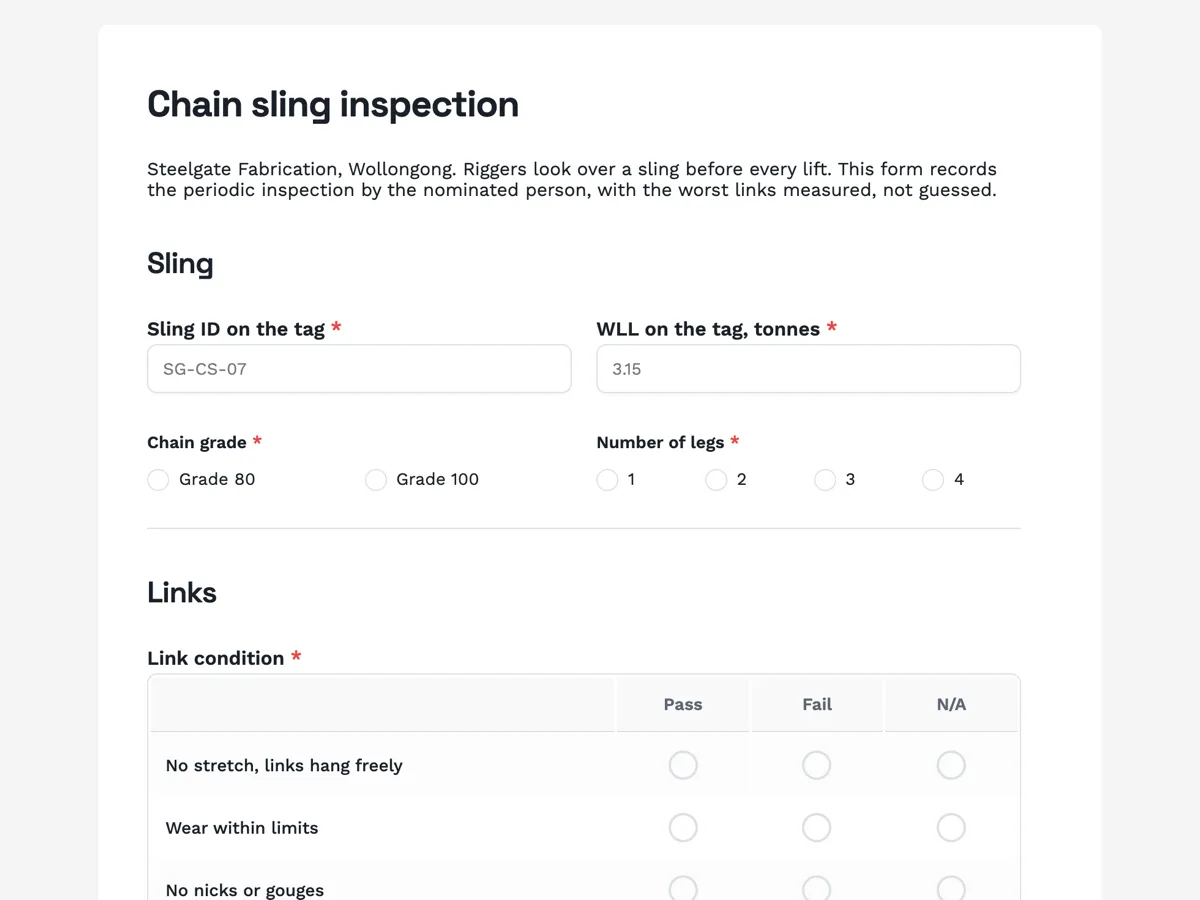
The form itself
A static copy of the finished form, exactly as it renders. Nothing here can be filled in or submitted, so read it as a reference and build your own from the button above.
Every field, and what it collects
The complete field list, in the order respondents meet it.
- Sling ID on the tagShort textRequired
- WLL on the tag, tonnesNumberRequired
- Chain gradeSingle choiceRequired
- Options: Grade 80 · Grade 100
- Number of legsSingle choiceRequired
- Options: 1 · 2 · 3 · 4
- Link conditionRating gridRequired
- Statements:
- No stretch, links hang freely
- Wear within limits
- No nicks or gouges
- No bent or twisted links
- No heat discolouration or weld spatter
- Hooks and fittingsRating gridRequired
- Statements:
- Hooks and safety latches
- Master link
- Shorteners
- ID tag present and legible
- Measured link wearTable
- Columns: Leg · Link position · Measured mm
- Photo of worst linkPhoto upload
- Photograph the worst link with the calipers on it so the reading shows.
- Nominated inspectorSignatureRequired
Sling
Links
Fittings
What each field on this form collects
The sling ID and the working load limit are copied from the tag, side by side. Grade 80 or 100 and the number of legs are single choices. The link grid has five rows: stretch, wear, nicks and gouges, bent or twisted links, and heat damage. The fittings grid has four: hooks and latches, master link, shorteners and the ID tag. A paragraph tells the inspector how to measure, and a four row table records the leg, link position and the measurement in millimetres. A photo of the worst link and the inspector's signature close the record.
Measuring separates an inspection from a glance
Most sling failures start with wear and stretch that look fine to the eye. The Australian standard for chain slings, AS 3775, sets rejection limits as percentages of the original dimensions, and only a measurement can show a link has crossed one. That is why the form has a table instead of a Pass box for wear. The ID tag row matters as much: a sling without a legible tag has no known working load limit and is withdrawn until it is identified or replaced. WorkSafe Victoria's lifting guidance and its alerts on sling failures show how quickly a worn or misused sling drops a load.
Grade 80 and grade 100
Grade 100 chain is stronger for its size than grade 80, so a sling of the same diameter carries a higher working load limit. That is useful until components are mixed. A grade 80 hook on a grade 100 chain makes the whole sling grade 80, and the tag no longer tells the truth. The grade question and the WLL from the tag sit at the top so the inspector compares them with the markings on each component as they work down the fittings grid.
How to adapt this form
A rigging loft that also inspects wire rope and synthetic slings builds a form for each, because the rejection criteria are completely different. A construction company adds the crane or site where the sling is kept. A business with dozens of slings adds a dropdown of storage racks so missing slings show up when a rack's inspections come back short.
What makes this form work
Wear is measured, not ticked
A four row table takes the leg, link position and millimetres. A record that says 9.1 mm on a 10 mm link can be checked against the limit later; a record that says Pass cannot.
The tag is a fitting
ID tag present and legible sits in the fittings grid. Without it the sling's grade and working load limit are unknown, which makes it as unfit for use as a cracked hook.
Grade and legs before the links
The grade and leg count come first, so the inspector knows how many legs to measure and which component markings should match.
Questions people ask
How often should chain slings be inspected?
Before each use by the rigger or user, and periodically by a competent person at an interval set by the standard, the manufacturer and the conditions, commonly no more than every three months in heavy use and at least yearly. Record the periodic inspection against the sling ID, as this form does.
What are the rejection criteria for a chain sling?
AS 3775 and manufacturers reject a sling for wear or stretch beyond set limits, cracks, nicks or gouges, bent or twisted links, heat damage, damaged or missing hook latches, distorted fittings, and a missing or illegible tag. The exact limits depend on the grade and size, so use the manufacturer's figures.
Can a chain sling with no tag be used?
No. The tag tells you the grade and working load limit, and without it nobody can say what the sling may lift. Withdraw it until a competent person identifies and re tags it, or replace it. The fittings grid on this form fails a missing tag for that reason.
Should damaged links be repaired?
Not by welding or heating, which changes the steel's properties. Damaged components are replaced with matching grade parts by a competent person, and the sling is proof tested or re certified as the standard requires. Many workshops simply replace the sling.
Can the measurements be exported?
Yes. The responses export to CSV with one column per field, and the table comes out as a JSON array of the filled rows. That is enough to sort or chart wear for a sling over time in a spreadsheet.
Build your own in about a minute
The button below opens the generator with this use case already described. Change the wording to match your own, generate, then edit anything you like.
Make one like thisOther form examples
Safety harness inspection checklist
A harness inspection checklist works along the webbing and stitching, then the D rings, buckles, adjusters, fall indicator and labels, and records whether the harness stays in service. This version for an access hire company also records the serial, manufacture date and the last six monthly inspection.
Hand tool inspection checklist for an electrician's bag
A hand tool inspection checklist works through striking tools, cutting and gripping tools and insulated tools, looking for the damage patterns that cause injuries, and lists anything taken out of service. This version is set up for an electrical contractor, so insulated tools get their own grid.
PPE inspection checklist for a construction crew
A PPE inspection checklist goes item by item through a worker's hard hat, glasses, hearing protection, hi vis, gloves, boots, respirator and sun protection, and records what was replaced. This formwork crew version also tracks the respirator fit test and the hard hat date, with both the worker and the leading hand signing.
Want the steps in the builder? Read Table and matrix fields, then Pull up a sling's history. For everything this generator can do, see the form maker.
Written and checked by the OneCraft team. Last checked .