Classic form
Hand tool inspection checklist for an electrician's bag
A hand tool inspection checklist works through striking tools, cutting and gripping tools and insulated tools, looking for the damage patterns that cause injuries, and lists anything taken out of service. This version is set up for an electrical contractor, so insulated tools get their own grid.
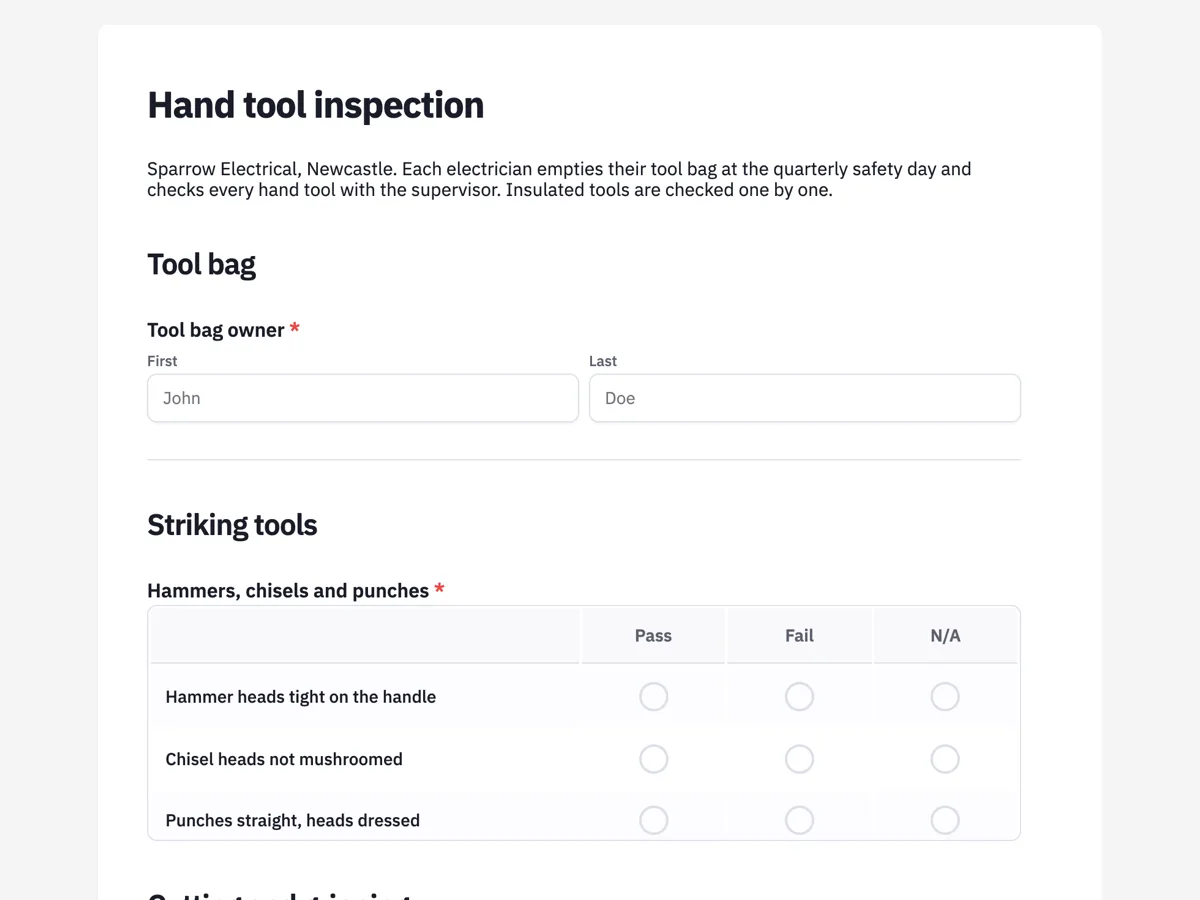
The form itself
A static copy of the finished form, exactly as it renders. Nothing here can be filled in or submitted, so read it as a reference and build your own from the button above.
Every field, and what it collects
The complete field list, in the order respondents meet it.
- Tool bag ownerNameRequired
- Hammers, chisels and punchesRating gridRequired
- Statements:
- Hammer heads tight on the handle
- Chisel heads not mushroomed
- Punches straight, heads dressed
- Knives, pliers and spannersRating gridRequired
- Statements:
- Knives retractable, blade lock works
- Plier and cutter jaws meet
- Snips sharp, spring works
- Spanners not spread at the jaw
- Insulated tool checksRating gridRequired
- Statements:
- 1000 V marking present
- Insulation free of cuts and cracks
- No bare metal showing at the shank
- Tools removed from the bagTable
- Columns: Tool · Reason removed
- Photo of removed toolsPhoto upload
- Lay the removed tools side by side and take one photo.
- Electrician signatureSignatureRequired
Tool bag
Striking tools
Cutting and gripping
Insulated tools
What each field on this form collects
The tool bag owner's name comes first. Three grids follow. Striking tools has three rows: hammer heads tight, chisel heads not mushroomed, punches straight. Cutting and gripping has four: retractable knives with working blade locks, plier and cutter jaws, snips, and spanners not spread. Insulated tools has three: the 1000 V marking, insulation free of cuts and cracks, and no bare metal at the shank. A three row table lists tools removed and why, then a photo of the removed tools and the electrician's signature.
The damage patterns that injure people
Hand tools rarely fail suddenly; they wear into a dangerous shape. A chisel struck thousands of times spreads its head into a mushroom whose edges break off and fly. A hammer head that loosens on its handle can leave it mid swing. A spanner whose jaws have spread slips off the nut and puts knuckles into whatever is nearby. A knife without a working lock folds onto the hand. Each row on this form names one of those patterns, so the check looks for the specific thing that goes wrong rather than asking whether a tool is in good condition.
Insulated tools for electrical work
Insulated hand tools for live work are made and tested to IEC 60900 and carry its double triangle symbol and a 1000 V rating. Their protection is only as good as the insulation, and a single cut from a stripping knife or a crack from a drop can expose metal. The rule in the paragraph is strict on purpose: damaged insulation removes the tool from live work for good, because it cannot be repaired to its original rating. WorkSafe Victoria's electrical pages and the HSE guidance on electrical work both treat working on live parts as a last resort, with insulated tools as part of the control.
How to adapt this form
A carpentry crew drops the insulated grid and adds saws, planes and nail bars. A plumbing business adds pipe wrenches, cutters and press tool jaws. A maintenance team with a shared tool board adds the board location instead of a bag owner, and checks the board at each shift change.
What makes this form work
Each row names a failure
Mushroomed chisel heads, spread spanner jaws, a blade lock that does not hold. Naming the failure tells a new apprentice what to look for, which a generic good condition box never does.
Insulated tools get a strict rule
The paragraph says damaged insulation removes the tool from live work for good. There is no partial pass for a tool that might be used near live parts.
Removals are listed with reasons
A three row table of tool and reason, and a photo of the pile. The supervisor can reorder and see which tools wear out fastest.
Questions people ask
How often should hand tools be inspected?
Before each use by the worker, and in a regular documented check, often quarterly or at each safety day, as this form does. Insulated tools should also be checked before every live job. Set the interval by how hard the tools are used and record it.
What does a mushroomed chisel mean?
The striking end has spread and curled over from repeated hammer blows, forming a lip. Pieces of that lip can break off and fly when struck. A mushroomed chisel is removed or the head is ground back to shape by someone competent, following the manufacturer's guidance.
How do you check insulated tools?
Look along the whole insulation for cuts, cracks, holes, swelling or bare metal, and confirm the double triangle symbol and 1000 V rating are present. Do not use a tool with damaged insulation for live work. Never add tape to an uninsulated tool to make it insulated.
Should broken hand tools be repaired?
Most damaged hand tools are cheaper and safer to replace. Some, such as a hammer with a damaged handle, can have the handle replaced with the correct part. Insulated tools cannot be re insulated to their rating. This form lists removed tools so they can be replaced.
Does an apprentice fill in their own tool bag check?
Yes, with the supervisor beside them. Doing it themselves teaches what to look for, and the supervisor confirms the result. The electrician signature on this form is the bag owner's, so the record shows who is responsible for that bag.
Build your own in about a minute
The button below opens the generator with this use case already described. Change the wording to match your own, generate, then edit anything you like.
Make one like thisOther form examples
PPE inspection checklist for a construction crew
A PPE inspection checklist goes item by item through a worker's hard hat, glasses, hearing protection, hi vis, gloves, boots, respirator and sun protection, and records what was replaced. This formwork crew version also tracks the respirator fit test and the hard hat date, with both the worker and the leading hand signing.
Power tool inspection checklist for building sites
A power tool inspection checklist looks at the guard, lead and plug, switch, body, blade or disc rating, handle and battery before a tool is used, and records the dates from its test tag. This builder version also asks whether the tool runs through an RCD.
Ladder inspection checklist with load rating and tag out
A ladder inspection checklist records the ladder's ID, type and rated load, then checks the stiles, rungs, feet, spreaders, labels and, on extension ladders, the guides, rope and locks. This shopfitter version ends with a red tag question so a failed ladder leaves the van the same day.
Want the steps in the builder? Read Grids and table fields, then Replace the paper tool audit. For everything this generator can do, see the form maker.
Written and checked by the OneCraft team. Last checked .