Classic form
PPE inspection checklist for a construction crew
A PPE inspection checklist goes item by item through a worker's hard hat, glasses, hearing protection, hi vis, gloves, boots, respirator and sun protection, and records what was replaced. This formwork crew version also tracks the respirator fit test and the hard hat date, with both the worker and the leading hand signing.
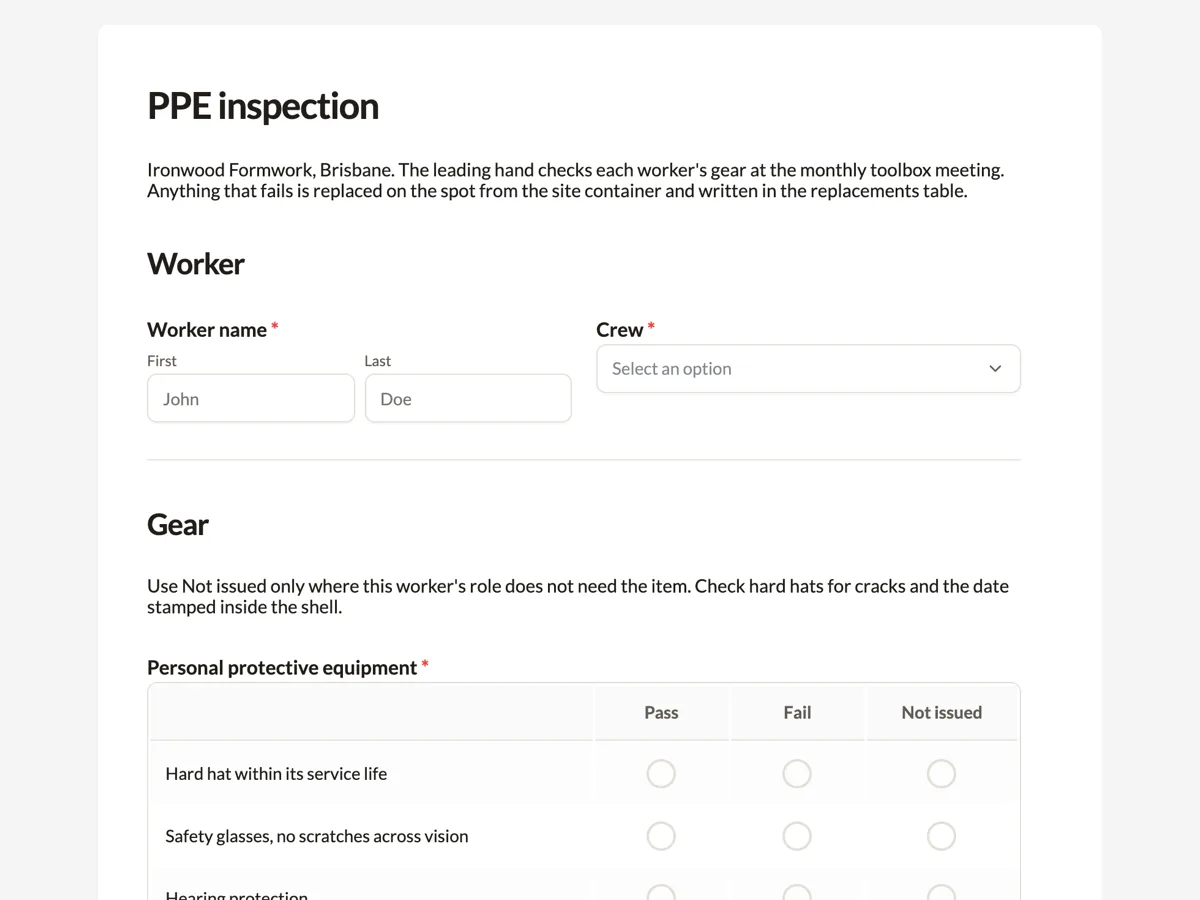
The form itself
A static copy of the finished form, exactly as it renders. Nothing here can be filled in or submitted, so read it as a reference and build your own from the button above.
Every field, and what it collects
The complete field list, in the order respondents meet it.
- Worker nameNameRequired
- CrewDropdownRequired
- Options: Formwork crew A · Formwork crew B · Steel fixers · Concrete pour crew
- Personal protective equipmentRating gridRequired
- Statements:
- Hard hat within its service life
- Safety glasses, no scratches across vision
- Hearing protection
- Hi vis shirt or vest
- Gloves suited to the task
- Steel cap boots, soles intact
- Respirator fits and seals
- Sun protection, brim and sunscreen
- Last respirator fit testDate
- Hard hat manufacture dateDate
- Replacements issued todayTable
- Columns: Item · Size · Date issued
- Photo of the damaged itemPhoto upload
- One photo of anything replaced today, before it goes in the bin.
- Worker signatureSignatureRequired
- Leading hand signatureSignatureRequired
Worker
Gear
What each field on this form collects
The worker's name and crew sit on one row. The grid has eight rows, each answered Pass, Fail or Not issued: hard hat within its service life, safety glasses, hearing protection, hi vis, gloves for the task, steel cap boots, respirator fit and seal, and sun protection. Two dates follow on one row, the last respirator fit test and the hard hat's manufacture date. A three row table lists replacements by item, size and date. A photo of the damaged item and two signatures, the worker's and the leading hand's, close the check.
PPE is the last line of control
Under WHS law, PPE sits at the bottom of the hierarchy of controls, used when the hazard cannot be removed or engineered away. That makes its condition matter: a cracked hard hat or a respirator that leaks around the nose is a control that has failed without anyone knowing. The employer must provide PPE, maintain it and train workers to use it, and the worker must wear it and report damage. This form records both sides of that duty in one check, which is why both people sign. HSE guidance on PPE in the UK sets out the same duties of supply, maintenance and training.
Hard hat service life and respirator fit testing
Hard hats age in the sun. Manufacturers set a service life from the date stamped inside the shell, and AS/NZS 1801 covers the helmets themselves. Recording the manufacture date makes an old shell visible before it cracks. Tight fitting respirators only protect if they seal, and a seal depends on the face, the model and the size, so fit testing is done when a worker is first issued a respirator and repeated at intervals. Formwork crews cut and grind, so silica dust makes the respirator row one of the most important on this form.
How to adapt this form
A food factory replaces the construction gear with hairnets, cut resistant gloves and freezer jackets. A laboratory adds lab coats, face shields and chemical gloves by type. An electrical contractor adds arc rated clothing and insulating gloves with their own test dates.
What makes this form work
Not issued is its own column
Pass, Fail or Not issued keeps the grid honest. A steel fixer with no respirator is not a failure, and a pour crew member with a missing one is, and the columns let the record say which.
Two dates that age gear
Last respirator fit test and hard hat manufacture date turn invisible ageing into numbers on a page, where an expired fit test or an old shell is obvious.
Both people sign
Worker and leading hand signatures sit side by side. The worker confirms what they were given, and the leading hand confirms what was checked and replaced.
Questions people ask
How often should PPE be inspected?
Workers should look over their PPE before each use, and a supervisor or leading hand should inspect it regularly, often monthly, as part of a toolbox meeting. Some items, like harnesses and respirators, have their own inspection or testing schedules set by standards and manufacturers. Record the regular inspections so gaps are visible.
When should a hard hat be replaced?
When it is cracked, dented, deeply scratched or has taken a heavy blow, when its harness is damaged, and when it reaches the service life the manufacturer sets from the date inside the shell. Sun exposure shortens its life. Replace it rather than repair it.
Who pays for PPE in Australia?
Under the model WHS laws, the person conducting the business must provide PPE to workers at no cost, unless it was provided by another business. Workers must use it as instructed and not misuse or damage it. Check your state law, which mirrors the model in most states.
What does a respirator fit test involve?
A qualitative or quantitative test checks that a tight fitting respirator seals on the wearer's face, using a taste or smell agent or a particle counter. It is done for the specific make, model and size. Facial hair under the seal defeats it, which is why clean shaven policies exist on dusty sites.
Can the replacements table hold more items?
The table shows the fixed number of rows set in the form, three here, and cannot grow while it is being filled in. Three covers most monthly checks. A crew that often replaces more can raise the row count in the builder before publishing.
Build your own in about a minute
The button below opens the generator with this use case already described. Change the wording to match your own, generate, then edit anything you like.
Make one like thisOther form examples
Safety harness inspection checklist
A harness inspection checklist works along the webbing and stitching, then the D rings, buckles, adjusters, fall indicator and labels, and records whether the harness stays in service. This version for an access hire company also records the serial, manufacture date and the last six monthly inspection.
Scaffold inspection checklist with the four triggers
A scaffold inspection checklist records why the inspection is happening, checks the base, standards, ledgers, bracing, ties, decks and edge protection, and updates the scaffold tag. This builder version also takes elevation photos and the inspector's licence number.
Chain sling inspection checklist with measured link wear
A chain sling inspection checklist confirms the tag and its working load limit, then checks every link for stretch, wear, nicks, bends and heat damage, and every hook, latch, master link and shortener. This fabrication shop version also records the measured wear on the worst link of each leg.
Want the steps in the builder? Read Matrix columns and signature fields, then See each worker's PPE history. For everything this generator can do, see the form maker.
Written and checked by the OneCraft team. Last checked .