Classic form
Alumni event registration form with class year and guests
A reunion is a seating problem wearing a dinner jacket, and the two facts that solve it are the year somebody left and the name they were known by then. This registration asks for both, keeps a guest table to three rows so a booking cannot quietly become a table of eight, and uses one optional question to collect the material that makes the night.
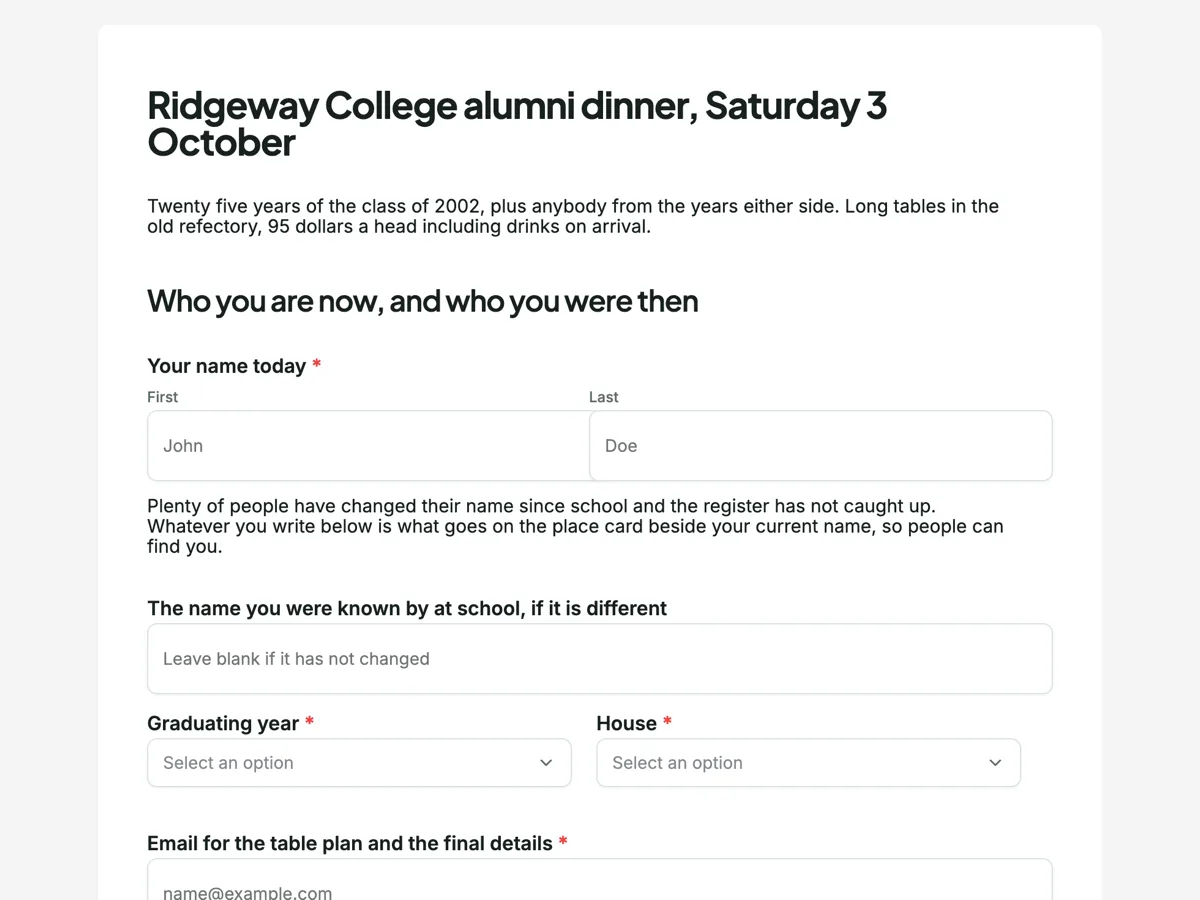
The form itself
A static copy of the finished form, exactly as it renders. Nothing here can be filled in or submitted, so read it as a reference and build your own from the button above.
Every field, and what it collects
The complete field list, in the order respondents meet it.
- Your name todayNameRequired
- The name you were known by at school, if it is differentShort text
- Graduating yearDropdownRequired
- Options: 1999 · 2000 · 2001 · 2002 · 2003 · 2004 · 2005 · I left before Year 12 · Former staff
- HouseDropdownRequired
- Options: Alderwood · Beckett · Cormorant · Dunmore · I genuinely cannot remember
- Email for the table plan and the final detailsShort textRequired
- Guests coming with youTable
- Columns: Guest name · Relationship to you
- Who would you like to sit near?Short text
- Dietary requirements for your whole bookingMultiple choiceRequired
- Options: No requirements · Vegetarian · Vegan · Gluten free · Dairy free · No pork · Halal · A severe allergy, I will email the committee
- A memory from your years hereLong text
- Your current postal addressAddress
Who you are now, and who you were then
Your seats
Dinner
The good question
The register
The name at school is the field that makes a reunion work
Alumni registers go stale in one specific way: people change their names and the register does not follow. A place card with only a current name means nobody at the table recognises anybody, which is the single most common complaint after a reunion dinner. So the second field asks for the name somebody was known by then, with a paragraph saying it goes on the place card beside the current one. The graduating year dropdown does the same job at the level of the room, and its two odd options, left before Year 12 and former staff, cover the guests most likely to be excluded by a plain year list.
Three guest rows, and a seating request that is honoured both ways
The guest table is fixed at three rows, which means one booking holds four people at most, and the paragraph says to book twice for more. That is a deliberate limit rather than a technical one: a reunion where one person books a table of ten is a reunion where nobody meets anybody. The seating request underneath is capped at a hundred and twenty characters and the thank-you screen makes the rule explicit, requests are honoured wherever two people name each other. Mutual naming is the only seating instruction a committee can actually act on at scale.
How to adapt this form
A university alumni event replaces house with a college or faculty dropdown and adds a current occupation field, which is what a development office genuinely uses afterwards. A reunion that includes a campus tour adds a session tick list before the dinner block. A larger association running ten year cohorts should turn the memory question into a separate submission form, because at four hundred guests it stops being a nice extra and becomes a moderation job that needs its own inbox.
What makes this form work
The place card carries both names
One optional field for the name somebody was known by at school, and the paragraph above says where it ends up. Without it a room of fifty people spends the first hour reading each other name badges and guessing.
The year dropdown includes left before Year 12 and former staff
Two options that cost nothing and rescue the guests a plain year list would exclude. A reunion that quietly turns away the person who moved schools in Year 10 has lost somebody who wanted to come.
Seating requests work only when they are mutual
The field is capped at a hundred and twenty characters and the thank-you screen states the rule: a request is honoured where two people name each other. That is the only version of a seating request a volunteer committee can honour at all.
Questions people ask
How many fields should a reunion registration have?
Ten here, five required, which is the right balance for a form filled by people who left school twenty five years ago and are doing this on a phone. Everything optional, the old name, the guests, the seating request, the memory and the address, still gets answered by most people because each one has an obvious reason.
Why is the guest table only three rows?
Because one booking should hold four people at most. A table renders exactly the rows it is given and cannot grow, so the limit is enforced by the field rather than by a rule nobody reads. The paragraph above says to book a second time, which is a smaller ask than it sounds.
Can this form take the ninety five dollars a head?
No. Numbers move a great deal in the fortnight before a reunion and the committee is usually a handful of volunteers rather than a finance team. The registration records the booking, an invoice or payment link follows, and cancellations become an email rather than a refund.
What happens to the memory people write?
A few are read out between the main course and dessert, without names unless somebody says otherwise, and the paragraph above the field says exactly that. Telling people how the answer will be used is what produces the small specific memories rather than three lines of general warmth.
Why collect a postal address at a dinner booking?
Because it is the only moment a school hears from most of its alumni, and the register is otherwise years out of date. It is optional and it sits last, after everything that affects the night itself, so nobody abandons the form over it. The thank-you screen says plainly that it replaces what the register held.
How are severe allergies handled?
The dietary tick list ends with a severe allergy, I will email the committee, which is deliberate. A tick box cannot carry the detail a caterer needs for an anaphylactic guest, and a form that implies otherwise is worse than one that asks for a conversation.
Build your own in about a minute
The button below opens the generator with this use case already described. Change the wording to match your own, generate, then edit anything you like.
Make my alumni event registration form with class year and guestsOther form examples
Student club registration form with a student ID check
A university society lives or dies on its mailing list, and a mailing list full of expired student accounts is worse than a short one. This nine field membership form takes a student number in a field that only accepts eight digits, then spends the rest of its questions working out which trips the committee should actually run.
Hackathon registration form that handles solo and teams
Half the people who register for a hackathon do not have a team yet, and a form that assumes otherwise loses them on the second question. This one asks solo or team first, then keeps the teammate table optional, and turns the skills tick list into the data the Friday night matching actually runs on.
Golf day registration form built around teams of four
A charity golf day does not register golfers, it registers teams, and every form that asks one player at a time creates the job of assembling them afterwards. This one takes the whole team in a four row table with a handicap column, then asks the three questions that actually cost money: carts, dinner seats and a hole.
Want the steps in the builder? Read Every form field and when to use it, then Design your welcome and thank-you screens. For everything this generator can do, see the form maker.
Written and checked by the OneCraft team. Last checked .