Classic form
Golf day registration form built around teams of four
A charity golf day does not register golfers, it registers teams, and every form that asks one player at a time creates the job of assembling them afterwards. This one takes the whole team in a four row table with a handicap column, then asks the three questions that actually cost money: carts, dinner seats and a hole.
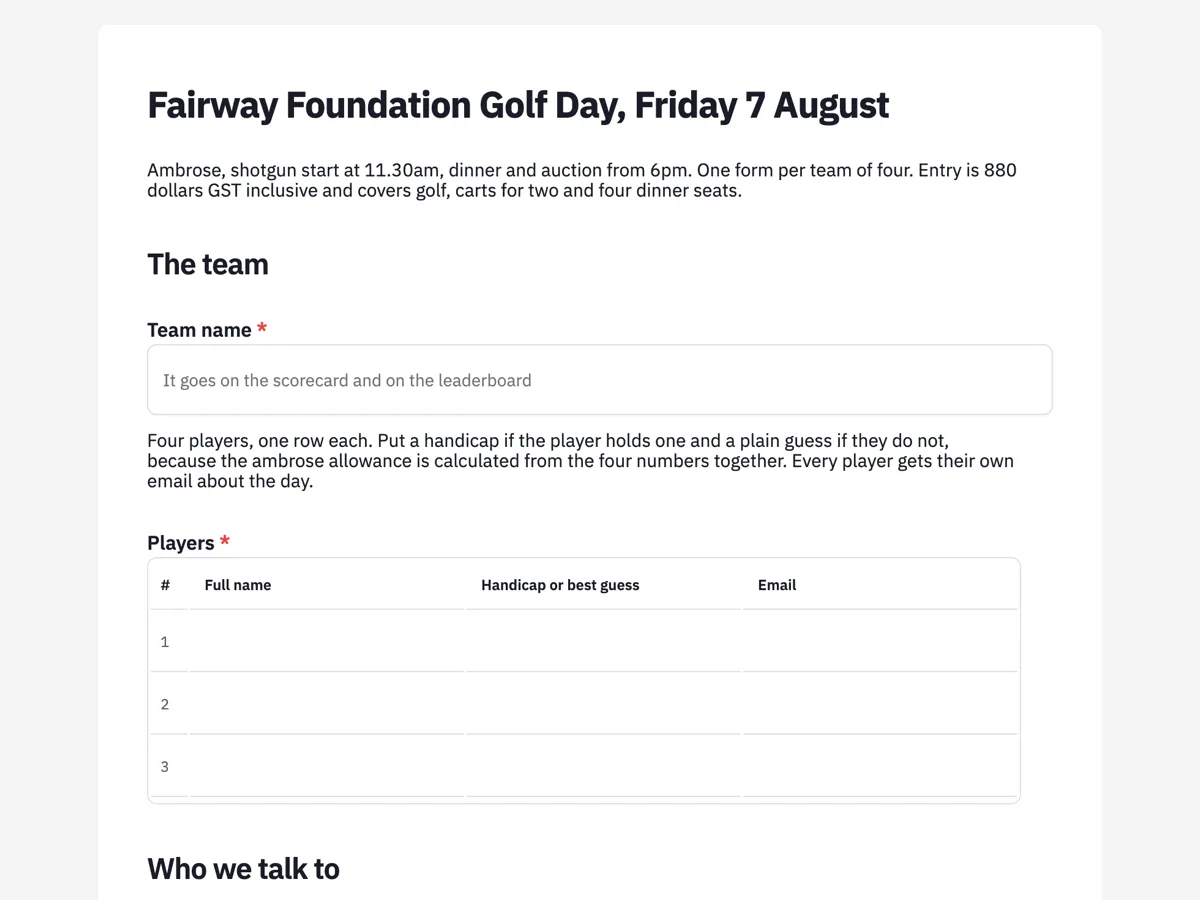
The form itself
A static copy of the finished form, exactly as it renders. Nothing here can be filled in or submitted, so read it as a reference and build your own from the button above.
Every field, and what it collects
The complete field list, in the order respondents meet it.
- Team nameShort textRequired
- PlayersTableRequired
- Columns: Full name · Handicap or best guess · Email
- Contact for the dayShort textRequired
- Contact mobileShort textRequired
- Email that receives the invoiceShort textRequired
- Cart hireSingle choiceRequired
- Options: Two carts, included in the team entry · One cart only, two of us are walking · No carts, we are all walking · A third cart, 70 dollars, for a player who cannot walk the course
- Total dinner seats needed, including the four already coveredNumberRequired
- Dietary requirements for the dinner, by nameLong textRequired
- Would your team sponsor a hole?DropdownRequired
- Options: No, entry only · Tee sign on one hole, 350 dollars · Hole in one hole with the prize car, 1,500 dollars · Longest drive or nearest the pin hole, 600 dollars · Dinner table sponsorship with a sign and a slide, 900 dollars · Ask me, we would like to talk about something else
- Extras on the dayMultiple choice
- Options: Four mulligan packs at 20 dollars each · A raffle bundle for the team at 50 dollars · Team photo on the first tee, 25 dollars, printed at dinner
- How did your team hear about the day?Short text
The team
Who we talk to
On the course
Dinner and the auction
Sponsorship
Register the team, not the golfer
An ambrose day is played in fours and scored in fours, so the unit of registration is the team. The four row table takes every player at once, with a handicap column because the allowance is calculated from all four numbers together, and an email column because each player still needs their own note about the eleven thirty start. Fixed at four rows, the table cannot grow, which is exactly right here: a fifth name is a second team, and the organiser would rather find that out as a second submission than as a crowded cell.
The three questions that decide the invoice
Carts, dinner seats and the hole package are where a golf day makes or loses its margin, and all three are asked as choices with prices rather than as free text. The dinner question is the one that catches organisers out, because a team of four usually brings partners, so the field asks for the total including the four already covered and says extra seats are ninety five dollars. Sponsorship sits last with an ask me option, which is where the largest packages actually come from, since a company that wants something custom will not pick a listed tier.
How to adapt this form
A corporate day without a charity arm drops the sponsorship dropdown and adds a company name and purchase order field in its place. A day played as individual stableford replaces the table with a single player block and an optional pair up request, since the organiser builds the groups. A club running its own members day keeps the table but swaps the handicap column for a membership number, because the club already holds the handicap and asking again invites a wrong one.
What makes this form work
One table holds four names, four handicaps and four emails
Twelve values in a single field, numbered one to four so the rows map straight onto a scorecard. A form that asked twelve separate questions would be three times as long and produce the same data.
The dinner question asks for the total, not the extras
Four seats are included, and the field asks for the total including them, with a note that extras are ninety five dollars. Asking how many extra seats do you need is the wording that produces a table for six when eight people turn up.
The sponsorship dropdown ends with ask me
Five priced packages from a three hundred and fifty dollar tee sign to a nine hundred dollar table, then an option for a team that wants to talk. The largest sponsorships almost never come from a listed tier, and a dropdown without that last line never hears about them.
Questions people ask
How many fields should a golf day entry have?
Eleven here, eight required, but the table is doing the work of twelve because it holds four names, four handicaps and four emails. That is the shape to aim for on any team event: one composite field for the roster and short questions for everything that changes the invoice.
Why is the player table fixed at four rows?
Because a table renders exactly the rows it is given and cannot grow, and an ambrose team is four. A fifth player is a second entry, not a bigger team. The fixed count also keeps the export clean, since every row maps to a seat at the dinner table and a place on the scorecard.
Can the form take the team entry fee?
No. Entry is eight hundred and eighty dollars before carts, extra dinner seats and a hole package, and most teams are invoiced to a company address that is not any player. The form records the entry and the invoice follows within two days, which the thank-you screen states along with the foundation ABN.
What if a player does not have a handicap?
They put a plain guess, and the paragraph above the table says so. An ambrose allowance calculated from four rough numbers is close enough for a charity day, while an empty column forces the organiser to ring four people the night before. Asking for a guess is what gets the column filled.
Why ask for dietary requirements by name?
Because the caterer plates by seat. A team that writes one vegetarian gives the kitchen nothing to work with at a round table of eight, while naming the person means the plate reaches them. The field is required with a write none instruction so a blank is never mistaken for no requirements.
Where does the sponsorship money get receipted?
Separately from the entry. The thank-you screen says the sponsorship portion of a hole package is receipted as a donation, which is what a sponsoring business needs for its own records. Keeping entry and sponsorship apart on the form is what makes that split possible later.
Build your own in about a minute
The button below opens the generator with this use case already described. Change the wording to match your own, generate, then edit anything you like.
Make my golf day registration form built around teams of fourOther form examples
Trivia night registration form booked by the table captain
A school trivia night is sold by the table, not by the ticket, and the person who books is the person who will chase seven other people for twenty dollars each. This eight screen form is written for that captain, and it asks how the table is paying rather than taking a card, because a P and C runs on bank transfers and envelopes.
Charity walk registration form with a fundraising target
A charity walk registration has to do two jobs that pull against each other, sign somebody up for a physical event and start them fundraising without making either feel like a commitment they cannot meet. This form asks for a target the walker sets, in a field with a paragraph above it saying nobody is chased for a shortfall.
Alumni event registration form with class year and guests
A reunion is a seating problem wearing a dinner jacket, and the two facts that solve it are the year somebody left and the name they were known by then. This registration asks for both, keeps a guest table to three rows so a booking cannot quietly become a table of eight, and uses one optional question to collect the material that makes the night.
Want the steps in the builder? Read Every form field and when to use it, then View, export and manage your responses. For everything this generator can do, see the form maker.
Written and checked by the OneCraft team. Last checked .