Classic form
Chainsaw pre start checklist with a chain brake test
A chainsaw pre start checklist tests the chain brake, chain catcher and throttle lockout, then the chain, bar oil and spark arrestor, before anyone cuts. This arborist version adds a protective gear grid, because the saw check alone says nothing about the leg the chain would hit.
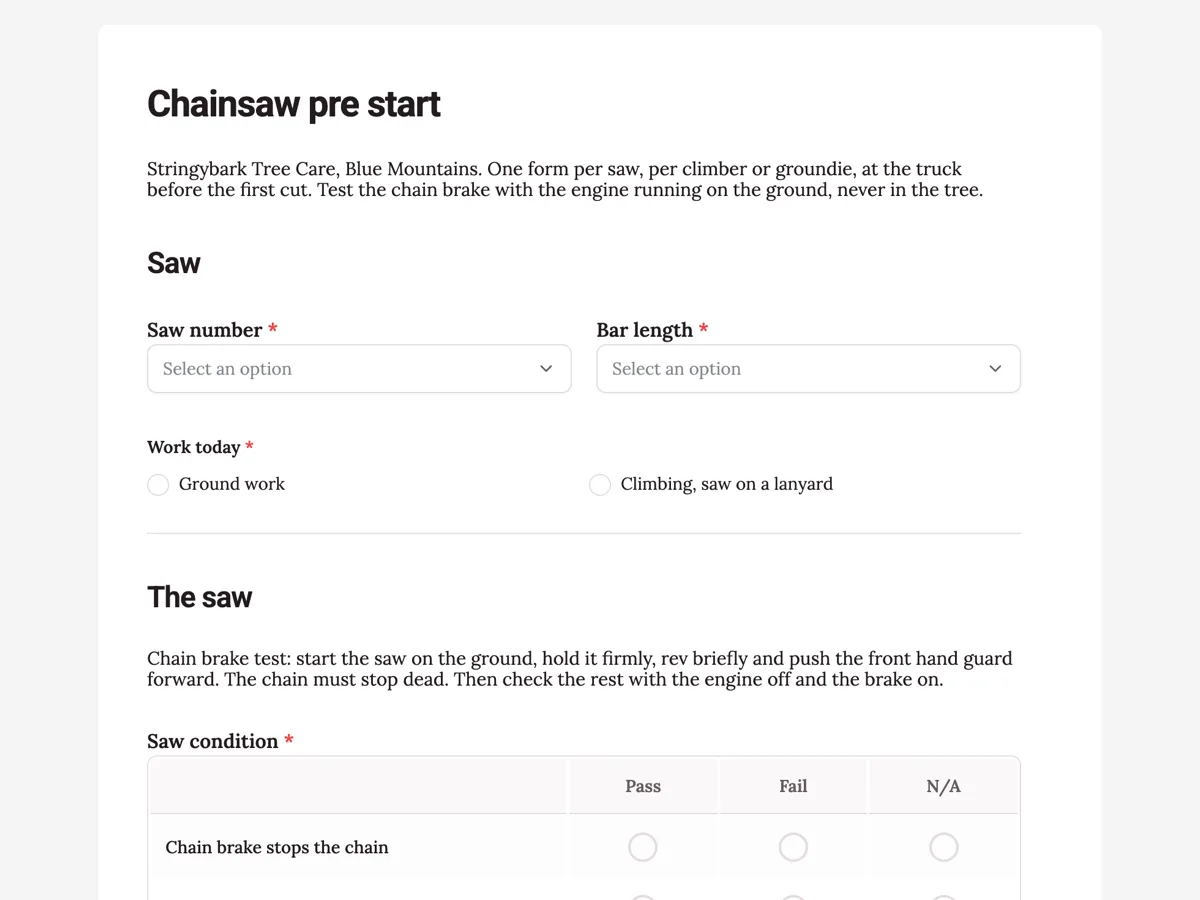
The form itself
A static copy of the finished form, exactly as it renders. Nothing here can be filled in or submitted, so read it as a reference and build your own from the button above.
Every field, and what it collects
The complete field list, in the order respondents meet it.
- Saw numberDropdownRequired
- Options: CS-1 top handle · CS-2 top handle · CS-3 rear handle · CS-4 rear handle, large
- Bar lengthDropdownRequired
- Options: 12 inch · 14 inch · 16 inch · 20 inch · 25 inch
- Work todaySingle choiceRequired
- Options: Ground work · Climbing, saw on a lanyard
- Saw conditionRating gridRequired
- Statements:
- Chain brake stops the chain
- Chain catcher present
- Throttle lockout works
- Chain tension correct
- Chain sharp, depth gauges even
- Bar oil flowing
- Spark arrestor screen clean
- Protective gearRating gridRequired
- Statements:
- Cut resistant chaps or trousers
- Helmet with visor and earmuffs
- Gloves
- Boots with chainsaw protection
- First aid kit with large wound dressing in the truck
- Photo of the problemPhoto upload
- Show the brake band, the chain or the gear that failed, in focus and close up.
- Saw user signatureSignatureRequired
Saw
The saw
What you are wearing
What each field on this form collects
Saw number and bar length are dropdowns, so a pre start always names one saw. A single choice records ground work or climbing with the saw on a lanyard. The saw grid has seven rows: chain brake, chain catcher, throttle lockout, chain tension, chain sharpness with even depth gauges, bar oil flow and the spark arrestor screen. The protective gear grid has five: cut resistant chaps or trousers, helmet with visor and earmuffs, gloves, boots with chainsaw protection, and the first aid kit with a large wound dressing. A photo of the problem and the signature close it.
The chain brake test is the one that matters
Kickback is the injury everybody who runs a saw knows about: the tip catches, the bar flicks back toward the face and neck, and the chain brake is what stops the chain in that fraction of a second. The paragraph above the saw grid sets out the test, engine running, saw held firmly on the ground, front guard pushed forward, chain stops dead. A brake band that is worn or glazed passes a visual check and fails this one. The chain catcher and throttle lockout follow because both are small parts that break off or get removed, and both decide what happens when something else goes wrong.
Protective gear the saw check does not cover
A perfect saw does not protect a leg. Chainsaw trousers and chaps work by fibres that jam the sprocket when cut, which only happens if the garment is intact and covers the right area, so a torn pair is a Fail. The helmet row includes the visor and earmuffs because saws are loud enough to damage hearing over a working day. The first aid row asks for a large wound dressing in the truck because a chainsaw cut bleeds fast and the nearest ambulance in the mountains may be a long way off. HSE guidance for tree work in the UK sets out the same kit, and Australian regulators publish equivalent advice.
How to adapt this form
A council bushfire crew clearing fallen timber adds a row for the felling plan and escape routes. A firewood merchant cutting on a saw bench swaps climbing for bench work and adds a row for the log dogs. A crew that also runs pole saws and hedge trimmers keeps this form for chainsaws and builds a shorter one for the other tools rather than adding rows that are N/A on most days.
What makes this form work
Brake test with the engine running
The chain brake row comes with a written test: start the saw on the ground and push the front guard forward. Checking a brake with the engine off proves the lever moves, not that the chain stops.
One saw per form
Saw number and bar length are required dropdowns. When CS-3 throws a chain on Thursday, the crew leader can see who signed it off on Monday and what they marked.
Gear is part of the pre start
Five protective gear rows sit under the saw rows and share the signature. A climber cannot sign off a saw while the form shows a torn pair of chaps without the crew leader seeing it.
Questions people ask
How do you test a chainsaw chain brake?
Start the saw on firm ground, hold both handles, rev briefly and push the front hand guard forward with the back of your left hand. The chain should stop at once. Some crews also test the inertia action as the manual describes. If the chain creeps or slows gradually, the brake band needs service before the saw is used.
What PPE is needed for chainsaw work in Australia?
Regulators and the industry codes expect cut resistant leg protection, a helmet with face and hearing protection, gloves and boots with chainsaw protection, plus high visibility clothing where vehicles or other crews are near. The relevant Australian Standard for leg protection is part of the AS/NZS 4453 series. Check your state regulator for the current list.
Should a chainsaw be checked every day?
Yes, by the person about to use it, at the start of the day and again after refuelling a saw that has been dropped or knocked. A saw can lose its chain catcher or bend its bar in a single bad cut. The form takes two minutes, and the time stamp shows when each saw was last checked.
Does the form work in the bush with no phone signal?
The form needs a connection to load and to submit, and nothing is saved before submit. In patchy reception, open the form at the depot or in the truck, fill it in, and submit when you have a signal. A printed blank copy of the form makes a good backup for a site with none.
Why is a chain catcher on the list?
When a chain breaks or comes off the bar, the catcher under the bar stops it whipping back toward the right hand. It is a small part that breaks off and is easy to miss. Its absence changes nothing until the day a chain fails, which is why it is checked every morning.
Build your own in about a minute
The button below opens the generator with this use case already described. Change the wording to match your own, generate, then edit anything you like.
Make one like thisOther form examples
EWP pre start checklist for boom lifts
An EWP pre start checklist runs every function from the ground controls, tests the emergency stop and emergency lowering, then checks the basket gate, anchor, platform controls and harness before anyone goes up. This boom lift version also records the WP licence line at 11 metres and makes the operator write a rescue plan.
Compressor pre start checklist for stored pressure
A compressor pre start checklist looks at the relief valve, the gauge, the receiver drain, hoses, couplings and whip checks before air goes into the line, then the guards, fuel and oil. This blasting workshop version also records when the air receiver is next due for its periodic inspection.
Telehandler pre start checklist by attachment
A telehandler pre start checklist starts with the attachment fitted, because forks, a bucket, a jib with a hook and a work platform each need their own load chart and sometimes their own licence. Then it tests the load moment indicator and checks the boom, stabilisers, steering mode, brakes and cab.
Want the steps in the builder? Read Grids, photo and signature fields, then Limit the form to your crew. For everything this generator can do, see the form maker.
Written and checked by the OneCraft team. Last checked .