Classic form
Commercial lease application form for a retail tenancy
A landlord letting a shop is choosing a business that will still be trading in three years, and the application is where that judgement is made. This sixteen field form asks what the premises will be used for in the words that go into the lease, what fit out it needs, and who is standing behind the entity.
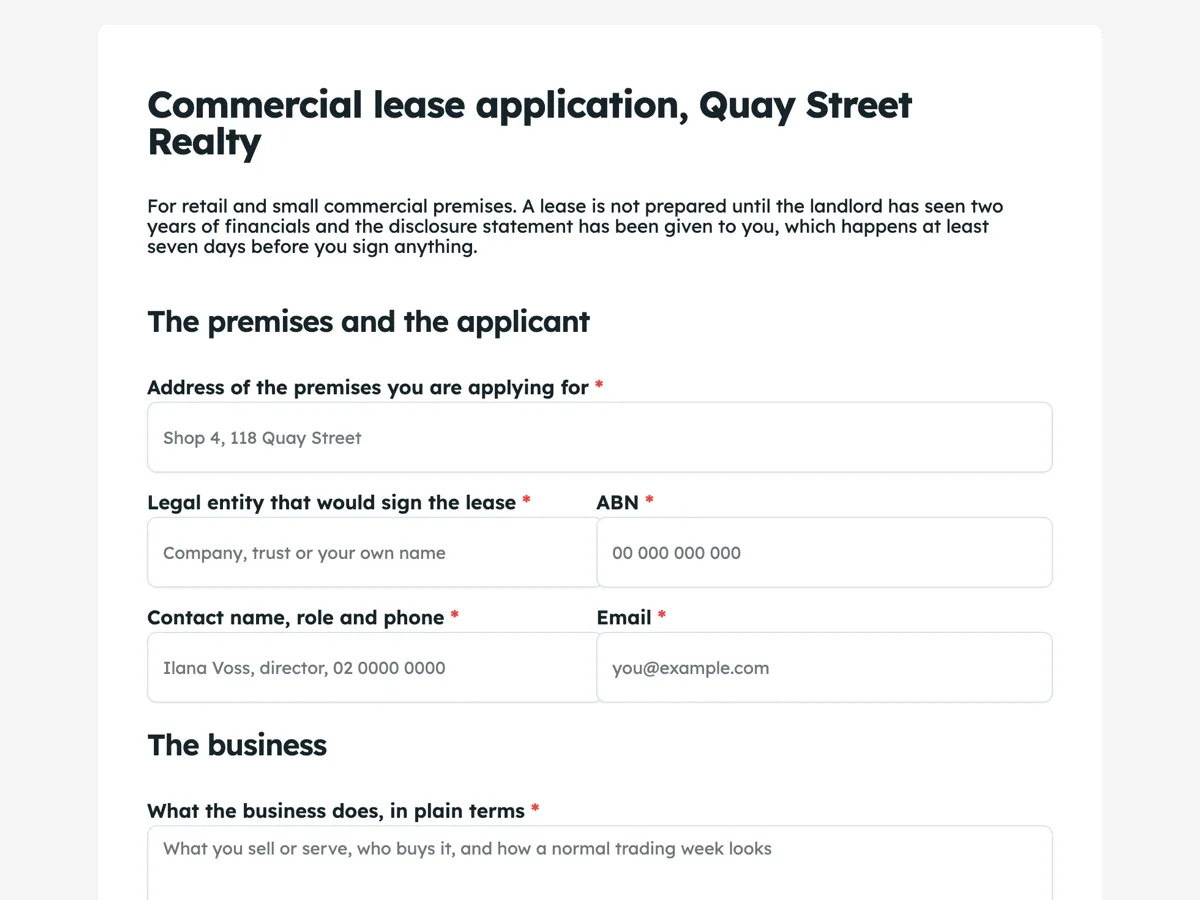
The form itself
A static copy of the finished form, exactly as it renders. Nothing here can be filled in or submitted, so read it as a reference and build your own from the button above.
Every field, and what it collects
The complete field list, in the order respondents meet it.
- Address of the premises you are applying forShort textRequired
- Legal entity that would sign the leaseShort textRequired
- ABNShort textRequired
- Contact name, role and phoneShort textRequired
- EmailShort textRequired
- What the business does, in plain termsLong textRequired
- Years the business has tradedNumberRequired
- Intended use of the premises, in the words you want written into the leaseShort textRequired
- Trading hours you expect to keepSingle choiceRequired
- Options: Business hours only, weekdays · Seven days, daytime · Seven days, including evenings · Late night trade, past 10pm · Seasonal or limited hours
- What fit out would the premises need?Single choiceRequired
- Options: None, it suits as it is · Cosmetic only, paint and fixtures · New shopfront or signage · Services work: plumbing, three phase power or exhaust · Full strip out and rebuild
- Lease term you are seekingSingle choiceRequired
- Options: 1 year with an option · 3 years with a 3 year option · 5 years with a 5 year option · 5 years or longer, no option needed · Flexible, the fit out cost will decide it
- Proposed guarantorsTableRequired
- Columns: Full name · Position in the entity · Owns property · Phone
- Financial statementsFile uploadRequired
- Two years of profit and loss and a current balance sheet. A business trading under two years may send its most recent tax return plus three months of bank statements instead. PDF preferred, up to 10 MB each.
- Bank reference, contact name and phoneShort textRequired
- DeclarationMultiple choiceRequired
- Options: The information and the financial statements provided are true and complete · I understand this application does not reserve the premises and is not an agreement to lease · I consent to the agency verifying the bank reference and obtaining a commercial credit report on the entity and the guarantors
- Signature of the applicantSignatureRequired
The premises and the applicant
The business
Fit out and the term
Backing for the lease
Declaration
What each block of this application collects
The first block separates the premises from the applicant and, importantly, asks for the legal entity that would sign rather than the trading name, because a lease is granted to an entity and the guarantees hang off that. The business block is where the decision starts: what the business does in plain terms, the years it has traded as a number, and the intended use written in the words the applicant wants in the lease, which is the field that quietly defines what they are allowed to do for the whole term. Trading hours follow, because a late night trade changes everything from the make good to the neighbours.
The Australian pieces on this form
Retail leasing in every Australian state runs on a disclosure statement given to the tenant before signing, with a minimum period between the disclosure and the signature. This form names seven days in the introduction, in the thank you screen and again in the paragraph above the declaration, so an applicant knows the timeline before they start rather than discovering it in a solicitor letter. The ABN is required and validated for shape because a commercial lease is a business supply. The guarantor paragraph explains that a bank guarantee or security deposit is negotiated separately and usually runs three to six months of rent, which is the number Australian retail landlords most often ask for and the one applicants most often have not budgeted.
How to adapt this form
An industrial agency replaces the trading hours question with a question on truck access and required clearance height, and swaps the fit out list for a racking and hardstand question, because the constraint is the building rather than the shopfront. An agency leasing to franchise operators adds a field for the franchisor name and a question about whether the franchisor requires a lease assignment clause, which changes the drafting. A landlord offering short term or pop up space cuts the guarantor table and the financial statements entirely and replaces them with a public liability certificate upload, since a three month licence is a different risk from a five year lease.
What makes this form work
The entity, not the trading name
The application asks for the legal entity that would sign the lease, with the trading name left out entirely. Guarantees, credit checks and the lease itself all attach to that entity, and an agency that collects the shopfront name instead redoes the whole application later.
Fit out and term sit together
Five fit out options from none through to a full strip out, then a term list whose last option is flexible, the fit out cost will decide it. A tenant spending two hundred thousand on a kitchen needs a longer term to amortise it, and the form lets them say the two are linked instead of guessing.
Owns property is a table column
The guarantor table asks name, position, owns property and a phone, in three rows. That one column tells the landlord which guarantees carry weight without asking three directors for a full statement of position, which is what turns a sixteen field form into a forty field one.
Questions people ask
Why does the form ask for the intended use in the applicant own words?
Because the permitted use clause in the lease is usually drafted from that answer, and it defines what the tenant may do for the whole term. A cafe that describes itself as a cafe and later wants to serve wine in the evening finds out how narrow the wording was.
What financial statements does a commercial landlord need?
Two years of profit and loss and a current balance sheet is the normal ask, and the upload description says so. A business trading under two years can send its most recent tax return and three months of bank statements instead, which is the realistic alternative and prevents a new business being filtered out by a document it cannot produce.
Does lodging an application reserve the premises?
No, and the form says it twice, in the paragraph above the declaration and in the second tick. Applicants routinely assume that submitting means holding, then stop looking at other sites. Stating it plainly costs the agency nothing and prevents the most common complaint in commercial letting.
Why ask whether each guarantor owns property?
Because a personal guarantee is only as good as what stands behind it, and property ownership is the single fastest indicator. It is a yes or no in a table column rather than a full assets disclosure, which keeps the application short while telling the landlord which guarantees are worth having and which need a bank guarantee alongside them.
What is the seven day period mentioned on the form?
Retail leasing law in Australia requires the landlord to give the tenant a disclosure statement a set minimum period before the lease is signed. This agency uses seven days and states it up front so an applicant plans for it. It is the window in which a tenant is expected to take their own legal and accounting advice.
Should a lease application ask for a bank reference?
Yes, and it should ask for the business banker by name rather than the branch. A banker who knows the account answers a useful question about how the business handles money, while a switchboard produces a week of transfers. It is one short text field and it is the cheapest verification on the page.
Build your own in about a minute
The button below opens the generator with this use case already described. Change the wording to match your own, generate, then edit anything you like.
Make my commercial lease application form for a retail tenancyOther form examples
Business credit application form for a 30 day trading account
Granting a customer thirty day terms is unsecured lending, and the paperwork that goes with it has to stand up when an account stops paying. This eighteen field application records the entity, its age, its payment habits and the person who guarantees the debt, with the credit reporting consent written where it is read.
Guarantor application form for a residential tenancy
A guarantor signs up to pay rent and damage that somebody else owes, often for a tenancy they will never live in. This thirteen field form collects the identity, income and obligations that make the promise assessable, and puts the full text of the guarantee directly above the tick and the signature.
Franchise application form that asks about capital before it asks about coffee
A franchise group can only assess three things from a first application: where the applicant wants to trade, what they can fund without borrowing, and whether they intend to stand in the store. This form asks those three in its first three screens and spends the other eleven on history, partners and timing.
Want the steps in the builder? Read Every form field and when to use it, then Shape the PDF version of your form. For everything this generator can do, see the form maker.
Written and checked by the OneCraft team. Last checked .