Classic form
Influencer collaboration form that asks for the rate card up front
Most creator pitches arrive as a paragraph and a link, and turning one into a decision takes three emails about numbers nobody put in writing. This twelve field form asks for the engagement rate, the audience region and the rate card in the same submission as the pitch.
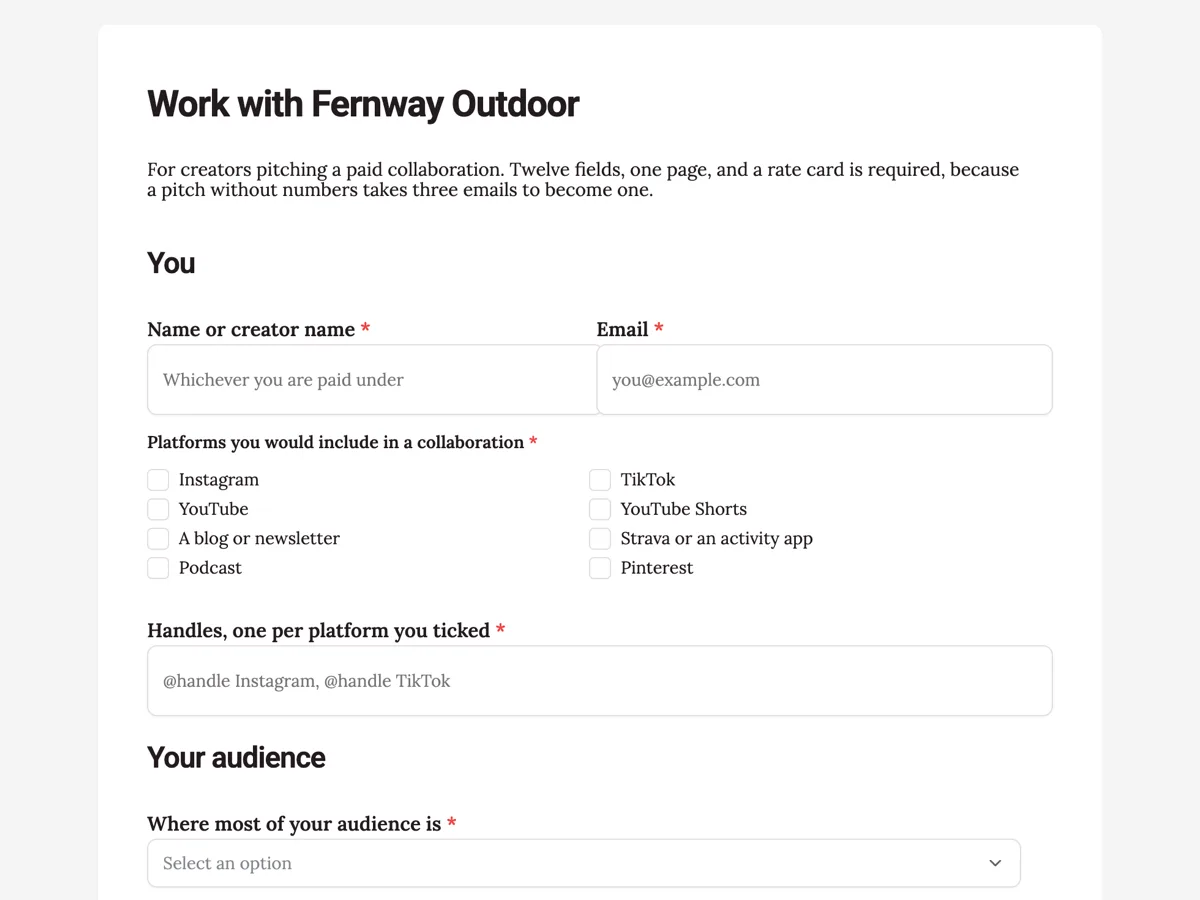
The form itself
A static copy of the finished form, exactly as it renders. Nothing here can be filled in or submitted, so read it as a reference and build your own from the button above.
Every field, and what it collects
The complete field list, in the order respondents meet it.
- Name or creator nameShort textRequired
- EmailShort textRequired
- Platforms you would include in a collaborationMultiple choiceRequired
- Options: Instagram · TikTok · YouTube · YouTube Shorts · A blog or newsletter · Strava or an activity app · Podcast · Pinterest
- Handles, one per platform you tickedShort textRequired
- Where most of your audience isDropdownRequired
- Options: Australia and New Zealand · United Kingdom and Ireland · United States and Canada · Western Europe · Nordics · South East Asia · Spread across several regions with no majority
- Engagement rate, as a percentageNumberRequired
- Median views on your last ten postsNumberRequired
- What are you open to?Multiple choiceRequired
- Options: Gifted product with no obligation to post · Paid post on a set brief · Paid post with creative freedom · Ambassador term of three months or more · Affiliate or commission code · Event or trip coverage · Product testing over a season with a long form review at the end · Licensing my footage for the brand own channels
- Your rate cardFile uploadRequired
- Whatever you normally send: a PDF, a one page image, or a screenshot of the rates in your media kit. One or two files, up to 10 MB each.
- Brands you have worked with, and what you did for themLong textRequired
- Earliest date you could shootDateRequired
- Before you send thisMultiple choiceRequired
- Options: The figures above come from my own analytics and I can screenshot them on request · I disclose paid and gifted partnerships clearly in the content itself · I am happy for this pitch and rate card to be kept on file for twelve months
You
Your audience
The collaboration
What each block of this form collects
The identity block is two fields and the second one matters more than it looks: name or creator name, whichever the creator is paid under, because a partnership that reaches contract stage needs the payable name rather than the handle. The platforms tick list is followed by a single handles field, which keeps eight possible accounts in one line instead of eight conditional fields. The audience block asks region rather than country, with an explicit option for a spread across several regions, since that is the honest answer for most creators and the one that decides whether a campaign shipping only within one market can use them. Engagement rate and median views sit side by side with a paragraph explaining what engagement rate means, because the two common definitions produce very different numbers. The collaboration block is eight options, a rate card, past work and a date.
Why the rate card is required rather than a number field
Asking a creator to type a single rate forces them to pick their lowest one, because they do not yet know the deliverable. Asking for a rate card instead gets the real structure: a price for a single post, a price for a bundle, a usage fee for licensing, and whatever they charge for a trip. The partnerships team can then match a budget to a package in one pass rather than negotiating from a number that was never meant to stand alone. The file field accepts images and PDF up to two files, which covers a designed media kit and the screenshot of a rates page that a creator without a media kit will send instead.
How to adapt this form
A brand running gifting only removes the rate card upload and the collaboration types list, and replaces both with a product preference dropdown and a shipping address, which turns a twelve field pitch into a six field request. An agency collecting creators for a roster adds a category tick list and a rights and exclusivity question, because a roster is sold on what it can promise a client. A brand with a fixed campaign brief flips the direction entirely: it replaces the open pitch with a campaign dropdown and a single availability question, and keeps only the engagement rate, the rate card and the disclosure ticks from this version.
What makes this form work
The rate card is a required upload
A single rate field would get a creator lowest number before they know the deliverable. A file instead gets the whole structure, single post through to licensing, so the partnerships team matches a budget to a package on the first read rather than in the third email.
Engagement rate is defined in a paragraph, not a tooltip
Interactions over followers and interactions over views are both called engagement rate and they differ by multiples. The paragraph above the two number fields says so and asks the creator to name which they used, which is the difference between a comparable figure and a decorative one.
Audience region allows no majority
Seven options ending in spread across several regions with no majority. That is the true answer for a large share of creators, and offering it stops the form collecting a market claim that a campaign would later plan against and be wrong about.
Questions people ask
Why ask for engagement rate and median views rather than followers?
Because followers are the easiest number to buy and the least useful to plan against. Engagement rate and a median across the last ten posts describe what a campaign would actually get, and taking a median rather than an average stops one viral post from carrying a whole pitch. Both are numbers a creator can screenshot on request.
What should a rate card contain?
A price for each deliverable the creator offers: a single post, a bundle, a story set, a long form video, usage or licensing, and travel if they do trips. The upload accepts a PDF, a designed one page image or a screenshot from a media kit, because the format matters far less than the numbers being written down before a conversation starts.
Why does the form ask where the audience is rather than where the creator is?
Because a campaign ships product and runs offers in specific markets. A creator in one country with an audience mostly in another is a good fit for a different campaign, not a worse one, and the dropdown has an option for a spread with no majority so nobody is forced to overclaim a single market.
Is gifted product with no obligation to post a real option?
It is the first option on the collaboration list for a reason. Some creators only accept product they are free to ignore, which produces the most credible content when they do post. Naming it first tells those creators the brand understands the arrangement rather than treating unpaid posting as an expectation.
How long should a brand keep a rate card on file?
The third tick on this form asks for twelve months, and the thank you screen repeats it. Campaigns are briefed a season ahead, so a pitch that is not right for spring is often right for autumn, and asking permission to keep the file is both more honest and more useful than quietly holding it forever.
Should the form ask creators to confirm they disclose partnerships?
One tick, yes, because it sets the expectation before any product moves and it costs a creator nothing to confirm. The substance is in the paragraph above it, which states that disclosure happens in the content itself and in the creator own words, rather than buried in a caption where an audience will not see it.
Build your own in about a minute
The button below opens the generator with this use case already described. Change the wording to match your own, generate, then edit anything you like.
Make my influencer collaboration form that asks for the rate card up frontOther form examples
Brand ambassador application form that reads the content before the reach
Ambassador programmes drown in applications from accounts that bought their audience, and a follower count cannot tell those apart from the creators worth signing. This thirteen screen form asks for a sample post, a sixty second unscripted video and what an audience actually comes for, then asks about reach in bands.
Market stall application form with insurance and power on it
A market coordinator is allocating fifty sites and balancing a row, which means the useful answers are the boring ones: what you sell, how big your marquee is, whether you need power and whether your insurance outlasts the season. This fourteen field form collects all four and gets the certificate expiry as a sortable date.
Wholesale account application form for a new stockist
A small maker approving a stockist is deciding where its product will physically sit, and no amount of paperwork answers that. This fourteen field application asks for the ABN and the order size, then asks for three photographs of the shop that will carry the range.
Want the steps in the builder? Read Every form field and when to use it, then View, export and manage your responses. For everything this generator can do, see the form maker.
Written and checked by the OneCraft team. Last checked .