Classic form
Wholesale account application form for a new stockist
A small maker approving a stockist is deciding where its product will physically sit, and no amount of paperwork answers that. This fourteen field application asks for the ABN and the order size, then asks for two or three photographs of the shop that will carry the range.
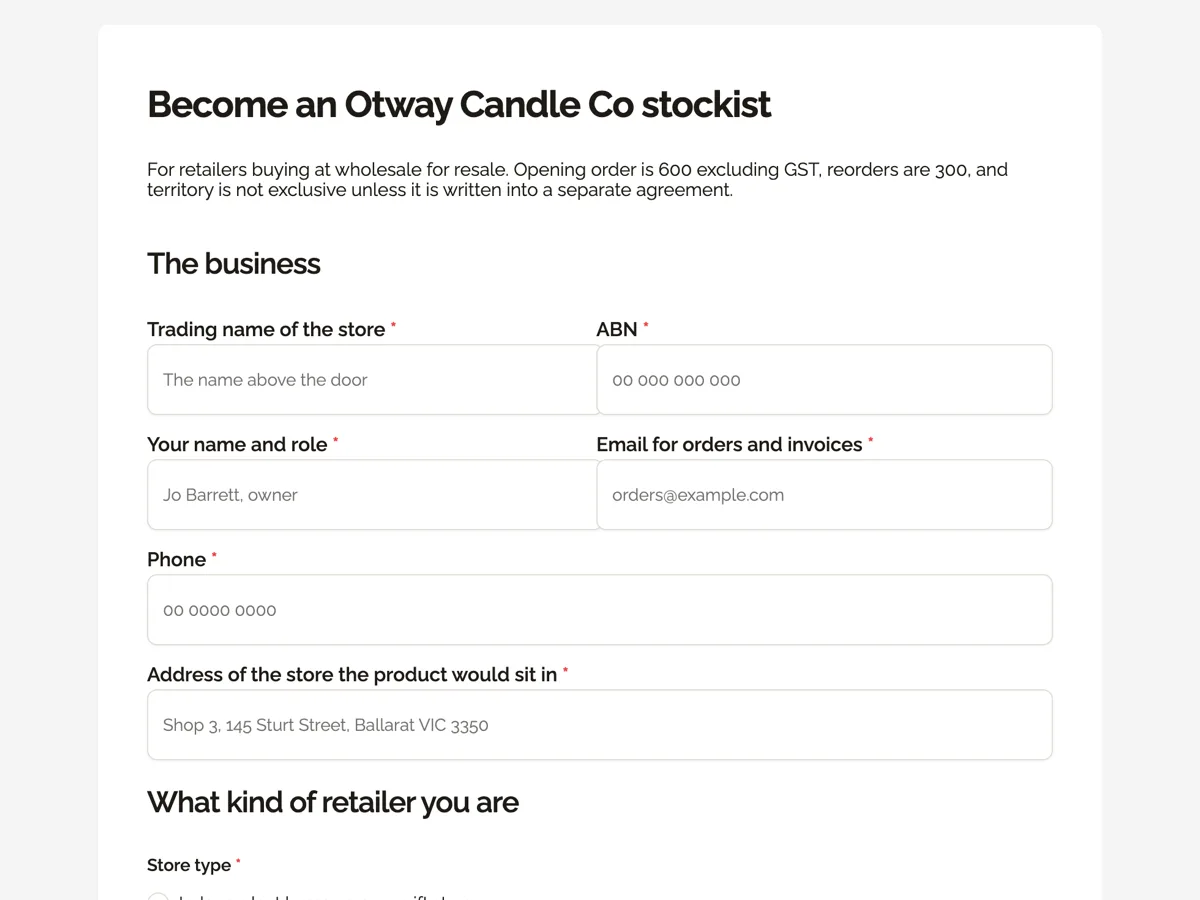
The form itself
A static copy of the finished form, exactly as it renders. Nothing here can be filled in or submitted, so read it as a reference and build your own from the button above.
Every field, and what it collects
The complete field list, in the order respondents meet it.
- Trading name of the storeShort textRequired
- ABNShort textRequired
- Your name and roleShort textRequired
- Email for orders and invoicesShort textRequired
- PhoneShort textRequired
- Address of the store the product would sit inShort textRequired
- Store typeSingle choiceRequired
- Options: Independent homewares or gift store · Florist · Cafe or providore with a retail shelf · Day spa or salon retail · Accommodation, selling in room or at reception · Online only, no physical store · Market stall or pop up · Department or chain store
- How many locations would stock the range?NumberRequired
- Website or InstagramShort textRequired
- What would you expect to order in a normal month once you are set up?Single choiceRequired
- Options: Under 300 excluding GST · 300 to 599 · 600 to 1,499 · 1,500 to 2,999 · 3,000 or more · Seasonal, most of it before Christmas
- Which candle or home fragrance brands do you stock now?Long textRequired
- Photographs of the storeFile uploadRequired
- Two or three: the shopfront, the shelf or table the range would sit on, and one wide shot of the room. Phone photos in daylight are exactly right. Images only, up to 10 MB each.
- AgreementMultiple choiceRequired
- Options: I am buying for resale from the business named above and I hold a valid ABN · I will not list the range on a third party discount marketplace · I understand territory is not exclusive unless a separate written agreement says so · I have read the opening order and payment terms
- SignatureSignatureRequired
The business
What kind of retailer you are
Where the product would sit
Trading terms
What each block of this application collects
The business block is the identity layer: trading name, the ABN, the applicant name with their role written into the same field, an orders email and a phone, and the address of the store the product would sit in, which is deliberately not a billing address. The retailer block sorts the application: a store type list with eight options that includes a day spa retail shelf and accommodation selling in room, both of which buy differently from a gift shop, a locations number, a link the team can look at, and an expected monthly order band whose last option is seasonal with most of it before Christmas. The competitor question is asked plainly and the placeholder says stocking a competitor is not a problem. The photographs are the decision. The terms paragraph and four ticks close it.
The Australian pieces on this form
Three things here are shaped by Australian wholesale practice. The ABN is required, and checked by the maker on the ABN Lookup, because a wholesale sale is a business to business supply and the maker needs the buyer registration rather than a name. Every price on the form is quoted excluding GST, in the introduction, in the order band options and in the terms paragraph, since wholesale is quoted that way here and a retailer comparing two suppliers on inclusive and exclusive prices will get it wrong. The first agreement tick asks the applicant to confirm they are buying for resale and hold a valid ABN, which is the statement that makes the transaction wholesale rather than a discounted retail sale.
How to adapt this form
A food producer swaps the photographs for a food licence number and a storage question, because refrigeration and shelf life decide the approval rather than display. A maker that does offer exclusive territories replaces the third agreement tick with a postcode field and a radius dropdown, and adds a question about existing exclusive arrangements the retailer holds with other brands. A wholesaler with a minimum order that varies by category turns the single order band into a category tick list with a minimum shown against each one, which moves the negotiation into the form and out of the first phone call.
What makes this form work
Two or three photographs decide the application
The upload asks for a shopfront, the shelf the range would sit on and one wide shot of the room, in daylight, from a phone. A maker can judge fit from those faster and more accurately than from every other field on the page combined.
The store type list names the odd retailers
Eight options include a day spa retail shelf, accommodation selling in room or at reception, and a market stall. Those buyers order in different sizes and rhythms from a gift shop, and a list that only offered retailer and online would have hidden all three.
Every price on the page is excluding GST
The introduction, the order bands and the terms paragraph all say excluding GST. A retailer comparing suppliers is comparing on the same basis, and the first agreement tick ties that to a valid ABN, which is what makes the sale a wholesale supply rather than a discount.
Questions people ask
Why does a wholesale application ask for photographs of the store?
Because a maker is deciding where its product will physically sit, and a shopfront, a shelf and a wide room shot answer that in ten seconds. Three phone photos in daylight tell a supplier more about fit than any written description of the store, and they are the one thing an applicant cannot exaggerate.
Is stocking a competing brand a problem?
No, and the placeholder in that field says so. A store already selling one or two home fragrance ranges has proven the category works for its customers, which is a good sign. A store carrying eight of them is a different conversation, because shelf space is finite and a ninth range rarely gets the display it needs.
Why ask for expected monthly order rather than the opening order?
Because the opening order is fixed by the supplier and says nothing about the retailer. The monthly band predicts whether this is an account that reorders or one that buys once and goes quiet, and the seasonal option is there because a large share of gift retailers genuinely do most of their buying before Christmas.
Can this form take the opening order payment?
No. A form on this product records an application, and the thank you screen says nothing is charged until the stockist places an order themselves. Approved retailers receive a line sheet and a portal login, which is where an order is placed, priced and paid. Keeping approval and ordering separate is also what makes the terms conversation possible.
Why is the store address asked separately from the billing details?
Because the decision is about where the product sits, not where the invoice goes. A buying group, a franchise or a retailer with a home office all bill from somewhere other than the shop floor, and a supplier that assumes the two match ends up approving a location it has never seen.
Should a wholesale application be signed?
When it carries trading terms, yes. The four ticks record the specific agreements, resale intent, no discount marketplaces, non exclusive territory and the payment terms, and the drawn signature turns the set into a record that is worth keeping with the account. It is not a supply agreement, and a supplier wanting one sends it separately for signature.
Build your own in about a minute
The button below opens the generator with this use case already described. Change the wording to match your own, generate, then edit anything you like.
Make one like thisOther form examples
Casual job application form built around an availability grid
Casual hiring turns on one thing, which is whether somebody is free when the roster has a hole. This twelve screen form puts a seven day by three shift grid at the centre, asks how many hours a week somebody actually wants, and treats the RSA, the work rights and the CV as things that change the roster rather than the decision.
Influencer collaboration form that asks for the rate card up front
Most creator pitches arrive as a paragraph and a link, and turning one into a decision takes three emails about numbers nobody put in writing. This twelve field form asks for the engagement rate, the audience region and the rate card in the same submission as the pitch.
Franchise application form that asks about capital before it asks about coffee
A franchise group can only assess three things from a first application: where the applicant wants to trade, what they can fund without borrowing, and whether they intend to stand in the store. This form asks those three in its first three screens and spends the other eleven on history, partners and timing.
Want the steps in the builder? Read Every form field and when to use it, then Shape the PDF version of your form. For everything this generator can do, see the form maker.
Written and checked by the OneCraft team. Last checked .